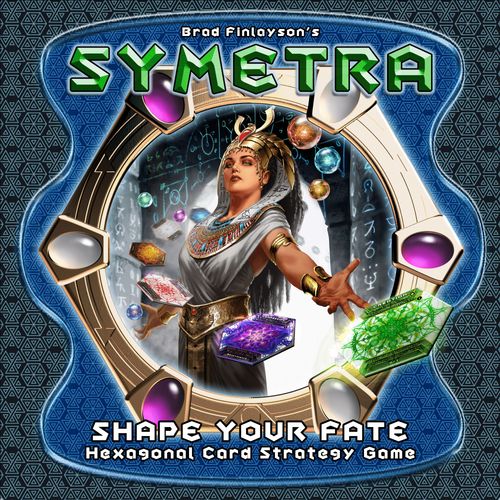
Symetra
Symetra Errata & Rules Changes
Designer's errata published by Game Point Game Systems on its news blog, "Symetra Errata & Best Game Mode" (3 February 2017, gamepointcentral.com/blogs/news/symetra-errata-best-game-mode). The designer's post also recommends a play mode and discusses constructed decks; only the rules changes are reproduced here. Where an erratum differs from the printed August 2014 rulebook, the printed text is kept in the rulebook and the erratum is shown below.
Rules Changes
In short we're making the base game mode slightly more complex, and the original game mode slightly simpler. Here is the lowdown:
In the rulebook I put forth the base game mode first. The base game mode is NOT the way Symetra is intended to be played. We created the base game mode as an introductory way for players to get into the game, especially at conventions. The key difference between the original game mode and base game mode is that the matrix is cleared after each cycle in the base game mode where it keeps growing in the original game mode. This keeps the complexity of the game in check but severely limits the potential for cool synergies and combos, which is where Symetra gets really exciting.
I feel like I went too far with one base mode rule difference and have since gone back to the original method for playing in house and at conventions, and for the next rulebook version I will be changing it back officially. In the rulebook I state that in the base game mode, when a card has no energy on it, it is immediately discarded, which is not how it is in the original game mode, where empty cards stay in the matrix. This was an unneeded simplification, and it just confuses people, for no real reason, when they move onto the original game mode.
With empty cards still in the matrix, it makes sense to include the 2 other charge options found in the original game mode. Each turn a player gets 1 charge action, where they can move 1-3 energy from their actual energy pool onto 1 card they already control in the matrix. The 2 other options for this charge action, which aren't used nearly as often, are the options to charge 1-3 energy from a card you already control into the matrix, to an adjacent card you control or an adjacent empty card, therefore taking control of it.
Errata #1 – Base Game Mode: Cards stay in the matrix if no energy is on them. Players can use their charge action to move 1-3 energy from a card they control in the matrix to an adjacent empty card, or adjacent card they control.
In Symetra, you play cycles of 3 rounds each, effectively allowing each player to play 3 cards each cycle. In the original game mode, the matrix is not cleared after each cycle, and keeps expanding until the end of the game. In theory, there is nothing wrong with this. However, in reality, especially in games with more players, the board can just get too large for players to keep track of, and can lead to some analysis paralysis, or really long conversations between teammates. The other part of this, is that you only have so much actual energy, and eventually you won't be able to play anymore cards, and players start passing anyway.
So to mitigate this slightly, in original game mode, after the first cycle of 3 rounds, each following cycle should have only 2 rounds. After testing this out, everyone seems to like it much better. However, even with this change, 5 and 6 player games can get out of control, and although it is slightly unbalanced (but less pronounced with more rounds), I recommend playing 3 cycles only, and skipping a player each time you set the first player for a cycle. So player 1 would go first the first cycle, player 3 the second cycle, and player 5 would go first in the third and final cycle.
Errata #2 – Original Game Mode: After the initial cycle of 3 rounds, each following cycle has only 2 rounds. 5 & 6 player games should last only 3 cycles, with the first player for each new cycle skipping from the 1st player in the 1st cycle, to the 3rd player in the 2nd cycle, and then the 5th player in the 3rd and final cycle.
Originally I had the starting energy split be 35 Actual & 15 Potential. However, more often than I would like, players ran out of potential too quickly, so I changed it to 30/20 for the official rules. After playing like this way for a while, I have found that after putting in the initial cycle cost of 3, leaving starting players with only 27 energy to work with, that this was too low. I switched the starting split to 33/17 in our play group and at conventions, and while although not a nice round number, it seems to be the sweet spot: leaving players with 30 after putting in 3 to start, and I'm seeing players run out of potential a lot less, even with just 2 more.
Errata #3 – All Game Modes: Players start with 33 energy in their Actual Energy Pool, and 17 energy in their Potential Energy Pool.