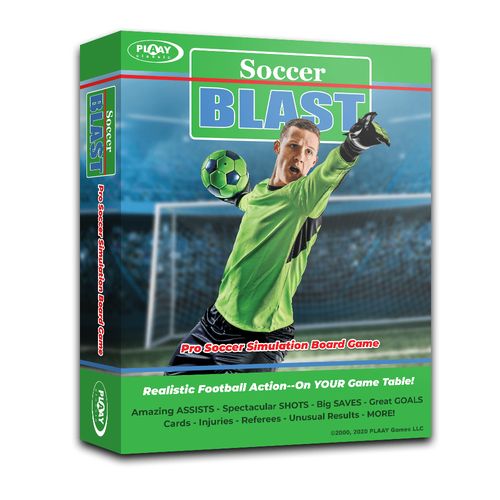
Soccer Blast Pro Soccer Game
Soccer Blast Pro Soccer Game — Chip Strategy & Corner Kick Notes
Source note: these are PLAAY Games' own designer articles, published on plaay.com (2015-2020, archived via the Wayback Machine), discussing the substitution "boost chip" system and corner kick frequency in SOCCER BLAST.
Chip Usage Strategies
The point of using boost chips in the soccer game is to replicate the effect of "freshness," or "invigoration" teams get from replacing a fatigued player with a fresh one. A chip represents a temporary "boost" in effectiveness, as if extra symbols were printed on the player's card, but they can only be gained when a player is brought in as a substitute.
Not all subs are created equal. Better players make better subs, which is why there are blue chips and green chips — different colors represent different strength levels. (Designer note: if you'd prefer to give a blue chip player two green chips instead, thus allowing you to perhaps get two separate three-symbol boosts instead of one six-symbol boost, feel free to do so.)
Red chips exist to make it beneficial to bring in an extra defender or forward for extra defense or offense strength.
Here are some things about chip usage that you may not have considered:
- You have options when subs are called for. Most teams are going to have an option of gaining ANY color chip when substituting, green, blue, or red. It's important to consider ALL the options. If a team is trailing, it might seem like a no-brainer to bring in an extra forward and get the red chip for triangles. However, timing is important. A sub called for in the 60th minute has different implications than one called for in the 80th minute. Consider a scenario where a team, trailing by a goal, replaces a defender with a forward in the 60th minute, and promptly scores the equalizer. Now they'll have to play the final 30 minutes with weakened defense.
- You never HAVE to use a chip. Often it's wise not to. For example, let's consider a situation in which Team A and Team B each have a blue chip on a midfielder. Team A gains an attack, and promptly spends its blue chip to gain the maximum of six triangles. Should Team B spend its chip for six squares? Not necessarily. Suppose Team B has four squares showing among its primary players; it might choose to try to stop the attack with its existing strength, and save the chip for an attack of its own in the upcoming minutes. Or, perhaps Team B has a goal keeper with a four- or five-star ON-TARGET save rating, though only a one-star REACTION rating. Team B could risk the attack being successful, knowing that the keeper stands a good chance of stopping the shot, and if there's a rebound shot, the chip could THEN be spent to thwart it. If the attack failed on either level, Team B would maintain its chip for later use, with Team A unable to counter with a chip of its own.
- Sometimes a lesser chip is better. It might seem that it's always best to gain a red chip when substituting, but that's not the case. Blue chips placed on midfielders can be used for squares or triangles: this is a big benefit. A red chip can only be used for triangles (if placed on a forward) or squares (if placed on a defender). In a tight game, the extra flexibility afforded by a blue chip can be a big plus. Or, consider a team with a sharp-shooting reserve forward who has four or five SHOT stars, but no symbols. Bringing this player in with a green chip can be a better choice than gaining a blue or red chip, especially if the supporting cast around the "sharp-shooter" is already rich with triangle and square symbols.
- Positions determine chip color, not position boxes. The numerical boxes are not the determinant for chip color, or for position. The rules read: "The game is designed for forwards/strikers and/or midfielders to be deployed in box 1, midfielders or defenders in boxes 2 and 3, and defenders in boxes 4 and 5" — and then, parenthetically, "you're allowed to vary the arrangement if you like, for strategic purposes." If you replace a defender with a forward, the forward gets a red chip for triangles that can't be lost through "switching." It doesn't matter what box the defender is in. Similarly, if you switch a forward with a defender, he gets a red chip for squares.
If you use as-played line-ups, use the game's chip rules: they're necessary to amp up a team's scoring power when key players are not being used in order to comply with as-played line-ups. If you are using as-played line-ups and don't use the boost chips, you are probably going to experience fewer goals. On page xiv of the Advance Options section, there's a paragraph on using boost chips for the home team when "triples" are rolled (i.e., 2-2-2, 3-3-3); for those who want to see more goal production, this is recommended as a starting point for integrating chip usage into the game outside of substitutions.
Keeping Chips in Play (Optional: Yellow Chip)
The chip system provides a scoring (or defending) boost when a replacement enters in the latter part of the match. As written, the effect is lost for green and blue chips when a "chipped" player loses his primary status (red chips are kept until used). The following optional system, from PLAAY Gamer Tim Chandler, makes the loss of chipped status a gradual thing rather than a here-and-gone phenomenon, using a new colored chip (suggested: yellow).
- Blue to Yellow: A blue chip is normally lost when the player possessing it switches to a secondary position. Instead of losing the chip altogether, it becomes a YELLOW chip, given to the primary position player of the same position that the blue chip had been originally assigned to. It functions like a blue chip except that it adds only 2 triangles or squares. If the yellow chip is not lost due to use and a switch of the same position thereafter occurs, remove the yellow chip and return the blue chip to the player to which it was originally assigned.
- Green to Yellow: A green chip is normally lost the same way. It similarly becomes a yellow chip, given to the primary position player of the same position, functioning like a green chip except that it adds only two triangles or squares (instead of three).
- Partial Chip Usage: Because a blue chip is lost when played, this preserves part of its strength when all of it is not required. If, when played on a scoring chance, only three or fewer triangles or squares are required to reach maximum scoring or defending potential, then one-half of the blue chip is lost and it is replaced by a green chip.
When a blue or green chip is replaced with a yellow chip, if the yellow chip is not used, simply replace it with the blue or green chip that it replaced, keeping the replaced chip below the stack, not on it. The chip currently in use (original or replacement) is placed on the player stack. When used, both the used chip and replacement chip are removed from the field when played.
Generating More Corner Kicks (Optional)
SOCCER BLAST resolves fewer corner kicks than occur in a real match, in the same way it resolves fewer direct free kicks than in real life: since many corner kicks have no real chance of scoring, the game only resolves those that do, which also grants somewhat better-than-real-life scoring odds to the ones that ARE resolved.
For gamers who want more corner kicks generated, use this optional rule: on defended ATTACKS where the defender does NOT have a circle (dice combinations that add up to 2, 3, 4, 5 or 6), instead of simply awarding possession to the attacking team, give the attacking team a corner kick. This adds roughly 3.5 to 4 corner kicks per game; better defenses will allow fewer corner kicks this way, and poorer defenses will give up more. It also adds value to the circle symbol.
Because the game's Corner Kick chart carries a somewhat elevated scoring chance, adding more corner kicks will nudge scoring up, perhaps an additional goal every eight to ten games. If you don't want the extra scoring potential, you can RECORD the results as corner kicks, but assume the corner was turned back, with the kicking team maintaining possession on the main chart — or disregard the option entirely.