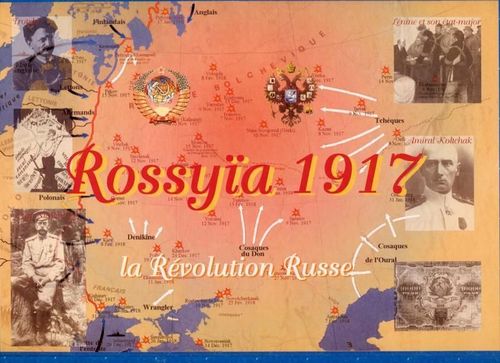
Rossyïa 1917
Rossyïa 1917: Whites Game Aid
Companion document to the community English translation (Randy Stone) of the French 3rd edition rules; see the main rulebook for the source note.
A. November 18
- The Whites automatically play the political option "Offensive Roumanie": They don’t draw another political Option.
- Starting PRs: Southern Whites 5, Siberians 4, Miller 1, Allies 1, Ukrainians 3, Rumanians 1. (The Czechs have none). This is the full amount of PRs available in the first turn.
- Starting Rail points: Southern Whites 0, Siberians 13, Miller 1, Allies 0, Ukrainians 9, Rumanians 3,. (The Czechs use those of the Siberians). This is the full amount of Rail points available in the first turn.
- March Movement is not allowed in the first turn.
B. The Southern – Siberian Rivalry
- Each turn the Whites must choose between the Siberian or the Southern Whites to determine which of the two receives the primary Western aid, to the detriment of the other…
- The “assisted” faction has an advantage: one HQ gets a +1 die roll modifier (DRM) when rolling for Armt points - either Koltchak (Siberian) or Denikine* (Southern) (*or Wrangel if Denikine is gone).
- The other White faction suffers a penalty: two HQ use a -1 DRM when rolling for Armt points - either Koltchak and Doutov (Siberian) or Denikine* and Hetman (Southern) (*or Wrangel).
C. The Great White Offensive
- The Whites hold the initiative for the first three turns of the game: Nov 18, Dec 18 and Jan 19. This is an exception.
- During these three turns the Whites play first and may activate three HQ consecutively, before the Bolsheviks can activate any. These HQs can attempt to coordinate among themselves, but not with other White HQ.
- In the second and third turns, the Whites can’t choose to activate first any of their three HQ which activated last in the previous turn.
D. Azerbaijan
- In January 19 Azerbaijan is conquered by Hetman.
- In the Reinforcement Phase the Southerner receives a 63.2.8 cavalry brigade [shock 3] in the Azerbaijan box. This raises the Political Level by 2 (for control of Bakou).
- Azerbaijan is worth 1 PR and serves to activate the rail line with Grozny (up to Rostov).
E. Southern Whites
- HQ: Denikine, Hetman, Tcherbatchef and Koutiepov (in 20: Wrangel and Slushov).
- The Southerners can be supplied from all ports in the Black Sea, in addition to the normal supply sources (e.g. 2 cities connected by rail).
- In 1918 the Tcherbatchef HQ can receive supplies from Kerson and Nicolaev.
- starting in January 19 the Whites have a naval capacity in the Black Sea, and can move from port to port in the Black Sea (See. xx).
- In May 20, depending on the Southern situation (explained in case S below), the Denikine HQ can either be withdrawn, remain in the game, or be replaced by Slushov.
- What’s more Wrangel arrives in June 20 with a new and powerful White Army around the Black Sea.
- Important Southern reinforcements arrive at the end of 20. They can arrive before any decrease the Political Level (see xx).
F. The Siberians
- HQ: Koltchak, Sakharov and Doutov.
- The Siberians can receive supplies from Omsk (off-map box) or by the rail line running off the southeast map edge, in addition to the normal supply sources.
- The “Koltchak" armored train can only be moved and activated by Koltchak.
- Important Siberian reinforcements arrive at the end of 19. They can arrive before any decrease in the Political Level (see. xx).
Kourgan
- If the Bolsheviks take Kourgan, the Siberians begin to rout..
- If attacked by Bolsheviks the Siberians must perform an attrition check for all their units in the attacked stack, before combat is resolved.
- The HQ, the armored train and the 5².2.6 "Kap" units are not affected.
G. Siberian Reinforcements
- At the beginning of game place the following units on the November 19 box of the turn track:
. 6 XX infantry 81.3.6
. 1 XX cavalry 74.3.8
- Starting in April 19, at the beginning of every turn, the Whites can advance the Siberian reinforcement’s turn of entry by one turn (toward April).
- Each advancement causes the Political Level to fall by 1 point.
- The Siberian reinforcements arrive in the Omsk off-map box.
H. Miller
- This is the White Army of the North at Mourmansk.
- Miller can receive supplies from Mourmansk or Archangelsk (off-map boxes), in addition to the normal supply sources.
I. Youdenitch
- This is the White Army of the Northeast, based in Estonia, starting in June 19.
- Youdenitch may be supplied from all ports on the Baltic (even in neutral Baltic countries), in addition to the normal sources of supply.
J. Aerial Interdiction
If interdiction is successful :
- It costs +2 MP to enter or to leave the interdicted hex.
- Rail movement is prohibited in the hex;
- An armored train can pass through by spending 5 MP (short-term repair)
- Supply is not affected;
- An interdicted rail line is unusable by HQ units for purposes of getting Armt points.
K. Armor Terror
- Tanks were used for the first time in Russia during the Civil War (in small numbers). Their effects inspired terror in the Reds, especially in cities.
- Through May 19, when an armored unit is used in an attack on a major or minor city the Whites gain a 2 column shift to the right on the CRT.
- However in this case the first attacker loss must be taken from an armored unit.
- In June 19, the effect is reduced: Whites only get a 1-column shift to the right.
- Starting in July 19, the "terror" effect ceases.
- It costs 3 PRs to rebuild an armored unit.
- Note: the Southern Whites receive their armor with the Koutiepov HQ (in January 19).
L. Western HQs
- HQ: Ironside, Anselme; each is a "White HQ" for purposes of the rules.
- The Allies receive supply from a port, or from a rail line (or major river) connected to a port.
- All Allied units in or adjacent to a port are automatically in supply.
- The Political Level is reduced by 1 if there are 6 steps of eliminated Allied units during the course of the game (cumulative). Simple losses aren’t counted.
- The Polish 103.3.6 unit arrives with the Allied army in the Black Sea. This unit is considered to be an Allied unit. It withdraws when Poland enters in war.
M. Zones of action limited to 4 Hexes
- The Allies can act within 4 hexes of the coasts.
- The Rumanians can act within 4 hexes of Bessarabie.
- The Ukrainians can act within 4 hexes east of the Dniepr river, everywhere west and south of the Dniepr, and within 4 hexes north of the row containing the last hex of the Dniepr.
- No attacks are allowed beyond the 4 hex limit.
N. Allies in the Black Sea
- In January 19 the Allies land at Odessa, if this city is White.
- The Whites receive Allied reinforcements gradually until April 19.
- Henceforth the Whites have a sea transport capacity of 16 points in the Black Sea. They also benefit from Naval Support (2 columns in attack).
- The Allies can’t be supplied through the Sea of Azov if Kertch in the Crimea is Red. In that case no naval support or landings are possible in the Sea of Azov.
- If Odessa is Red in January 19, the Allies arrival (and their reinforcements) are delayed a turn. They land on the coast within three hexes of Odessa in February 19.
Intervention Mer Noire (reinforced)
- If this political option is played, the Anselme HQ can move to "the interior" and leave the 4-hex zone on the coast. He must remain within 4 hexes of a White Russian HQ. Failing to do so lowers the Political Level by 1 and causes him to retreat toward the coast.
- Anselme rolls a die when he is activated:
1 active, 2-6 inactive.
- Active:       Anselme plays normally.
- Inactive:     Anselme can’t attack.
- The Allies can utilize rail movement by using Southern White rail points.
O. Allied Command and the Sea
- The Allied HQs Anselme and Ironside can command Allied units from a distance, from port to port in the same sea.
- Tracing a command path across the sea counts as 2 hexes. The port of arrival counts as 1 hex.
- Europe: Allied units in the Europe box can also be commanded by an Allied HQ. The distance to Europe is 4 hexes.
- Naval movement between Europe and Russia costs a unit its entire movement allowance for a turn.
- Coasts: Allied units are always in supply in a coastal hex.
- Caspienne: Allied units here are not commanded by a HQ. They act as independent units, and are in supply when on the coasts.
Example: the Anselme HQ is 2 hexes from Sébastopol (taken by the Allies). He commands all his units within 6 hexes (his command radius).
He can also command units within a hex of Odessa (HQ - 2 hexes to Sébastopol, 2 hexes by sea, 1 hex for Odessa, and 1 for the adjacent hex = 6 hexes).
P. Allied Aid
- Each Allied HQ, Ironside and Anselme, can give 1 Armt point (maximum) to a White HQ while losing 2 Armt points itself. This is done when the Allied HQ activates, just after gaining its own Armt points.
- Each Allied HQ can make only one such grant per turn.
- The Allied HQ providing the aid must be within the command radius of the recipient White HQ (with the radius not blocked by enemy units, ZOC, etc…).
Q. Caspienne I and II
- Caspienne I and II are two off-map boxes. They serve solely for the Allies, when the political option “Intervention Caspienne” has been played.
- The Allies can also move their units between the Caspienne boxes and Europe or the Caucasus Republics, at the rate of 1 box per turn.
- The Allies are always in supply in these boxes (or when in transit).
R. White Junction
- The two factions, Southern and Siberian, make a junction the first time that units of both factions are adjacent to each other at the end of a movement phase (provided that the adjacent units are in supply).
- The increases the Political Level by 2.
S. Denikine – Wrangel
- At the end of May 20, the general Southern situation is examined, before the arrival of Wrangel and his units (in June 20).
- The Whites count the number of Southern combat units in the game (not counting air and armored train units). The Political Level is also considered.
The Fate of Denikine:
- If the South has ≥ 35 units in play and the Political Level is ≥ 50, Denikine remains in the game.
- If the South has ≥ 35 units in play and the Political Level is < 50, Denikine resigns and is withdrawn from the game. He is replaced by the 12.0.6 Slushov HQ (taken from the Southern reinforcements).
- If the South has < 35 units, Denikine resigns and no one replaces him.
- Regardless of Denikine’s fate, Wrangel arrives in the June 20 reinforcements.
T. Southern Reinforcements
- At the start of 1920, these reinforcements are placed on the turn track on the appropriate dates:
Group 1 - November 20
. HQ Slushov 12.0.6 (unless he replaced Denikine, end of May 20)
. 6 X infantry 5.2.6 [no shock]
. 2 X cavalry 63.2.8 [shock 3]
. 2 X cavalry 6².2.8 [shock 2]
Group 2 - December 20
. 10 X infantry 5.2.6 [with shock]
. 2 X cavalry 6².2.8 [shock 2]
. 3 X cavalry 51.1.8
- Starting January 20, at the beginning of each turn, the Whites can advance the turns of entry by a turn (toward January).
- Each advancement lowers the Political Level by 1 for each group advanced (every time).
- The Whites can choose to advance only one group (instead of both).
- The two groups can’t arrive at the same time (there must be at least a one turn difference between them).
- The reinforcements arrive within one hex of a Southern city or in the Europe box.
U. Armored Trains
- An armored train has a defense strength of 1.
- An armored train has 1 step. Only one train armored can stack in a hex. They use no HQ command capacity to activate.
- They can advance into and follow a rail line just captured by a friendly unit.
Special Abilities
- Battering ram attack: the armored train stack (alone) can attack an enemy hex, while ignoring the other adjacent enemy stacks.
- Heavy Artillery: an armored train is a heavy artillery unit and gains that bonus: against a city (combat strength tripled), attack across a major river (combat and shock strength not halved).
- Full-steam retreat: an armored train may react during an enemy activation. At any time during an enemy activation a train can retreat up to 10 hexes on the rail line (maximum per turn).
- If its stack is annihilated in combat the armored train can flee without loss. If it is not able to do so it is destroyed.
- Reminder: an armored train is worth 1 in defense (regardless of its combat strength).
- Immunity of steel: an armored train is always supplied no matter where it is. It never checks attrition and is never a victim of "enemy propaganda".
White Armored Trains
- Siberian: Koltchak 65.1.15
- Ukrainian: one 33.1.15 train
- Czech: one 54.1.15 train
- Miller: one 2².1.15 train
- The Southern Whites gain a 54.1.15 train if they capture Rostov, and get a second 33.1.15 train if they take Kharkov.
- The Poles enter the war with two 44.1.15 trains.
- The Siberians and the Czechs lose their armored trains if the Bolsheviks take Omsk.
- Miller loses his train in the event he fails to control at least one city having a rail line.
- The Ukrainians loses their train if they fail to control at least one city in the Ukraine.
V. Internal Conflicts
- When the Political Level is very high (White) or very low (Red), victory becomes enticing... and a struggle for power breaks out among the leaders.
- This affects 1 or 2 "factious" HQs from the leading side.
- White: 1 HQ if the Political Level ≥ 65, or 2 HQ if the Political Level ≥ 91.
- Bolshevik: 1 HQ if the Political Level ≤ 25, or 2 HQ if the Political Level ≤ 15.
- In the Political phase, the opponent chooses 3 HQ "candidates", while naming them in order "1, 2 and 3". He then rolls a die to determine the affected HQ:
[1-2] the 1st HQ
[3-4] the 2nd HQ
[5-6] the 3rd HQ
- If there are two factious HQ, the opponent repeats the process to determine the second HQ. He can choose different HQs the second time.
- For the Whites, only the Russian HQs can be chosen (not the foreign HQs: Allied, Polish, Czech, etc…).
Penalties
- Two penalties exist for the affected HQ: activation choice and a random penalty.
- 1st penalty: the opponent chooses when the factious HQ is activated (the owning player can’t choose it). He announces his choice when the player owning the factious HQ activates another HQ.
- In this case, the intended HQ is not activated and the factious HQ is activated instead. The choice of the factious HQ takes priority.
- The owning player can’t attempt a coordination with another HQ. Only the factious HQ activates.
- 2nd penalty: random, when the factious HQ is activated!
- The factious HQ is checked (a die roll) to see what happens to it...
the opponent plays the HQ! He takes command of units in its command radius, but outside of major cities. He can’t unstack the units, the HQ must stack with a unit, the HQ loses its Armt points and doesn't receive any, all movement allowances are halved (rounded down).
nothing, no 2nd effect
the HQ receives no Armt points (this turn)
same as 3, + the HQ can’t move
same as 3-4, + it loses all its Armt points
same as 3-5, + its command capacity is halved…
W. White HQ Errata
- The Hetman has a movement allowance of 9 (like Denikine).
- The Polish HQ Sikorski has a movement allowance of 6 (instead of 3).
- The Allied HQ Anselme has a movement allowance of 6 (instead of 15).
- Reminder: the movement factor is also the command radius of the HQ.
- The Czech HQ Viktor has a command rating of 11 (instead of 10).
PAGE
The Whites