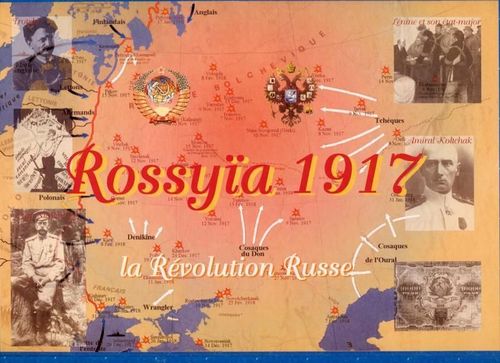
Rossyïa 1917
Rossyïa 1917: Scenario
Companion document to the community English translation (Randy Stone) of the French 3rd edition rules; see the main rulebook for the source note.
The Grand Campaign
In November 1917 the Bolshevik Revolution breaks out in Petrograd (October 17 in the Russian calendar...). In Russia the Soviets look everywhere to spread and consolidate their precarious power while breaking that of the opposition. But somewhere on the Don, a handful of men, officers for the most part, assemble to begin the struggle against the new masters of the old Russia: the volunteers who will soon be called the "Whites".
They are as yet only a few hundreds, but less than one year later, they will be hundreds of thousands in all Russia, in Siberia, Crimea, the Baltic, and the Caucasus. Their pitiless and heroic war against the Bolshevik forces will last three years. Three years during which they will come very close to victory on several occasions, just failing to take Moscow, arriving at the outskirts of Petrograd, bringing Lenin to the edge of the capitulation and occupying for a time more than half of the vast space of Russia!
This is also the time when, under the iron hand of Trotsky, the Red Army is forged, that instrument of the permanent proletarian revolution, which after engulfing the White forces, won't be stopped until they reach Warsaw.
This poorly known epic, this phase of history that failed to change the destiny of the world, is now for to you to replay, for you to decide if it’s possible to avoid 70 years of Soviet rule over half of the planet!
A. Length: from November 18 to September / December 21 (35-38 turns).
B. Starting Political Level
- The initial political Level: 46.
- Detail: 28 (version 1) +10 (Czechs) +1 (Southern Allies) +3 (Romania) +1 (Sotchi port) +3 (Vinitza, Tarnopol, Lemberg).
C. Weather
- In November 18, the weather everywhere is Mud.
- Reminder: in Mud crossing a major river costs 2 MP, and a minor river 1 MP.
Example: the Southern Whites won't be able to cross the Don, unless attacking Rostov.
D. Initial Unit Placement
- The Bolsheviks place all their units first.
- Following that the Whites place their units.
E. Red Reallocation
- Once they’ve finished setup, the Bolsheviks can switch the positions of any 2 units, anywhere they want (infantry or cavalry). They can perform two such exchanges.
- This allows them to moderate the luck of the draw.
Example: the Bolsheviks exchange a 8².3.6 in Grozny with a 4.3.6 in Moscow. Then a cavalry 105.3.6 in Perm with a 6².3.6 in Kazan.
F. Starting PR Pools
- The Bolsheviks have 13 PR.
- The Whites: South 5 PR, Siberian 4 PR, Miller 1 PR, Allies 0 PR, Ukrainian 3 PR, Rumanian 1 PR. (The Czechs have no PR).
- These numbers include the PRs received for the 1st turn.
G. Rail and PR rates
- Initial capacities for RAIL / PR.
• Bolsheviks: 45 / 13
- Whites:
- Miller:       1 / 1 (Mourmansk)
- South:        0 / 0
- Siberian:     13 / 4 (Omsk)
- Czech:        x / x
- Allies:       x / 1 (Europe)
- Ukrainian:    9 / 3
- Romania:      3 / 2
- Neutrals:
- Poland:       9 / 3   - Lithuania:    2 / 1
- Turkey:       0 / 1   - Latvia:       3 / 1
- Finland:      1 / 1   - Estonia:      0 / 0
- Armenia:      0 / 1 (Kars)
H. Political Options
- The Whites automatically draw and play "Offensive Roumanie". Romania is at war against the Bolsheviks at the start of the game .
- The Bolsheviks draw 2 political options in November 18.
I. Special Rules - 1st Turn
- Czar and Czechs: determine their destiny at the beginning of the game, before the setup, - see the next page.
- Kazan: the rail line east of Kazan is impassable for the Bolsheviks on the 1st turn , except for supply.
- March Movement: prohibited on the 1st turn.
- Black Sea: the Bolsheviks may be supplied by sea on the 1st turn only. They have a 2-unit transport capacity between Odessa and Sébastopol (a HQ counts as 1 unit).
Example: the Red Army of Bessarabie is supplied by rail to Odessa (then by sea to Sébastopol).
J. The Great White Offensive
- The Whites have the initiative in Nov 18, Dec 18 and Jan 19.
- During these 3 turns, the Whites play first and activate 3 HQ in succession.
Multiplayer Game
- It’s strongly advised to have 4 players for the full campaign.
A. Four Player Game
-
There are 2 White players and 2 Bolshevik players.
-
Victory: each player keeps track of victory points (VP) – see "Victory" on the last page .
- Whites:
-
"Koltchak" White no.1: Siberians + Czechs + Miller + Poles + Finns + Northern Allies + Makhno (when controlled by Whites).
-
"Denikine" White no. 2: Southerners + Youdenitch + Southern Allies + Ukrainians + Rumanians + Turks.
-
White rivalry: in case of disagreement about which HQ to activate roll a die.
-
The player who decides is: even Koltchak; odd Denikine.
-
Unified Government: if this political option (Gouvernement Blanc Uni) is played, the White rivalry ends. The Koltchak player decides which HQ to activate in case of disagreement. If he loses Omsk, it’s the Denikine player.
- Bolsheviks:
-
"Stalin" Bolshevik no.1: Stalin, Zinoviev, Worochilov, Boudieny, Kojnilov, Frunze and Dzerjinski. He also plays Makhno.
-
"Trotsky" Bolshevik no.2: Trotsky, Tchoukatchevski, Kirov, Ordjozenike, Iegorov, Blucher, Wsevolod and Cosaque.
-
Central Committee: the "head" of the two players depends on the Political Level.
- Political Level ≥ 35: Trotsky
- Political Level ≤ 34: Stalin
-
In case of a disagreement regarding their common decisions, the head of the Central Committee decides (e.g.. distribution of PR, of reinforcements, order of activation, etc…).
-
Victory Points: if a joint attack results in the capture of a VP site, the two players share the VP.
B. Three Player Game
- Same as the four player game except that there is only one Bolshevik player
Czar Nicholas II
This rule represents the prior period of October 17 to November 1918. It concerns the fate of the Czar and the imperial family. Historically, the imperial family had been executed in July 18 at Iekaterinbourg ...
- Czar Nicholas II: every player makes a secret political choice, then a die is rolled (and possibly modified).
- Whites (3 choices): 1) do nothing; 2) connivance; 3) international pressure.
- Bolsheviks (3 choices): 1) do nothing; 2) death; 3) mercy.
- The two players make their political choices in secret, then a die is rolled.
        -1      Czar freed (case 1)
        0-1     Czar imprisoned (case 2)
Czar killed, family imprisoned
(case 3)
Czar and family executed (case 4)
- Whites (by their choice, and if they want it):
-2 <connivance >: Political Level -10
-3 <international pressure >: Political Level -10 + shift the level of victory by one in favor of the Bolsheviks on the Political Table (e.g. a draw becomes a marginal Bolshevik victory).
- Bolsheviks (by their choice, and if they want it):
+1 <death >: Political Level +5
-1 <mercy >: Political Level -5 + special **
- Special **: having chosen "mercy", if the Czar is not executed, the Bolsheviks receive 3 infantry divisions placed within 5 hexes of Moscow.
[Note: the officers of these divisions deserted after the Czar's execution].
Case 1 – Czar freed
- The Political Level increases by 5, unless the Whites chose "international pressure".
- In November 18 the Allies intervene in the Caspian Sea and in the Black Sea 2 hexes southwest of Odessa (instead of in January 19) (remove the 2 political options).
- Every Allied HQ has a zone of action extending 4 hexes from a White Russian HQ.
- The Allied withdrawal political options (in the Bolshevik pool) are postponed until later: Retrait Nord (November 19), Retrait Mer Noire (January 20) and Retrait Caspienne (February 20).
- Gouvernement Blanc unifié: this political option is applied immediately (remove from the White pool).
- The Czar counter is put on a Siberian HQ and must remain with it.
- The Siberian HQ with the Czar is worth +2 (instead of +1) for combat and when rolling for Armt points.
- The Siberian faction receives triple the number of Russian PRs from the city where the Czar is located.
- The Czar is eliminated if his Siberian HQ is destroyed. The Political Level drops by 10 and all these rules are annulled.
Case 2 – Czar imprisoned
- The Czar and his family are alive and prisoners in a random city (die roll).
• Captivity:    1. Kazan; 2. Viatka; 3. Yaroslav;
        4. Orel; 5. Tsaritzin; 6. Voronej.
- The Bolsheviks have no choice. This isn’t their decision to make.
- Relocation: in the reinforcement phase the Bolsheviks can order the Czar to be relocated. The Political Level drops by 2 (even if it fails). Determine a new city (see Captivity above) and the Czar is relocated there. If this city is White (or isolated), roll the die again. If the same city is rolled, the Czar remains where he is and is not moved (the order has not been obeyed…).
- Liberation: if the Whites capture the city where is the Czar is held, make a check (die roll).
        1-2     Czar freed      (Case 1)
        3-4     Czar captive (relocated) (Case 2)
        5-6     Czar and family executed  (Case 4)
- If the Czar is freed, Case 1 applies and he is placed on a Siberian HQ.
- If the Czar is relocated, Case 2 applies: a new city is determined (see Captivity above) and he is moved there immediately. If this city is White (or isolated), roll again. If the same city is rolled, roll the die again: even - the Czar is freed (Case 1); odd - the Czar and family are executed (Case 4)
Case 3 – Czar killed, family imprisoned
- Same as Case 2, except for the following:
- Use the back side of the Czar counter to represent the Imperial family. They can be freed under the same conditions.
- The liberation of the Imperial family has a lesser effect: apply the tripled PRs and the White Unified Government rules (but not the rules concerning the Allies and the +2 bonus for the Siberian HQ).
Case 4 - Czar and family executed
- The Czar counter is not used and the game begins normally.
Czechs
These are Czech ex-prisoners of war gathered and rearmed by Russia during the First World War. The Czechs are powerful, but they don't have any PRs. In the long term they want to return to Czechoslovakia (created in November 18!).
- Czech attitude: every player makes a secret political choice, then a die is rolled (and possibly modified).
- Whites (3 choices): 1) nothing; 2) entente; 3) White pressure.
- Bolsheviks (3 choices): 1) nothing; 2) internment; 3) exile.
        -1      Czechs active           - Case 1
        0-1     Czechs semi-inactive    - Case 2
        2-3     Czechs quasi-inactive - Case 3
        4-6     Czechs inactive - Case 4
Whites (by their choice, and if they want it):
-4 <entente >: Political Level -5
-6 <pressure >: Political Level -10
Bolsheviks (by their choice, and if they want it):
+2 <internment >: Départ tchèque 3 turns later (pool November 19)
-2 <exile >: Départ tchèque 2 turns earlier (pool June 19) + special **
-
Special **: if "exile" is chosen and the Czechs are active or semi-inactive, Czech withdrawal takes place as soon as the Départ Tchèque political option is played, even if the Political Level ≥ 80.
- Case 1 – Czechs Active
-
The Czechs are played normally, except that they have no PR and Rail points.
-
They can make unrestricted attacks. Pay attention to their losses - see Départ Tchèque.
-
The BILT: the Siberian 5².2.6 "Bilt" unit is mixed: half Czech / half Russian. They start with Viktor's Czech army (instead of Doutov).
-
The Bilt can be commanded by a Siberian HQ or by the Czech HQ.
-
If the Bilt unit suffers 1 loss, the HQ that commands it can spend 1 Siberian PR to bring it up to full strength. If the Bilt takes 2 losses, the unit is permanently eliminated.
- Case 2 – Czechs semi-inactive
-
The Czechs are Inactive, unless the Whites attempt to activate Koltchak (1st) with the Czechs. The coordination test is an exception to the usual:
even Czechs Active; odd Czechs Inactive
-
If the Czechs are active, apply Case 1 (without Bilt). Koltchak and the Czech are activated together.
-
If the Czechs are inactive, apply Case 4. Koltchak is activated alone. The Czechs will be activated later.
- Case 3 – Czechs quasi-inactive
-
The Czechs are Inactive, unless the Whites attempt to activate Koltchak (1st) with the Czechs. The coordination test is normal:
[1-2] Czechs Active; [3-6] Czechs Inactive
-
If the Czechs are active, apply Case 1 (without Bilt). Koltchak and the Czech are activated together.
-
If the Czechs are inactive, apply Case 4. Koltchak is activated alone. The Czechs will be activated later.
- Case 4 – Czechs Inactive
-
The Czechs are Inactive, unless the Whites attempt to activate Koltchak (1st) with the Czechs. The coordination test is normal:
[1-2] one attack authorized; [3-6] no attacks.
- If the test succeeds, the Czechs are limited to only 1 attack. Koltchak and the Czech are activated together.
- If the test fails, the Czechs cannot attack. Koltchak is activated alone. The Czechs will be activated later.
- in either event: (Case 4 only)
- The Siberian HQ Koltchak rolls for his Armt using +2 (instead of +1).
- The Czech HQ Viktor rolls for his Armt using +1 (instead of +2).
- Viktor can give 1 Armt to Koltchak while losing 2 Armt (no more). This is done when the Czech HQ is activated, after rolling for Armt. Only one such grant per turn. He must be within Koltchak’s radius (without obstructions).
- Half of the Czechs must be placed on rail hexes (rounded up). The other half within 3 hexes. Failure to comply: the Political Level drops by 1 (per turn).
- Exception: if the Bolsheviks attack the Czechs (other than Bilt), they are Active for 1 turn when next activated - apply Case 1 (except for Bilt).
- The BILT: the Siberian 5².2.6 "Bilt" is not mixed, it is Czech.
- The Siberians can command the Bilt, but can’t replace losses.
XX division, X brigade, III regiment, II battalion,
A. BOLSHEVIKS
Don Army
- Rostov:
. HQ Ordjozenike 12.0.6
. 1 XX infantry
. 1 XX cavalry
. armored train 54.1.15 (on rail)
- Mariopol:
. 2 XX cavalry
- Stravopol:
. 1 XX infantry
1st Siberian Army
Ouralsk – within 2 hexes:
. HQ Dzerjinski 10.0.5
. 2 XX cavalry
. 4 XX infantry
2nd Siberian Army
Kazan - within 3 hexes:
. HQ Blucher 18.+2.6
. 5 XX infantry
. 1 XX cavalry
3rd Siberian Army
Perm - within 2 hexes:
. HQ Tchoukatchevski 16.+2.6
. 5 XX infantry
. 1 XX cavalry
1st Ukrainian Army
- Iekaterinoslav - within 3 hexes:
. HQ Worochilov 14.+1.6
. 1 XX infantry
. 4 XX cavalry
- Krementchoug:
. 2 XX infantry
- Kharkov:
. 1 XX infantry
2nd Ukrainian Army
- 1 or 2 hexes north of Kiew (outside city) - swamp and forest
. 4 XX infantry
. 1 XX cavalry
- hex east of Kiew (right bank of Dniepr, on rail)
. HQ Kirov 12.0.6
. 2 XX infantry
. armored train 33.1.15 (reduced side) (on rail)
Baltic Army
Petrograd - within 1 hex:
. HQ Boudieny 14.+2.7
. 4 X marines 5.2.5
. 1 XX cavalry
. 1 XX infantry
. Trotsky + Trotsky’s armored train 66.1.15 (reduced side) (on rail)
Bessarabien Army
Kichinev - within 1 hex:
. 3 XX infantry
- Odessa:
. HQ Iegorov 14.+1.6
. 1 XX infantry
Moscovie
Moscow - within 5 hexes:
. 4 XX infantry
. 1 XX cavalry
Caucasus
Groszny:
. 2 XX infantry
Other:
. Voronej:      1 XX cavalry
. Archangelsk:  1 XX infantry
. Viatka:       1 XX infantry
. Kotlas:       1 XX infantry
. Saratov:      1 XX infantry
. Astrakhan:    1 XX infantry
. Sébastopol:   1 XX infantry
B. WHITES
Tcherbatchef
Nikolaev - within 1 hex:
. HQ Tcherbatchef 8.+1.8 with 1 Armt
. 3 X cavalry 4².2.8
. 1 X infantry 41.2.6
Dénikine
- Iekaterinodar:
. 2 XX cavalry 64.2.8 [shock 4]
. 1 X cavalry 4².2.9
- Maïkop - within 3 hexes:
. HQ Dénikine 25.+1.9 with 2 Armt
. 7 X cavalry 4².2.9
. 3 X infantry 5.2.6 [no shock]
. 4 X infantry 51.2.7
. 1 X infantry 8².2.6 [Imperial Guard]
. 5 III artillery 33.1.6
- Novorossirsk (port):
. 1 X infantry 5.2.6 [no shock]
- Sotchi (port):
. 1 X infantry 5.2.6 [no shock]
Hetman
Vladicaucase (excluded) - within 2 hexes (outside Georgia):
. HQ Hetman 14.+2.9 with 2 Armt
. 4 X infantry 51.2.6 [with shock]
. 3 XX infantry 6.3.6
. 4 X cavalry 63.2.8 [shock 3]
Czechs
Iékatérinbourg - within 2 hexes:
. HQ Viktor 11.+2.6 with 1 Armt
. 5 X infantry 8².2.6
. 2 X cavalry 7².2.8
. 2 III artillery 33.1.6
. armored train 54.1.15 (on rail)
. special: add 1 X infantry 5².2.6 (BILT) [Siberian-colored counter]
if the Czechs are Active at start of game (see page 2)
- Kourgan:
. 1 X infantry 3.2.6
Koltchak
Iékatérinbourg - within 3 hexes; and up to 6 hexes in single file on the rail line
. HQ Koltchak 20.+1.8 with 2 Armt
. 4 X cavalry 31.2.8
. 1 III cavalry 21.1.8
. 10 X infantry 3.2.6
. 2 X infantry 41.2.6 [imperial guard]
. 3 III artillery 23.1.6
. Koltchak’s armored train 65.1.15 (on rail)
Sakharov
Samara - within 2 hexes, east of the Volga
. HQ Sakharov 15.+1.6 with 1 Armt
. 6 X infantry 5.2.6
. 4 X infantry 3.2.6
. 2 III of cavalry 21.1.8
. 1 III infantry 1.1.6
Doutov
Orenbourg - within 3 hexes:
. HQ Doutov 14.+1.6 with 1 Armt
. 4 X cavalry 63.2.8
. 4 X infantry 3.2.6
. 1 III artillery/horse 2².1.8
. special: add 1 X infantry 5².2.6 (BILT) [Siberian-colored counter]
if the Czechs are not Active at start of game (rule xx)
Miller:
Mourmansk box
. HQ Miller 14.+2.6 with 1 Armt
. 8 X infantry 3.2.6
. 3 X cavalry 3².1.8
. 2 III mountain 31.1.7
. armored train 22.1.15 (on rail)
Allies
- Europe box
. 2 X infantry 2.1.6 [British]
. 1 III artillery 33.1.5 [British]
- Mourmansk
. HQ Ironside 12+1.10 with 1 Armt
. 2 III infantry 21.1.6 [French]
. 1 III marines 3.1.6 [French]
. 1 X infantry 2.1.6 [British]
. 3 X infantry 41.2.6 [American]
- The Whites have a sea transport capacity of 10 points in the Barents/Baltic Sea. They have naval support (2 columns in attack), except in Snow weather.
Ukrainians
- Kiew:
. 1 XX infantry 5.2.6
- Jitomir:
. 1 III infantry 31.1.6
- Vinitza:
. 2 X cavalry 4².2.8
- Tarnopol:
. HQ Peltioura 10.+1.5 with 1 Armt
. 2 X infantry 4.2.6
- Lemberg:
. 1 XX infantry 5.2.6
. 2 X infantry 4.2.6
. armored train 33.1.15 (on rail)
Romanians
. HQ III 12.+1.6 with 1 Armt
. 4 XX infantry 10².3.6
. 2 XX infantry 5.2.6
. 3 XX cavalry 6².3.8
. 3 III artillery 33.1.5
C. Turn Record Track
-
Place the following counters directly on the Turn Record Track at the start of the game. See their particular rules in the Game Aide.
-
Offensive Pologne (White political option)
on October 19 .
- Red Cossacks
in November 19:
. HQ Cosaque 6.0.8
. 4 XX cavalry
. 2 XX infantry
- Siberian Reinforcements
in November 19:
. 6 XX infantry 81.3.6
. 1 XX cavalry 74.3.8
A. Victory - End of the Game
- The game ends with a total Victory by one side if:
- Bolsheviks:   the Political Level falls to 0
- Whites:       the Political Level reaches 100
- Otherwise the game ends between September / December 1921 - Political Table.
B. Multiplayer Game
- Each player keeps track of Victory Points (VP) during the game - see the Political Points Table.
- Each player's VP is multiplied by a factor depending on the Political Level. The player with the greatest adjusted VP is the winner.
•       Pol. Level      Koltchak        Denikine        Bolshevik
        91 - 99 2       3/2     ¼
        65 - 90 3/2     2       ½
        55 - 64 1       1       ¾
        46 - 54 1       1       ¾
        26 - 45 ½       1       ¾
        16 - 25 ½       ¾       1
        01 - 15 ½       ½       2
- The 2 Bolsheviks (in Four Player game): the victory that separates the Staline and Trotsky players is "moral" because they win together. The one that has the greatest VP total will be the First Secretary of the Party, and at Lenin's death (in 1924), will direct the young Soviet Union!
C. Degrees of Victory
- Red Total Victory:
- The Soviet Union is proclaimed. World War II will be won by the Soviet Union. The Warsaw Pact will be established in Eastern Europe.
- The Soviet Union will break apart in 80 years.
- Red Decisive Victory:
- The Soviet Union is proclaimed. World War II will be won, but Berlin will be taken by the Allies. The Warsaw Pact won't exist.
- The Soviet Union will disintegrate in 70 years.
- Red Major Victory:
- The Soviet Union is proclaimed. World War II will be won, but all of Central Europe will be liberated by the Allies.
- The Soviet Union will break apart in 60 years.
- Red Minor Victory:
- The Soviet Union is proclaimed. World War II will be won by the Allies. Moscow will be retaken thanks to the Allied victory.
- The Soviet Union will be left divided, and will collapse in 50 years.
- Draw:
- Russia is divided in 2: Soviet Union / Federal Republic of the South.
- World War II will be lost in the East. Only the Soviet Union will resist in Siberia; then Southern Russia will be freed by the Allies.
- Russia will be reunified in 90 years 90 (without Ukraine, Byelorussia, Caucasus).
- White Minor Victory:
- Wrangel establishes a military Dictatorship in Russia. World War II will be lost in the East. The Allies will liberate Russia (thanks to the atomic bomb).
- Russia will be divided after the war (without Ukraine, Byelorussia, Caucasus).
- White Major Victory:
- Republic of Russia is proclaimed. Denikine is elected President. World War II will be won by the Allies.
- Russia will be divided democratically in 70 years.
- White Decisive Victory:
- Republic of Russia is proclaimed. Koltchak is elected President. World War II will be co-won by Russia and the Allies.
- Russia will be divided democratically in 90 years 90.
- White Total Victory:
- The Russian Empire is re-established. Czar Nicolas III reigns. World War II will be won by Russia.
- Russia is and will remain "one and indivisible".
PAGE 1
PAGE
PAGE 7
La Victoire
Ordre de Bataille
La Guerre Civile Russe