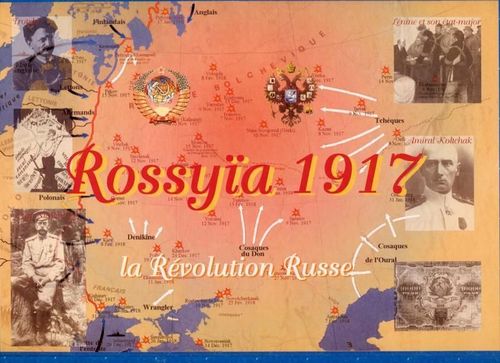
Rossyïa 1917
Rossyïa 1917: Nationalities
Companion document to the community English translation (Randy Stone) of the French 3rd edition rules; see the main rulebook for the source note.
NATIONALITIES
A. Czechs
- The Czechs are a special White faction. They are distinct from the Siberian faction.
- The Czechs never receive PR or Rail points. They can never rebuild their depleted units, or recreate destroyed units (exception: the Bilt unit).
- They use the Siberian supply sources.
- All cities taken by the Czechs are immediately reassigned to the Siberians, as are conquered rail lines.
- The Czechs can utilize rail movement by means of the Siberian Rail points.
Active Czechs
- Czechs are played normally by the Whites.
- [if Case 1 has been rolled] - The Siberian "Bilt" 5².2.6 unit is mixed. The HQ that commands it can spend 1 Siberian PR to rebuild that unit.
Semi - Inactive
- Die roll: even Active Czechs; odd Inactive Czechs
Quasi - Inactive
- Die roll: [1-2] Active Czechs; [3-6] Inactive Czechs
Inactive Czechs
- Die roll: [1-2] one attack allowed; [3-6] no attack
- Koltchak rolls for Armt points with a +2. Viktor rolls for Armt points with a +1.
- Viktor can give 1 Armt point to Koltchak while losing 2 Armt points.
- Half of the Czechs must be placed on rail hexes (rounded up.). The other half must be within 3 hexes. Failure to respect this lowers the Political Level by 1 (every turn).
Czech Withdrawal:
- The Red political option "Départ tchèque” can occur from August 19 on, unless it has been either delayed or advanced at the beginning of the game (See xx).
- The Czechs have 3 turns to evacuate (the current turn + 2 turns).
- The evacuation takes place when all Czech units are in Omsk.
- Political Level penalty: -1 per missing step if the evacuation has <10 steps (a reduced unit is worth 1); and if there is a Withdrawal delay (one turn delay -1, two turns -2, three turns -3).
- At the end of the 3rd turn, the Czechs on the map are withdrawn (out of Omsk) – Political Level penalty: -1 / unit (the HQ is worth 1).
- Exception: the 5².2.6 (Bilt) and the 3.2.6 (27th brigade) are ignored and can remain in game. They pass to Siberian command.
B. Ukraine
- Ukraine is in the Southwest of Russia. It’s bounded on the east by the Dniepr, and on the north by the hex row containing the last hex of the Dniepr.
Zone of Action:
- The Ukrainians can operate everywhere in the Ukraine.
- They can operate up to 4 hexes beyond the Ukraine (to the north, and to the East beyond the Dniepr). They can’t attack beyond the limits of these 4 hexes.
Kiev:
- When the Whites attack Bolshevik-occupied Kiev, they benefit from help given by Ukrainian partisans.
- One Bolshevik unit in Kiev must make an immediate attrition check (chosen by the Whites). Then the Whites make their attack.
- At the end of every turn that Kiev is not Red, the "Offensive Pologne" political option is advanced (roll a die): even 1 month, odd 2 months.
PR Value:
- Kiev is worth 2 PRs to the Ukrainians only.
- For the Bolsheviks or White Russians Kiev is worth 1 PR point only.
Ukrainian Redoubt:
- If the Ukrainians lose Kiev and Lemberg, the Ukrainian "Redoubt" is placed within 8 hexes of Kiev, west of the Dniepr.
- The redoubt generates 1 Ukrainian PR point per turn.
- Each turn when the Ukrainians are activated the redoubt can be relocated within an 8 hex radius.
- If the redoubt is destroyed, it reappears 2 turns later in the Ukraine.
- It’s withdrawn from the game if Kiew or Lemberg becomes Ukrainian again (it can come back later in the game). At that point the Ukrainians use the PRs of the city.
- If Poland enters the war and takes Kiev, the Ukrainians receive Kiev’s PRs, but not Lemberg’s.
C. The Baltic Countries
- Whites can enter, leave or retreat freely through the Baltic countries.
- Baltic rail lines can serve to supply the Allied or Youdenitch factions.
- However the Bolsheviks can invade the Baltic countries by playing the political option "Révolution Mondiale".
- After that the Balts can be commanded by an Allied HQ or by Youdenitch.
D. The Greens
- The "Greens" are a rather new “unpredictable” anti-bolshevik faction. This is an organized peasant’s revolt (of extreme violence), that developed in central Russia.
- The Greens come into play in xx 19.
- The Greens have a "zone of revolt", delimited by a green border on the map. They are automatically in supply within that zone, and can’t act beyond it.
- The Whites activate the Greens as one of their HQ every turn.
- The Greens are checked then to determine what happens (a die roll):
        1-3     the Greens are played by the Whites
        4-5     the Greens are inactive (ignore them)
6       the Greens are played by the Bolsheviks. They can’t unstack the units, the HQ must stack with a unit, the HQ may not spend any Armt points, all movement values are halved (rounded down).
- The Green HQ Antonov draws Armt points under the +2 column.
- The Greens receive 1 PR per turn, as long as the Antonov HQ is not eliminated.
- An eliminated unit can be recreated anywhere in the Green zone.
Military Strength
. HQ Antonov 6.0.6
. 5 Infantry X 3.1.6
. 1 Cavalry X 81.2.8
- ZOC: Green units don't exercise any ZOC.
- Rail: a Green unit occupying a rail hex has only one effect, toward the East, all Red HQs draw their Armt points using the "2+ hexes" column, even if they are on or adjacent to the rail line. They don’t block supply or rail movement.
- Flight: Antonov and the Green units can retreat before combat into any hex not having an enemy ZOC.
NEIGHBORING COUNTRIES
A. Romania
- Romania is already at war against the Bolshevik in November 18.
- Their supply source is Bucharest (and the Rumanian rail lines).
- Their goal is the conquest of Bessarabie.
Zone of action:
- The Rumanians can operate in Romania and in Bessarabie.
- They can operate up to 4 hexes beyond Bessarabie. They can’t attack beyond the limits of these 4 hexes.
Rumanian Peace:
- Once Kichinev is either conquered or evacuated by the Bolsheviks, a peace treaty is signed 2 turns later (at the end of the turn).
- Bessarabie becomes Rumanian and the Political Level increases by 2.
New War:
- Thereafter the Bolsheviks can declare war against Romania at the end of any political phase, to recover Bessarabie.
- If Kichinev is not reconquered in the 2 turns following the declaration of war, a peace treaty is signed again (the Political Level decreases by 2).
- If Kichinev is either reconquered or evacuated by the Rumanians, a victorious peace treaty is signed 2 turns later and the Political Level increases by 2.
B. Finland
- Finland enters the war if the Whites play the "Offensive Finlande" political option , possible from March 19 on.
- Their goal is the conquest of Carélie.
- Their supply source is Helsinki (and the Finnish rail lines).
- The Political Level is increased by 2.
Zone of action:
- The Finns can act in Finland and in Carélie.
- They can operate up to 4 hexes beyond Carélie. They can’t attack beyond the limits of these 4 hexes.
Finnish Peace:
- The Bolsheviks can ask for peace at the end of any turn, after one turn of war.
- If Petrograd has been taken by the Finns, a peace treaty is signed at the end of the turn. Petrograd is restored afterwards, but no Red reinforcements appear in Petrograd the following turn.
- Carélie becomes Finnish and the Political Level increases by 2.
- Once the peace treaty is signed, no further war is possible.
Bolshevik Peace:
- If the Bolsheviks conquer Helsinki, the opposite happens.
- Finland makes peace and Carélie remains Red. The Political Level is lowered by 2.
C. Poland
- Poland enters the war in 2 ways: either by playing the "Offensive Pologne" political option (in principle from October 19 on), or, starting in January 20, by making a check for war-entry.
- The Political Level increases by 4.
- Political Option: at the beginning of the game place the "Offensive Pologne" option on the October 19 box on the turn record track.
- At the end of each turn that Kiew is not Bolshevik, the Polish political option advances (roll a die): even by 1 month, odd by 2 months.
- When the current turn matches the turn containing the political option, that option is put in the White Political Pool.
- Poland declares war if the Whites draw the Polish option.
- Check for war entry: starting in January 20 a check takes place at the beginning of every turn. A die is rolled according to the situation and the game turn.
- This check takes place before drawing political options.
- Poland declares war on 6+.
+1      per Russian city under White control: Lemberg, Tarnopol, Grodno, Wilna, Brest - Litowsk (within the border claimed by Poland, in green)
        +1      from May 20 on
- Their goal is the conquest of Greater Poland (the green border).
- Their supply source is Warsaw, and the Polish cities connected by their rail lines; including the “Polish” cities (west of the green border).
- The Polish 103.3.6 unit that is withdrawn from the Allies in the South, arrives in Poland as a reinforcement on the second turn of the war (unless it has been permanently eliminated).
- As soon as Poland enters the war:
- the Polish political options are added to the Red pool (Grève des Dockers) and White pool (Partisans polonais x2, Aide polonaise, Alliance anti-Bolchevique).
- the "Offensive de la Pologne" option becomes "Occident Soutien".
Zone of action:
- The Poles can operate in Poland, in the Ukraine, and in Russia **, and possibly in the Baltic countries (if the Bolsheviks play Révolution Mondiale).
- They can operate up to **16 hexes beyond the green border, in Russia. They can’t attack beyond this 16 hex limit.
- Lemberg: if the Poles take control of this city, they receive its resources: 3 rail and 1 PR point.
- The Sikorski HQ must always remain in Poland (red border).
The Treaty of Riga:
- If the Poles control and conquer all Polish cities (west of the green border) or if those cities have been evacuated by the Bolsheviks, the Bolsheviks may not play the "Traité de Riga” political option before May 1921.
- If the Poles don't control all Polish cities, the "Traité de Riga” political option is normally playable in August 20 or later.
- If the Traité de Riga option is played, Poland make peace and expands up to the green border. The Political Level increases by 10 levels +1 for each Polish Red city.
Bolshevik Peace:
- If the Bolsheviks conquer Warsaw and all Polish cities (red border), the opposite happens.
- Poland makes peace and keeps their initial border. The Political Level drops by 10 levels.
D. Turkey
- Turkey invades Armenia if the Whites play the "Offensive Turquie" political option, possible from April 20 on.
- The political option is immediately put back in the White political pool.
- Their goal is the conquest of Kars.
- Their supply source is the Turquie off-map box.
Zone of action:
- The Turks must invade Kars.
Turkish Peace:
- once Kars is conquered, a peace treaty is signed 2 turns later (at the end of the turn).
- Kars becomes Turkish and the Political Level increases by 2.
- After the peace is signed, a second war is possible.
Second War: if the Whites replay the political option
- Turkey enters the war again, under 2 conditions:
- the Turkish Peace has been concluded;
- the Bolsheviks control Rostov, Astrakhan and Groszny, or these cities are “abandoned" with no White unit within 6 hexes of them.
- The goal is the "Grand Conquest" of the Caucasus and southernmost Russia.
- Turkey receives 5 PRs per turn (including Kars), plus its conquests.
- The Political Level increases by 2.
Zone of action:
- Off-map boxes: Armenia, Georgia, Azerbaijan (invasions allowed).
- Southernmost Russia: bounded by a line of hexes from the Black Sea to Astrakhan.
Turkish Peace:
- The Bolsheviks refuse Turkish conditions and do not accept peace.
- The Turks must make peace if half of the Turkish army is destroyed (11 units).
- In this case, Kars becomes Red again and the Political Level drops by 2, and by 1 level for each city restored to the Bolsheviks (that had been under Turkish control).
Conflict with Southern Whites:
- Southern Whites and Turks must remain a minimum of 5 hexes apart.
- The Turks may never cede a city to the Southerners (they keep the PR and Rails points for themselves).
CAUCASIAN REPUBLICS
A. Armenia
- Armenia is made up of two off-map boxes: Armenia + Kars.
- It has no military strength.
- A Southern White force of up to 12 steps can enter and take refuge in Armenia.
- The Allies can enter and remain in Armenia without restrictions.
- Supply is ensured for all, but no one benefits from the PR point of Kars if the Bolsheviks have not attacked Armenia.
- If Turkey invades Kars, the Whites are forced to retreat before combat to the Armenia off-map box. If the White force is unable to retreat, it is removed from the game (and interned in Turkey).
- The Bolsheviks can invade Armenia without a declaration of war. In this case the Whites can enter Armenia without restriction and can benefit from the Kars PR point.
B. Georgia
- Georgia is made up of 2 off-map boxes: Georgia I + Georgia II.
- It has no military strength.
- A Southern White force of up to 12 steps can cross Georgia without stopping and go directly to Armenia. This movement costs 4 movement points.
- The same goes for the other way, toward the hexes that connect to Georgia.
- The Allies can enter and can remain in Georgia without restriction.
- The Bolsheviks can invade Georgia without a declaration of war. In this case the Whites can enter Georgia without restriction and can benefit from the Tiflis PR point.
Étrangers