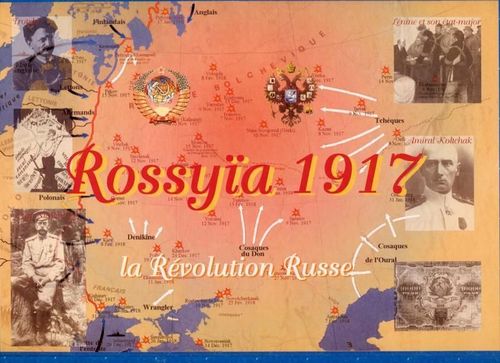
Rossyïa 1917
Rossyïa 1917: Bolsheviks Game Aid
Companion document to the community English translation (Randy Stone) of the French 3rd edition rules; see the main rulebook for the source note.
A. November 18
- Once they've finished setting up their units, the Bolsheviks can make two unit exchanges, with each exchange switching the positions of two units. These can be made wherever they want (with infantry or cavalry).
- The Bolsheviks draw 2 political Options.
- The Bolsheviks have 45 Rail and 13 PRs. This is their full amount of PR / Rail points for the 1st turn.
- The Army of Bessarabie, HQ Iegorov, is supplied by sea this turn. For this turn it also has a 2-unit sea transport capacity between Odessa and Sébastopol (HQ counts as 1).
- Kazan: the rail line running east from Kazan is impassable in the 1st turn for the Bolsheviks, except for purposes of supply.
B. Trotsky
- Trotsky always moves with his armored train.
- He is moved by an activated HQ. He can be far away, but he must end his movement within 10 hexes of the activated HQ. Trotksy doesn't count toward the command capacity of the activated HQ.
- Trotsky "energizes" the HQ and increases its value by 1, both for combat and for Armt points.
- This effect lasts for the duration of the activation of this HQ. He can’t choose Makhno.
- If his armored train is destroyed, Trotsky is eliminated.
- Constraints: Trotsky and his armored train must remain in Russia or in the Ukraine (therefore he can’t enter Poland, Romania or Finland).
C. Red Moscow
- From February 19 on Moscow triples its PR value for the Red army.
- Moscow is worth 9 PRs (not 3 more) for the Bolsheviks.
D. The March Revolution
- Starting in April 19, the Political Level is reduced by 1 at the beginning of every turn.
E. Bolshevik Garrisons
- Starting in February 19, the Bolsheviks must establish a garrison of 1 unit in every major/minor city which generates PR or Rail points. Garrisons are verified at the end of the turn.
- The Bolsheviks must place a HQ unit in Moscow, and a second HQ in Kazan if they capture Omsk.
- A garrison HQ can be activated and can command units to make attacks, etc... But the HQ can’t move.
- If Moscow is taken by the Whites, this rule doesn't apply anymore.
- Penalty
- If the garrison requirement isn't met, the Bolsheviks must eliminate from their reinforcements 1 division / minor city (black), and 2 divisions / major city (red).
- The lost divisions are chosen among the reinforcements for the city closest to the deficient area.
- Exception
- Ignore major/minor cities which are not connected to a Bolsheviks supply line (by rail or river). No garrison is necessary.
F. Makhno
- Makhno enters play in February 19.
- Makhno is a Ukrainian anarchist, very favorable to the Bolsheviks, but he is "unpredictable".
- The Bolsheviks activate Makhno as one of their HQ every turn (instead of one of their own).
- Makhno is checked then to find what he does (die roll):
        1-3     Makhno is played by the Bolsheviks
4       same as 1-3, except that he can only        attack the Ukrainians
        5       Makhno is inactive (ignore him)
6       Makhno is played by the Whites. The Whites can’t unstack Makhno’s units, the Makhno HQ must stack with a unit, the HQ can’t spend Armt points, all movement is reduced by half (rounded down).
- The Makhno HQ is always supplied in the Ukraine. Makhno and his units can never leave the Ukraine, or attack beyond it (see Ukraine, White Game Aid).
- The HQ obtains Armt points using the "2+ hexes" column regardless of where it is.
- If Makhno doesn't receive an Armt point, 2 units must make an attrition check (his choice).
- Makhno must always be stacked with a unit.
- If the Whites plays Makhno, he can’t attack the Bolsheviks as long as they didn't attack him.
- If Makhno is killed, his HQ can’t return to the game. His units undergo the fate of independent units.
G. Red Cossacks
- At the start of the game place the Red Cossacks in the November 19 space on the game turn chart (this represents their turn of entry):
HQ Cosaque 6.0.8
4 cavalry XX
2 infantry XX.
- At the start** of every turn in which the Bolsheviks control Tzaritzin or Gouriev, the turn of entry of the Red Cossack Army is moved one month earlier on the turn chart (**except for November 18).
- The Red Cossacks arrive as reinforcement when their turn of entry arrives. They are placed within 4 hexes of Gouriev or Astrakhan.
- At the end of each turn before they enter that the Bolsheviks don't control either Astrakhan or Gouriev, 1 Red Cossack unit is lost (they may choose to lose any but the HQ). It can be rebuilt (after the arrival of the Red Cossacks).
- The Red Cossack HQ and its units are always in supply within 4 hexes of Astrakhan or Gouriev (regardless of the control of these cities). They are not in supply beyond that range unless they are supplied by another Red supply source.
H. Major Rivers
- Dnieper: in the Ukraine, the river flows by Kiev and Odessa.
- Don: the river runs by Rostov and goes back up toward Voronej.
- Volga: the river passes by Astrakhan and then up toward Tsaritzin, Samara, Kazan, toward Nijni-Novgorod; and the river Kama goes toward Perm.
- Vytchegda: (Great North) the river runs by Kotlas and Viatka.
- Ural: the river goes by Gouriev and go back up toward Orenbourg.
- Irtych: the river flows by Kourgan.
Supply:
- A major river is a source of supply if:
- 2 cities are connected by the major river (without the presence of adjacent enemy units);
- 1 city is sufficient if it is connected by rail to another source, or if it is a port (for the Whites: Rostov, Odessa or Astrakhan).
I. River Transport
- Every "major river" has a transport capacity of 1 unit (combat or HQ).
- Its necessary to control 1 city on the major river.
- The embarking unit must be adjacent to the major river, but may even be in an enemy ZOC.
- The landing can be made in an empty or friendly-occupied hex anywhere along the major river, even in an enemy ZOC.
- The major river is cut by the presence of an enemy unit adjacent to the river.
- The Volga: the Bolsheviks have a double river transport capacity. They have a transport capacity of 1 on the Volga north of Samara (toward Nijni-Novgorod, Kazan), and also a separate capacity of 1 to the south of Samara (toward Astrakhan, Tsaritzin). So if Samara is controlled by the Bolsheviks their river transport capacity becomes 2 everywhere on the Volga.
Snow
- No river transport is possible in the North Weather Zone when the weather is Snow.
- Snow doesn't effect supply by major river.
- In the South Weather Zone river transport is possible in all weather.
J. Bridges
- Each rail line crossing a major river is a bridge. The bridge belongs to the player who last had control of the two sides. This is even if they lose one side of it.
- A city on a major river also has a bridge. The bridge belongs to the one who controls the city (this concept is fundamental).
- A change of control takes place at the end of an activation (as with Railheads).
- Hint: You can use the railhead markers (red / white) to signify their control.
- A bridge is not usable if the opponent controls the opposite side.
- Note: a ZOC extends to the opposite side of a bridge (by the one who controls it).
Example: in November 18, the Siberians can’t use the bridge on the Volga (toward Kazan), because this bridge is Bolshevik. It will become White when the Siberians have taken the two sides.
K. Petrograd and Krönstadt
- Petrograd and Krönstadt, adjacent, are mutually supplied by each other and don’t need to have a line of communication with another city.
- Comment: Krönstadt is in fact a fortress protecting access to Petrograd. In game terms it is represented as a major city.
L. The Kronstadt Marines
- The 5.2.5 units of Bolshevik “Marines" can operate within 4 hexes of Petrograd.
- No attacks are allowed beyond the 4 hex radius.
- There is a White political option that eliminates them (from June 19).
M. Cavalry Army
- Half of the units of an Army can be composed of cavalry (rounded down), not more.
- Beginning in 1920, this constraint is lifted for 1 Bolshevik Army, commanded by Tchoukatchevski.
N. Armored Trains
- A armored train has a defense value of 1.
- A armored train has 1 step. Only one train armored per hex. 0 in Capacity of a HQ.
- It can advance and can follow a rail hex taken by a friendly unit.
Special Abilities
- Battering Ram Attack: the armored train stack can attack (alone) an enemy hex while ignoring other adjacent enemy stacks.
- Heavy Artillery: an armored train is a heavy artillery unit when attacking a city (value tripled), and across a major river (combat and shock not divided).
- Full steam retreat: when the opponent is playing, the armored train can react to his actions. It can retreat at any time up to 10 hexes (max. per turn).
- If its stack is eliminated in combat, the armored train can retreat without suffering loss.
- Reminder: an armored train is worth 1 in defense (regardless of its value).
- Immunity of steel: an armored train is always in supply wherever it is. It never suffers attrition and is never victim of "enemy propaganda".
The Bolshevik armored trains (in November 18)
- The Bolsheviks have 3 armored trains: Trotsky’s train 66.1.15 (reduced side) / 87.1.15 (full side), and two other classic trains 54.1.15 / 33.1.15.
- The Bolsheviks lose 1 level when Rostov is taken by the Whites. The 54.1.15 train becomes 33.1.15 (reduced side). They recover it if they retake Rostov.
- The Bolsheviks gain 1 level if they conquer Omsk (in Siberia). A train is flipped to full value (ex. Trotsky’s train goes to 87.1.15, or a 33.1.15 train to 54.1.15).
- The Bolsheviks receive 1 level in reinforcements in August 19.
O. Kourgan
- If the Bolsheviks take Kourgan (in the Urals), the Siberians begin to rout..
- If attacked by Bolsheviks the Siberians must perform an attrition check for all their units in the attacked stack, before combat is resolved.
- The HQ, the armored train and the 5².2.6 "Kap" units are not affected.
P. War in Siberia
- If the Bolsheviks take the Omsk off-map box, they are supposed to pursue combat deeper in Siberia.
- To reflect these faraway fights, the Bolsheviks must put 10 units, 2 of which must be cavalry, "in garrison" at Omsk. No HQ is necessary.
- A HQ unit must go Kazan as a "garrison" on the turn following that in which Omsk becomes Red. (See. XX).
- If the Bolsheviks have less than 10 units at Omsk, they must move in 1 unit per turn, until a sufficient amount is present.
- Note: this rule also applies if Omsk is unoccupied by Siberian units and Kourgan is taken by the Bolsheviks, with a free rail line to Omsk.
Q. Guerrillas in the Caucasus
- If the Bolsheviks take all cities south of the Don and the Volga below Tsaritzin, as well as Azerbaijan, the Caucasus is considered reconquered and Red.
- To reflect guerrilla warfare in the area, the Bolsheviks must put 4 units, 1 of which must be cavalry, "in garrison" at Rostov, Novorossirsk, Vladicaucase and in Azerbaijan.
- Note: this rule also applies if these cities are “abandoned", without having a Southern unit within a 6-hex radius of them.
R. Nationalities
- The Political Level is reduced by 1 if there are 6 steps of destroyed Allied units during the course of the game (cumulative). Simple losses aren’t counted.
- The Allies regularly give PRs to the White Russians via the political option "Soutien Occident". This option is put back in the White Pool every time that its played, and it will increasingly be played in 1920.
- Poland is a sizeable adversary. The Allies will give lots of PRs via this political option, especially in 1921 (aid doubled). The Bolsheviks have a chance to put an end to the war by playing the political option "Traité de Riga", while giving in to all Polish demands. This costs 10 political points.
- Kiev is not a prize to disregard, because Poland is activated sooner if Kiev is not Red at the end of the turn. The Whites get a bonus for attacking Kiev, because Ukrainian partisans inflict losses before combat...
S. Internal Conflicts
- When the Political Level is very high (White) or very low (Red), victory becomes enticing... and a struggle for power breaks out among the leaders.
- This affects 1 or 2 "factious" HQs from the leading side.
- White: 1 HQ if the Political Level ≥ 65, or 2 HQ if the Political Level ≥ 91.
- Bolshevik: 1 HQ if the Political Level ≤ 25, or 2 HQ if the Political Level ≤ 15.
- In the Political phase, the opponent chooses 3 HQ "candidates", while naming them in order "1, 2 and 3". He then rolls a die to determine the affected HQ:
[1-2] the 1st HQ
[3-4] the 2nd HQ
[5-6] the 3rd HQ
- If there are two factious HQ, the opponent repeats the process to determine the second HQ. He can choose different HQs the second time.
- For the Whites, only the Russian HQs can be chosen (not the foreign HQs: Allied, Polish, Czech, etc…).
Penalties
- Two penalties exist for the affected HQ: activation choice and a random penalty.
- 1st penalty: the opponent chooses when the factious HQ is activated (the owning player can’t choose it). He announces his choice when the player owning the factious HQ activates another HQ.
- In this case, the intended HQ is not activated and the factious HQ is activated instead. The choice of the factious HQ takes priority.
- The owning player can’t attempt a coordination with another HQ. Only the factious HQ activates.
- 2nd penalty: random, as the factious HQ is activated!
- The factious HQ is checked (a die roll) to see what happens to it...
the opponent plays the HQ! He takes command of units in its command radius, but outside of major cities. He can’t unstack the units, the HQ must stack with a unit, the HQ loses its Armt points and doesn't receive any, all movement allowances are halved (rounded down).
nothing, no 2nd effect
the HQ receives no Armt points (this turn)
same as 3, + the HQ can’t move
same as 3-4, + it loses all its Armt points
same as 3-5, + its command capacity is halved…
T. End of the Game
- The game ends if, at the end of a turn, the Political Level reaches 0 or 100 (Red or White total victory).
- Otherwise it ends at the end of 1921 between September and December.
- Roll a die at the end of every turn:
- September:    6
- October:      5-6
- November:     4-6
- December:     automatic end
- End of Game: the Political Level indicates the degree of victory - see the Political Table. See the back of the Full Campaign for the final description.
le Bolchevique