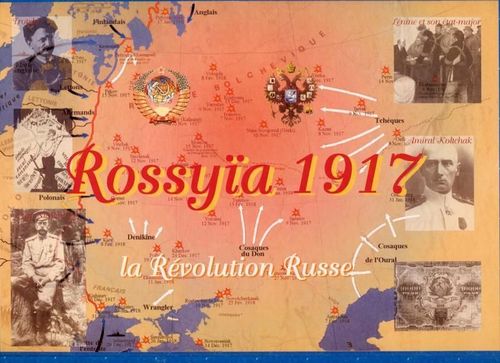
Rossyïa 1917
Rossyïa 1917: Baltics
Companion document to the community English translation (Randy Stone) of the French 3rd edition rules; see the main rulebook for the source note.
This is an optional rule used from February 1919 in the normal game. This is also a scenario that can be played separately.
Lithuania, Latvia, Estonia
In November 1917 the Bolshevik Revolution bursts in Pétrograd (October 17 in the Russian calendar...). In Russia the Soviets look everywhere to spread and consolidate their precarious power while breaking that of the opposition. But somewhere on the Don, a handful of men, officers for the most part, assemble to begin the struggle against the new masters of the old Russia: the volunteers who will soon be called the "Whites".
They are as yet only a few hundred, but less than a year later they win a series of victories, just failing to take Moscow, arriving at the outskirts of Petrograd, bringing Lenin close to capitulation and occupying for a time more than half of the vast space of Russia!
This is also the time when the Red Army is forged under the iron hand of Trotsky, which the White forces will barely stop in front of Warsaw.
A. Length: February 19 to June / September 19 (5 to 8 turns).
X. Political Level: when playing the Baltic scenario the initial political level is xx.
B. Weather
- In February 19 the weather everywhere is Snow.
X. Initiative
- In February 19 the Bolsheviks have the initiative.
- In March 19 it goes to the Whites. It alternates every turn, etc…
X. Red PRs
- The Bolsheviks maintain a second pool of PRs, "Red Balts", separately for their war in the Baltic countries.
- These PRs may be used for Bolshevik and Red Baltic units at the same time without distinction.
- The Bolsheviks receive PRs from the Baltic cities that they control.
- The Red HQ Stuka also gets PRs by means of the Armaments Table, using the weather and the distance between the HQ and a Red Baltic city (and not a rail line). Thus the HQ receives a variable number between 0 and 2 PRs each turn, in addition to the PRs from the Baltic cities.
- The Stuka HQ receives its Armt points in addition to this, of course.
X. Map - Errata
- Rail line: add a rail line along the coast from Koenigsberg - to Riga.
- Libau: city port 2 hexes north of Memel in coastal hex in forest.
- Tallin: the capital of Estonia is worth 1 Rail / 1 PR point.
X. White PRs
- There are 3 different nationalities, but they are all activated and played together by the German HQ Von der Goltz.
- The White Balts and White Russians jointly receive the PRs of the Baltic cities under White control. They use the same pool of PRs.
Germany:
- The Germans have their own pool of PRs and receive a flow of 3 PRs per turn from Germany.
- When the Treaty of Versailles takes place, Germany loses its flow of PRs. The Von der Goltz HQ receives a variable number of PRs by means of the Armaments Table, using the weather and the distance between the HQ and Libau (or Memel). Thus the HQ receives a variable number between 0 and 3 PRs each turn.
X. Zone of Action
- No unit of the two sides can leave the Baltic countries except as noted below.
- No attacks are allowed outside of the Baltic countries.
- If the Red political option "Révolution Mondiale" has not been played, the Bolsheviks are prohibited from moving new forces into the Baltics or reinforcing Red units there that are battered.
- Exceptions:
- the Bolsheviks can move their 2 Red divisions freely through Russia, but if they finish their movement there, they won't be able to return to any Baltic country.
- if the Bolsheviks play "Révolution Mondiale" they can come and go freely. The Red Balts can’t leave the Baltic countries however.
- if the Germans create their Baltikum (see xx), they can leave the Baltic countries (with the White Russians also).
X. The Iron Division
- The following 3 German units form the "Iron Division":
. 1 XX infantry 103.3.6 [fer I]
. 1 X infantry 73.2.6 [fer II]
. 1 III artillery 44.1.6 [fer III]
- When these 3 units are stacked together, they have a +4 bonus in combat strength – then the Iron Division has a combat value of 25.
X. Red and White Balts
- At the beginning of the game each side has some Red or White Baltic units.
- These units are supplied everywhere in the Baltic countries, and can move about in any Baltic region.
- The White Balts disappear when the Baltic Republics are formed as independent states (see xx).
- The Red Balts disappear when the Bolsheviks make peace.
- Red and White Balts must remain in the Baltic countries and can’t attack outside their borders.
X. The Treaty of Versailles
- In June 1919, the Treaty of Versailles is signed between the Allies and defeated Germany (at the beginning of the turn). Its a key moment for the Baltic War.
- In the East, Germany is officially required to evacuate all Baltic countries.
- Four cases are possible depending on the situation:
- Red Peril: the Bolshevik played "Révolution Mondiale". The Peril takes precedence and the Germans can remain without penalty. - Case 1
- German withdrawal: after a few adventures the Germans return to Germany. The Bolsheviks can make peace or can continue the war. - Case 2
- German refusal: the Germans continue the war in a more unpredictable manner. This has an impact on the Political Level and the Allies in the north. - Case 3
- German Baltikum: the Germans conquered the Baltics. The Treaty of Versailles partially applies in the East. - Case 4
- Rivalité Versailles:
- If the Whites play the "Rivalité Versailles" political option (formerly the Roumanie counter) in June 19 , the Treaty of Versailles is delayed and doesn't take place until September 19.
X. Red Peril - Case 1
-
If the Bolsheviks played "Révolution Mondiale", the Germans are not affected by the Treaty of Versailles in the East. The Red Peril is greater (see xx).
-
Youdenitch enters play in Estonia in June 19 (see xx).
-
German Withdrawal - Case 2
-
All German units are withdrawn from the game.
-
The Bolsheviks have the choice to either make peace and recognize the Baltic states officially or to pursue the war.
-
Peace: the Bolsheviks make peace - see xx.
-
The Bolsheviks must play "Révolution Mondiale" to intervene in the Baltics again.
-
War: the war continues. Youdenitch enters the game in June 19 with half of his force. He can command the Balts.
• in Estonia HQ Youdenitch 12.+3.6 with
5 Armt
                4 X infantry 41.2.6
                1 III of cavalry 31.1.8
                5 PRs
- The other half arrives in July 19.
X. German Refusal - Case 3
- The Political Level is lowered by 3.
- The "Retrait Arctique" political option is placed in the Red pool.
- The following German units make an immediate attrition check:
- a check for each unit: 11².3.6 and 9².3.6.
- only one check for the "Iron Division": 103.3.6 [fer I], 73.2.6 [fer II], 44.1.6 [fer III]; the Whites distribute the losses freely.
- Half of the White Russians are eliminated (rounded up), chosen at random. If Riga is Red they are all eliminated.
- All White Balts are eliminated, except the 31.1.6 unit. The German receives 3 PRs in compensation, unless Riga is Red
- Riga and Tallin are evacuated by the Whites.
- The Baltic Republics are constituted, even if some Red units are still in the Baltic countries (see XX). If a Baltic capital is Red, its units are placed in a single stack on the coast within 3 hexes.
- Lithuania: pro-White. They’re played by the Whites (in defense). The xx number of PRs serves the White Russian units still in the game.
- Estonia: neutral. It can be invaded by the Germans, in which case they are played by the Bolsheviks as long as a German unit is in Estonia. Youdenitch can’t receive supplies if Estonia is hostile. Estonia is conquered if the Germans destroy all the Estonian army and take Tallin. It then becomes pro-White.
- Latvia: hostile to the Whites. They’re played by the Bolsheviks. If Riga is attacked, each attacking stack makes an attrition check before the attack. This takes place once (it simulates Allied aid by a defensive naval bombardment). Latvia is conquered if the Germans destroy all the Latvian army and take Tallin. It then becomes then pro-White.
X. German Baltikum - Case 4
- If the Germans control all cities of the 3 Baltic states, they create the "German Baltikum” at the end of the turn. This can occur before or after the Treaty.
- The Political Level is increased by 2.
- This "fait accompli" is partially accepted by the Allies at the time of the Treaty of Versailles (if the Treaty takes place before).
- The Germans perform attrition checks for certain of their units, and their flow of PRs is reduced and becomes variable at the moment of the Treaty. The White Balts disappear.
- On the other hand, all White Russians remain in the game. They can be commanded by either Von der Goltz or by Youdenitch, either one.
- The Whites control the 3 Baltic states (in defense).
- Youdenitch can receive the Baltic PRs if he wants.
- Petrograd:
- The Germans and Youdenitch can leave the Baltic countries to attack the Bolsheviks. They can coordinate on a 1-4.
- They operate in a region within 8 hexes of Petrograd (in Russia).
- They can re-enter the Baltic countries without being interned, then leave again, etc…
- Remember: officially the Baltics are neutral. The Bolsheviks must play "Révolution Mondiale" to invade the Baltics (and to attack the Germans and Youdenitch in their den).
X. The Baltic Republics
- The Baltic Republics are constituted as independent states when there are no Red units in the Baltic countries or if the Germans choose Refusal when the Treaty of Versailles occurs.
- Then the Bolsheviks make peace automatically, and the Baltic Republics become officially neutral.
- The Political Level increases by 2.
- Each Baltic state is re-equipped and receives all its units, as follows:
- at xx:
2 X infantry 3.2.6
2 X cavalry 41.2.8
- at Tallin:
3 X infantry 3.2.6
1 X cavalry 41.2.8
- at Riga:
4 X infantry 4.2.6
- The Baltic units are always in supply in their home country.
- All White and Red Balts are withdrawn from the game.
- The Stuka HQ is withdrawn from the game (permanently).
X. Youdenitch
- In July 1919, the new White army of Youdenitch is created.
• Estonia       HQ Youdenitch 12.+3.6 with 5 Armt
                7 X infantry 41.2.6
                3 III of cavalry 31.1.8
                1 III artillery 64.2.5
                5 PR
- Youdenitch receives supplies from all ports on the Baltic and from Tallin.
- He can leave Estonia, or fight in the Baltic countries if the Bolsheviks are still present.
- If Youdenitch returns to Estonia, he is withdrawn from the game (internee), except in the German Baltikum case.
X. World Revolution
- If the Bolsheviks plays "Révolution Mondiale", they can intervene directly in the Baltic countries.
- The Germans are not affected by the Treaty of Versailles in the East (if the option is played before the Treaty). The Red Peril is greater.
- The two Bolshevik PR point pools are combined into one.
- through September 19, the Bolshevik intervention is limited per turn to:
- sending 2 divisions (maximum);
- use of 2 PRs from the Bolshevik pool.
- from October 19 on the Bolsheviks are free from all constraint.
- Youdenitch comes into play in Estonia in June 19 (see xx).
Scenario
X. BOLSHEVIKS
Bolsheviks
Riga – within 1 hex.
HQ STUKA 12+0.6
2 X infantry
Red Balts
- Dunabourg – within 1 hex
2 X infantry 4.2.6
- Riga - within 1 hex
4 XX infantry 6.3.6
2 XX cavalry 6².3.8
- outside Tallin – within 2 hexes
3 XX infantry 5.3.6
1 XX cavalry 6².3.8
X. WHITES
Germans
- Prusse Orientale:
HQ Von der Goltz 20.+2.6 with 5 Armt
1 XX infantry 103.3.6 [fer I]
1 X infantry 73.2.6 [fer II]
1 III artillery 44.1.6 [fer III]
1 XX infantry 11².3.6
White Balts
- outside Riga – within 2 hexes
1 X infantry 31.1.6
2 X infantry 5.2.6
White Russians
- outside Riga – within 2 hexes
2 X infantry 41.2.6
1 X cavalry 7².2.8
X. BALT
- The Baltic Republics are on course for independence.
Lituanie
- Lithuania is pro-White at the beginning of the game.
- The Lithuanian army doesn't exist yet.
Lettonie
- Latvia is played by the Whites at the beginning of the game.
- Its hostile to the player who controls Riga.
- The Latvian army is composed of a single unit at the beginning of the game.
- on the border of Estonia:
1 X infantry 4.2.6
Estonie
- Estonia is played by the Whites at the beginning of the game.
- If no Red units are in Estonia at the end of a turn, Estonia becomes neutral. Its units are immediately placed in Tallin.
- The Whites can also attack Estonian Tallin. In this case Estonia changes sides and is played by the Bolsheviks as if Tallin is White.
- The Estonian army is as follows at the start.
Tallin:
3 X infantry 3.2.6
1 X cavalry 41.2.8
REINFORCEMENTS
March 19
German
Prussia 1 XX infantry 9².3.6
White Russian
Riga 2 X infantry 41.2.6
April 19
German
Prussia 2 X infantry 61.2.6
White Russian
Riga            2 X infantry 41.2.6
                1 X cavalry 7².2.8
May 19
German
Prussia 2 X infantry 61.2.6
June 19
German
Prussia         1 X infantry 61.2.6
                1 armored train 33.1.15
A. Victory - End of the Game
- The game is ended by the Victory Point total of a side if:
- Bolshevik:    the Political Level reaches 0
- White:        the Political Level reaches 100
- Otherwise the game ends between September / December 1921 – Political Table.
Les Baltes