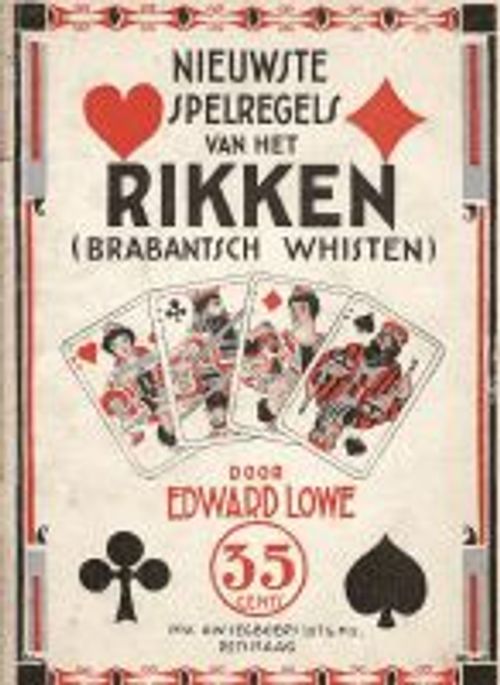
Rikken
Rikken Community Write-up
Table of Contents
Table of Contents
General rules
- The game is played with all 52 playing cards of a pack, without jokers.
- The lowest card is the 2 and the highest is the ace.
- The first bid that is made stands.
- "Gerikt" (having bid Rikken) is final; a player who has been outbid on Rikken may not change it.
Bidding
The bidding proceeds as follows. The player to the left of the dealer makes the first bid, then the next player makes a bid, and so on. This is repeated until the highest bid is reached. As soon as a player has passed, that player may no longer bid.
The possible bids, the order in which they stand, and the value for making the bid all vary, but an overview of the possible bids is given below.
The points value of each bid may be set by the players. The points that the highest bidder (and his partner) wins or loses are paid by, or paid to, the other players.
It can also happen that several players bid the same bid at the same time. For example, once one player has made a misère bid, another player (who may still bid) may decide to misère along and also try to take zero tricks. When the bidding is over, the highest bidder, if applicable, states what trump is and which card he asks for as partner.
Rikken for money or points
The bidding, the possible bids, the order in which they stand and the value for making the bid vary, but an overview of the possible bids is given below. "Beter" is the same bid but with hearts as trump, and it always ranks above the other trumps. Beter Rikken can therefore only be overbid by 8 alleen or higher.
Bid order
- TROELA (THREE ACES) is always mandatory: if someone has three aces in hand, he must declare it. The player with the fourth ace is automatically his partner, and also determines the trump suit (depending on what he holds himself; consultation with the partner is out of the question). That trump may not be the same suit as the fourth ace! The partner with the fourth ace must also lead with that ace, and that trick may not be trumped! You and your partner try to take at least 8 tricks. If you succeed, you each earn the basic amount of 10 cents (passer 1 pays player 1, passer 2 pays player 2). Each overtrick earns an extra 5 cents. If you fall short of tricks, that costs a basic penalty of 10 cents plus 5 cents for each "down" trick (so at least 15 cents). PS: in the exceptional case that you hold four aces, you ask for a King as partner; otherwise everything stays the same.
- RIK is the standard game: you try to take at least 8 tricks with a trump suit that you choose yourself. Only once you are allowed to play your bid (that is, once the others have passed), you name the trump suit and say which ace you ask for "mee" (as partner). The holder of that ace is your partner for that hand. Note: he may not say that he is the partner; that only becomes clear after the asked-for ace is played! The payout is the same as above.
- BETERE RIK: this bid can only be made if someone has already bid RIK. Otherwise as 2, but the trump is now hearts.
- ACHT ALLEEN (8 ALONE): you may only make this bid if someone else has already bid something! As the name says, you must take at least eight tricks with a trump suit of your choice, but without asking for a partner. The payment is the same as for 1 (but you are paid by three players!).
- PIEK or PICCOLO: you have such low cards that you think you can take only one trick on your own. Not more, not less. There is no trump. As soon as you take a second trick, the game is over and you pay each of the others 20 cents. But if you succeed and take exactly one trick, you receive 20 cents from everyone. (PS: others may happily "meepieken" (piek along)! That means they must also take a single trick in that same round. You may also still pass with "bijPiek". That is an ordinary pass, unless someone after you bids Piek and plays it, in which case you automatically piek along. If a bid below Piek is played, this is called an incomplete bid.)
- NEGEN ALLEEN (9 ALONE): you may always bid this directly, even if no one has made another bid. Otherwise the same as 4 (value 20 cents).
- MISÈRE: your cards are so low that you - on your own and without trump - will not take a single trick. A kind of super-PIEK. It earns 30 cents, but it is difficult, because before you know it you have taken a trick and it is over.
- TIEN ALLEEN (10 ALONE): speaks for itself (30 cents).
- OPEN PIEK: you think you will take only one trick (just like PIEK). But... you may lead yourself, and when the others have played to the trick and the first card of the second trick lies on the table, then you lay down your own cards, so that everyone sees what you have. The others may not confer (40 cents).
- ELF ALLEEN (11 ALONE): clear (40 cents).
- OPEN MISÈRE: the same as 9, but now take no trick at all! (50 cents).
- OPEN PIEK MET EEN PRAATJE (WITH TALK): exactly as 9, but now the others may chat freely about the tactics to follow (once you have laid your cards open on the table; 55 cents).
- TWAALF ALLEEN (12 ALONE): 60 cents.
- OPEN MISÈRE MET EEN PRAATJE (WITH TALK): 65 cents.
- DERTIEN ALLEEN (13 ALONE): 70 cents.
- SCHOPPEN MIE: can only be bid when everyone has passed and the dealer must therefore make a bid. The Queen of Spades ("schoppen vrouw") must be discarded as soon as its holder cannot follow suit. No spades may be played before the Queen of Spades has been played (unless you only have spades left, of course). The players who take the trick with the Queen of Spades and the last trick each pay 15 cents. If this is the same person, he pays all the others 15 cents.
Furthermore, it can also happen that several players bid at the same time. For example, once one player has made a misère bid, another player (who may still bid) may decide to misère along and also try to take zero tricks. When the bidding is over, the highest bidder, if applicable, states what trump is and which card he asks for as partner.
The asked-for ace
The partner is determined by the Rikker by asking for an ace. This must be an ace of a suit in which he himself holds at least one card. This can sometimes not be done, for two reasons:
- The Rikker holds all 4 aces: in this case the Rikker asks for a King as partner (if he also holds all 4 Kings, he asks for a Queen, and so on).
- The Rikker holds the ace of every suit in which he has cards: in this case the Rikker asks "blind" for one of the aces he does not hold (and says so when asking for the ace). The Rikker may then, if the asked-for ace has not yet been played, lead a card face down, and this trick then counts as the first trick of the asked-for suit. At the end of the trick the face-down card is laid open before the trick is cleared, and the game then continues as normal.
Sometimes played variant: the Rikker announces the ace he wants as partner. However, he must himself get the lead to ask for the ace. If he is already on lead, that is simple. If not, those who are not partner will try to prevent the Rikker from being able to ask for his ace, so that he must take the required 8 tricks without help from a partner.
The game
When playing Rikken, one player makes a suit trump and asks for a partner. For example, clubs are trump and whoever holds the ace of spades is the partner. The partner is only officially known once the Rikker plays the asked-for ace. The suit should become known if possible, and there is no obligation to trump. The asked-for ace must be played when the partner asks for it. If the opposing side plays the suit of the asked-for ace, the ace may only be played when there is no other option. The asked-for ace may not be trumped when it is asked for.
If the Rikker or his partner may lead, they will begin by drawing trumps.
The opponents of the Rikker's pair will usually lead in a suit other than trump or the asked-for suit. But because the players, apart from the partner, do not know at first who the partner is, it sometimes pays to sow a little confusion.
When playing an alone bid or a piek/misère, the other 3 players together form a bloc against the highest bidder.
Play continues until all cards have been played, or until a player (usually the bidder) is certain of the number of tricks that will be taken and lays them open. For example, with a 9 alone, with 9 trump cards and low side cards, the leader can immediately state that he is certain to take the 9 trumps and not the other 4. Also, a piek or misère will not be played on if it is already known that it will not be made.
Dealing
The first dealer is chosen at random (most commonly: the youngest begins, so the player sitting to the right of the youngest begins dealing). It is up to the dealer whether he has the cards passed around by the person on his right hand or shuffles them. It goes without saying that the player to the left of the dealer may call his game first. If this game is chosen, he may lead a card first. The dealing moves to the next player in each new hand, clockwise. The player who won or lost the previous hand does not automatically become the dealer, so everyone gets a turn to sit "in front". The tricks a player takes in a hand are neatly set aside. The dealing sequence used is 6-7 or 4-5-4, depending on where you play.
Shuffling
Unlike almost every other card game, in Rikken the cards are lifted once (also called "heffen") rather than shuffled. This keeps the cards together, so that the chance of a good hand increases. Often the first round is "gestoken" (played as a stok round), particularly when other card games are also played "met de stok". This means everyone lays their cards out by suit and gives them back to the dealer. The dealer then deals them again, after lifting them once.
Playing for money
To keep the game somewhat serious, a cash prize per bid may be used.
Malheur / Troela
In Brabant this is often used as the highest bid and so goes above everything. There are, however, many ways to play troela.
Whoever holds 3 aces in hand may make this bid (not 4 aces - in some places declaring malheur/troela is mandatory). Then the one who holds the 4th ace must declare himself and is at once the partner. This is therefore the only form of play where the partner is known in advance. In fact it is nothing other than normal Rikken, but with this difference: the partner must now determine the trump instead of the "Rikker", and he may not make trump with the ace he himself holds (the asked-for ace). The danger is of course that the partner has no good cards with which to Rik, but that is the gamble. Together they at least hold all 4 aces, but this game often turns out differently than expected.
The scoring is the same as for normal Rikken. Sometimes this game is counted double. In some regions, whoever holds 4 aces must also play troela; in that case the partner is the one holding the king of hearts, or the holder of troela must ask for a king.
Another form: the partner with the 4th ace must lead with this ace, and this suit is then also trump. Usually at least 9 tricks must then be taken instead of 8.
Yet another form: the suit of the 4th ace is determined automatically, and only becomes trump when the 4th ace is played. The 4th ace does not necessarily have to be played when that suit is played. So until that time, even the holder of malheur/troela does not know who his partner is.
Passing games
When everyone passes, the cards are usually dealt again. Alternatives are:
- 2 or 5: everyone must take either 2 or 5 tricks. Up to 3 of the 4 players can therefore win.
- 1, 3 or 5: as 2 or 5, but everyone must take 1, 3 or 5 tricks.
- 1, 5 or 11: as 2 or 5, but everyone must take 1, 5 or 11 tricks.
- 1 or 5: as 2 or 5, but then 1 or 5 tricks.
- Schoppen dame, last trick or schoppen mie: one may not take the Queen of Spades ("schoppen dame") or the last trick. In the first round no spades may be played. The idea is that you discard your Queen of Spades into another trick when you can no longer follow suit, so make sure you play off a suit of which you have few cards and keep low cards.
- Rondpiek (round Piek): this game is not played by very many people but is still a well-known passing game. Everyone pieks, and whoever holds out the longest wins, so whoever is left with 1 trick. Those who have 0 or more than 2 tricks are out and must make sure the others also lose.
- Verplicht misère (mandatory misère): the same as round Piek, but here the aim is to take exactly zero tricks.
- Verplichte rik (mandatory Rik): the player after the dealer must Rik, he may choose the trump and the ace himself, and only needs to take 7 tricks with his partner.
- Wijven (women): the aim is to take no queens, or to take all four queens. If all four queens are taken, the other 3 players pay. No queens (and at least 2 players hold 1 or more queens): you are paid by the players with 2 or more queens. 1 queen = pay nothing, 2 or 3 queens = pay.
- Sjoemelen (cheating): here everyone passes three cards of the same suit to the person on their right. Then everyone passes 3 cards, which they have not just received, to the left. Then everyone passes 3 more random cards across to the player opposite. Now bidding may take place again. In this variant very high bids are often made, because you can receive many cards of the same suit, and you can choose whether to keep high cards (to take many tricks) or low cards (to piek or misère). It can however also lead to a troela.
Common variants
- The order and scores of the bids differ from place to place.
- In some places the better suit is not always hearts but a suit that varies from game to game.
- Beter rikken, 8 beter, 9 beter and so on are not allowed everywhere.
- In some places alone-Rikken may not be bid as the first bid.
- In many places the partner must pay along if the Rik bid is not made. In other places the partner must pay along if he himself has taken fewer than two tricks.
- Piek bids are by no means allowed everywhere.
- 3 pieken, 4th player must piek along: as 2 or 5, but then everyone must take 1, 3, 5, 7, 9 or 13 tricks (odd, but not 11).
- In some places 7 alone is played, a bid between Rik beter and 8 alone.
- Usually the cards are dealt again when everyone passes.
- In some places the dealer may not pass when the other three players have already done so.
- In some places one more round of bidding is held when everyone has passed.
- In many places it is mandatory to declare malheur/troela when one holds three aces.
- There is also a variant in which the same rules are used, but the game is called pieken (piek) instead of rikken, because it is played with players who very often piek. The names of the bids are also different: rikken is called "pas met bijpiek plus", because presumably rikking is not allowed anyway, and after a piek bid one may choose to piek along. So "beter rikken" is also called "pas met bijpiek plus beter". Troela is called "troelnaai" because of the annoying feature that no piek can then be played. Often 2 or 3 people piek at the same time in this game, and occasionally everyone piks. If everyone passes, "1 or 5" is played, but this is of course called "piek or 5". If someone does rik after all, that is called an incomplete bid. This game variant is mainly played at secondary schools and the university in Nijmegen.
Sayings (aantal uitspraken)
These are common sayings used at the table. They are included for their flavour and are not rules.
- "Goeie maat gewenst." (Good partner wanted.) (Said when someone dares a Rikje but is not sure of the Rik.)
- "Een goed maatje is het halve werk." (A good partner is half the work.) (Idem.)
- "(Dezelfde) Kleuren is geld beuren." (Same suits is money raising.) (For example, when you have spades trump and ask for the ace of clubs; often others say "of de broek scheuren" (or tear the trousers) after it.)
- "Dan kleurt het." (Then it colours.) (After the Rikker has announced trump (for example hearts), he thereby indicates the asked-for ace (in this case diamonds).)
- "De blinde aas telt voor twee, daarom vraag ik 'm mee." (The blind ace counts for two, that is why I ask for it.) (When you have to ask for a blind ace.)
- "Ga je handen eens wassen!" (Go and wash your hands!) (When the dealer has dealt very badly.)
- "Er in gespeeld is ook gespeeld!" (Played in is also played!) (When someone rikked with poor cards and lost the game and makes excuses.)
- "Dat is geld dat we zeker hebben!" (That is money we are sure to have!) (When someone with a dubious reputation piks or plays misère.)
- "Nou, eieren of jong!" (Well, eggs or chicks!) (When someone is dawdling about playing a card.)
- "Die binne benne, benne binnen!" (They are in, in they are!) (When the partner is not yet known and three people have already played a card, so that the Rikker takes the trick himself with a high card.)
- "Is het bod soms rikken met praatje?" (Is the bid perhaps Rikken with talk?) (When someone cannot keep his mouth shut during the game.)
- "Is het soms met praaaaaaaatje?" (Is it perhaps with talkkkkk?) (Idem.)
- "Welten stefmaat!" (When your partner gets nothing, makes a big mistake and as a result you cannot take anything (goes broke).)
- "Stalen maat." (Steel partner.) (When someone Riks but has not yet declared the asked-for ace, someone may indicate with "Stalen maat" that he is a good potential partner.)
- "Maasje erin!" (Ace in!) (When someone is not paying attention and loses through a huge blunder (lets it be played in).)
- "Een goeie (of echte) pieker haalt de eerste slag." (A good (or real) piek player takes the first trick.) (To justify that the piek player takes the first trick straight away.)
- "Hij verpest het spel voor andere mensen!" (He spoils the game for other people!) (When someone piks.)
- "Een nood-rik." (An emergency Rik.) (The Rikker wants a strong partner.)
- "In de kleur spolt het deur." (In the suit it spoils the door.) (Asking for the asked-for ace in the same suit as the suit in which one is riking.)
Rikken with a dummy (three players)
This variant has existed for at least 50 years. After bidding, the dummy's cards are laid face up. If a partner has been asked for and the dummy is the partner, the cards of the dummy are played by the player who riks. Otherwise they are played by the player who was not asked for; this partner only becomes known when the dummy is to play. In the case of a piek or misère, the players who did not bid or who bid the lowest decide who plays the dummy. The dummy receives its own points, but will not win easily because it cannot itself bid. This variant has its own dynamics and is certainly as much fun as playing Rikken with four.
Rikken with a sitter-out (five players)
The dealer deals the cards to the other four players but does not play himself. As in ordinary Rikken, the dealing moves one place each time, so that everyone sits out once per round. In this variant the dealer may lift the cards.