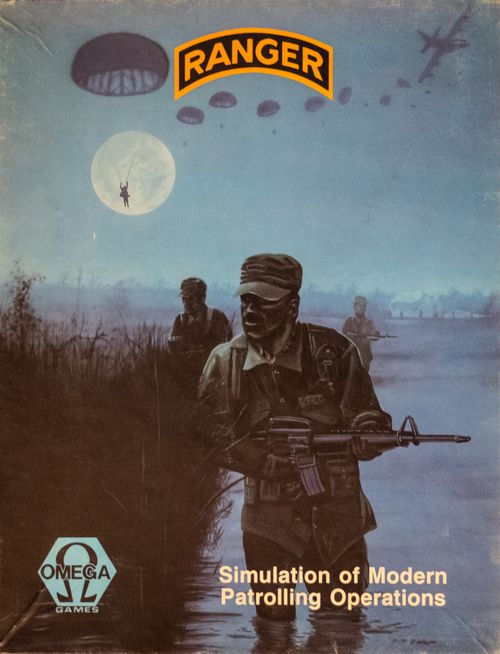
Ranger
Ranger — Patrolling Tactics Booklet
Table of Contents
Table of Contents
Introduction
Patrols are small units assigned a specific mission directed against a precisely defined objective. A patrol can be any size, but usually is comprised of a squad or platoon. When possible, an integral small unit is assigned the patrolling mission. This maximizes the patrol's effectiveness by utilizing all of the small unit's prior training and cohesiveness. The individual in command of the operation is termed the patrol leader, with his second in command being the assistant patrol leader.
A squad patrol is comprised of a patrol (squad) leader (PL) and two five man fire teams. Each fire team has a fire team leader (TL), a grenadier (G) and three riflemen (R). Each grenadier is armed with an M203 dual purpose weapon. The M203 is an M16 assault rifle with a 40mm grenade launcher mounted under the barrel. All other squad members are armed with a standard M16.
A squad patrol may be augmented by a three man machine gun team. The gunner (MG) carries an M60 machine gun. The crew is completed by an assistant gunner (AG) and an ammunition bearer (B), each armed with an M16.
A platoon patrol is comprised of three identical squads and a platoon headquarters. The platoon headquarters consists of the patrol leader (PL), assistant patrol leader (APL), two radio telephone operators (RTOs) and two machine gun teams. No machine gun teams augment the squads.
Patrol operations are conducted by small units forward of friendly positions. Larger units employ patrols, usually in defensive situations, to augment their battle plans. These patrols are used to provide security, gain timely information, harass the enemy and destroy or capture enemy personnel and equipment.
Patrolling is an inherently difficult type of operation as the patrol is operating alone in enemy territory. If the unit becomes decisively engaged, there are no units on the patrol's right or left flank to provide support. The patrol may also be beyond the range of its own supporting units such as artillery or aviation assets. Due in part to this isolation, the success of Ranger operations depends upon a combination of extensive planning, stealthful movement and, when necessary, violence of firepower. Patrols must prepare to face any adverse situation without assistance.
Patrols must plan for every possible occurrence. Contingency plans for dealing with enemy situations must be prepared and rehearsed in as much detail as possible. Each contingency action must be planned in advance and every member of the patrol must be fully briefed on all plans. Any member of the patrol may find himself the senior surviving Ranger at any time. Due to the amount of responsibility shouldered by each soldier, patrolling is a difficult task for most units.
There are two major types of patrols: combat and recon. All patrols share common basic concepts and principles. Each type of patrol, however, has its own unique aspects.
Combat patrols are those patrols with a mission of destroying or capturing enemy personnel and equipment. Raids and ambushes are the two types of combat patrols. Raids are missions directed against lightly defended targets in the enemy rear area. Ambushes harass and interdict the enemy's movements. They are established on well travelled routes or natural lines of drift (ridges, valleys, rivers, etc.) along which the enemy is likely to travel. Ambush patrols establish a kill zone in which they are able to isolate and destroy an enemy force. All combat patrols use surprise as a combat multiplier. In other words, the small force may inflict damage and losses on an enemy force in excess of normal expectations due to having achieved surprise.
Recon patrols attempt to stealthfully perform a reconnaissance of an objective to provide intelligence for future operations. The information gained by a recon patrol may be used as the basis for future operations or to confirm or deny information gained previously. Recon patrols avoid all contact with enemy forces in the objective area. If the enemy is aware of the patrol's presence, the information gained is likely to be useless.
Although any infantry unit may be assigned a patrolling mission, such missions are the specialty of Ranger units. Ranger units are organized to provide the US Army with a capability to perform extended patrolling operations in enemy rear areas. Ranger units are comprised of individuals with the highest standards, qualifications and training available.
Planning
Planning for a patrol begins upon the patrol leader receiving the mission briefing from headquarters. Although patrols may be initiated at company or platoon levels, they are usually coordinated by the battalion S2 (Intell Officer) or S3 (Operations Officer). Battalions are the smallest units with a staff to plan and implement a proper patrolling plan.
The patrol leader issues a warning order as soon as possible to maximize the amount of time spent preparing for the mission. The warning order includes a minimum amount of information that allows the members of the patrol to prepare properly for the mission. This would include the situation, mission, chain of command, organization, uniform, weapons, ammunition, equipment, time schedule and special instructions necessary for preparing the patrol for the mission. These instructions would direct the patrol to conduct all necessary coordinations, test fires and drawing of ammunition and special equipment.
The patrol leader must determine the equipment needed to accomplish the patrol's assigned mission. The men of the patrol will each carry their standard equipment plus certain items of special equipment. This equipment includes special weapons and ammunition, radios, nightsights, binoculars and ropes. Each Ranger carries a rucksack to aid in transporting this equipment. Most special equipment is carried in the rucksack and is not ready for immediate use. This equipment, to include additional ammunition, is readied for use during a security halt or during actions at the objective.
Radios are carried by the RTOs in a platoon patrol. For a squad patrol, however, one man carries a radio in his rucksack as an additional duty. These radios are PRC-77 FM radios used to contact higher headquarters and adjacent units. Each patrol has, as standard equipment, several smaller squad radios used for short range internal communication. These radios allow key personnel to exchange information and signals when separated. These squad radios are not represented in Ranger and are automatically assumed to be available in the quantity necessary for the mission.
The M47 Dragon medium anti-tank weapon is the patrol's anti-vehicular weapon. The tracker unit of this system is the weapon. The tube containing the missile is considered to be the round of ammunition. One tracker is carried per squad, but more than one round of ammunition may be carried.
Prior to actually commencing the patrol, the entire operation is outlined in an extensive operations order. The comprehensive plan is developed and issued by the patrol leader to outline the patrol's actions from inspections to debriefing. Although unit standard operating procedures may apply to many actions detailed in the order, any others will be fully covered. The operations order addresses: the enemy and friendly situation, the mission, execution of the mission, the concept of the operation, sub-unit missions, coordinating instructions, service support, command, signal and any applicable annexes to cover special aspects of the patrol.
Coordinating instructions are very detailed and cover: actions at the objective, time of departure and return, movement techniques, routes, departure from and return to lines, rally points, actions on contact, actions at danger areas, actions at halts, fire support, rehearsals, inspections, debriefing and any EEI (essential elements of information) to be obtained. The annexes cover any insertion by aircraft, patrol base activities, river crossing, aerial resupply, small boat operations, link-ups with other patrols or transportation by trucks. The operations order is attended by every patrol member.
After the operations order, inspections and rehearsals are conducted. All of the patrol's actions are prioritized and rehearsed in the order determined by the patrol leader. Each action is rehearsed to the patrol leader's satisfaction. Rehearsals continue as time permits. After the final full dress inspection, the patrol sterilizes the planning area as a counter-intelligence step. The patrol then moves to the marshalling site or the forward friendly unit (FFU) for insertion or infiltration.
Insertion/Infiltration
The patrol must first move to the enemy's rear area to begin operations. The patrol may either infiltrate through enemy lines by ground movement or be inserted in the enemy's rear area. There are several methods of inserting a patrol in the enemy's rear area. These include: airborne insertion, airmobile insertion, rappelling from helicopters and small boat operations. Insertion or infiltration should be undetected.
The patrol's objective may be deep in the enemy's rear areas or relatively close to friendly lines. Insertion is usually used to place a patrol closer to a deep objective. Infiltration is used to allow a patrol to pass through friendly positions into enemy territory. A long-range patrol may also use passage of lines combined with a lengthy ground movement.
Units that pass through friendly lines conduct extensive coordination prior to arriving at the FFU's location. When and where the unit is to arrive and the enemy situation are covered in this coordination. Upon arrival, the unit is met by a guide from the FFU. The guide escorts the unit to a security area. This is established as an initial rally point (IRP). The patrol leader will conduct a final coordination with the FFU commander at which only "need to know" information is exchanged. The patrol leader finalizes his plan and prepares the patrol to move through lines.
The patrol is then led through friendly positions to the enemy side of all fortifications by the guide. The APL is at the front of the formation with the guide. The guide leads the patrol through a concealed opening in the fortifications, wire and minefields. At the far side of the gap in the wire, the APL identifies each member of the patrol as they pass his position. After a final briefing by the APL, the guide is left at the gap in the wire as the patrol moves out of the area. After the patrol leaves, the guide returns to his unit.
The patrol moves quickly out of friendly weapons range to prevent being caught in a cross fire during an enemy attack. After clearing this danger zone, the patrol leader conducts a listening security halt. The patrol spends a few minutes during the halt adjusting to the sights and sounds of the battlefield. Upon completion of the listening security halt, the patrol resumes movement along their planned route.
Objectives which are deep in the enemy's rear usually are assigned to patrols that will be inserted into the area of operations. This minimizes the risk of the patrol being discovered during a long movement and allows the patrol to be relatively fresh and alert during actions at the objective.
The point of insertion should be at a great enough distance from the objective so as not to alert the defending enemy force. There are many methods of inserting a patrol in enemy territory. These include: parachuting, airmobile insertion, rappelling from helicopters and use of small boats. The method used depends upon the enemy situation and friendly assets available.
Airborne insertions, airmobile insertions and rappelling from helicopters all involve using aircraft to transport the patrol to the area of operations. Airborne insertion involves parachuting into a large, open area termed a drop zone or DZ. Airborne operations find all personnel making a static line parachute jump with all equipment. Airborne insertion may be conducted from USAF transport aircraft or US Army helicopters.
If helicopters are used, the patrol may land, parachute or rappel. Rappelling is used in areas where terrain does not permit the helicopters to land. When rappelling, the Rangers use individual ropes, snap links and climbing ropes to conduct a controlled descent from hovering helicopters. Both parachuting and rappelling require special training and rigging prior to embarkation. In an air assault, or airmobile insertion, the helicopters set down momentarily in an open area designated as the landing zone or LZ. During the instant the aircraft are on the ground, the patrol disembarks with all of their equipment.
During planning, the patrol leader develops an aircraft load plan which minimizes the effect any lost aircraft has on the mission. In doing so he cross loads aircraft with critical personnel. For instance, all of the leaders are not on the same aircraft. All members of a machine gun crew would be loaded on the same aircraft, however, since the loss of a single man reduces the effectiveness of a weapons crew. When using helicopters, the possibility exists of reduced airlift being available. For this reason, the patrol leader develops a bump plan which would provide a new load plan in the event any reduction in airlift capacity develops.
In all three types of air transported insertions, the Rangers move quickly to a pre-designated assembly point and quietly reorganize for movement once on the ground. The danger of the patrol being discovered during insertion is greater if the patrol is slow in moving off the LZ/DZ. As soon as possible, the patrol commences movement to their objective.
The patrol may also use small boats for insertion. The patrol is usually moved by larger naval craft into the area of operations and inserted. The patrol is cross loaded in boats as with an air movement. Each boat has a leader or coxswain. The coxswain supervises the loading and lashing of equipment in the boat. He also is responsible for commanding and steering the boat during movement.
The movement of the patrol by small boats depends upon stealth. If contact occurs, very few Rangers will be able to fire as ten of the fifteen men in each boat are involved in paddling. Certain key weapons, however, may be rigged to provide a limited direct fire capability.
A member of each boat is assigned the duty of navigator. The navigator is charged with maintaining the patrol's location exactly by using a compass for resection (using azimuths to known points for reference) or following the course of the river on the map. During darkness, the navigator may operate with a red filtered flashlight under the concealment of a lined poncho in the bottom of the boat. During darkness, another designated Ranger quietly relays navigational information to the covered Ranger.
Each boat is silently propelled by the paddling of ten men. Depending on the enemy situation, the patrol might use outboard motors on the boats. This will increase the patrol's speed and greatly reduce fatigue, but the noise may compromise security. Upon reaching the debarkation point, the patrol moves into a security position on land while the boats are secured and camouflaged. The boat teams immediately retrieve the lashed down equipment and prepare for movement. When each Ranger has recovered his equipment, the patrol leader signals the point man to move out. The patrol commences movement along the planned route.
Movement
The patrol spends the majority of the operation involved in movement to and from the objective. While moving, the patrol is seeking to avoid enemy contact. The patrol has an assigned mission at a specific objective. Any contact during movement will merely endanger the success of the mission. For example, nothing is accomplished by killing six enemy soldiers during movement to the objective only to have the raid on a SAM site fail due to a compromise of surprise.
In planning a route, the patrol leader attempts to use terrain which will reduce the prospect of the patrol encountering any enemy forces. An aggressively planned route through the densest terrain will greatly aid the patrol in moving without detection. The patrol should avoid all danger areas. The patrol will more likely be spotted and engaged on a road or in the open, than in wooded or swampy terrain since enemy units will be less likely to occupy positions in difficult terrain. Villages and areas of deadfall should be by-passed if possible. Villages ensure the patrol will be spotted; while deadfall areas, in which all trees are fallen, inhibit movement greatly.
An integral part of planning a patrol's route is the development of the fire support plan. The patrol leader personally coordinates with the fire support officer to establish coverage of the patrol's movements. Target Reference Points (TRPs) are plotted and recorded with the FSO to aid in calling indirect fire support in the event it is needed. The objective and its approaches are primary targets with additional TRPs plotted on the route. If fire support is needed, the artillery and mortar units' response time is greatly reduced if the target is within a short distance of a TRP.
Alternate routes and TRPs are also plotted to allow the patrol to maintain this advantage if forced to change its route. If the patrol needs to deviate from its primary route, the patrol leader must issue a fragmentary order (FRAGO) to the patrol. The FRAGO covers the new route and can only add a limited number of TRPs. If an alternate route with its TRPs was not plotted or cannot be utilized, the patrol loses the advantage of coordinated fire support.
From time to time, the patrol leader may find himself forced to cross a danger area such as a trail or a stream. In these instances, the patrol must work efficiently to minimize the amount of time spent in the area. Security must be placed on the flanks and the far side of the danger area must be secured prior to allowing the patrol to cross. The patrol then moves quickly out of the area. Any contact that occurs should be broken off as soon as possible.
During movement, the patrol is lead by a point man. He is singularly oriented to security and enemy observation. He is the team leader of the lead fire team. The man behind him is the primary compassman. He ensures the patrol follows its planned route. Other Rangers in the patrol, including the patrol leader, are also responsible for double checking the compassman's navigation. Rangers in different sections of the patrol are assigned the duty of paceman. These Rangers use a known pace count to translate the number of steps they take into a distance in meters.
The patrol leader will follow the lead element. In a squad patrol, this will place him between the two fire teams. In a platoon-sized patrol, the patrol leader follows the first squad in the order of march. The patrol leader keeps any machine gun teams directly to his rear and under his control. The assistant patrol leader precedes the last element in the order of movement. In a squad-sized patrol, he is the team leader of the second fire team. In a platoon-sized patrol, he is the platoon sergeant and is located between the second and third squads in the order of march.
During movement, the fire teams of the patrol usually move in a wedge formation. This is the basic small unit formation of the US Army infantry. The members of the fire team follow the team leader to his flank and rear. This arrangement resembles a rough wedge. This wedge formation, while difficult to teach and train (as well as maintain during movement) provides the maximum in security for the moving fire team. In the heaviest vegetation or during darkness, the fire team may use a modified wedge or file formation. This aids in control in environments of greatly reduced visibility.
The patrol uses four different movement formations: travelling, travelling overwatch, bounding overwatch and file. Travelling is used when enemy contact is least likely. It consists of all fire teams moving in column with a minimum of distance between them. Fire teams use wedge formations. Travelling overwatch uses a mix of security and speed. It is used when contact with the enemy is possible but not likely. It is similar to travelling except the lead element is farther out in front of the other elements. This prevents the entire patrol from being engaged by enemy fire. Only the lead element will come under fire. This leaves the patrol leader the freedom to maneuver the remainder of the patrol to a more advantageous assault position.
Bounding overwatch is used when enemy contact is probable. It is a slow, secure method of movement in which units alternate between moving 100-200 meters and overwatching or covering the other element's movement. This formation trades speed for the maximum in security. Since only one element of the patrol is moving, only it is likely to be detected and engaged by the enemy. Again this leaves the patrol leader with the freedom to maneuver the remainder of the patrol to a more advantageous assault position.
File formation allows the patrol to greatly reduce security in order to maximize control. The fire teams all use the file formation. Rangers stagger to the right and left alternatively in a loose file. This prevents all Rangers from being directly behind each other. File is usually used during darkness or in swamps or other heavily vegetated areas. In these circumstances, control is deemed more important than the additional security provided by the other formations.
While moving, the patrol will occasionally need to halt for one of several purposes. During such halts, the assistant patrol leader will move up to the patrol leader's location, ensuring security along the way. He ensures each Ranger is in the prone position behind the best available cover and concealment, facing out and alert.
Upon reaching the planned area of the objective rally point (ORP), the re-entry rally point or a patrol base, the patrol leader halts the patrol to recon the location. The patrol leader conducts a leader's recon of the tentative position to determine its suitability. If it proves to be satisfactory, the patrol occupies the position. If not, the patrol leader selects another tentative location and issues a FRAGO.
During movement, the possibility of a break in contact exists. A break in contact occurs when a portion of the patrol loses sight of the Rangers ahead of them and the patrol becomes separated. A break in contact will, at the least, cause time to be wasted re-establishing contact. The patrol leader uses several control measures to minimize the possibility of a break in contact.
During patrolling operations, the unit makes great use of hand and arm signals. Proper sound discipline is of paramount importance forward of friendly lines. The patrol leader uses several such signals to implement control measures designed to alert him of a break in contact. He will signal for a headcount to begin from the rear by passing back the proper hand and arm signal. If the whispered count is incorrect, the patrol leader knows a break may have occurred. The patrol leader should also periodically designate enroute rally points for the patrol to fall back to in case of becoming dispersed. Several rally points are automatically in effect (IRP, LZ, DZ, ORP, etc.) Others should be designated to prevent the patrol from being forced to fall back too far to regroup. The distance the patrol has travelled is also checked by calling for the current pace count by using a hand and arm signal.
Enemy Contact
During movement, the patrol makes all efforts to avoid any contact other than those planned at the objective. The patrol was organized to accomplish a specific mission. The patrol leader should be singularly oriented toward accomplishing that mission and returning safely to friendly lines. Despite all efforts, however, several types of enemy contact might possibly occur.
The patrol might encounter enemy patrols, indirect fire, minefields, snipers or encounter the enemy while moving by small boat. Actions upon contact must be planned and rehearsed in advance and be fully understood by every member of the patrol.
During movement, the patrol might encounter an enemy patrol. There are many different types of such chance contacts. The patrol might be ambushed, encounter a moving patrol or make contact during insertion or infiltration.
Chance contacts are meetings of two patrols. If the enemy sights the patrol first, the patrol will come under fire. If the patrols sight each other simultaneously, they will engage each other immediately. If the patrol sights the enemy first, the patrol leader will have a decision to make concerning firing, moving away or holding fast. Above all, chance contacts are undesirable.
Ambushes are divided into two categories: far ambushes and near ambushes. Near ambushes, those where the enemy patrol is within hand grenade range, are the most deadly type of contact. In a properly executed near ambush, no one in the kill zone survives. Ambushes are usually sited along roads, trails or natural lines of drift. If the enemy has prepared the kill zone properly the only possibility of survival is to fight through the enemy positions by immediate assault and regroup on the far side. In a far ambush, the enemy force is beyond hand grenade range and is less deadly. The patrol is not in the kill zone of the enemy force and contact should be broken off. Snipers are treated as far ambushes with less killing power. Assaulting a sniper could prove disastrous if the sniper is skilled.
If the patrol encounters an enemy force during insertion or infiltration, the patrol should break off contact. If the patrol encounters a moving enemy patrol, contact should be avoided if at all possible. If contact is unavoidable, every effort should be made to surprise the enemy with the maximum firepower.
If the patrol encounters a minefield, it should be avoided if at all possible since breaching a minefield is very time consuming. Certain types of terrain should also be avoided. These types of terrain are referred to as danger areas. Danger areas (roads, trails, open areas and rivers) increase the patrol's chances of being spotted by the enemy.
The patrol avoids enemy indirect fire by moving constantly and avoiding being spotted. If the patrol does come under enemy bombardment, it must disengage as quickly as possible. The patrol leader must also avoid friendly artillery fire by not calling for indirect fire support against enemy forces closer than 150 meters or less.
If the patrol encounters an enemy force during a small boat movement, the enemy might be a patrol boat or an enemy river outpost. While embarked in small boats, the patrol has a greatly reduced combat capability. Therefore, all efforts should be taken to avoid combat. If contact occurs, it should be broken off, if at all possible.
Methods of breaking contact include: the clock method, disengaging by bounds, assault by fire and maneuver and immediate assault. The clock method is executed by designating a rally point in a direction and at a specified distance. The patrol then moves to the rally point individually. Disengaging by bounds and assaulting by fire and maneuver both are executed by having one element maneuver while the remainder of the patrol suppresses the enemy force with effective fire. During an assault the patrol closes with the enemy positions, while they withdraw during a disengagement. Immediate assault refers to all patrol members assaulting individually as quickly as possible. Once the patrol assaults through the enemy, all surviving members regroup on the far side of the enemy positions.
If the patrol's actions do not break contact with or eliminate the enemy force, the two forces will remain engaged in a firefight. The patrol and the enemy force will attempt to turn the situation in their favor through fire and maneuver. If a firefight develops on the objective, the patrol has mishandled the assault and is in serious jeopardy. The enemy is likely to have nearby reaction forces to reinforce the defending unit. If engaged in a firefight anywhere else, the patrol is in danger of not accomplishing its mission. The patrol leader must either win a firefight quickly or extract the patrol from any firefights and withdraw the unit from the area.
Actions at the Objective
After reaching the objective area, the patrol occupies the objective rally point (ORP). Before actually occupying the ORP, the patrol leader recons the location personally to determine its suitability. As the patrol occupies the ORP, the assistant patrol leader ensures security and sites the machine guns and grenade launchers. The patrol begins preparing their equipment for the mission. Necessary items are removed from the rucksacks and readied.
The patrol also reorganizes for the mission. The patrol moves in a standard organization, but task organizes into elements at the ORP. The security element is comprised of three two-three man security teams used to secure the patrol's flanks and rear during the mission's execution. In a combat patrol, the support element is formed from the machine gun teams to provide direct fire support during the assault. The remainder of the patrol comprises the assault element and conducts the actual assault. In a recon patrol, the recon element is comprised of two 2-3 man recon teams which conduct the reconnaissance.
The leaders conduct a recon of the objective while the patrol members prepare in the ORP. The leader's recon pinpoints the objective, emplaces a surveillance team (2 men from the assault or recon element), establishes a release point and locates positions for the different elements of the patrol. When satisfied with their recon, the leaders return to the ORP.
After any necessary revisions to the patrol's plan, the patrol moves from the ORP to the release point. The patrol leader quickly checks with the surveillance team for any updated information. The leaders then place their elements in position. The security teams establish their positions.
During actions at the objective, security is emphasized. Contact should be avoided until desired by the patrol leader. Any premature contact might prove disastrous to the patrol or compromise the mission. Once security is emplaced, the remaining elements of the patrol occupy their positions.
The patrol executes the mission and performs all actions at the objective. The actual actions at the objective differ for the different types of patrol. The patrol may be a recon patrol assigned a point or area mission. Ranger deals only with point recons. Combat patrols include raids and ambushes. There are several types of ambushes ranging from the basic line and L formations to very exotic formations such as the Z, T, V, triangle, box, and baited trap. Only the line and L formations are used in Ranger.
In all types of missions in Ranger, the objective area is secured by flank and rear security teams. The flank security teams are placed along roads coming into the objective area while the rear security team is left to secure the ORP.
During actions at the objective, a recon patrol conducts a complete, undetected reconnaissance of the objective area to include preparation of a detailed sketch. The recon teams move around the objective stealthfully to gain a good view of the objective from several vantage points. Several methods of employing recon teams are doctrinally sound, but all point recons share the same basic concept of moving around the objective for a complete view.
In a combat patrol, the assault and support elements occupy positions from which they can direct effective fire on the objective. The support element, containing the machine guns, is placed in a position from which they can support the entire assault. In an ambush the assault element is placed in a line or L formation along the edge of the road or trail. In a raid, the assault element is placed in a line along the edge of the objective. The patrol leader must be careful to initiate the ambush only on a force the patrol can defeat.
In a combat patrol, the assault element will attack the enemy position and overwhelm it with firepower. They then assault the objective, disarming the enemy on the objective and securing the far side to form a security line. Pre-selected teams then search the area for POWs, EEI and casualties; emplace demolitions; and evacuate prisoners and casualties to the assault line. The patrol then withdraws back to assault positions and executes the demolitions.
After completing all actions at the objective, the patrol withdraws to the ORP and prepares for movement. The patrol moves quickly out of the area. As soon as the patrol has moved a safe distance, a security halt is conducted. All intelligence gained is disseminated to all patrol members. This prevents the patrol from failing its mission if certain key members are subsequently killed.
Patrol Bases
Patrol bases are used during extended patrols for planning, rest and resupply. Security is again the primary concern during actions in a patrol base. A perimeter is formed by the patrol and key weapons are sited in the most advantageous positions. The Rangers occupy two or three man positions with at least one Ranger in each position alert and manning his weapon.
In the patrol base, a specified work plan is followed. Security is first on the work plan, as no activity occurs until a recon and security (R&S) team have searched the surrounding area. Security within the patrol base is next; followed by maintenance, sanitation and personal hygiene, resupply, obtaining water, messing and rest in the order determined by the patrol leader. To conduct resupply, an element of the patrol will move a safe distance from the patrol base and receive an aerial resupply.
Field planning is conducted in a patrol base to prepare for the next mission. The revised plan is completed as during the initial planning phase prior to beginning the operation. All planning is adjusted, however, for the time and security limitations of being behind enemy lines. Rehearsals may be conducted either by a brief back or by a reduced force in the center of the patrol base. Rehearsals also may be conducted during the immediately ensuing movement.
The patrol is always prepared to evacuate the patrol immediately if the enemy situation dictates. The patrol usually leaves the patrol base in accordance with the patrol leader's planning. Enough time must remain for the patrol's movement to its next objective. When the patrol is ready to leave the patrol base, the area is sterilized. Every effort is made to leave no trace of the patrol's occupation.
An additional form of patrol base is the clandestine patrol base. Clandestine patrol bases are usually used by smaller patrols. The Rangers perform all activities in a false patrol base location and then move a short distance to occupy the clandestine patrol base. The only activity in a clandestine patrol base is rest. The Rangers occupy a very small position with at least one alert Ranger providing security. Clandestine patrol bases are not utilized in Ranger.
Extraction/Exfiltration
The same considerations apply to movement to the extraction point or to re-enter lines as during any other movement. The patrol still avoids all contact as the mission is not successfully completed until the patrol is safely back in friendly territory for debriefing.
Upon reaching the extraction point, the patrol will occupy a perimeter or strongpoint defensive position and request extraction. The patrol uses a perimeter if the patrol is large enough to establish positions around the area. If, however, the patrol is too small or the area is too large, a strongpoint defense is established. The patrol is divided into teams which establish positions at key locations in the area.
The helicopters will return and lift the patrol out of the pick-up zone or PZ and begin an aerial movement back to friendly lines. If the patrol is in a strongpoint, the teams must converge on the PZ on signal. The aircraft will return the unit to the marshalling area. The patrol then moves back to its parent unit for debriefing.
If exfiltrating, the patrol will recon and occupy a re-entry rally point or RRP within 1000m of the FFU's lines. From the RRP, the unit will make contact with the FFU for instructions. The FFU will send a guide out through a gap in the wire. The re-entry point may or may not be the same as the initial passage point. For maximum security, the re-entry point should be different. A leaders' recon will attempt to pinpoint the gap in the wire and link-up with the waiting guide. If the gap is not located, the patrol withdraws back to the RRP. The patrol will not move laterally along the fortifications in front of the FFU. This is extremely dangerous and invites friendly fire. A second recon is attempted only if during daylight. If during darkness, the patrol waits until daylight in the RRP and then tries again.
Upon contacting the guide, the patrol is called and brought forward for re-entry through lines. The APL again counts and identifies each member of the patrol as they pass through the gap in the wire. The guide leads the patrol to a security position. The patrol leader then confers briefly with the FFU commander. Again, information is exchanged only on a "need to know" basis. The unit is then moved back to its parent unit for debriefing and resupply.
If the patrol leader makes a determination the patrol no longer has the capability to accomplish its mission, he should request permission to abort the patrol from the TOC. The decision to abort the patrol rests with the TOC and not the patrol leader. If an abort request is denied, the patrol leader must continue to lead the patrol to its objective or face possible disciplinary action upon returning. The patrol leader does not have a complete understanding of the overall battlefield situation. The TOC will decide if the mission is more important than other considerations.
Debriefing
The patrol is extensively debriefed by the battalion S2 and S3 or their representatives upon their return to their unit. All information acquired is passed on to the staff to include any EEI, equipment obtained or sketches made at the objective. The debriefing is the completion of the mission.
Partisans
Patrols may, from time to time, be able to count upon the assistance of local partisans. Friendly partisans can act as guides and informants and are extremely valuable. Partisans will assist the patrol in navigation and security, especially in the objective area. The patrol must link up with the partisan through a pre-arranged rendezvous procedure. Both far and near recognition signals must be properly exchanged or one side or the other will, most likely, open fire upon the other. Upon extraction, the partisan may either accompany the patrol or be left in the area of operations at the PZ, RRP or small boat embarkation point.
Summary
Patrols are the most difficult and exciting small unit missions assigned to infantry units. Mastering the required skills to perform such missions properly is a time consuming process. Many units, officers and NCOs never become comfortable with the requirements. The importance of well executed patrolling to a maneuver unit, however, cannot be overstated.
Tactical Summary
The Tactical Summary on the back cover of the booklet repeats the movement-formation diagrams described above (wedge/modified wedge fire team formation; travelling/travelling overwatch, file, and bounding overwatch for both squad and platoon; and perimeter defensive formation) for quick reference during play.