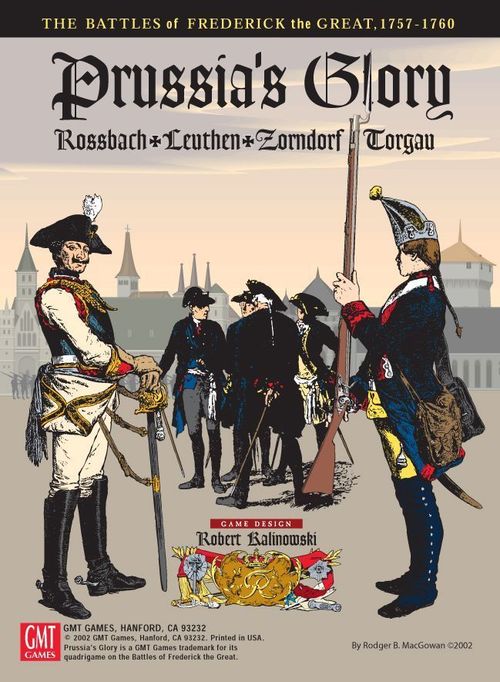
Prussia's Glory: The Battles of Frederick the Great
Prussia's Glory: Scenario Book
Table of Contents
Table of Contents
21. Rossbach
Rossbach, 5 November 1757, saw Frederick decisively defeat an impulsive French/Holy Roman Empire (FrE) flank move by cutting across their line of march in an archetypal oblique maneuver.
21.1 Additional VP Schedule
The FrE player gains 10 Victory Points for having 3 infantry Units in or adjacent to the town of Klein/Grosskayna (1607/1608/1706) OR Reichardtswerben (2604/2605/2606) at game's end. Only one bonus may be claimed. For the Battle scenario, only Reichardtswerben may be counted.
21.2 Victory Conditions
The victor and victory level are determined after the completion of the last turn of the scenario:
- Prussian Decisive Victory: The FrE army is Broken, the Prussian army is not Demoralized, and the differential is +22 or more (historical).
- Prussian Substantive Victory: The FrE army is Broken, the Prussian army is not Demoralized, and the Victory Point differential is +16 or more.
- Prussian Marginal Victory: The FrE Army is Demoralized or Broken, the Prussian army is not Demoralized, and the Victory Point differential is 6 or more.
- FrE Marginal Victory: No other victory conditions met.
- FrE Substantive Victory: The FrE army is not Demoralized, and the Victory Point differential is 6 or less.
- FrE Decisive Victory: The Prussian Army is Demoralized, and the differential is 0 or lower.
21.3 Main Scenario
The scenario lasts from 0830 to 1730 (10 turns).
Prussian Army Information:
- Morale: 14
- Army Activation Cost: 1 pt. first try, free thereafter
- Group Command Ratings (No Specific Groups):
- Inf/Arty: 5
- Cavalry: 5
- Special Leaders:
- Frederick: 5 (Use new marker from PGII, shared with Leuthen)
- Seydlitz: 5C (Use new marker from PGII, shared with Zorndorf)
- Friendly Map Edges: East and North
FrE Army Information:
- Morale: 12
- Army Activation Cost: See 21.4
- Group Command Ratings:
- Inf/Arty: 2
- Cavalry: 3
- Loudon/Saint Germain: 3 (Note — despite their historic "detachment" names, Loudon and St. Germain function as a Specific Group, NOT Detachments)
- (No Special Leaders)
- Friendly Map Edges: South and West
Set Up
FrE player sets up first. Place all Wing Leaders and their Units south of Mücheln, west of row xx23 and north of row 2700, as marked on the map. Prussian player sets up second. Place all Leaders and their Units east of row xx18, north of row 2500, as marked on the map.
21.3.1 No Army Commander: The FrE army has no overall Army Commander. Because of this, no French CdOA is possible. Though the Austrian Hildburghausen was nominally in charge, he had little influence over Soubise's French. Both are treated as Wing Leaders.
21.3.2 Baden-Baden May Command Cav: All FrE cavalry Units within 3 hexes of Wing Leader Baden-Baden may trace command to him as well as their own Wing Leaders.
21.4 Historical Time Pressures/FrE Army Activation
Historical Note: The FrE had been in retreat for a week, and both morale and supplies were low. Although in a good defensive camp, logistics, morale, and, to an extent, the commanders' mercurial thought processes made a decisive move on the Prussians or further retreat toward supplies unavoidable. Similarly, the Prussians needed a quick decision in Germany due to Austrian threats in Silesia, and could ill-afford to let the FrE army retreat and remain at-large. Hildburghausen's almost fatalistic decision to attack (which shamed flighty Soubise into joining, then backing with instant confidence), however ill-founded, was greeted with enthusiasm by the FrE troops. This is reflected as follows:
Each turn, during the Army Activation phase, the FrE player rolls the die. On a roll of 1, they may voluntarily Activate at no cost. If voluntarily Activated, the FrE player can immediately claim up to a +8 morale point bonus if all Units leave their positions and move each turn until any three FrE line infantry Units (non-Croat) are either:
- adjacent to a Prussian Unit and/or
- in or adjacent to a Reichardtswerben hex or a Klein/Grosskayna hex.
The FrE player must have all units move and remain east of the Entrenchments within 5 turns, and adjacent to a Prussian unit or a VP town within 6 turns. Place any unused markers 4 and 5 spaces past the turn in which the FrE activates to note those deadlines (i.e., if they activate in the 9:30 turn, place markers in the 13:30 and 14:30 boxes). If less time is available, the first deadline is 16:30, and the second is 17:30. If all units are not east of the entrenchments after the first deadline movement phase, the bonus is subtracted again, AND the FrE takes an immediate –8 AM penalty. If not adjacent to a Prussian unit or VP town after the second deadline movement phase, only the bonus is subtracted again. This bonus cannot increase FrE morale beyond 18.
Optional Rule – Grognard Bonus Limit: This Bonus cannot increase FrE morale beyond 14.
Design Note: The original max of 18 was a compromise – a very favorable boost to counter historical hindsight, and induce players to reenact the FrE's march, despite its disastrous results. However, a max of 14 is probably truer to history, and will reduce the number of "Bonus steroid-induced" FrE victories.
21.4.3 If the Prussian attacks using Prussian Line infantry (not including the Frei Battalion Unit) before the bonus is claimed, it is no longer available.
21.4.4 Passiveness Penalties: At the end of every Prussian movement phase, and every FrE movement phase that the FrE army does not Advance, roll one die. Armies that are not Activated must still make a Passiveness roll. A Prussian roll of 6 subtracts 2 from Prussian morale. On the first FrE roll of 5 or 6, subtract 2 from FrE morale; thereafter, subtract 2 on rolls of 5, and 3 on rolls of 6. FrE morale may not be reduced below six due to penalties; if reduced to six, ignore any further penalty results. The penalty rolls stop for both sides after the first combat of any sort. Activation by either side does not stop penalty rolls. However, FrE Advance does prevent a FrE roll during that turn.
If attacked by the Prussians before the deadline, the FrE may retain the bonus and all movement restrictions are lifted. If during the FrE Advance, Prussian units cross west of the Entrenchments before all FrE units have crossed east, all FrE units are immediately relieved of the obligation to cross or remain east. If Prussian units move adjacent to the entrenchment line to block FrE exit, those FrE units that cannot exit are exempted from triggering deadline penalties if they move adjacent to the blocking Prussian units (to the maximum allowed by stacking limits) and attack those blocking units. Any remaining units which, due to stacking limits, cannot get adjacent to blocking Prussian units, must still move as far as possible in an attempt to cross the nearest unblocked portion of the entrenchment line in the honorable spirit of these Advance rules. FrE units in Routed status are temporarily exempted from triggering the deadline penalties; such units that rally to Dis or Formed status must resume eastward movement in the honorable spirit of these Advance rules unless Prussian units are west of the entrenchments per above.
The simple intent of all the above is this—if the FrE player takes the bonus, he is expected to move to attack the Prussian army, or reach a VP town. FrE players that take the bonus, then attempt to avoid battle, must live with their guilty consciences, and ruined reputation among fellow wargamers, forever more!
If the FrE don't get their units all east of the trench line by the deadline, subtract the -8 AM bonus, and they suffer a -8 AM penalty beyond that for a total of -16 AM. If they clear east of the line, but aren't adjacent to a Prussian unit or VP town, only subtract the bonus, -8. If they don't make the first or the second deadlines, they suffer the -16 penalty only; they don't suffer the second deadline penalty.
21.4.1 The FrE player must state they will voluntarily Activate and advance to claim the bonus. If they do not Activate on a turn, the bonus is potentially available each subsequent turn they roll a 1.
21.4.2 If FrE AM is 7 or less at the start of the Army Activation phase, the FrE may always voluntarily Activate and Advance; no die roll is necessary. The automatic activation/bonus can also be claimed if Prussian units move within three hexes but do not attack in that player turn.
21.5 Battle Scenario
Strongly favors the Prussians; for historical record only. This scenario begins at 1430 and ends at 1730 (4 game-turns). Use the set up hexes printed on the counters. Coalition artillery may not be placed on top of a stack. All values from 21.3 apply, except Prussian Army Morale starts at 10.
21.5.1 Mandatory Movement: On turn 1, all Soubise/Hildburghausen Units and artillery must march 3 hexes in as straight lines as possible toward Reichardtswerben, hex 2606. Units must remain stacked in the same order. Baden-Baden, Loudon, and Saint Germain follow normal Command and movement rules. Units move three hexes even if in Degraded Command status.
21.5.2 Prussian Surprise: The Prussians caught most of the FrE army in Column. On turn 1, add +3 DRM to all Prussian artillery bombardments and Close Combats, and subtract –3 from all FrE artillery bombardments and Close Combats.
21.5.3 Rules 21.3.1, 21.3.2 and 21.4 still apply.
21.6 Main Scenario Variant—Hildburghausen In Charge
Design Note: This assumes FrE Command functioned as intended.
Hildburghausen is considered the FrE Army Commander (Initiative 3) as well as an FrE Wing leader. While Hildburghausen is the Army Commander the Base Infantry Rating is increased to 3. Hildburghausen has no second in command. If he is eliminated, replace him with a standard replacement leader and drop the Base Infantry Rating back to 2.
ACTIVATION: It costs 1 AM to attempt Normal Activation. Hildburghausen may make a Normal Activation and still claim the Advance Bonus. If Hildburghausen does not choose to attempt Activation on a turn, make Passiveness rolls as normal.
Quick Start Set Up Errata
Rossbach: Change the Aust Croats & Croats set up hexes to 2124, bump the Aus Hus, 69 Hus, Szhny Hus west to 2125.
Counter Errata
Rossbach: On the French Cav 25 Penthrve unit, the morale on the back should be 3, not 5.
22. Leuthen
On 5 December, 1757, Frederick's flanking approach achieved almost complete surprise and gained his most famous victory against Prince Charles' Austrian army.
Design Note and Thanks: Special Thanks to PG fan Norbert Moehring, for his analysis and thought in proposing enhancements to the Leuthen scenarios, accepted and included below.
22.1 Victory Conditions
There is no additional VP schedule for this scenario. The victor and victory level are determined after the completion of the last turn of the scenario:
- Prussian Decisive Victory: The Austrian army is Broken, the Prussian army is not Demoralized, and the Victory Point differential is +24 or more (historical).
- Prussian Substantive Victory: The Austrian army is Demoralized, the Prussian army is not Demoralized, and the Victory Point differential is +14 or more.
- Prussian Marginal Victory: The Austrian army is Demoralized, the Prussian army is not Demoralized, and the Victory Point differential is +6 or more.
- Austrian Marginal Victory: No other victory conditions met, and the Austrians either a) occupy any two Leuthen hexes, or b) have more Victory Points than the Prussians. (Design note: These tightened conditions will serve to negate any wormy Austrian "run away" strategy seeking a non-fighting marginal victory.)
- Austrian Substantive Victory: The Prussian Army is Demoralized, and the Victory Point differential is +6 or less.
- Austrian Decisive Victory: The Prussian Army is Demoralized, and the Victory Point differential is 0 or lower.
22.2 Main Scenario
The scenario lasts from 0700 to 1700 (11 turns).
Prussian Army Information:
- Morale: 18
- Army Activation Cost: Already Activated
- Group Command Ratings:
- Inf/arty: 5
- Cavalry: 4
- Special Leaders:
- Frederick: 5 (Use new marker from PGII, shared with Rossbach)
- Driessen: 5C (Use new marker from PGII)
- Friendly Map Edges: West and South
Austrian Army Information:
- Morale: 24
- Army Activation Cost: 2 pts.
- Group Command Ratings:
- Inf/arty: 2
- Cavalry: 4
- Arenberg Reserve Wing: 3
- Nadasdy Wing: 4
- Detachment (Advance Guard Wing): 4
- (No Special Leaders, but see 22.4)
- Friendly Map Edges: See 22.2.4
Set Up
Austrian player sets up first. Army Wing leaders must be placed within 1 hex (Nostitz 5 hexes) of the following hexes:
- Lucchese: 2008
- Kheul-Starh: 2309
- Arenberg: 2607
- Col/Wied/Hal: 2910
- Serbelloni: 3310
- Nadasdy: 3710
- Nostitz (Detachment): Within 5 hexes of 2519
Units are set up within 3 hexes of their leaders, with up to 3 artillery Units per Wing. Nadasdy and Serbelloni may only have one artillery Unit deployed amid both their wings Units, and the Nostitz Detachment may not have any artillery.
The Prussian player does not set up on map (see 22.2.2).
22.2.1 Austrians may not attempt Normal Activation until the 0900 turn. Historical Note: Charles took the Austrian army out of a good position and marched west for battle; commentaries note the advance created substantial confusion which lasted through the night, dampening staff notions of attempting further army movement the next morning, which (it is presumed) would not start smoothly.
22.2.2 Prussian Entry: On any turn, the Prussian player may enter any number of Wings with up to three artillery per Wing via any of the Neumarkt entry zone hexes marked on the west center edge of the map. Units are considered Effective and In Column on the turn of entry, and pay one hex to enter the map. Units/Wings may enter on different turns and any entry hexes.
22.2.3 Morning Fog: From 0700-0800, LOS is limited to three hexes.
22.2.4 Austrian Friendly Map Edges: Treat the town of Leuthen as the friendly map edge until the Austrian army is Demoralized. All Austrian Units retreat toward and into the closest Leuthen hex, then continue toward the east edge. After Austrian Demoralization, routed Units retreat directly toward the East map edge.
22.2.5 Nadasdy: Infantry Wing Leader Nadasdy may apply his MM to Sweeping Charge attempts.
22.2.6 Frozen Streams: Treat all stream hexsides as clear hexsides, and ignore all additional movement costs/combat drms for them on the TEC and CRT.
22.3 Battle Scenario
This scenario begins at 1300 and ends at 1700 (5 game-turns). Use the set up hexes printed on the counters. Prussian Wing Leaders are set up with any Unit from their Wing, and Frederick may be stacked with any Prussian Unit. Rules 22.2.4, 22.2.5, and 22.2.6 apply, and all values from 22.2 apply, except Austrian Army Morale starts at 21. The Sax Chv KB and Hus 11/34 Austrian Units do not start at full strength, and start on the step marked with a set up hex.
Historical Note: These Units took losses in a morning skirmish around Borne, when Nostitz' troops were overrun in the fog by the powerful Prussian Advanced Guard.
22.4 Main Scenario Variant—Daun in Charge
Historical Note: Charles had drawn steady criticism all year as commander, and many hoped he would step down; his insensitivity and privileged position kept him in charge. Assume the monarchy was less tactful and Charles less stubborn; dispatches arrive the night before battle; Charles is recalled, Daun takes over.
Use the Daun 4 * 2-6 counter from the Torgau game in place of Charles. Increase Basic Inf/arty Command Rating to 3, Austrian AM to 26. Austrian may attempt Activation starting on the 0700 turn. If using this optional rule, or if Daun takes over from Charles, Daun becomes a Special Leader. Use the new marker from PG II (shared with Torgau).
Counter Errata
Leuthen: The Prussian Cavalry Command Effectiveness Counter should have a range of 1-4, not 1-5. Degraded range should be 5-6, not 6.
Map Errata
Leuthen: The time in the turn 3 box should read 0900, not 0800.
23. Zorndorf
Zorndorf, fought in blistering heat on 25 August 1758, was the most savage battle in the Seven Years War.
23.1 Additional VP Schedule
The Prussian player gains two VP for routing the Russian Light Baggage the first time.
23.2 Victory Conditions
The victor and victory level are determined after the completion of the last turn of the scenario:
- Prussian Decisive Victory: The Russian army is Broken, the Prussian army is not Demoralized, and the Victory Point differential is +30 or more.
- Prussian Substantive Victory: The Russian army is Demoralized, the Prussian army is not, and the Victory Point differential is +16 or more.
- Prussian Marginal Victory: Russian Army morale is 6 or less, and the Victory Point differential is greater than 0 (historical result).
- Russian Marginal Victory: No other victory conditions met.
- Russian Substantive Victory: The Prussian Army is Demoralized, and the Russian army is not.
- Russian Decisive Victory: The Prussian Army is Demoralized, the Russian Army is not, and the Victory Point differential is –12 or lower.
23.3 Main Scenario
The scenario lasts from 0300 to 1900 (17 turns).
Prussian Army Information:
- Morale: 47
- Army Activation Cost: 1 pt. first try, free thereafter
- Group Command Ratings:
- Inf/arty: 4
- Cavalry: 4
- Dohna Wing: 2
- Special Leaders:
- Frederick: 4I (Use new marker from PGII, shared with Torgau)
- Seydlitz: 5C (Use new marker from PGII, shared with Rossbach)
- Friendly Map Edges: See 23.3.3
Design Note: Dohna, assigned the 'refused wing', seems to have embraced his role whole-heartedly, and did not move to engage until Frederick personally prodded him.
Russian Army Information:
- Morale: 56
- Army Activation Cost: 3 pts. first try, 1 thereafter
- Group Command Ratings:
- Inf/arty: 3
- Cavalry: 3
- Browne Wing: 2
- (No Special Leaders)
- Friendly Map Edges: See 23.3.3
Design Note: Browne, though a solid division leader, was here saddled with the Observation Korps — second line garrison and territorial troops who were already half spent, having only reached the field at 3 a.m after a night march.
23.3.1 Broad Historical Set Up:
Prussian player sets up first. Manteuffel and his Units must be placed within 1 hex of 3215. Seydlitz and his Units must be placed within 3 hexes of 3215. All remaining Units and Leaders along with all artillery are placed along the 3 start lines on the map.
Russian player sets up second. Place the Wing Leaders on the map first. Browne must be placed within 1 hex of 2212, one other Infantry Wing Leader (Saltikov or Golitzin) must be within 2 hexes of 2108, and the last is placed within 2 hexes of 2210. One Cavalry Wing Leader (Demiku or Gaugreben) is placed within 2 hexes of 2217, the other within 2 hexes of 1809. After placing leaders, all Units are placed within 3 hexes of leaders, with the Light Baggage being placed with an Infantry Wing. Artillery may be placed with any Infantry Wing.
23.3.2 Free Set Up:
Play Note: This option may markedly benefit the Russians.
Prussian player sets up first. One Wing leader may deploy within three hexes of 3215. All other Wing Leaders deploy anywhere north of the Mietzel river. Units are placed within 3 hexes of their Wing Leader, with all Artillery stacked with any Infantry Unit.
Russian player sets up second. All Wing Leaders are placed anywhere south of the 2500 hex row, east of the Mietzel River, and west of or in Gross Cammin, with Units placed within 3 hexes of their leaders and artillery placed with any Infantry Wings.
23.3.3 Friendly Map Edges: Depending on set up and maneuver, the armies could end up engaging each other in any direction. Use the closest map edge directly opposite the enemy's main line; i.e., if the Prussians are advancing from the east, the Russians should rout west; and the Prussians east. Let Honor and common sense prevail!
23.3.4 Additional Army Morale Changes: Fatigue Rules (Series rules 12.3) are in Effect for all Zorndorf scenarios. NOTE: These Fatigue Rules are now contained in the standard Series Rulebook.
23.3.5 Russian Light Baggage: All Units pay +1 MP per hex they enter adjacent to the Light Baggage, and may not move through or stack with it. It is treated as infantry for movement and command purposes, and may trace command to any friendly leader. If the Light Baggage takes a Loss Point, it always routs. It may be routed repeatedly, but never eliminated or captured until it Routs off map. It cannot be rallied, can never attack, cannot go In Column and is Parenthesized (7.2.5).
Historical Note: The light baggage consisted of 2000+ wagons in a confused mass; the counter represents its center, but congestion was heavy throughout its vicinity.
23.3.6 Mietzel River: All Units must be In Column to cross the Mietzel River. Unless crossing at the bridge, all non-In Column Units (including Routs) must stop when moving adjacent, and go no further.
23.3.7 Prussian Unit Exhaustion: Many Prussian infantry and cavalry Units have parenthesized combat strengths on their last step (see 7.2.5).
Historical Note: After 17 exhausting hours, Prussian Units essentially ignored orders for a final attack.
23.3.8 Russian Cossack Stacking: All Russian Cossack Units count as double their step number for stacking and Engaged purposes. That is, a full strength (2 step) Cossack Unit should be treated as 4 steps for stacking and Engaged purposes.
23.4 Battle Scenario
This scenario begins at 0900 and ends at 1900 (11 game-turns). Use the set up hexes printed on the counters. All Wing Leaders may be set up with any Unit from their Wing, and the Army Commanders may be set up with any friendly Unit. The Prussian player uses the values from 23.3, except Army Morale begins at 34 and the west and south map edges are considered friendly. The Russian player uses the values from 23.3, except Army Morale begins at 46 and the north and east map edges are considered friendly. Rules 23.3.4 through 23.3.8 still apply.
24. Torgau
Torgau, fought in icy rain 3 November 1760, pitted Frederick against archrival Marshal Daun in the war's bloodiest battle.
24.1 Additional VP Schedule
The Austrian player loses 10 points if at game's end, the Army Commander (if surviving) and 5 Wing Leaders cannot trace a path free of EZOC to any Torgau hex.
Historical Note: The Torgau bridges were the Austrians' retreat path in case of defeat; they had already sent their baggage train across the Elbe that morning. The intent of the specific Victory Points is to discourage "hedgehog" defenses that disregard supply realities, and keep the Austrian respectful of the withdrawal route (as Daun and O'Donnel no doubt were).
24.2 Victory Conditions
The victor and victory level are determined after the completion of the last turn of the scenario:
- Prussian Decisive Victory: The Austrian Army is Broken, the Prussian Army is not Demoralized, and the Victory Point differential is +20 or more.
- Prussian Substantive Victory: The Austrian Army is Demoralized, the Prussian Army is not, and the Victory Point differential is +10 or more.
- Prussian Marginal Victory: The Austrian Army morale is 6 or less, and the Prussian Army morale is higher than the Austrian Army morale (historical result).
- Austrian Marginal Victory: The Prussian Army morale is 6 or less, and Austrian morale is higher than the Prussian Army morale.
- Austrian Substantive Victory: The Prussian Army is Demoralized, the Austrian Army is not, and the Victory Point differential is 0 or less.
- Austrian Decisive Victory: The Prussian Army is Demoralized or Broken, the Austrian Army is not, and the Victory Point differential is –12 or less.
24.3 Main Scenario
The scenario lasts from 0600 to 1800 (13 turns).
Prussian Army Information:
- Morale: 28
- Army Activation Cost: 1 pt. first try, free thereafter
- Group Command Ratings:
- Inf/arty: 3
- Cavalry: 4
- Special Leaders:
- Frederick: 4I (Use new marker from PGII, shared with Zorndorf)
- Friendly Map Edges: South, West and North
Austrian Army Information:
- Morale: 21
- Revised Start Morale (recommended): 24
- Army Activation Cost: See 24.3.1
- Group Command Ratings:
- Inf/arty: 3
- Cavalry: 4
- Lascy Wing: 4
- Detachments (up to 3): 4
- Special Leaders:
- Daun: 4 (Use new marker from PGII, shared with Leuthen)
- Friendly Map Edge: See 24.3.2
Design Note: Setting Austrian AM for Torgau was a thorny challenge, as Daun's wound and departure from the field had a significant impact on the Austrian command's confidence and resolution to "stick it out." The original start AM level "factors in" Daun's wound and its effect on Austrian morale as a sure thing. But since PG's release, enough Torgau game outcomes have been reported to show this start AM was probably low. Players are free to use the original value, but the revised value of 24 should represent the Austrians in a more tenacious light.
Set Up
Austrian player sets up first. The Austrian player may have up to three Detachments, set up in any hexes north of the 34xx hex row, as marked on the map. The detachments can include Ried, any of his Units and Drg 31. The Units in a detachment must be stacked or adjacent, and there must be 3 hexes between the closest Units of different detachments. After setting up detachments, all remaining Units and Leaders (except Lascy, his Units and artillery Unit 6) are placed within the box noted on the map.
Design Note: Austria's 60 excellent 12 lb and 300+ 6 lb howitzers and regimental guns gave devastating fire. The counters depict 210 cannon; for playability, the other regimental guns are folded in those weightier infantry Units.
Prussian player does not set up Units on map. All Units must enter via the Langenreichenbach entry zone. The Army must Activate and roll for command as usual, and Units pay 1 hex or MP to enter the map. Wings may be placed In Column if Effective while off map. Units/Wings may enter on different turns and any entry hexes.
24.3.1 Austrian Activation Costs: If Lascy's Wing (24.2.2.3) has not arrived, Normal Activation costs 4 AM. If Lascy's Wing has arrived, Normal Activation costs 3 AM. Any Activation from a CdOA always costs 2 AM, regardless of Lascy's presence.
24.3.2 Austrian Friendly Map Edges: Depending on set up and maneuver, the armies could end up engaging each other in multiple directions. Retreat Units away from the enemy line that caused their retreat. Again, Let Honor and common sense prevail!
24.3.3 Lascy's Wing: At the start of Austrian Command Determination each turn, the Austrian player rolls the die to determine if Lascy's Wing arrives. When his entry is rolled, place the Wing and artillery Unit 6 in any Torgau hex.
| Turn | Lascy Enters on |
|---|---|
| 0600 | 1 |
| 0700 | 1-2 |
| 0800 | 1-4 |
| 0900 | 1-5 |
| 1000 | Automatic |
Lascy is Effective on turn of arrival and may move on the first turn without need to attempt Austrian Army Activation. Thereafter, Lascy's Wing may not move until Army Activation.
24.3.4 All Detachment Units can trace command to Ried, including Drg 31.
24.3.5 Austrian SP Limits: Austrian infantry can count a total of 9 SP in Close Combat, in an exception to 19.3.
24.3.6 Prussian Freikorps Stacking: The Prussian Freikorps cavalry units (Friekorps Dragoons and Friekorps Hussars) count as double their step number for stacking and Engaged purposes.
24.3.7 Optional Rule – 1900-2000 night turn.
Historical note: Though the major efforts were spent by 1900, further dwindling, confused actions continued to about 2100. At the cost of some additional complexity and time, players may enact these last hours as well.
Upon mutual agreement, players may play an additional turn representing the 1900 and 2000 hours. Use all normal rules with the following adjustments:
- Artillery may fire at adjacent units only
- Add +1 to all Command and Rally rolls, in addition to any other adjustments.
- All IC movement rates are halved from the standard Effective or Degraded rates (round up).
24.4 Battle Scenario
This scenario begins at 1400 and ends at 1800 (5 game-turns). Use the set up hexes printed on the counters. All Wing Leaders may be set up with any Unit from their Wing, and the Army Commanders may be set up with any friendly Unit.
The Austrian Drg 31 is not used in the battle scenario. The 2 step artillery Units may be placed in any hex containing infantry Units, no more than 2 per hex.
The Prussian Army uses all values from 24.3, except that Army Morale starts at 27 and only the south and north map edges are friendly. The Austrian Army uses all values from 24.3, except that Army Morale starts at 23. Use rule 24.3.2 to determine friendly map edges again. Rules 24.3.4 through 24.3.6 still apply.
24.4.1 Prussian reinforcements: On the 1500 turn, artillery Units 3, 4, and 5 enter at hex 1110. They must pay 1 MP to enter the map.
Counter Errata
Torgau: Prussian units: Change the entry hex for the following artillery units from 1510 to 1015: Br, 7/10Hw, and Br/Hwz.