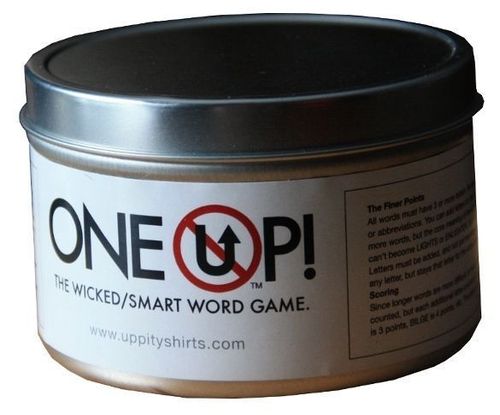
One Up!
One Up! How to Play Rules
Table of Contents
Table of Contents
Opening
The object of One Up! is to have the most words/highest letter count at the end of the game. To achieve this, each player makes words from the letters turned over in the center of the playing area, and/or by stealing words from other players. How does one go about that? You've got to be whip smart, and have good reflexes of course. But there's a lot of nuance involved, too. Let us explain.
First, catch your hare. Just kidding. Open your One Up!, empty all the tiles onto a flat playing surface, and then turn all of the tiles face down. For the sake of argument, let's say there are 4 people playing this game of One Up!: Player 1, Player 2, Player 3, and Player 4. Each player will take a turn flipping over 1 tile at a time while all players try to call out words from the letters that have been turned over. Since each word must be at least 3 letters long, the first player, and the first player only, turns over 3 tiles to start the game.
In this case let's say Player 1 (chosen randomly), goes first and turns over 3 tiles. The tiles are: A, T, R. Player 2 immediately shouts out "ART", takes the 3 tiles from the center to make the word ART, and places that word in front of him. Play continues: Player 2, who is to Player 1's left, turns over another tile in the center, this time an "S". Player 3 yells "TARS" and takes the word ART away from Player 2 and makes the word TARS for himself.
Any player can steal any other player's word(s) at any time during the game by adding at least one letter to it, and changing the core meaning of the word. (You can also "steal" your own word by adding a letter to it.) Player 3 couldn't have called out "ARTS" in the above example even though it adds a letter to Player 2's word, because it doesn't change the essential meaning of that word.
Turning over tiles in turn now continues clockwise – Player 3 turns over a letter "Z". Since no one can make a new word with only one letter, and since the Z cannot be added to TARS to make a new word, play continues.
Player 4 turns over a tile and it's the letter "A". No one can make a word, so play continues. Player 1 is next and turns over the letter "P". Player 4 shouts out "ZAP" and places that word in front of him.
Player 2 is up so he turns over an "M" and he immediately shouts out "SMART" and takes Player 2's TARS and forms the word SMART. (Editor's note: the sheet reads "Player 2's TARS", but TARS was made by Player 3 earlier in this example; transcribed as printed.)
Play continues, with all words in play at all times. The key to winning is to always be on the lookout for letters that can be added to existing words, as well as keeping an eye on the tiles in the center to make a new word.
Remember: proper names, abbreviations and foreign/slang words are not allowed. You can combine 2 or more words to form a new word, but you must also add a letter(s). And the core meaning of a word must always change when forming a new word.
Sample Game (About Halfway Through)
The sheet shows the following sample game. Layout as printed (Player 1 at the top, Player 2 on the right, Player 3 at the bottom, Player 4 on the left):
- Top (Player 1 seat): MARTIANS; DIME
- Right (Player 2 seat): STAND; TROOP; DEBUT; YULE
- Bottom (Player 3 seat): PLAZA; FROGGY
- Left (Player 4 seat): SLUMP; HOKEY; FOES, where the Uppity tile (circled in red on the sheet) stands in for the "E"
- Center (5 tiles turned over): J, D, U, W, B
We can see that Player 3 stole Player 4's ZAP and made PLAZA with it. We can also see that Player 1 stole Player 2's SMART and made it into MARTIANS. (We only have 5 tiles turned over in the center as an illustration of the state of the game; all the other tiles that aren't turned over at this point aren't shown.)
Note that Player 4 has a weird-looking tile that is being used as the letter "E" in the word FOES. It's the Uppity tile, which is kind of like a wild tile and can be used as any letter, at any time. So we could, in the above situation, call out the word FLOWS and steal FOES by changing the Uppity tile to an "L", taking the "W" from the center (remember we always have to add a letter when stealing a word) and make FLOWS. The Uppity tile would then be an "L", but could be changed to any other letter on a subsequent steal. This is known as the "Kastner Rule."
We can also see from the above example that someone could call out the word "BUD". Another possible play is to add the "B" to SLUMP to form PLUMBS.
You get the idea. Play continues like this until all the tiles in the center are turned over and all words that can made from them, are. There may be tiles in the center that cannot be used – these are not counted.
To add up the score, each player removes one letter from each of his words, and then counts the remaining letters, which are each worth one point, except the Uppity tile, which is worth 4 points. The person with the highest score wins.