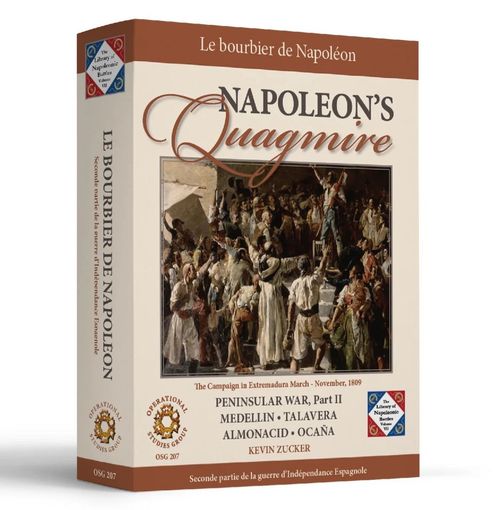
Napoleon's Quagmire
Napoleon's Quagmire — Study Folder
Table of Contents
Table of Contents
Game Components
- 2 Map Sheets 34" x 22" and 2 Map Sheets 17" x 22"
- 2 Counter Sheets: 560 die-cut playing pieces
- 2 Booklets: System Rules, Study Folder
- 15 Player Aid Cards: TRC x5, Initial Set-up x5 (French x2, British x1, Spanish x2), Casualty x2, Combat Results, Reorganization, Weather
- 2 Decks of 50 Cards each
- Adding the Cards Folder, 11" x 17"
- Combat Tables Folder, 11" x 17"
- Orders Slip Sheet/Sequence of Play
- Victory Worksheet
- Cards Removed from Deck/Scenario Parameters
- Game Box
25.0 Scenarios
The Year 1809 began with Napoleon's departure from the Iberian Peninsula, to face the Austrian threat on the Danube. He left his brother, Joseph, in nominal command of his armies in Spain, as puppet king in Madrid. Fighting flared on several fronts simultaneously, and the French occupation had some successes, notably at the siege of Saragossa, concluded by Marshal Lannes just before his departure to join the Emperor. However, the Napoleonic magic could not work at such distances. A dispatch took twenty days to travel the 2,500 km from Vienna to Madrid and generally arrived out of date. A series of battles were fought during the course of the year along the approaches from Portugal to Madrid, where Arthur Wellesley had just arrived with a small British Army to second the Spanish Armies of Extremadura and La Mancha.
25.1 The Scenario Information
Napoleon's Quagmire includes four Battle Games and one Campaign Game, plus the combat of Aranjuez as a bonus game. Players select a game to play, and then refer to the Initial Set-up Cards (25.21) and the appropriate section, listed below, for the scenario information for each game:
- 27.0 MEDELLIN, 27-28 March
- 28.0 TALAVERA, 27-28 July
- 29.0 BONUS BATTLE ARANJUEZ, 5 August
- 30.0 ALMONACID, 10-11 August
- 31.0 OCAÑA, 18-19 November
- 32.0 CAMPAIGN GAME
25.11 Turn Record Card (TRC): For each Battle a TRC is provided. The Game-Turn marker is placed on the turn designated as the Game Start.
25.12 One-Day Scenarios: Players are encouraged to begin by playing any of the one-day Battle Games (Day of Battle, DoB). Aranjuez includes no Day of Battle scenario.
25.13 French Nationalities: The French Player controls units of French (blue), Polish (crimson), Baden-Nassau (grey-green or feldgrau), Hessian-Rheinbund (gray), Dutch (orange), and Westphalian (blue-green) nationalities. Joseph's Royal Guard is dark blue.
25.14 Coalition Nationalities: The Coalition Player controls British (red), King's German Legion (dark red), Portugese (wine red), and Spanish (white) units.
25.15 French Player Units with Mixed Nationalities: Guye, Corbalan and Jamin are mixed units of French and Swiss or Spanish troops. Ormancy, Porbeck, Kruse, Paris, Briche and Schäffer are also of mixed nationality. The second nationality is indicated by the color inside the unit type symbol.
25.16 Cavalry Brigades with Disparate Vedettes: French IV Corps Vedettes brigade differently over time. These are listed in the battle scenario information.
25.17 Coalition Commanders: Cuesta (MED, TAL), Venegas (ARA, ALM) and Areizaga (OCA) are the Spanish Commanders. Cuesta may not place officers or units of the Anglo-Allied Army in command nor give them a March Order. Wellington/Wellesley may not command or give a March Order to units belonging to either of the Spanish Armies.
- Non-Cooperation: Units of the Spanish and Anglo-Allied armies cannot stack together or combine in an attack. If units from both nationalities are adjacent to a single French stack, only one of them can be subject to 10.31. The other stacks remain "in contact."
- General Retreat declaration may apply to either the Spanish or the Anglo-Allied army, or both, at the Coalition player's option. The Coalition Player may declare General Retreat one time for the Spanish and once for the Anglo-Allied army per game.
- The Spanish and Anglo-Allied armies have entirely separate supply sources, labeled (S) and (A) respectively. Spanish units may not trace to Anglo-Allied supply sources, and vice-versa.
25.18 Wellesley's Anglo-Allied Army of Portugal: British regulars, King's German Legion, Portugese and one Spanish unit (Pérez) appear at Talavera. The Pérez Spanish infantry brigade is part of the Anglo-Allied Army and is an exception to 25.17.
25.19 Spanish Armies: Spanish forces comprise two separate armies. The formation stripes of the Army of Extremadura are in dark colors with white type and yellow initiative boxes; the Army of La Mancha (later renamed Army of the Center), has light colors with black type. Four units of the Vanguard Division (Enriquez, Solano, Hernandez, Vanguard arty.) appear at Ocaña and are considered part of the Army of La Mancha/Center for that battle.
25.2 Setting Up the Scenarios
All units set-up in Supply as Hidden Forces (8.2). All reinforcements are in supply upon entry (25.5). Units may start in Road March at the owning player's option.
25.21 Initial Set-up: The units to set-up are listed on the Initial Set-up Cards. The First Player (26.6) sets up first. The Initial Set-up specifies the location for each unit. This may be modified by Mode Cards (24.5). The units to set-up at reduced strength are listed with an ®. They are treated as having been eliminated and already reorganized. "Composition" and "Comments" are for historical interest.
25.22 Hex Numbers: The hex numbers on the Initial Set-up cards show where units are located at the start of the scenario. Place all combat units and leaders on the map in the hexes specified. If there is no hex number listed, the unit is not placed in the PEU box, but is out of play; or, may be ALT (25.51). The second player may adjust any one friendly unit by one hex prior to the first player turn (not in an EZOC). The set-up may include overstacked hexes. Make sure to observe stacking limits on your first move.
25.23 Reinforcements (19.1, 25.5): Reinforcement arrival is listed on the Turn Record Card as modified by the play of Arrival Cards (24.7). If the Corps designation follows an officer's name, all units of that corps arrive on the same turn (25.53). If a division is listed, all units of that division arrive on the same turn.
25.24 Pontoon Trains: Availability of pontoon trains is specified in the scenario information. Available Pontoon Trains must be set-up within [7] hexes of any friendly Commander unless otherwise specified.
25.25 Baggage Trains: All Baggage Trains set-up within [7] hexes of any unit in their respective formation or enter as reinforcements (25.26), unless otherwise specified. Each French corps has its own dedicated baggage train. The Anglo-Allied Army baggage train provides supply for the entire Army of Portugal. Each Spanish baggage train provides supply for up to FIVE formations. The baggage train to use is specified in the Scenario information (after the Alternate Reinforcements).
25.26 Train Reinforcements:
- If a train is mentioned in the reinforcement schedule it enters as specified.
- If an entire formation is listed as a reinforcement on a single turn, the baggage and pontoon trains arrive after all combat units.
- If a formation arrives over several turns, the trains arrive at owner's choice of time.
- If part of the formation sets-up on map and part arrrives later as a reinforcement, trains set up or arrive with either group at owner's choice.
25.27 Leaders: Leaders set-up in the hex specified, or, at owning player's choice, Commanders may set-up with any Friendly force—Officers in any hex containing units of their Formation—in supply and not in an EZOC. Leaders ignore Mode Cards unless specifically mentioned. Leader cards may be played as "inapplicable" (24.35) prior to the named leader's arrival.
25.28 Vedettes: Vedettes may be deployed at the beginning of a scenario at the owning player's choice, anywhere within three hexes of their parent unit (not in an EZOC). The second player deploys all available vedettes first, then the first player deploys.
25.29 Joseph Bonaparte: This commander-officer can ether place his own Reserve in command, or place a French Officer in command, at TAL, ARA and ALM.
25.3 Forces at a Glance
Key: H = in play. • = Not Available, or may be ALT. (part) = part of formation only. Forces at Aranjuez are identical to ALM (29.1).
25.31 French Forces
| Corps | MED | TAL | ALM | OCA |
|---|---|---|---|---|
| I | (part) | H | • | • |
| IV | (part) | H | H | (part) |
| V | • | • | • | H |
| 1 Cav | H | H | • | • |
| 3 Cav | • | H | H | H |
| Res | • | H | H | H |
25.32 Coalition Forces
Spanish Army of Extremadura (yellow initiative box)
| Corps | MED | TAL | ALM | OCA |
|---|---|---|---|---|
| Van | (part) | (part) | • | • |
| 1 | H | H | • | • |
| 2 | H | H | • | • |
| 3 | H | H | • | • |
| 4 | • | H | • | • |
| 5 | • | H | • | • |
| Adl | H | • | • | • |
| 1 Cav | • | H | • | • |
| 2 Cav | • | H | • | • |
Spanish Army of La Mancha / Army of the Center
| Div | MED | TAL | ALM | OCA |
|---|---|---|---|---|
| Van | • | • | • | (part) |
| 1 | • | • | H | H |
| 2 | • | • | H | H |
| 3 | • | • | H | H |
| 4 | • | • | H | H |
| 5 | • | • | H | H |
| 6 | • | • | • | H |
| 7 | • | • | • | H |
| Cav | • | • | • | H |
British Army of Portugal
| Div | MED | TAL | ALM | OCA |
|---|---|---|---|---|
| 1 | • | H | • | • |
| 2 | • | H | • | • |
| 3 | • | H | • | • |
| 4 | • | H | • | • |
| Cav | • | H | • | • |
| Ind | • | H | • | • |
| Res | • | H | • | • |
25.3 (continued)
25.33 Utility Markers: Counter Sheet #2 contains the Utility Markers for use with all games in the Library of Napoleonic Battles. Utility Markers are Road Block (25.72), Late Start, Garde Recule, Fire, Smoke, Reinforcements Delayed, Casualty Level Markers, Square, Out of Supply, Overrun, Control, Repaired Bridge, I.P., Road March, Out of Command, In Command and Repulse. The use of these markers is explained below or in the Series Rules Folder.
- Casualty Level Markers: Each Corps or division has a marker with its formation i.d. These markers are placed on the Demoralization Track to record Casualty Levels instead of using the first eliminated combat unit of each corps (21.1).
- Late Start: Use the marker on all unawakened Commanders (Card No. 2, Late Start). The reverse side denotes Commanders and officers who are unable to provide command while Reorganizing.
- Garde Recule: When Guard units suffer the results of "Ae," "Ar," or "Ex" (11.3) place on the Casualty level marker of every corps that was affected by the guard retreating (25.76).
- Reinforcements Delayed: applies to forces that are subject to Card No. 27, Delay—March Confusion, etc.
- Square Marker: Place the square marker on any infantry unit that was successfully charged to denote increased movement costs.
25.4 Scenario Information Detail
The following information is provided in 27.0—32.0.
25.41 Duration: The game ends with the completion of the last turn specified under "Duration," or may end immediately when all the formations of one side are demoralized or have exited. The Level of Victory still has to be determined (26.2).
25.42 Mode Cards at Start: The number of Mode Cards to draw on the first turn only.
25.43 Remove Cards from Deck: Before play begins remove specified number of cards from each Player's card deck (24.2). See separate list per Battle. On the reverse side is Scenario Parameters. This sheet is a summary of all the info you need to play, for all the battles, in one place.
25.44 Bonus Cards: On the second turn of each battle, each player draws a number of Bonus Cards specified for that battle. If playing the campaign, at the end of each battle, each player draws a number of Bonus cards determined by victory level (26.5).
25.45 Alternate Reinforcements (ALT): (25.51)
25.46 Special Rules: Rules that apply to this battle; at start conditions and map area in play. Spain-Specific Rules (25.7, 25.8) apply to all battles.
25.47 Victory Conditions: Victory Points (26.1) are awarded for control of places on the map. Certain VP locations that do not count in a battle may be listed.
25.5 Reinforcements
Reinforcement units (19.1) are placed on the Turn Record Cards, and enter at the mapedge hex specified on the TRC. All units of the formation enter on the same turn unless listed separately, subject to card play, depending on size of formation for multi-hex forces (25.53). When a Division is listed, all units with that divisional designation arrive on the same turn (25.23).
25.51 Alternate Reinforcements (ALT): ALT Reinforcements are listed in the Scenario Information by group number. One numbered group of friendly ALT Reinforcements appears for each Alternate Reinforcements Card (No. 29) played. ALT groups must appear in order of priority starting with #1. Each time an ALT group enters, the enabling card is removed from play after being scored (26.16). ALT reinforcements enter at a reinforcement entry hex or Supply Source of the same army. At Talavera Spanish ALT Reinforcements arrive at the Spanish S/S and British ALT at the Anglo-Allied S/S.
If not using the cards—roll two d6 during the Command Movement Segment of every Recovery Turn: on a result of 2 or 3, you may enter the next group of Alternate Reinforcements listed; if you roll a 4–12, there is no result. If you roll a 2 or 3, your opponent can roll 2d6 to delay by one turn the alternate reinforcements; the delay is successful if he also rolls a 2 or 3.
25.52 Hidden Reinforcements: All Reinforcements enter the map as Hidden Forces. Vedettes may enter instead of their parent LC units.
25.53 Deploying Off-Map Reinforcements: For multi-hex forces, prior to entry, all additional stacks after the first are deployed off-map in a column (see Glossary), beginning with the leader at the front of the column, and ending with the baggage (25.26). Reinforcements can enter in Road March at the owning player's option.
25.6 March Orders
One March Order per player may be issued prior to the start of any scenario, to any friendly force in play on the map, if a Commander of the appropriate army is on-map at the start of the scenario (20.1). Special Rules may alter the number of March Orders at start.
25.61 Pre-Programmed March Orders: The Special Rules may specify mandatory "pre-programmed" March Orders. These orders represent historical conditions limiting the leaders' freedom of action. They can be removed according to 20.23. One March Order can be changed at night (20.4, 2.2B).
25.62 Late Start Mode Card: If you want to change a pre-programmed March Order and you drew a Late Start Mode Card, you'll need to wake up first. A "sleeping" leader moves with his units. NOTE: Any kind of SNAFU can be covered by the term "asleep."
25.7 Spain-Specific Rules
25.71 Weather Tables: Determine Weather on the first turn of each day. Check again at 9AM and every 3 turns thereafter. Weather stays the same between checks.
25.72 Roadblocks (Optional Rule): A roadblock represents a physical obstruction plus some hundreds of men. A roadblock blocks all movement—friendly and enemy—along a road or trail (including retreats). Does not affect Command Radius. A unit may enter the hex but may not proceed along any road or trail in that hex until the roadblock is cleared (25.74). EXCEPTION: The unit may depart by the same hexside as it entered the hex.
25.73 Roadblock Construction: Roadblocks may only be placed in a road or trail hex at either end of a bridge, in a town hex, slope hex, or woods hex. Each army can construct up to 2 Roadblocks at start and 2 each Night PM turn, not in EZOCs, within 2 hexes of a friendly infantry unit. Roadblocks are deployed like hidden units. Construction is automatic—simply place the Roadblock Marker on a road or trail hex. Guerrillas may be used to build additional roadblocks (25.86).
25.74 Clearing roadblocks: A roadblock may be revealed by recon (8.3). To clear a roadblock an infantry unit must enter the roadblock hex or attack a unit stacked with it (25.75). It costs an infantry unit 2 MPs to clear a roadblock that it is stacked with.
25.75 Defending a Roadblock: Infantry units stacked with a roadblock are doubled in strength. The roadblock is automatically cleared when the unit(s) defending the hex are removed by combat.
25.76 Guard: There are no "Guard units" for purposes of 11.3 in Napoleon's Quagmire.
25.77 Baggage Train Movement: All Formations must recover any units awaiting reorganization before their baggage trains move farther away from the current friendly supply source. If the Formation's Trunk Line (17.43) is increased, roll for each unit of the Formation still on the Reorganization Display: on a die roll of 5 or 6 move the unit to the PEU. All units that are out of supply (or lack a baggage train) upon reorganization (22.2) must also roll as above.
25.78 Ford Hexsides: Fords are treated as stream hexsides and share all the effects of stream terrain. When using the Cards, prior to the play of French Card No. 16, only the Coalition may freely use fords. During Thunderstorm weather all Fords are unusable (all three turns) for both sides.
25.79 Stone Bridges: All named bridges are made of stone and may not be damaged (7.63).
25.8 Guerrillas
Guerrillas appeared out of nowhere to menace the security of French columns. This is a powerful tool for the Spanish Player. Take measures accordingly. Guerrillas are in play only when using the cards. When you play Coalition Card No. 20, the Guerrilla card, immediately bring into play a number of guerrilla markers equal to the Guerrilla intensity of that battle. Guerrillas are a type of vedette (16.0) with special abilities, as follows.
25.81 Guerrilla Intensity Level: This number, listed in the Scenario Information, specifies quantity of Guerrillas available in each battle. Deploy that number of Guerrillas face down, not within 7 hexes of any French combat unit, vedette, baggage train or Supply Source,[1] and in hilltop or woods hexes if possible. No more than 3 Guerrillas may be in play at any one time.
[1] This wording adds vedettes, etc., not listed on card.
25.82 Guerrilla Initiative: Guerrillas cannot be placed in command. They move by Initiative only. Remove the Guerrilla unit from play immediately and permanently when it obtains an Initiative die roll result of 6.
25.83 Guerrillas and Reconnaissance: Whenever the French Player conducts Recon (8.3) against a force which turns out to be a guerrilla, he must pay an extra 1 MP. If his force has no more MPs, he may not conduct Recon. Guerrillas conduct recon like all vedettes but cannot be reorganized. On the Reconnaissance Table, convert ved-recov results to guerrilla PEU. PEU Guerrillas may be drawn out again for future guerrilla card play.
25.84 Guerrilla scouting: Each guerrilla unit may make one long-distance scouting attempt per day, if in a hilltop, town, or chateau hex. Roll 1d6 and add "5" to the die result to determine range. All French units to which the Guerrilla has a LOS (8.5) within that range, may be examined by the Coalition player, then immediately re-hidden.
25.85 Other Guerrilla actions: Guerrillas may destroy bridges and trestles (7.62-7.63) and set fire to towns and woods (Fire card, No. 7). They have all properties of vedettes (16.2).
25.86 Roadblock: Prior to the start of the friendly movement phase, at the Coalition Player's option, a Guerrilla marker can be removed and replaced with a roadblock marker, if the guerrilla is in a roadblock-eligible hex (25.73).
25.87 Guerrilla Raid Card No. 16: You don't need a guerrilla counter on the map to play this card. The effect of this card is not dependent on the physical presence of a guerrilla counter.
25.9 Team Play
In a multi-player game, one assumes the role of the French commander; Coalition Players represent Wellesley and/or Cuesta/Venegas/Aréizaga. The Commanders control their historically-associated formations (25.18, 25.19).
25.91 Communication Among Players: Players may not freely discuss their plans, tactics or strategy unless the Commanders they represent are within four hexes of each other.
25.92 Aides-de-Camp: Written notes may be passed between Coalition players. One message may be dispatched per player every friendly Command Phase.
25.93 Objective Hexes: Only place names, not hex numbers, may be specified as objective hexes.
25.94 Arrival Time: Written notes are dispatched during the Friendly Command Phase and are received during a later Friendly Command Phase. Travel time between leaders—three complete Turns.
25.95 Victory: After the winning side is determined, each of the Players compares the total VPs that he obtained (or hexes his units were first to occupy for his side). He becomes C-in-C in the next battle, with choice of which side to play and choice of teammate.
26.0 Victory Conditions
Victory is awarded to the player or team with the most Victory Points at the end of the game. In the Campaign Game, the level of Victory is according to the ratio of each side's Victory Point total (26.23).
26.1 Victory Point Awards
Victory Points are awarded for the conditions listed (26.11). Calculate victory point awards at the end of each battle.
26.11 Determine VP Totals: VPs are awarded for…
- a) Enemy Combat SPs Eliminated (26.12)
- b) Enemy Formations Demoralized (26.13).
- c) Captured Enemy Baggage Trains (26.14).
- d) Controlled Hexes (26.15)
- e) Total VPs of cards you have played (26.16)
- f) Leaders in a town through the Night (26.17)
- g) Captured Commanders (26.18)
- h) Units that have exited the map (26.31)
26.12 Total Combat SPs Eliminated: At the end of the battle, total the losses in SPs by both sides, including the total SPs in the PEU, Unrecovered and Recovered boxes. Don't count SPs in the Full Strength Holding Box. Subtract the smaller from the larger total. The side losing the least SPs receives VPs as follows:
| Difference | VP Award |
|---|---|
| 0-4 | 0 VPs |
| 5-9 | 1 VP |
| 10-14 | 2 VPs |
| 15-19 | 3 VPs |
| 20-24 | 4 VPs |
| 25-29 | 5 VPs |
| 30-34 | 6 VPs |
| 35-39 | 7 VPs, etc. |
When calculating Total Combat Strength count the unit's Full Strength. EXCEPTION: For units starting the scenario at Reduced Strength, use reduced strength.
26.13 Enemy Formations Demoralized: Each Player receives [4] VPs for each enemy Formation demoralized at the end of play. EXCEPTION: only [2] VP are awarded for demoralization when the demoralization level of the formation is 4 or less.
26.14 Captured Baggage Trains: The Player receives [2] VPs for each Enemy Baggage Train captured (18.14).
26.15 Control: The Player receives [4] VPs for each Enemy Supply Source he controls. Each Player also receives the number of Victory Points printed on the map for each VP Hex he controls. EXCEPTIONS:
- The Scenario Victory Conditions may specify certain VP hexes that do not apply in that scenario.
To be considered in control of a hex, a friendly Combat Unit in Supply must physically occupy the hex, or be the last Combat Unit to have occupied or moved through it. An occupying unit that is Out of Supply at the moment it enters or moves through a hex does not control that hex. To indicate the control of a hex, place a control marker of the proper side in the hex.
26.16 Cards: Add or subtract the VP Value of each card you have played during the game, if that card's instruction was actually used, as specified on the card.
26.17 Leader in a town throughout the Night: Each player receives 1 VP for every friendly Leader in a town or a Chateau who will remain there until 7 AM.
26.18 Capture of Commanders: A player receives a number of VPs for each captured Commander equal to that Commander's Command Rating.
26.2 Levels of Victory
At the end of the battle the total of Victory Points achieved by the two players is compared as a ratio (French: Coalition), which determines the level of victory—Marginal, Tactical, or Strategic. Divide the French by the Coalition VP total.
26.21 Find VP Ratio:
| VP Ratio | Result |
|---|---|
| 1 to 2 or less | Coalition Strategic |
| 1 to 1.5 / 1 to 1.99 | Coalition Tactical |
| 1 to 1 / 1 to 1.49 | Coalition Marginal |
| 1.01 to 1 / 1.5 to 1 | French Marginal |
| 1.51 to 1 / 2 to 1 | French Tactical |
| More than 2 to 1 | French Strategic |
26.22 When Total of VPs is Zero: Convert scores of "0" to "1" in order to calculate VP ratio.
26.23 Levels of Victory in the Campaign Game: In the Campaign Game at the end of each battle, the winner, Level of Victory and total VPs for each side must be recorded (26.5).
26.3 Exiting the Map
Either Player may choose to exit his units by playing the "General Retreat" card once per game. If not using the cards, the Phasing Player may still declare one General Retreat per Army (20.5).
Exit hexes are not marked on the maps. Individual units in a General Retreat move to the closest Supply Source of the appropriate army (20.51). Special Rules may specify additional exit hexes (30.61). Friendly units may exit where an enemy unit previously exited. The exiting unit pays the Movement cost of the hex it is leaving once again. Exited leaders may not reorganize units. Units that exit the map cannot be returned to play and are not considered eliminated for Victory Point purposes. Units forced to retreat off the map are eliminated (12.34).
26.31 VP Award: If he makes a "General Retreat" the Exiting Player receives [4 VP] for exiting each friendly baggage train, and [1 VP] for every five combat units exited. EXCEPTION: The total number of VPs from exiting units may not exceed the total number of enemy combat units PEU and UAR. EXAMPLE: The Coalition player exits 25 units. The French lost 5 units, so all five VPs are counted.
26.32 Exit by March Order: A force may be assigned a March Order to exit the map.
26.33 No Award: Even if you do not declare "General Retreat," you may choose at any time to exit individual units to prevent their destruction, but unless they exit at an appropriate Supply Source, you receive no VPs, and the exited units cannot be returned to play.
26.4 Zero Loss Award
The Player receives [2] VPs if the total of eliminated SPs in the Friendly PEU + Unrecovered + Recovered boxes at the end of the game is zero.
26.5 Bonus Cards in the Campaign Game
The campaign includes Medellin, Talavera, Almonacid, and Ocaña. Score the Level of Victory at the end of the individual battles. Each victory in prior games will allow the winning player to draw "Bonus Cards" from his card deck at the battles that follow.
- Each Strategic Victory: 3 Bonus Cards per battle
- Each Tactical Victory: 2 Bonus Cards per battle
- Each Marginal Victory: 1 Bonus Card per battle
Each player receives a minimum of 2 Bonus Cards.
EXAMPLE: The French Player wins a Tactical Victory at Medellin, and a Marginal Victory at Talavera. He would draw three "Bonus Cards" (plus the regular cards) on turn two of Almonacid. The Coalition Player would draw the minimum of 2 Bonus Cards each day.
26.6 First Player
The first player sets-up first. The French Player is the First Player.
27.0 The Battle of Medellin
Victor Moves on Seville, 27-28 March 1809
27.1 Introduction
Gregorio García de la Cuesta planned to attack Marshal Victor's Corps of 18,000 after it had crossed the Guadiana River at Medellin. The French deployed on the plain to face a Spanish army of 26,000 spread out along an extended front four miles long. An initial attack by Latour-Maubourg's dragoons against del Parque's infantry was met with firm resistance and repulsed. As the Spanish advanced and casualties increased, their formations began to lose steadiness. Seeing an opportunity, Latour-Maubourg launched a second attack. This time his dragoons routed the left flank Spanish cavalry, while Lasalle's light cavalry were equally successful on the opposite flank. Without cavalry to cover the flanks, Cuesta's army disintegrated, losing 8000 casualties and 2000 prisoners along with 9 colors and 20 guns.
27.11 Duration: 28 Mar., 10 AM—5 PM (8 turns).
27.12 Mode Cards at Start: 1 French, 1 Coalition.
27.13 Bonus Cards, Turn 2: French 2, Coalition 2.
27.14 Pontoon Trains: none.
27.15 Counter Mix: (25.3).
27.16 First Player: The French Player is first player.
27.17 Guerrilla Intensity Level: 1
27.18 Improved Positions at Start: 0
27.19 Prevailing Wind Modifier: (Card No. 7) -1
27.2 Alternate Reinforcements
FRENCH
- #1. Schäfer, Chassé/IV Corps
- #2. MILHAUD/3C
COALITION
- #1. Manglano/4th Div
- #2. Bassecourt/5th Div
27.21 Spanish Baggage Train: Extremadura-a
27.22 The Vanguard Division: HENESTROSA, Zayas, Enriquez, Villalba, arty (27.56).
27.3 Special Rules
27.31 Damaged Bridges at Start: None. The bridge of Medellin (Puente de los Austrias) may not be destroyed.
27.32 March Orders at Start: Each Player has one (20.1).
27.33 Map Area in Play: Set up all units in accordance with the "Medellin" column of the Initial Set-up. This scenario uses the Medellin (M) Map.
27.34 Leval's Division: The 3rd Div./IV Corps is NOT considered part of I Corps for Command, but is for Supply.
27.4 Victory Conditions
VPs are earned as per 26.1.
27.41 Control: VP Hexes that Do NOT count: none
27.5 Approach to Battle
The Approach to Battle will give the Spanish player a much greater chance of victory than attempting the really far-forward Day of Battle set-up. Here the opposing forces are about to enter the map—only the Spanish Vanguard Division (Henestrosa) set-ups on map, after arriving on March 26th. At noon on March 27th the whole Spanish army arrived, while the Vanguard moved up to within 5 hexes of Medellin. A vedette of the Almansa Dragoons returned from the right bank to report the French Army approaching from the other side of the Guadiana. Henestrosa's orders are to maintain the position in front of Don Benito and to secure the Villanueva road for the arrival of the army.
27.51 Duration: 27 Mar, 5 PM—28 Mar, 5 PM (17 turns).
27.52 Mode Cards at Start: French 0, Coalition 2
27.53 Alternate Reinforcements: (27.2)
27.54 Improved Positions at Start: none
27.55 March Orders at Start: None (no commander on map).
27.56 Set-up, Coalition: HENESTROSA/Van (27.22), 2013. This is the complete set up. NOTE: There is no AtB column for Medellin on the set-up card.
27.57 All other Scenario Information: (same as 27.1—27.4)
28.0 The Battle of Talavera
Wellington's Nightmare, 27-28 July 1809
28.1 Introduction
Viscount Wellesley had 20,000 British and 32,000 unreliable Spanish troops set up in defensive positions in front of Talavera, flanked by the River Tajo, watching the approach of the French army of 46,000 veterans and 84 guns. The French attacked Wellesley's center in column and were repulsed. In the afternoon a gap opened in the British center and the French threw in 10,000 troops. Wellesley could only spare 3,000 to oppose them. With both sides firing point blank, the French columns broke, leaving 1,700 dead and wounded. As the day ended, news arrived that the Spanish Army of La Mancha, under Venegas, was moving on Madrid. Joseph called off the attacks and went to protect his capital. A French army under Marshal Soult quickly appeared on Wellesley's communications, forcing Wellesley's retreat on Merida and the Portuguese frontier, at Badajoz. Until the fateful moment that Joseph went off in the wrong direction, the "fate of the Peninsula hung on a thread which could not have borne the weight for even twenty-four hours." [2]
28.11 Duration: 28 July, 10 AM—9 PM inclusive (15 turns).
28.12 Mode Cards at Start: 2 French, 1 Coalition
28.13 Bonus Cards, Turn 2: French 3, Coalition 2.
28.14 Pontoon Trains: with Cuesta, 1; with Wellesley, 1; and with Joseph, 1.
28.15 Counter Mix: (25.3).
28.16 First Player: The French Player is first player.
28.17 Guerrilla Intensity Level: 2
28.18 Improved Positions at Start: British and Spanish Armies have one each (1023 and 0720). The French have none.
28.19 Prevailing Wind Modifier: (Card No. 7) -1
28.2 Alternate Reinforcements
FRENCH
- #1. Corbalan/Res
- #2. MORTIER/V
- #3. Schwitter/Res and 122nd Line/V
COALITION
- #1. Craufurd/Ind, Ross HArt/Ind
- #2. WILSON/Res
28.21 Cavalry Brigades with Disparate Vedettes: In the French IV Corps, assign vedettes as follows: Strolz: 10 Chas, 26 Chas. Ormancy[3]: 3 Vistula Lanc, Westph. Chev
28.22 Spanish Baggage Trains: Extremadura-a, Extremadura-b
28.23 The Vanguard Division: ZAYAS, de Moya, Bajez, Lanc Andalucia, arty
28.3 Special Rules
28.31 Damaged Bridges at Start: none. The bridges over the Río Tajo (Puente Romano) may not be destroyed.
28.32 March Orders at Start: Bassecourt (5th Spanish Div) and Alburquerque (2C Div) each have a pre-programmed March Order to 0417, plus one (20.1). The French Player has one (20.1).
28.33 Map Area in Play: Set up all units in accordance with the "TAL" column of the Initial Set-up. This scenario uses the Talavera (T) Map.
28.34 Cuesta: Indecisive, the picture of mental and physical inability, the old man was still smarting from a quarrel with Wellington on the 24th, when his hesitation spoiled a chance to defeat Victor alone. His Command Rating may be used to place either one officer or one unit in command (instead of both).
[2] Napier, History of the War in the Peninsula and in the South of France, p. 169
[3] Ormancy has a gray initiative box because of its mixed nationality. See "Composition" on the Initial Set-up Cards.
28.4 Victory Conditions
VPs are earned as per 26.1.
28.41 Control: VP hexes that do NOT count: none
28.5 Approach to Battle
The French are about to ford the Alberche on the heels of the British Divisions stationed there. Sherbrooke managed to reach the main lines; Mackenzie was involved in combat at Torres de Salinas. "We were by no means such good soldiers in those days as succeeding campaigns made us." —Lord Munster
28.51 Duration: 27 July, 11 AM—28 July, 9 PM
28.52 Mode Cards at Start: French 2, Coalition 2
28.53 Alternate Reinforcements: (28.2)
28.54 Improved Positions at Start, Coalition: 1023, 0720. French: none.
28.55 March Orders at Start: The British 1st Division holds a pre-programmed March Order to (0822).
28.56 Late Start: The Coalition commanders, Wellesley and Cuesta, are subject to Late Start (Card No. 2). This card is in effect and should be played onto the map at start (in addition to any other Mode cards) for the AtB. NOTE: Cuesta does not subtract from the die to awaken.
If not using the cards, none of your Commanders may move or transmit command until awakened. Roll for each Commander during the friendly Command Phase. Each Commander will awaken:
- on a die roll of 1; or
- if an awakened friendly Commander moves into or through the sleeping Commander's hex; or,
- if any Enemy unit engages a friendly unit within 10 hexes of the Commander.
Roll at the start of every Command Phase. On each turn subtract 1 additional from the die. NOTE: Cuesta does not subtract from the die to awaken.
28.57 Night Combat [Optional]: On the evening of July 27th the impatient Victor started his attack on the Cerro without even obtaining permission from King Joseph. The "Night PM" turn of July 27th does not use the Night Sequence, rather the normal Day SOP.
- There is No Command Movement Segment: All Movement is by Initiative. EXCEPTIONS: Units with a current March Order in effect (20.4); Commanders moving individually.
- There is NO LOS during Night. You must define attacks before revealing enemy units.
- All "Ar*" results become "Shock."
- Artillery type units may not bombard or contribute their strength to an adjacent attack; they may defend against enemy attacks.
- Cards are not drawn or played at Night (26.5).
28.58 Battlefield Lull: In the morning of the 28th an informal armistice prevailed across the battlefield until 10 AM. For a more historical battle you can skip the 6 AM – 9 AM turns entirely and move from Night AM directly to the 10 AM turn.
28.59 All other Scenario Information: (same as 28.1—28.4)
29.0 The Battle of Aranjuez
A Battle Aborted, 5 August 1809
29.1 Introduction
This Approach to Battle uses the Ocaña Map to show the French attempt to cross the Tajo. The forces involved and other scenario info are the same as for Almonacid. The scenario starts on August 5th and may last through the 6th.
Venegas' demonstrations near Madrid were intended to distract Sebastiani's IV Corps from moving to support Joseph, but Sebastiani was able to march away, fight Wellesley, and return in time to drive Venegas back into the Sierra Morena mountains.
Venegas directed his army to concentrate in the neighborhood of Aranjuez. Of his five divisions, three were present when the French came in sight: the 1st Div Lacy, 2nd Div Vigodet and 3rd Div Giron. Castejon's 4th Div was at Ocaña with Venegas, and Zerain's 5th Div was at Dos Barrios.
On 5 August the French reached the Valdemoro area, forcing Lacy back. Attempts to reach the crossings on the Tajo were repulsed; but Sebastiani, whose men were in the lead, finally drove the Spanish outposts back across the river. The rest of Venegas's army drew up in order of battle beyond the river.
Finding two fords across the Tajo, Sebastiani sent his men across and to attack the Spanish position. The Spanish held firm, however, and Sebastiani called off the attack. King Joseph then arrived, and decided to move downstream to Toledo, where the Polish division garrisoned the town and controlled its bridges.
29.11 Approach to Battle Duration: 5 August, 12 Noon—6 August, 9 PM (27 turns).
29.12 Mode Cards at Start: 2 Coalition, (no French forces on map) (24.53).
29.13 Bonus Cards, Turn 2: Coalition 2, French 3.
29.14 Pontoon Trains: none.
29.15 Counter Mix: This battle uses the same forces as for Almonacid (25.3). The units in play are identical.
29.16 First Player: The French Player is 1st player.
29.17 Guerrilla Intensity Level: 2
29.18 Improved Positions at Start: 0
29.19 Prevailing Wind Modifier: (Card No. 7) 0
29.2 Alternate Reinforcements
FRENCH
- #1. Corbalan/Res
- #2. MORTIER/V
- #3. Schwitter/Res and 122nd Line/V
COALITION
- #1. Jacome/6th Div
- #2. Copons/7th Div
- #3. Freire, Cav Div
29.3 Special Rules
29.31 Damaged Bridges at Start: 1722/1822. The Puente Largo (0615) and the Puente de la Reina (2116) may not be destroyed.
29.32 March Orders at Start: French Forces have a March Order to the Vado de la Isla (1522). Lacy (Spanish 1st Div.) has a March Order to cross the Puente de la Reina (2016).
29.33 Map Area in Play: This scenario uses the Ocaña (O) map. See column ARA on the La Mancha/Center Set-up Card. There is no column for this battle on the French Initial Set-up. The French don't have any units to set-up (everybody arrives as reinforcements). Consult the 10 August column on the French Initial Set-up card to confirm which units arrive at Aranjuez. For example, Strolz/IV and Ormancy/IV are there, while Paris is not.
29.34 Spanish Infantry Shock Modifier: For any shock combat without Spanish cavalry the Spanish player's Modifier on the Shock Combat Table is increased by one. Instead of adding 0, +1, or +2, on a die roll of 1, 2 = +1; 3, 4 = +2; 5, 6 = +3.
29.4 Victory Conditions
The VPs are earned as per 26.1.
29.41 Control: Hexes that do NOT count: 4719, 5007
30.0 The Battle of Almonacid
An Attack Forestalled, 11 August 1809
30.1 Introduction
On 9 August Sebastiani crossed the Tajo at Toledo and ran into the Spanish 5th division of Zerain on the heights, forcing them toward Almonacid. By 10 August the rest of the Spanish army had come face to face with Sebastiani's corps and Milhaud's dragoons. The Spanish General Venegas planned to attack on 12 August, but the impetuous Sebastiani beat him to the punch. Joseph and his Reserve were about ten miles to the rear.
30.11 Duration: 11 August, 7 AM—9 PM (14 turns).
30.12 Mode Cards at Start: 2 French, 1 Coalition
30.13 Bonus Cards, Turn 2: Coalition 2, French 2.
30.14 Pontoon Trains: none.
30.15 Counter Mix: (25.3).
30.16 First Player: The French Player is 1st player.
30.17 Guerrilla Intensity Level: 3
30.18 Improved Positions at Start: 0
30.19 Prevailing Wind Modifier: (Card No. 7) 0
30.2 Alternate Reinforcements
FRENCH
- #1. Corbalan/Res
- #2. MORTIER/V
- #3. Schwitter/Res and 122nd Line/V
COALITION (select any Spanish entry hex)
- #1. Jacome/6th Div
- #2. Copons/7th Div
- #3. Freire, Cav Div
30.21 Cavalry Brigades with Disparate Vedettes: In the French IV Corps, each brigade is assigned vedettes as follows: Strolz: 10 Chas, 26 Chas. Ormancy: Vistula Lanc, Westph. Chev
30.22 Spanish Baggage Train: La Mancha
30.3 Special Rules
30.31 Damaged Bridges at Start: None. The bridges of Toledo may not be destroyed.
30.32 March Orders at Start: Each Player has one (20.1).
30.33 Map Area in Play: This scenario uses the Almonacid (A) Map. Set up all units in accordance with the "ALM DoB" column of the Initial Set-up.
30.34 Toledo Garrison: The Polish Division (less the 4th Rgt.), with Potocki's bde ®, comprises the garrison of Toledo. These units must remain within Toledo until Spanish combat or non-combat units move to within 7 hexes of any Toledo hex.
30.35 Spanish Infantry Shock Modifier: In Shock combat without Spanish cavalry, Spanish player's Modifier on the Shock CRT is increased by one (29.34).
30.4 Victory Conditions
The VPs are earned as per 26.1.
30.41 Control: VP Hexes that Do NOT count: none
30.5 Approach to Battle Scenario
30.51 Duration: 10 Aug., 8 AM—11 Aug., 9 PM (32 turns).
30.52 Mode Cards at Start: 2 French, 1 Coalition
30.53 Alt Reinf: (30.2).
30.54 Improved Positions at Start: none
30.55 March Orders at Start: Spanish Forces on the Camino de Ocaña have a March Order to Ocaña (4719). French Forces on the Camino Real de Andalusia have a March Order to Ocaña (4719). (Note: the Update at the end of this document says to replace this text with "Each player has one (20.1)." and to move the text above to the Ocaña Approach to Battle as 31.55.)
30.56 All Other Scenario Info: (same as 30.1–30.4)
30.6 Aranjuez-Almonacid Mini-campaign
This mini-campaign links the two battles. Forces begin with the Aranjuez scenario and transit from the Ocaña map to the Almonacid map, using the TRC for Almonacid AtB to continue play for up to two more days.
30.61 General Retreat: If either Player chooses to make a General Retreat (20.5), and exit the Ocaña map: FRENCH to (0117, 1734 or 1434), SPANISH to (1434, 1734, 3334 or 4534). Exit forces re-appear on the Almonacid map as per TRC or Initial Set-up for each unit. Units listed ® or eliminated on the Initial Set-up for the 10th should be ignored. Your forces available will depend on the outcome of the actual battles that you fought on the 5th- 6th. You will carry your losses forward from the 6th to the 10th. Any units awaiting reorganization are automatically reorganized at reduced strength for Almonacid. Milhaud's entry hex for August 9th is 1501 or 2101 (French player's choice).
30.62 Marches of Maneuver: It is not necessary to complete the actual marches of maneuver toward the exit hex as long as no opposing forces remain in contact. Until either Player makes a General Retreat, play continues on the Aranjuez map. If there is no General Retreat, the Mini-Campaign continues on August 10th, AtB.
30.63 Time in Transit: After a General Retreat, both players' forces will appear on Map A according to the Almonacid TRC. MODIFIER: Each Player must roll one d6 for each group of reinforcements (those arriving on the same turn). Die Roll of 1, -2 turns; 2, -1; 3 or 4 no change; 5, +1, 6, +2 turns. The appropriate baggage train(s) for each side arrive(s) on the turn after all friendly combat units have entered.
30.64 Duration: 5 August, 12 Noon—11 Aug., 8 PM (54 ± turns).
30.65 Change of Parameters: Because the mini-campaign is a combination of 2 scenarios, the number of cards removed and other scenario parameters may vary. At the end of the August 6th 9 PM turn, reshuffle the decks with the new cards removed as per ALM.
30.7 Mini-Campaign Victory Conditions
The running total of Victory Points in both battles is tallied per side, and compared as a ratio. See the "Campaign Ratio" Section of the Victory Worksheet to determine the level of victory for the mini-campaign.
31.0 The Battle of Ocaña
Spain's Darkest Hour, 19 November 1809
31.1 Introduction
Juan Carlos de Aréizaga took command of the Army of the Center and marched from the Sierra Morena toward the plain on November 3, crossing the Tajo 60 miles south of Madrid. This was a threat Joseph could not ignore. He sent Marshal Mortier across the Tajo, behind Areizaga, and found him at Ocaña, awaiting his baggage trains. Soult—now Chief of Staff—chose to ignore the Spanish left, protected by a steep ravine, and attacked their right. Sebastiani took three brigades of cavalry against Freire's Spanish horsemen, and quickly routed them. The brigades then attacked the flanks of the infantry, slow to form square. At the same time the Polish and German infantry of IV Corps assaulted the Spanish center, inflicting Spain's greatest defeat in the Peninsular War, taking nearly 19,000 killed, wounded, prisoners and deserters. The strategic consequences were devastating—the only force capable of defending southern Spain was gone. Seville, temporary Spanish capital, was certain to be overrun that winter.
31.11 Duration: 19 Nov., 12 Noon—5 PM (6 turns).
31.12 Mode Cards at Start: Coalition 1, French 1
31.13 Bonus Cards, Turn 2: Coalition 2, French 3.
31.14 Pontoon Trains: Coalition 1, French 2—deployed in 1722/1822 and 1720/1820.
31.15 Counter Mix: (25.3).
31.16 First Player: The French Player is 1st player.
31.17 Guerrilla Intensity Level: 3
31.18 Improved Positions at Start: 0
31.19 Prevailing Wind Modifier: (Card No. 7) +1
31.2 Alternate Reinforcements
FRENCH: none
COALITION: none
31.21 Cavalry Brigades with Disparate Vedettes: In the French IV Corps, each brigade is assigned vedettes as follows: Paris: 10 Chas, Vistula Lanc. Briche: 10 Hus, 3 Dutch Hus
31.22 Spanish Baggage Trains: La Mancha, Center. Coalition formations can use either of the two trains.
31.23 The Vanguard Division: ZAYAS, Enriquez, Solano, Hernandez, arty
31.3 Special Rules
31.31 Damaged Bridges at Start: 1722/1822. The Puente Largo (0615) and the Puente de la Reina (2116) may not be destroyed.
31.32 March Orders at Start: One per side (20.1). Spanish Forces on the Camino de Ocaña have a March Order to Ocaña (4719). OPTIONAL: Spanish cavalry general Freire may be given a pre-programmed March Order to Ocaña.
31.33 Map Area in Play: Set up all units in accordance with the "OCA" column of the Initial Set-up. This scenario uses the Ocaña (O) Map.
31.34 Spanish Infantry in Shock Combat: For any shock combat without Spanish cavalry the Spanish player's Modifier on the Shock Combat Table is increased by one. Instead of adding 0, +1, or +2, on a die roll of 1, 2 = +1; 3, 4 = +2; 5, 6 = +3.
31.4 Victory Conditions
The VPs are earned as per 26.1.
31.41 Control: VP locations that do NOT count: 1822
31.5 Approach to Battle Scenario
The largest cavalry action of the Peninsular Wars took place on November 18th when Milhaud encountered part of Friere's cavalry at the Mar de Ontigola. The encounter helped to cover the concentration of the Spanish infantry arriving at Ocaña.
31.51 Duration: 18 November, 1 PM—19 November, 6 PM (20 turns).
31.52 Mode Cards at Start: 1 French, 1 Coalition
31.53 Alt Reinf: (31.2).
31.54 Improved Positions: none
31.55 March Orders: (20.1). (The Update at the end of this document adds: Spanish Forces on the Camino de Ocaña have a March Order to Ocaña (4719). French Forces on the Camino Real de Andalusia have a March Order to Ocaña (4719).)
32.0 Campaign Game
March-November, 1809
32.1 Introduction
The Campaign Game is the "Link Game," consisting of four Battle Games (excluding Aranjuez) played successively in order, with each day's fighting influencing the number of bonus cards you get (26.5). Record VPs achieved each day on the Victory Worksheet.
32.11 Duration: Equals the total number of turns in the four Approach to Battle Games.
32.12 Mode Cards at Start: 3 French, 2 Coalition.
32.13 Bonus Cards/Card Deck: 3 French, 3 Coalition.
32.14 Pontoon Trains: One with Wellesley, one with Joseph, two with the Spanish Army Commander.
32.15 Counter Mix: The forces in play and Alternate Reinforcements at each individual battle do not vary (25.3). EXCEPTION: (32.51)
32.16 First Player: The French Player is 1st Player.
32.2 Alternate Reinforcements
(see individual battle)
32.3 Special Rules
All Special Rules from the individual battles apply. (See 27.3, 28.3, 30.3 and 31.3.)
32.4 Campaign Game Victory Conditions
The total of VPs is tallied per player each day of the Campaign at 9 PM (26.5). See the "Campaign Ratio" Section of the Victory Worksheet to determine the overall level of victory for each day of the campaign.
32.41 Control: (see individual battle).
32.5 Initial Set-up
To start the Grand Campaign, use the MED set-up (27.0). At the conclusion of the Night PM turn of 28 March, the action moves to the Talavera map. The following steps are needed to prepare for the next Approach to battle.
32.51 Force Structure: Assemble the Spanish forces that remain on the Medellin map. Transfer all surviving forces in the 1st, 2nd, and 3rd Divisions onto the map for the coming battle. Do not use the substitute units. Set up units that did not appear at the prior battle as per Initial set-up card.
32.52 Reduced and Eliminated Units: Listings of units ® or eliminated on the Initial Set-up for the coming battle should be ignored if those forces already fought in a prior battle. Your forces available will depend partly on the outcome of the actual battles that you fought on the prior battlefields, and the condition of the units needed for the next battle. Units sometimes change their color stripes—always work with the appropriate counter called for in that battle. During the Start Phase for the next battle, all units remaining in the UAR box are automatically reorganized. All units that were in the UAR box or reduced at the end of the prior battle set-up with their full strength side, and all units in the PEU may be set up at reduced strength. [PEU is only "Permanent" for one battle.]
32.53 Replacements: Both players may re-invert reduced-strength units of their choice, to account for any replacements received from Card No. 4. Replacement arrivals are not subject to the rules of Reorganization (22.2). Any baggage trains and vedettes that have been eliminated up to that point will also return to play. Any leaders that have been captured remain out of play. Formations without officers get a repl. leader (5.52).
32.6 Campaign Victory Conditions
The running total of Victory Points in each battle is tallied per side. See the "Campaign Ratio" Section of the Victory Worksheet to determine the level of victory.
Historical Notes
The French Army of 1809 was not the worn-out Army often pictured—war weary and full of raw recruits. These troops were veterans of the great victories of 1806-07—a better army, possibly, than the one Napoleon wielded against Austria in 1809.
The I Corps in Spain was commanded by Marshal Victor —the chief of staff of that same corps in 1807. All his infantry regiments were exactly the same two years later. Several generals were in the same jobs. The only question was how many drafts of low-quality replacements the corps had received. In 1809, new troops could still be brought up to speed by the veterans. While the I Corps had exactly the same orbat as it had in 1807, the V Corps was partly the same; but Sebastiani’s IV Corps was an entirely new organization, with only one division of French troops, joined to a division of Poles and one of Germans. These assorted troops did yeoman service in 1809 and their commander exploited them mercilessly. The French cavalry in Spain, likewise, “were not provisional regiments, hastily put together, but hardened veterans of the campaigns of 1806 and 1807 in Germany and Poland. They had proven themselves on numerous battlefields ... They believed in themselves and trusted their leaders. They were led by some of the most renowned cavalry COs of the age at both the division and brigade level." French dragoons were pretty tough indeed; many were on counter-guerrilla operations at one time or another.
Sometimes the initiative rating of a combat unit is influenced by the skill of the CO, not just the raw material he has to work with. In the Initiative of a cavalry brigade, the ability of the commander counts for more than with an infantry CO.
The Spanish Armies
Spain was a ruined country, occupied by the enemy, and deprived of the institutions of government. The Spanish armies were a collection of remnants of the Royal Army and recruits lacking experience and training. Taking the offensive against the French was not a good idea. Hastily organized armies were thrown against the French one after another, dispersed or destroyed. A succession of defeats at Ucles, Ciudad Real, Medellin and Almonacid ended with the Ocaña disaster, which brought the Spanish cause to its lowest ebb. The French had succeeded in sweeping away the Spanish armies, and went on to take Seville, the capital of the Spanish Junta, on 31 January 1810.
The Medellin Campaign
Finding no Spanish forces except those in the direction of Villanueva de la Serena, Marshal Victor ordered Lasalle and Ruffin to join him immediately in Medellin, leaving behind the Dutch brigade (at Trujillo), two German battalions (at Merida) and the 1st regiment of Dragoons (at Miajadas). Victor decided to cross the Guadiana to attack, instead of bypassing the Spanish army to take Badajoz. In a meeting engagement, the initial advantage lies with the side that deploys first. The advantage was with General Cuesta, deploying from three columns, while Victor was forced to start from a single column, in a very dangerous defile, over the Guadiana. At first light on March 28, the cavalry division of Lasalle started over the bridge, encountering no opposition. Victor believed that the Spaniards, giving up such a good position, might be contemplating a hasty withdrawal.
The French general ascended to the castle hill, up into the north tower, with a very broad view of the Spanish Army deploying for battle, with the left wing moving toward Mengabril. Latour-Maubourg’s division of dragoons followed Lasalle across the bridge, and then Leval’s infantry, greatly diminished in strength, with the battalions of Nassau and Baden (brigade Porbeck). At ten o’clock, all available forces were gathered around Medellin.
The Spanish were already in their assigned positions in front of Don Benito. Brigadier General José María de Alos described the Spanish approach march:
“At eight o'clock our divisions began to march, the 1st (del Parque) and 2nd (Trias) progressing by the Camino Real to support the Vanguard (Henestrosa), ahead of Don Benito, and the 3rd (Portago), while the Andalucia division (Alburquerque) took the right. Around noon the enemy fire started, their batteries were many and well-served, and ours answered in proportion as they arrived.”
The French cavalry sought to find some interval, but the Spanish line offered no openings. Lasalle made a left oblique and Latour-Maubourg’s dragoons went to the right, but the Spanish flanks were protected by their wide deployment. The historian Arteche comments:
"To cover a front as extensive as the Spanish line, more than a league, many men are needed, and without a second line, lacking a reserve, with several intervals covered by light cavalry, … the brigade of grenadiers commanded by Zayas was a little to the rear and formed a reserve on that wing.” Except for Zayas, there is no reserve to fill gaps; therefore the advance must be slow to avoid any gaps. Such a long line is the worst possible formation for an attacker. From two in the afternoon, when Cuesta gave the order to advance, the fighting raged. The French cavalry awaited a chance to charge, but would not be committed unless the Spanish battalions lost their formation. When the two armies closed, Latour-Maubourg believed his chance arrived and ordered the 2nd and 14th regiments of dragoons to charge the division of the Duke del Parque, marching on the center left. The charge failed due to the discharge of a battery in the middle of the line, and the battalions next to it stood firmly, opening a heavy fire, and forcing back the dragoons. This in turn exposed the left flank of the Germans in the center (brigade Porbeck). Victor had to support them with Villatte’s division from the rear. French cavalry facilitated the withdrawal of the infantry. Puthod’s brigade came up into the French line, while Cassagne remained in reserve. For the first time, the French front line appeared solid. With their slow progress the Spanish had squandered their initial advantage.
General Cuesta fully realized that the key to the action was not in the center but the enemy right, on the plateau of Retamosa, where there was a battery. Braving the fire of these guns, the Spanish columns attacked, and some officers and soldiers penetrated the battery. The French, led by the dragoons, counterattacked. Cuesta ordered the available Spanish cavalry to oppose the dragoons. The regiments of Almansa and Infante, as well as the Cazadores of Toledo, moved indecisively, becoming disordered by a battalion in their way, and then fled the field at a gallop. The dragoons of Latour-Maubourg, who at the beginning of the battle had been repulsed by the infantry, now surrounded the Spanish left wing just as the grenadiers of Zayas had gone to attack the battery. The left wing of the Army of Extremadura was rolled-up. The battalions disintegrated or stood still and surrendered en masse; others retained their discipline and fought to the end, as the Royal Walloon Guards, until enemy artillery obliterated them from close range. Their corpses marked the rows as if on parade. On the right wing, that remote portion of the army might have had an opportunity to try to manoeuvre. However, Lieutenant General Eguia, the chief-of-staff, failed to act on his own initiative. Alburquerque proposed an immediate withdrawal in columns to maintain order, but Eguia could not make up his mind to give the order.
Seeing that the cavalry of Latour-Maubourg had overwhelmed the Spanish left wing and headed for the center, Lasalle ordered his division forward as well. The 2nd Hussars charged the Lancers of Andalucia. Outnumbered, the Spaniards turned and fled, providing an example soon followed by the rest of the cavalry. Lasalle's cavalry, after breaking the division of Alburquerque, turned to their right and converged concentrically with the dragoons of Latour-Maubourg, which in turn had overrun the divisions of Henestrosa, del Parque and Trias. The Spanish ranks were taken in flank and rear by the French cavalry, and in front by the infantry of Villatte. Overwhelmed and surrounded, the Spanish battalions only had one option left—annihilation. The plain that extends between Medellin and Don Benito witnessed the tragic Cannae of the War of Independence.
Of the estimated 10,000 casualties suffered by the Army of Extremadura, only 1,850 were taken prisoner, all the rest were dead or wounded. Nine flags and 20 of the 30 artillery pieces were also lost. Fortunately, in the afternoon a tremendous storm stopped the carnage and saved the lives of many.
The Talavera Campaign
- Jun 26: Victor—Talavera. Venegas resting, Santa Cruz de Mudela
- 1 Jul: Napoleonic dispatch of Jun 12 arrives, reaches Joseph at El Moral
- 2 Jul: Soult retreating down the Esla from Galicia. Ney—Astorga > Benavente. Mortier—Valladolid > Salamanca
- 3 Jul: Wellesley crosses the border into Spain. Zarza-la-Major > Talavera. Cuesta (waiting on the Tagus)
Soult’s II Corps lacked clothing, munitions, and guns. The Spaniards suffered from a hopeless want of cooperation, jealousy and suspicion. Venegas and Cuesta were enemies, and Alburquerque was insubordinate. Cuesta dreaded losing control of his army to Wellesley.
Cuesta’s Reinforcements After Medellin: These included a new brigade of Granadan levies, one division taken from the Army of La Mancha, and large drafts of infantry and cavalry replacements from Andalusia—6 cav. Rgts., and 8 or 9 inf. rgts. TOTAL 7,000 cavalry, 35,000 infantry, 800 arty., 30 guns. Less dets.: 2 bns > Wilson and 2 bns. > del Reino
Venegas’s Army: 20 bns from campaign of Tudela—10,000 men. New Andalusian regiments raised in winter and spring. TOTAL 26,298 men including 3,383 cav.; effective 23,000
Non-cooperation between Armies: Wellesley’s supply situation—wanting transport, British troops subsisted on half-rations after 23 July. 200 Portugese carts still on the way from Abrantes and a Spanish train coming from Andalusia. In later years Wellington never moved without a heavy train and a vast provision of sumpter-beasts and camp followers.
- 18 Jul: Wellesley crossed the Tietar at Bazzgona (pont.)
- 20 July: Wellesley entered Oropesa
- 21 Jul: Junction of Wellesley (21,500) and Cuesta (27,000 inf., 6,000 cav.)
- 22 Jul: Skirmish at Gamonal—four-hour clash. Latour, 6 rgts dgn vs. Alburquerque’s Cav Div. Anson’s cavalry arr., French retreat (with 2 bns. in Talavera) across the Alberche to join Victor. Wooden bridge over the Alberche intact.
- 23 Jul: No Battle—French depart in the afternoon
- 24 Jul: At dawn, Victor ten miles from mapedge.
- 25 Jul: Cuesta adv. in 2 cols. >Santa Ollala, HQ Torrijos. Cuesta learned the French had 50,000 men.
The fundamental difficulty of all French operations in the Peninsula was that commanders could never discover the whereabouts of the enemy till he actually came in contact with their outposts.
23 Jul — Joseph departs Madrid with Reserve: Gde inf 1,800; Chev. Gde 250; Godinot X 3,350 (Dessolle); 27th Chas 250 (2); Arty 200 (2 btys.); TOTAL 5,850
25 Jul — Joseph meets Victor at Bargas: Victor 23,000; Jos 5,850; Sebast 17,500; TOTAL 46,350; IV det. 3,000 in 4 Pol bns (Toledo garrison)
On the morning of 26 July, the French advanced on Torrijos, 50 km outside of Talavera—I Corps in the lead. The Spanish army withdrew to camp in front of the Alberche, losing 1,000 men during the day. On the morning of 27 July, the Spaniards continued their withdrawal across the Alberche. The French began to appear at Noon.
27 Jul — Set-up: Spanish withdrawing toward their set-up hexes. Sherbrooke and MacKenzie evacuate east bank via bridge and ford of Cazalegas. MacKenzie engaged in combat, Casa de Salinas. MacKenzie’s division not the best.
The French Arrive on-map
Victor’s infantry arrived, with Lapisse in the lead, advancing in battle order with the 16th Lt. as a first line, and forded the Alberche on the far-right.
Wellington’s HQ, Casa de Salinas.
Cavalry vedettes descended from the heights above the Alberche. Lapisse (16th Lt.) drives-in pickets of Donkin’s bde., before attacking Donkin and the left regiment (2/31) of MacKenzie. The 87th, 88th, and 31st were broken. Their loss of 440 men included 80 prisoners. Wellesley re-formed the 31st on the 1/45th. The 5/60th served as a rallying point for the 87th and 88th. MacKenzie’s troops fell back slowly to their assigned posts.
The Battlefield
The Portiña ceases to be of any tactical importance toward the town. Talavera, with a population of 10,000, was a former industrial center on hard times. Dilapidated Roman bridge of 45 arches.
Wellesley had already discovered that the army of Estremadura were very poorly drilled, and would be much safer behind walls and enclosures than in the open. Talavera’s walls, though run-down, were still quite defensible. The Spaniards had lost 1,000 men ® during the retreat on the 26th. Donkin’s bde ® reduced on the 27th due to losses at Combat of Casa de Salinas: Donkin (289) + Mac (153).
TOTAL: British 20,194; Spanish 32,000
7 PM — Reinforcements—Res + IV Corps: advanced cavalry under Merlin, pushing down the highway to Talavera.
Leales de Fernando VII, Badfajoz (2), Toledo: With shouts of “Treason” these four battalions of Portago’s division broke and went off in complete disorder. Two of them had never been in action; the other two badly cut up at Medellin and filled with recruits.
French units Reduced on the 28th: 9th Leger; Ruffin’s Div. ® had lost one third or more of officers and 1,500 men.
Orbat Notes
- Only the 4th Rgt. of Poles present—4 bns at Toledo.
- Lasalle’s div. now commanded by Merlin
- Leval’s div ®—1,000 casualties (1/4 strength)
Battle Formation
• Lapisse placed his bdes one behind the other.
• Sebastiani placed his bdes side by side—each with 1 rgt in 1st and 1 rgt in 2nd line.
• Leval had lost 650 men in 45 minutes. With his 2nd attack— his division was elim.
• One of Henestrosa’s cavalry regiments—the Rgt. Del Rey —acted to prevent the Hessians from forming square. “Driving before them with ease the comparatively insignificant screen of light troops,” IV Corps infantry regiments lost one-third of their number in 10 minutes. In the enemy ranks, Cameron lost 500 of 1,400; Langwerth lost half his force. Löwe, already ®, lost 350/9500. “That these troops ever rallied was much to their credit.”
Wellesley detached Stewart’s strongest bn—the 1/48th — with 700 men (after morning losses). Refugees formed-up behind the 48th. The Guards fell back on MacKenzie’s Bde. That the small force should ever have held its ground after losing more than one-third of its number is almost miraculous. MacKenzie and Langwerth, Lapisse and Porbeck KIA.
Grass Fire on the slopes of Cerro de Medellin. After the battle, the British army was exhausted. “The British Army could have done nothing on the 29th. Not only tired but half starved. Campbell’s Div was intact; Hill’s, reduced by 25%; Mackenzie, by one-third. Sherbrooke’s divisioin, having lost 40%, was nearly demoralized. 29 Jul
- 29 Jul, 6 AM: Craufurd arrived with Lt Bde + HArt. He had dropped his baggage at Oropesa and marched 43 miles in 22 hours. The 3,000 Poles of Valence’s division garrisoned Toledo. Wilson entered Escalona on the upper Alberche. Soult’s vanguard entered Bejar, and, on 1 August, Plasencia.
- 2 Aug: MORTIER slept at Malpartida. Cavalry clash at Navalmoral.
- 3 Aug: Captured dispatches. Bridges on the Tagus.
The Battle of Aranjuez
On 29 July, Venegas reached Ocaña. His Advanced Guard was at Aranjuez and rear guard in Yepes. Lacy’s division was in front of Toledo. On August 2nd, Lacy was recalled to Aranjuez, and on the 3rd, the Advanced Guard reached Puente Largo. Over the next two days the Spanish Army concentrated between Aranjuez and Ocaña. On the 5th, the Advanced Guard was driven from Puente Largo back across the Tagus. King Joseph with Sebastiani’s Corps, the Reserve, and Milhaud’s division of dragoons arrived via the Madrid road in front of Aranjuez.
Venegas had every intention of fighting. Of his five divisions, three were holding that town when the French came in sight; the other two were echeloned between Aranjuez and Tembleque. A detachment of 800 men had been left to watch the debouches from Toledo, and a couple of battalions observed the ford of Añover. Sebastiani, whose troops led the advance, drove in the Spanish outposts in front of the Puente Largo, who retired across the Tagus (1722). But beyond them the greater part of the army of La Mancha was visible in battle order, prepared to receive the attack: Venegas himself, however, chanced to be absent at the moment, as he had ridden over that morning to Ocaña, and General Giron was in charge of the defence. Sebastiani risked an attack on the Spanish position, which was accessible by means of two fords. But finding that the enemy was in great force and stood firm, he drew off his men after a sharp skirmish. Joseph called off the operation and ordered Sebastiani’s corps to the bridge of Toledo, Milhaud’s cavalry to the ford of Añover.
The Battle of Almonacid
On the evening of August 8, IV Corps concentrated at Toledo. On the 9th Sebastiani passed the bridge and drove the Spanish detachment back upon a whole Spanish division, Zerain’s 5th Division. After a sharp skirmish, it withdrew to Almonacid, on the high road to Mora and Madridejos. The same evening Milhaud’s dragoons assailed the ford of Añover, drove off the small force that was guarding it, and fell into line on Sebastiani’s left. Joseph and the reserves, owing to the delay caused by a defile over the narrow bridge of Toledo, were some ten miles to the rear of Sebastiani. On the next morning Venegas came up with his remaining four divisions—Lacy, Vigodet, Giron and Castejon—and joined Zerain at Almonacid. At that moment, too impatient to await Joseph’s Reserve, Sebastiani attacked.
The Ocaña Campaign
French deployment (notes in shaded boxes from Napier):
- V Corps – Talavera
- I Corps – Yebenes; cav. – Mora
- IV Corps dispersed as follows: Toussaint, garrison of Madrid; Belair, behind the Tajuna; Leval, Toledo; Werlé, Ocaña; Milhaud, Ocaña
- Guerrilla bands from Aragon operating under Villa Campa.
1809: La Campaña del Tajo—José Luis Calvo Albero
Areizaga’s army was the best which had been seen under the Spanish banners since Tudela. The men had all been furnished with new clothes and equipment since August, mainly from English stores landed at Cadiz.
The quality of the troops was very unequal; if there were many old battalions of the regular army, there were also many new units composed of half-trained Andalusian levies. The cavalry included the old runaways of Medellin, and many other regiments of doubtful value. The morale was on the whole not satisfactory. The corps which belonged to the original army of La Mancha were certainly in every respect superior to those from Estremadura.
Between the 3rd and the 8th of November, Aréizaga made nearly fifteen miles a day, though the roads were somewhat broken up by the autumn rains. On the 8th he reached La Guardia, eighty miles from his starting point, and his advanced cavalry under General Freire had its first skirmish with a brigade of Milhaud’s dragoons at Costa de Madera, near Dos Barrios.
- Nov 3-8: Aréizaga marched – Consuegra > Tembleque
- Nov 7-9: Leval – Toledo > Aranjuez > Ocaña; Gazan – Talavera > Toledo
- Nov 10: IV Corps – falling back from Dos Barrios
- Nov 10-13: Aréizaga halted at Dos Barrios
Soult and King Joseph had been taken completely by surprise. On November 10 the Marshal discovered an army of at least 40,000 men close in front of Aranjuez. He had noone between Areizaga’s vanguard at La Guardia and the Spanish capital, save the Polish division of the IV Corps stationed at Aranjuez, and Milhaud’s five regiments of dragoons at Ocaña. On the 10th Leval’s Germans were ordered from Toledo to Aranjuez to join Sebastiani’s Poles. Mortier’s first division was hurrying from Talavera to Toledo, and his second division was making ready to follow. The I Corps was lying in front of Toledo at Ajofrin, with cavalry at Mora and Yebenes: Victor reported no hostile force had come his way, but a large army had marched past his left front along the great chaussée from Madridejos to Aranjuez.
For three fatal days, the 9th, 10th and 11th of November, the Spanish main body remained halted in a mass at La Guardia. On the 11th Areizaga sent forward the whole of his cavalry, supported by Zayas and his Vanguard division against Milhaud’s five regiments of dragoons before Ocaña, supported by Sebastiani’s Polish infantry. In this Combat of Dos Barrios, the French cavalry drew back behind the infantry. The Spanish squadrons were thrown into confusion by the infantry and, in that condition, were charged by the French cavalry with the loss of two guns. During the night the French evacuated Ocaña and retired to Aranjuez. They had lost about fifty men, Freire’s cavalry just over 200. On the 11th, Soult kept his corps quiet, waiting for reports from Oropesa. Heudelet’s report arrived in the night, stating that scouts had not discovered any allied force within several marches. On the 12th, Areizaga brought his army to Ocaña and his cavalry scouted the gates of Aranjuez and the Puente La Reyna. The German division from Toledo had arrived. No attack was delivered against Aranjuez. Instead Areizaga marched away to La Zarza and seized the fords of Villamanrique. He didn’t know that Victor’s corps had been recalled from Ajofrin to march on Aranjuez. Mortier’s corps was concentrated at Toledo, while the II Corps was in motion from Oropesa to Talavera, and Paris’s light cavalry was watching the roads to the east of Madrid.
On the 12th, Soult directed the I Corps to Aranjuez; the V Corps to Toledo; the II Corps to pull out of Oropesa and replace the V at Talavera. Bellair’s brigade continued to watch the banks of the Tajuna, and IV Corps remained in position on the heights in front of Aranjuez. Dessoules division was recalled to Madrid. Lacy’s division crossed the Tagus, and two Spanish pontoon bridges were built near Villamanrique. But the 13th, 14th and 15th were days of storm, the river rose, and the artillery and train stuck fast on the vile cross-roads from Ocaña. Less than half the army had crossed by the 15th when the advanced cavalry skirmished with Paris about Arganda on the high road from Albacete to Madrid.
- Nov 12-14: I Corps – Toledo > Aranjuez > Morata
- Nov 12-14: V Corps > Toledo; II Corps > Talavera
- Belair/I behind the Tajuna, 1,500 men at Bayona
- Nov 14: Aréizaga > en route Santa Cruz de la Zarza
- Nov 14: IV Corps > Mirador de Ontigola > Bayona; 1 Bde left in Aranjuez
- Nov 14: Reserve – Madrid
On the 14th, the French I and IV Corps were concentrated at Aranjuez and the V at Toledo. The King’s guards were at Madrid. Dessoles division was in the Guadarama, 50 km. from Madrid. Soult destroyed the bridges of Aranjuez and Puente la Reyna [Oman: unlikely this bridge put out of commission] and ordered Victor to join him to offer battle on the Tajuna; but Areizaga retreated just as Victor’s cavalry appeared to his front. (See maps on page 22ff.) Nov 16
- Nov 16: I Corps Cav. – Perales; IV Corps Cav. – Chinchon
- Nov 16: V Corps > en route to Madrid, at Illescas; V Corps > re-routed to Aranjuez
On the 16th, the I and IV Corps infantry were at Morata de Tajuña and Bayona, except for one brigade of IV Corps left at Aranjuez. The I and IV Corps cavalry were at Perales de Tajuña and Chinchon. Mortier’s V Corps left a brigade of infantry and one of cavalry at Toledo, and marched NE to Illescas, to act as a reserve to Victor. On the 17th Areizaga pulled back with the intention of marching back to Ocaña to take up his old LOC via Madridejos. He destroyed his bridges and drew up for battle on the heights of Santa Cruz de la Zarza. Soult then reversed the marching orders of all his columns save Victor’s and bade them return hastily to Aranjuez, where the bridge was repaired in haste. Victor, however, had got so far to the east that he was directed to cross the Tagus at Villamanrique and follow hard in Areizaga’s rear. The King, calling the IV Corps from Bayona (Titulcia), could throw 25-30,000 men across the Tagus at Aranjuez. Mortier was called from Illescas to Aranjuez. This means that Mortier had to arrive at 0117.
- Nov 18: Joseph arr. Aranjuez, evening w/Gde., Dessolles; I Corps – Villarejo de Salvanes
On the morning of the 18th Milhaud’s and Paris’s cavalry, riding at the head of the French army, crossed the Tagus at Aranjuez, and pressing forward met Freire’s horsemen, between Ontigola and Ocaña. The lead Spanish infantry as in Ocaña while Areizaga’s column was strung out between La Zarza and Noblejas. The collision of Milhaud and Freire brought about the largest cavalry fight during the whole Peninsular War. A pontoon train, previously prepared at Madrid, enabled the French to repair the broken bridges near Aranjuez in two hours, and about one o’clock on the 18th, a division of cavalry, two divisions of infantry of the fourth corps, andf the advanced guard of the V Corps, passed the Tagus, at the bridge of La Reyna and at a ford. The King arrived in Aranjuez in the evening of the 18th with the French guards, two Spanish battalions, and a brigade of Dessoulles division, about 10,000 men.
Approach to Battle: Prelude at Ontigola
With Victor in pursuit of Aréizaga, Marshal Soult’s Army was preparing to spring the trap. Sebastiani was in Aranjuez accompanied by the German division of Leval, the Polish division of Werle, the light cavalry brigade of Paris and Milhaud’s division of dragoons; altogether 9,500 infantry and 3,500 cavalry, with 20 pieces of artillery. Now arriving: Mortier’s V Corps, Dessolles’s brigade, the King’s Guard, and the cavalry of Beauregard. Victor’s I Corps was barely in touch with Areizaga’s rearguard.
The French held the principal crossings—the bridge of boats on the Royal Road, the Queen’s bridge a few miles upstream, and even the ford at Oreja further upriver, on the road linking San Juan with Oreja.
The Spanish Army’s Approach
On the morning of November 18th, Areizaga sent the Vanguard of Zayas, 5th Div of Zerain, 3rd of Giron, 2nd of Vigodet, 6th of Jacome and 7th of Copons toward Ocaña, preceded by the cavalry divisions. The 1st Div of Lacy and 4th Div of Castejon remained behind at Villamanrique destroying the bridges. At Villarrubia de Santiago, the 5th Div turned towards Dos Barrios, followed by the headquarters and part of the baggage. General Areizaga joined these troops (off map).
The Spanish had already covered the road from Santa Cruz de la Zarza to Ocaña back and forth, through the mud, although it had stopped raining.
The cavalry under General Freire, had two divisions already in Ocaña, the 1st of Bernuy and 2nd of Rivas. In the afternoon, Soult ordered his cavalry to move towards Ocaña in search of the enemy. Two roads were chosen: on the old road from Aranjuez to Ocaña, known as the High Road, from Aranjuez, past the Mar de Ontigola marched Milhaud’s division of dragoons, at least two of its regiments, about 900 sabers.
Along the road north, through the hills rising to the Ontigola Lookout went General Paris, with the 10th Chasseurs and Vistula Lancers, about 750 sabers. The steepness of the route meant Paris was slower. Milhaud appeared in front of the Spanish first.
The Spanish cavalry deployed rapidly from column into two lines. In the first line, from right to left, were the Royal Carabineers, the Regiment Infante, and the Almansa Dragoons (Bernuy); in the second line were the Guard de Corps, Pavia Dragoons, and Cazadores de Madrid, a force of approximately 1,600 sabers altogether. For his part, Milhaud deployed his dragoons in line of battle. On one side was the Mar de Ontigola with its muddy banks, and on the other the slopes climbing to the Lookout. As a result, the action was much constrained for space of manoeuvre.
The Spanish enjoyed the advantage of charging downhill. The first charge pushed back the line of dragoons, however when the brigade of General Paris appeared on the Spanish right flank, charging downhill into the flank of the Spanish cavalry still engaged with the dragoons. General Paris was immediately followed by the light cavalry of the V Corps; the whole making a reinforcement of about 2,000 men. In time the French were surprised by the intervention of the second uncommitted line. The first line of Spanish cavalry was overthrown, and the second line became immersed in a battle for survival as it was gradually forced back.
Between Ontigola and Ocaña the Spanish cavalry had no chance to rally, closely pursued by the French Chasseurs. Zayas and Giron, who came quickly to cover the gap, had to open ranks to allow the fugitives to pass. The infantry closed ranks and discharged a volley which curbed the enthusiasm of the Imperial horsemen, who left their advanced guard near the town.
Morning
The Spanish infantry was gradually concentrating at Ocaña, beginning with the Vanguard of Zayas, the 2nd Div of Vigodet and 3rd Div of Giron, who took up positions on the outskirts of town. Behind them were the 6th Div of Jacome and 7th Div of Copons. Further back marched the 1st Div of Lacy and the 4th Div of Castejon, who had remained in Villamanrique destroying the bridges over the Tagus. The 5th Div of Zerain, along with the headquarters and baggage, had been diverted to Dos Barrios, where they spent all day and part of the night. Areizaga was with them, about eight kilometers from Ocaña. Finally, the rest of the Spanish cavalry, the divisions of March and Osorio, who had been at Villarejo de Salvanes facing the cavalry of Victor, marched back towards Ocaña.
The infantry located in Ocaña was to be divided into two separate forces. The first, formed by the Vanguard and the 2nd Div, would march to Aranjuez. The second would move in support, remaining between Aranjuez and Ocaña.
Areizaga’s orders to Zayas
Tomorrow, the 19th at dawn, march with your Vanguard and the 2nd Division of Infantry to Aranjuez. This movement is to be executed with energetic speed; on the understanding that you will be supported by the infantry that is already in that village, under command of General Girón, who will be established between there and the royal palace by that time, and also supported by the cavalry under its commander, General Freire. I have already communicated to them the necessary orders, the intention being to discover the state of the bridge of boats and strength of the enemy in that area, and anything else that may be worthy of notice.
In a postscript, Areizaga reveals a major enemy force in Aranjuez, but does not cancel his first order, telling him the 1st and 4th divisions will be placed behind him, in front of Ocaña. However, Lacy and Castejon had been acting as a rearguard at Villamanrique, and therefore would not reach Ocaña until the following day.
Generals Bernuy and Giron made their way to the lodgings of General Zayas where an important meeting was being prepared among all the generals present, but not Lacy, Castejon or Copons, who had still to reach Ocaña. “The action at Ontigola resulted in the meeting of generals and division commanders in my lodgings, present were: Pedro Agustin Giron, Juan Bernuy, Manuel Freire (who came later), Pelegrino Jacome, and Gaspar Vigodet; after Pedro Agustin Giron was appointed to command, the first thing we did was to establish outposts and advanced guards for the security of the army. The time was approximately 11 o’clock at night.”
Giron, realizing that the enemy were preparing a great battle for the next day, sent a despatch to Areizaga: Areizaga leaves for Ocaña, sending word to Giron shortly after midnight that he intends to arrive in the morning aftr some brief cavalry skirmishes in the darkness along the road to Aranjuez.
Areizaga went to Ocaña with the 5th Div; the 7th Div of Copons had arrived shortly before dawn, but the 1st and 4th divisions had yet to appear.
8:00 am: All of the available forces assembled, including Areizaga himself. Victor with the I Corps was progressing by forced marches along the Arganda road towards Villarejo de Salvanés and Villamanrique. Morale was high with the prospect of finishing the job started three months earlier at Almonacid the deliver the coup de grâce to the Spanish army.
The other two French Corps were reduced, the IV Corps of Sebastiani and the V Corps of Mortier each had only two of their three infantry divisions, but the Reserve of Dessolles and the battalions of the Royal Guard arrived as reinforcements.
With most of his army concentrated at Aranjuez, Soult sent the cavalry to harass the Spanish on the Ontigola road, where French outposts were already very close to Ocaña. The infantry stood on the right flank facing Ocaña, along the Royal Road from Aranjuez. Victor must hurry to cross the Tagus and follow the Spaniards westward march to Ocaña.
9:00 am: The whole Spanish army was finally deployed. The Vanguard, 2nd and 3rd divisions were preparing to march to Aranjuez. The Vanguard was on the outskirts of Ocaña, on the road that leads to Aranjuez. General Zayas describes the terrain: “Ocaña is located on an immense plain called the Meseta, a plateau cut by a ravine that extends on its right almost to the olive groves, towards Noblejas and Villarubia. The left of the same plateau extends about the distance of a cannon shot until it reaches the Royal Road (Camino Real). From the same town runs a cart track, called the Ontigola road or old road of Aranjuez, which is difficult for the movement of artillery. It was by this road that I directed my march and that the other divisions had to follow.”
Zayas began his march, soon informed about the movements of the enemy ahead. Areizaga made an appearance and ordered him to resume his starting positions to the left of the town, along the Cabañas road with the road to Dos Barrios at his back.
The 2nd Div of Vigodet was mostly in the town. To their right was the 3rd Div. 6th Div of Jacome and 7th Div of Copons deployed behind the first line, to make room for the 4th and 1st divisions. The 5th Div of Zerain that arrived from Dos Barrios, was deployed between the 6th & 7th. The French left Aranjuez before 8:00 am and appeared in front of Ocaña at 11:00. The cavalry had its advanced guards in front of Ocaña. Milhaud’s dragoons led the march, leaving the old road of Aranjuez at Ontigola, turned left in the direction of Noblejas, to take advantage of the olive groves
After the cavalry came the infantry, the Polish division of Werle and the German division of Leval, marching by the same road. They marched in column by regiments, deploying in front of the Spanish divisions of Giron, Castejon and Lacy. One hour behind marched the infantry of Mortier, the divisions of Girard and Gazan, who left the Ontigola road more to the left than their predecessors, Girard being practically to the rear of Leval, and Gazan to the right of Girard. The Reserve, with Marshal Soult, arrived in front of Ocaña by the Royal Road. Joseph’s Royal Guard was located in the ravine of San Francisco, next to the convent, to prevent any Spanish incursion from the position of Zayas. Soult must await Victor, marching hard from Villamanrique. At noon the battle began.
—Ocaña 1809, Francisco Vela Santiago
Designer's Notes
For the Bonaparte regime in Spain, 1809 was a year of some successes. The Guerrilleros were not yet creating havoc along the lines of communication, but the resistance to the French occupation spread across all classes of Spanish society.
Wellington was still signing orders as Wellesley. Although his situation was perilous for a week or so after Talavera, the outcome brought him up in the peerage. Talavera was another "near-run thing."
All the battles in Extremadura revolved around river crossings. The French moved across the Guadiama at Medellin; across the Alberche at Talavera; across the Tajo at Aranjuez, again at Toledo, and at Almonacid.
When laying out a map, we try to accommodate the main roads, either parallel, or at 60° angles to the mapedge. If all the troops arrive by one main road, that should run down the middle of the map. If we want to stretch over to an important hex, that is fine too.
We try to locate the actual battlefield in the center of the map, and to use all of the map (AtBs help with this), without drawing the mapedge too near the action. Ocaña and Almonacid are good examples—we made sure to include 9 or 10 hexes beyond the end of the Spanish lines.
A major river or a mountain chain is good to have running along a mapedge. That physical barrier is a valid reason for movement to be impossible in that direction. On the smaller maps, we placed the battlefields in the middle with room for the Advance to Battle. These small map battles often revolve around river crossings or other defiles.
A note about TLNB Charges. ALL cavalry attacks would be at the charge. What we term a "charge" is not ordinary combat, but an extreme form of charge—a way of breaking into a line, leaping into the enemy batteries, and upsetting the infantry. The charging unit is certain to be disorganized for the rest of the battle (out of play) if they didn't shock the hell out of the defenders at the first onrush. Remember, being "permanently" eliminated doesn't mean all those men and horses are dead. Many of the officers and cadre are, but the majority are just spread along the fringes of the battlefield, milling around trying to find a comrade. They are "available for reorganization."
Update (23 March 2018, Study Folder version 1.52)
Publisher's official update sheet, reproduced as published. Where it conflicts with the text above, this Update governs.
French Initial Set-up
- Talavera DoB: ignore the notation "®" for Sebastiani.
- Talavera AtB: Lasalle's HArt #3 arrives at 12n rather than 11AM as noted on the game's blue setup sheet.
- Talavera AtB: change the French pontoon from arriving with Joseph to arriving with Victor at 11AM.
- Almonacid AtB: add Soult's arrival time of 9PM; in the ALM DoB note his set-up hex 0815.
- Ocaña AtB: regardless of TRC or setup card, Soult only appears if Card No. 23 is played (stack with any reserve unit). If not using the cards he never arrives. If he arrives before the Reserves, enter him with the Reserves. If the Reserves are already in play, place him with a Reserve unit.
- Ocaña AtB: set up the French pontoons at the start in the same locations as in the DoB.
Whenever a Commander (other than Napoleon) is lost/captured, the highest initiative officer from the same arm (infantry/cavalry) will be elevated to a [1] commander-officer. This "transfer" should be done in the same manner as the loss of an ordinary officer (two Game-Turns after loss bring him back on the map). Replace the new commander with a generic replacement officer to take over his formation. This new commander is not required to put his original formation in command. (Preceded on the sheet by a partial historical remark: "It was 'military standard procedure' for a commanding officer (from Lt to Gen) to be replaced; even the Commander in Chief".)
Talavera
- 28.2: Change the French Alt Reinforcements: #1 Corbalan/Res; #2 Schwitter/Res and 122nd Line/V; #3 MORTIER/V, 1st Div/V, Cav/V, HArt/V; #4 Remainder of V Corps.
- 28.31: Add: The Alberche bridge (hex 2325) may not be destroyed.
- Add new 28.35: Assume French Card No. 16 (see 25.78) has already been played at the start of the game. Remove it from the deck and place it face up on the map.
- 28.52: Change: Mode Cards at Start: French 2, Coalition 0 (see 28.56).
- 28.56: Delete: "(in addition to any other Mode cards.)"
Aranjuez
- 28.2: Change the French Alt Reinforcements: #1 Corbalan/Res; #2 Schwitter/Res and 122nd Line/V.
(The update sheet labels this change "28.2"; it is evidently meant for the Aranjuez Alternate Reinforcements, 29.2.)
Almonacid
- 30.2: Change the French Alt Reinforcements: #1 Corbalan/Res; #2 MORTIER, Schwitter/Res and 122nd Line/V; #3 - SOULT, Vielande, Chauvel, 15th FA/V
- 30.55 should read "Each player has one (20.1)." Remove the existing text from 30.55 as it applies to the Ocaña Approach to Battle (see below).
Ocaña
- 31.55: Add: Spanish Forces on the Camino de Ocaña have a March Order to Ocaña (4719). French Forces on the Camino Real de Andalusia have a March Order to Ocaña (4719).
Remove Cards from Deck
- French, Card No. 29 TAL column, remove the 1. The French now use all 4 cards.
- French, Card No. 29, ARA column, remove the 3. The French now use just 2 cards.