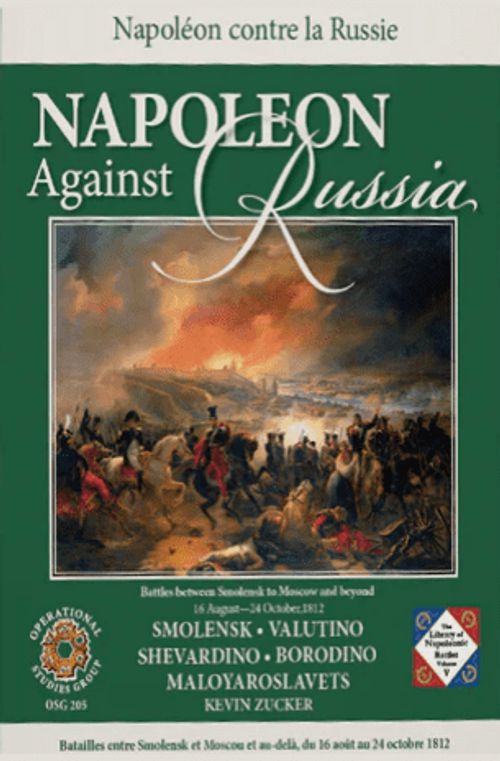
Napoleon Against Russia
Napoleon Against Russia: From Smolensk to Maloyaroslavets, August 15-October 24, 1812 — Study Folder
Table of Contents
Table of Contents
- Game Components
- 25.0 Scenarios
- 26.0 Victory Conditions
- 27.0 The Battle of Smolensk
- 28.0 The Battle of Valutino
- 29.0 The Battle of Shevardino
- 30.0 The Battle of Borodino
- 31.0 The Battle of Maloyaroslavets
- 32.0 Smolensk Mini-Campaign
- 33.0 Shevardino-Borodino Mini-Campaign
- 34.0 The Grand Campaign Game
- Historical Notes
- Bibliography
- Designer's Notes
Game Components
- 3 Map Sheets 22" x 34" and 1 Map Sheet 17" x 22"
- 2 Counter Sheets: 560 die-cut playing pieces
- 2 Booklets: System Rules, Study Folder
- 16 Player Aid Cards: TRC x5, Initial Set-up x7 (French x3, Russian x4), Casualty x2, Combat Results, Reorganization
- Deck of 100 Cards
- Booklet of Card Instructions, 11" x 17"
- Combat Tables Folder, 11" x 17"
- Orders Slip Sheet/Sequence of Play
- Victory Worksheet
- List of Cards Removed from Deck
- Game Box
25.0 Scenarios
In late June 1812, half a million French and Allied troops began pouring onto Russian soil, advancing further and further into the desolate steppes; failing time and again to bring the Russians to battle; losing one-fifth of their number to exhaustion, lack of supplies and indiscipline. Napoleon might have suspected a trap, though it was sprung haphazardly, and the noose was partly made of his own overweening pride and limitless ambition. The farther the French advanced, the more hardened and determined the Russians became. Between Smolensk and Borodino, a great victory was needed. The French army was getting worn-out, and the outcome of the campaign hung in the balance.
25.1 The Scenario Information
Napoleon Against Russia includes five Battle Games and three Campaign Games. Players select a scenario to play, and then refer to the Scenario Information and the Initial Set-up Cards (25.2) to set up the game. There is a major section of scenario detail for each battle:
- 27.0 SMOLENSK, 16-17 August
- 28.0 VALUTINO, 18-19 August
- 29.0 SHEVARDINO, 5-6 September
- 30.0 BORODINO, 7 September
- 31.0 MALOYAROSLAVETS, 23-24 October
- 32.0 SMOLENSK MINI-CAMPAIGN, 16–19 Aug.
- 33.0 BORODINO MINI-CAMPAIGN, 5–7 Sept.
- 34.0 GRAND CAMPAIGN GAME, 16 Aug.–24 Oct.
25.11 Turn Record Card (TRC): For each of the five battles a one-page TRC is provided. The Game-Turn marker is placed on the turn designated as the Scenario Start.
25.12 One-Day and Longer Scenarios: Players may choose one of the Day of Battle scenarios (DoB), or the Smolensk Approach to Battle (AtB) Scenario. Players are encouraged to begin by playing any of the Day of Battle Scenarios.
25.13 The Campaign Games: You can choose to play the Smolensk Mini-Campaign (4 days), the Borodino Mini-Campaign (3 days), or the Grand Campaign Game that links all the battles.
25.14 French Army Nationalities: The French Player controls units of the following nationalities: French regular (sky blue), Imperial Guard (dark blue), Polish (crimson), Bavarians (green), Westphalian (gray-green), Württemberg (dark blue with red unit type symbol), Italian (white with green unit type), Portugese (wine-red), Holland (orange).
25.15 French Player Units with Mixed Nationalities: French units with a different color inside the unit type symbol contain elements of a different nationality. A gray unit type indicates the presence of Saxon troops. A yellow unit type indicates Spanish troops. A red unit type indicates Württemberg troops. EXCEPTIONS: Colbert's brigade contains both Dutch and Polish troops; Girardin's brigade, French and Polish; Mouriez, Dutch, French and Württembergers; Gengoult, French and Portugese. (See the French Army Set-up card "Composition" section for details.)
25.16 Cavalry Brigade with Disparate Vedettes: Subervie's IIC cavalry brigade contains one regiment of Polish vedettes, one of Prussian Uhlans and one of Württemberg jaegers.
25.17 Russian Commanders
Russian Commander Barclay de Tolly is the First Army Commander, and may not place officers or units of Second Army in command nor give them a March Order. Bagration commands the Second Army with similar limits. Barclay and Bagration do not appear at Maloyaroslavets.
- Non-Cooperation: Units from the First and Second armies cannot stack or combine together in an attack. If units from different armies are adjacent to a single French unit (or stack) only one of them can be subject to 10.31. The other stack(s) remain "in contact."
Commander-in-chief Mikhail Kutuzov. Arriving the week before Borodino, the old fox was barely able to sit a horse, did not witness the fighting, ate lunch during the battle, and may only enter play when the Russian player plays the Kutuzov card.
- The Tsar's brother Konstantine (officer of the Guard Corps) departed for St. Petersburg on August 18th and missed the battle of Borodino. Use a Replacement officer for him in that battle.
25.18 Russian Armies, Units
(See the Russian Initial Set-up card.)
- Barclay's First Army. II, III, IV, V, VI, I Cav., II Cav., III Cav., Platov's Cossacks, 1st Artillery Corps, and the Smolensk Militia.
- Bagration's Second Army. VII, VIII, IV Cav., Karpov's Cossacks, 2nd Artillery Corps, and the Moscow Militia (Lebedev).
- Wittgenstein's I Corps (Alternate Reinforcement at Smolensk) belonged to neither army and may not be commanded by Barclay or Bagration. It is not affected by non-cooperation (25.17).
25.19 French Command: Murat cannot place officers Poniatowski or Junot in command (V and VIII Corps).
25.2 Setting Up the Scenarios
All units set-up as Hidden Forces (8.2).
25.21 Initial Set-up: The Units to set-up are listed on the Initial Set-up Cards. The First Player (26.6) sets up first. The Initial Set-up specifies the location for each unit. This may be modified by Mode Cards (24.5). The units to set-up at reduced strength are listed with an ® on the Initial Set-up. They are treated as having been eliminated and already reorganized. If there is no hex number shown on the Initial Set-up card, they are not placed in the PEU box, but are out of play; if ALT see (25.51). "Composition" and "Comments" are for historical interest only.
25.22 Hex Numbers: The hex numbers show where units were historically located at the start of the scenario. Place all combat units and leaders (25.25) directly on the map in the hexes specified. The set-up may include overstacked hexes. Make sure to observe stacking limits as you move your units on your first move. The Valutino map (E) overlaps the Smolensk map (W) (32.23).
25.23 Reinforcements (25.5): Reinforcement arrival is listed on the TRC as modified by the play of Arrival Cards (24.7). If the Corps Roman numeral designation follows an officer's name, all units of that corps arrive on the same turn. If a division is listed, all units of that division arrive on the same turn. EXAMPLE: At Borodino, the French Player's 10th Div/III — including Gengoult-b, Marion-b, Bruny-b and Ragmey — arrives at 6PM.
25.24 Pontoon Trains and Baggage Trains: Availability of pontoon trains is specified in the scenario information. Available Pontoon Trains must be set-up within [7] hexes of any friendly Commander unless otherwise specified.
All Baggage Trains set-up within [7] hexes of any unit in their respective formation or enter as reinforcements behind the main body of their corps, at the back of the column, unless otherwise specified. French and Russian corps generally have their own dedicated baggage trains (below).
- If a train is mentioned in the reinforcement schedule it enters as specified.
- If the formation arrives as a reinforcement the baggage and pontoon trains arrive last (during the same turn as the non-divisional artillery, if any).
- If the formation's existing non-divisional artillery does not arrive, its baggage train does not arrive either.
- If part of the formation sets-up on map and part arrives as a reinforcement, the baggage train arrives with the principal part of the formation, or with the non-divisional artillery (owning player's choice).
- The French Old Guard, and the Russian I Cav, II Cav, III Cav, the Militia Corps, and the two Cossack Corps of Platov and Karpov have no baggage trains. These units can trace supply to any Friendly baggage train or Supply Source within reach (18.21).
25.25 Leaders: Leaders set-up in the hex specified, or, at owning player's choice, as follows: Commanders may set-up with any Friendly force — Officers in any hex containing units of their Formation — in supply and not in an EZOC. Leaders ignore Mode Cards. EXCEPTION: Card 2, Late Start. Leader cards may be played as "inapplicable" (24.35) prior to the named leader's arrival.
25.26 Vedettes: Vedettes may be deployed at the beginning of a scenario at the owning player's choice, anywhere within three hexes of their parent unit (not in an EZOC). The second player deploys any/all of his available vedettes first, then the first player deploys his. The cavalry parent unit(s) for deployed vedettes are placed in the Holding Box.
25.3 Creating the Counter Mix
Between August 15 and September 5 the armies took great losses; a majority of units on each side (32 or so) lost strength. These units have an entirely separate counter (with the same name) with a lower strength, indicated by a yellow Initiative box. Further losses at Borodino tolled disproportionately among officers and veterans. Hence at Maloyaroslavets the French Army was more brittle and many French units start the battle in a reduced state.
25.31 Dark Blue Initiative Box: Units with a dark blue Initiative box have a substitute unit with either a red or yellow Initiative box. The dark blue is only on units with a substitute. You will never use the substitute in the same game as the dark blue version. The dark blue is the basic version (usually the strongest) used at the battle of Smolensk/Valutino. If the substitute version has a red Initiative box (25.33), the basic version continues in play through Borodino.
25.32 Yellow Initiative Box (suffix "-b"): For both the French and Russian armies, use this (usually weaker) counter instead of the dark blue basic version at Shevardino/Borodino and Maloyaroslavets. The Russian Reserve Artillery, and a few others (25.34), only have a yellow version (no dark blue version) as they were not present at Smolensk.
25.33 Red Initiative Boxes (suffix "-m"): These units and leaders only appear at Maloyaroslavets. Some Russian units got rebuilt up to their Smolensk strength. In such cases, the "Smolensk version" with the dark blue Initiative comes back into play at Maloyaroslavets.
25.34 Units Appearing only at Borodino-Shevardino: Counters with a yellow Initiative but no "basic version" do not get the -b or -m suffix after their names. There is only one Russian unit for Ostrovsky/IV, Vorontsov/VIII, the 2 Artillery Corps, and the Moscow Militia. These appear at Borodino and Shevardino.
25.33 Initiative Box Colors At a Glance: (this section is numbered 25.33 in the original booklet, reusing the number from 25.33 Red Initiative Boxes above)
| Color | Battles |
|---|---|
| Dark Blue | Smolensk/Valutino (and Borodino*) |
| Yellow | Shevardino/Borodino (and Maloyaro.) |
| Red | Maloyaroslavets only |
* if the substitute has a Red Initiative box (25.31).
25.34 Units Without Substitute Units: (also reusing a number from above) Leaders and units that have no substitute may appear in all five battles (see Initial Set-up cards).
25.35 French Forces Present: All French formations are included in all five battles. EXCEPTIONS: Maloyaroslavets — VIII Corps
25.36 Russian Forces Present: All Russian formations are included in all five battles. EXCEPTIONS: The I and II Artillery Corps and the Moscow Militia are not present at Smolensk/Valutino or at Maloyaroslavets; Wittgenstein's I Corps is an ALT Reinf. for Smolensk only; IIIC and Karpov's Cossacks are not present at Maloyaroslavets.
25.4 Scenario Information Detail
The following information is provided in 27.0—34.0.
25.41 Duration: The game ends with the completion of the last turn specified under "Duration," or may end immediately upon: Napoleon's capture (26.18); or, when all the formations of one side are demoralized and/or have exited. The Level of Victory still has to be determined (26.2).
25.42 Mode Cards at Start: Specifies the number of Mode Cards to draw on the first turn only.
25.43 Remove Cards From Deck: Remove specified number of cards from card decks (24.2). See separate list of "Cards Removed From Deck" per scenario.
25.44 Bonus Cards: On the second turn of each scenario (and at the beginning of each day thereafter, for campaign scenarios) each player draws a number of Bonus Cards: either the number specified for that battle, or a number determined by prior victory level (26.5) if playing any campaign scenario.
25.45 Alternate Reinforcements (ALT): (25.5)
25.46 Special Rules: Rules that apply only to this battle. 1812-Specific Rules (25.7) apply to all the battles of NAR.
25.47 Victory Conditions: Victory Points (26.1) are awarded for control of places on the map. Certain VP locations that do not count in a scenario may be listed.
25.5 Reinforcements
Reinforcement units (19.1) are listed on the Turn Record Cards. Reinforcements enter at the mapedge hex specified on the Turn Record. All units of the formation enter on the same turn unless listed separately, subject to card play, or depending on size of formation for multi-hex forces (25.53). When a Division is listed, all units with that divisional designation arrive on the same turn.
25.51 Alternate Reinforcements (ALT): ALT Reinforcements are listed in the Scenario Information by group number. One numbered group of friendly Alternate Reinforcements appears for each Alternate Reinforcements Card (No. 29) played. ALT groups must appear in order of priority starting with #1. Each time an ALT group enters, the enabling card is removed from play after being scored (32.13). ALT groups enter at reinforcement entry hexes or as noted. In some cases they are already on the map (27.33, 29.37).
If not using the cards — roll two d6 during the Command Movement Segment of every Recovery Turn: on a result of 2 or 3, you may enter the next group of Alternate Reinforcements listed; if you roll a 4–12, there is no result. If you roll a 2 or 3, your opponent can roll 2d6 to delay the alternate reinforcements; the attempt is successful if he also rolls a 2 or 3.
25.52 Hidden Reinforcements: All Reinforcements enter the map as Hidden Forces. Vedettes may enter instead of their parent LC units.
25.53 Deploying Off-Map Reinforcements: For multi-hex forces, prior to entry, all additional stacks after the first are deployed off-map in a column (see Glossary), beginning with the leader at the front of the column, and ending with the baggage (19.23). Reinforcements can enter in Road March at the owning player's option.
25.6 March Orders
One March Order per player may be issued prior to the start of any scenario, to any friendly force in play on the map, if a friendly Commander is on-map at the start of the scenario (20.1). Scenario instructions may modify this amount.
25.61 Pre-Programmed March Orders: The Special Rules may specify mandatory March Orders (also 26.32). These orders represent historical conditions limiting the leaders' freedom of action. They can be removed according to 20.23. EXCEPTION: 27.33. One March Order can be changed at night (20.4, 2.2B).
25.62 Late Start Mode Card: If you want to change one of those pre-programmed March Orders and you drew a Late Start Mode Card, you'll need to wake up first. A "sleeping" leader moves with his units. NOTE: "Sleep" is shorthand for "an inconceivable oversight."
25.7 1812-Specific Rules
25.71 Weather: In Napoleon Against Russia ignore all weather rules (23.0). Weather is fair throughout all the battles (no effect). At Night the LOS is reduced to one hex.
25.72 Recovery Turns: Each day's Recovery Turns (22.12) are always at 9 AM, Noon, 3 PM, and Night PM (2.2A).
25.73 Corps Demoralization Awards: 4 VPs per Corps. EXCEPTIONS: within the French I Corps, 2 VPs per division (26.13); 2 VPs per Cavalry Corps or Artillery Corps.
25.74 Release of French Imperial Guard: Units of the OG and YG Corps may not voluntarily engage prior to play of French Card No. 11. Staking the Guard (11.3) still applies.
If not using cards — use the die roll process (25.51). On a 2 or 3, release the YG; on the next 2 or 3, the OG.
25.8 Team Play
In a three-player game, one assumes the role of Napoleon; Russian Players represent Barclay and Bagration; or, at Maloyaroslavets, Kutuzov and Dokhturov or Miloradovich. The Commanders control their historically-associated formations (25.18).
25.81 Communication Among Players: Players may not freely discuss their plans, tactics or strategy unless the Commanders they represent are within four hexes of each other.
25.82 Aides-de-Camp: Written notes may be passed among Russian players. One message may be dispatched per player every friendly Command Phase.
25.83 Objective Hexes: Only place names, not hex numbers, may be specified as objective hexes.
25.84 Arrival Time: Written notes are dispatched during the Friendly Command Phase and are received during a later Friendly Command Phase. Travel time between leaders:
- on the same map section — three complete Turns
- from one map to the other — 14 complete Turns
25.85 Victory: After the winning side is determined, each of the Players compares the total VPs that he obtained (or hexes his units were first to occupy for his side). The player with the highest score gains the Commander-in-Chief's role on next playing.
26.0 Victory Conditions
Victory is awarded to the player or team with the most Victory Points at the end of the game; or, in the Campaign Game, according to the ratio of each player or team's Victory Point total (26.23 and 32.4).
26.1 Victory Point Awards
Victory Points are awarded for Enemy Combat Strength Points eliminated, Enemy Corps Demoralized, etc. If playing a campaign scenario, calculate victory point awards at the end of each individual battle.
26.11 Determine VP Totals: VPs are awarded for:
- a) Enemy Combat SPs Eliminated (26.12)
- b) Enemy Corps Demoralized (26.13)
- c) Captured Enemy Baggage Trains (26.14)
- d) Controlled Hexes & Improved Positions (26.15)
- e) Total VPs of cards you have played (26.16)
- f) Leaders in a town through the Night (26.17)
- g) Captured Commanders (26.18)
- h) Units that have exited the map (26.31)
26.12 Total Combat SPs Eliminated: At the end of play, total the losses in SPs by both sides, including the total SPs in the PEU, Unrecovered and Recovered boxes. Don't count SPs in the Full Strength Holding Box. Subtract the smaller from the larger total. The side losing the least SPs receives VPs as follows:
| Difference | VP Award | Difference | VP Award |
|---|---|---|---|
| 0-4 | 0 VPs | 20-24 | 4 VPs |
| 5-9 | 1 VP | 25-29 | 5 VPs |
| 10-14 | 2 VPs | 30-34 | 6 VPs |
| 15-19 | 3 VPs | 35-39 | 7 VPs, etc. |
When calculating Total Combat Strength count the unit's Full Strength. EXCEPTION: For units starting the scenario at Reduced Strength, use reduced strength.
26.13 Enemy Corps Demoralized: Each Player receives [4] VPs for each enemy Corps demoralized at the end of play. EXCEPTION: only 2 VP are awarded for demoralization of an enemy cavalry corps (IC, IIC, IIIC, IVC, Cos, GC), artillery corps (1A, 2A), and for each division of the French I Corps (25.73).
26.14 Captured Baggage Trains: The Player receives [2] VPs for each Enemy Baggage Train captured (18.14).
26.15 Control: Each Player receives [4] VPs for each Enemy Supply Source and [1] VP for each Enemy Improved Position he controls at the end of the scenario. Each Player also receives the number of Victory Points printed on the map for each VP Hex he controls. EXCEPTIONS:
- The Scenario Victory Conditions may specify certain VP hexes that do not apply in that scenario.
- If a player begins the game in control of an enemy Supply Source, no VPs are scored for it.
- VPs are not scored for the occupation of enemy Supply Sources by Reinforcements that enter there.
To be considered in control of a hex, a friendly Combat Unit in Supply must physically occupy the hex, or be the last Combat Unit to have occupied or moved through it. An occupying unit that is Out of Supply at the moment it enters or moves through a hex does not control that hex. To indicate the control of a hex, place a control marker of the proper side in the hex.
26.16 Cards: Add or subtract the VP Value of each card you have played during the game, if that card's event was actually used, as specified on the card. VPs of cards are tallied during Night PM Card Segment (2.2A.3) before the cards are reshuffled (24.23).
26.17 Leader in a town throughout the Night: Each player receives 1 VP for every friendly Leader who remains in a town all night.
26.18 Capture of Commanders: A player receives a number of VPs for each captured Commander equal to that Commander's Command Rating. EXCEPTION: The game ends immediately in a Russian Victory the moment Napoleon is captured.
26.2 Levels of Victory
At the end of the battle the total of Victory Points achieved by the two players is compared as a ratio (French: Russian), which determines the level of victory — Marginal, Tactical, or Strategic. Divide the French by the Russian VP total.
26.21 Find VP Ratio:
| VP Ratio (French to Russian) | Result |
|---|---|
| 1 to 2 or less | Russian Strategic |
| 1 to 1.5 / 1 to 1.99 | Russian Tactical |
| 1 to 1 / 1 to 1.49 | Russian Marginal |
| 1.01 to 1 / 1.5 to 1 | French Marginal |
| 1.51 to 1 / 2 to 1 | French Tactical |
| More than 2 to 1 | French Strategic |
26.22 When Total of VPs is Zero: Convert scores of "0" to "1" in order to calculate VP ratio.
26.23 Levels of Victory in the Campaign Game: In the Campaign Game the winner, Level of Victory and total VPs for each side, achieved in each individual battle, must be recorded. A given level of Victory will allow the winner to draw "Bonus Cards" from the Card Decks in the upcoming battles in the campaign (26.5).
26.3 Exiting the Map
Either Player may choose to exit his units by playing the "General Retreat" card.
If not using the cards, the Phasing Player may declare a General Retreat (20.5); or may exit at any exit hexes specified in the Scenario Information (27.42, 29.42, 30.42, 31.43).
Either Player's forces may exit at any Friendly Supply Source hex, at any Friendly exit arrow, and may also exit where Enemy units have previously exited. The exiting unit pays the Movement Point cost of the hex it is leaving once again. Exited leaders may not reorganize units. Units that voluntarily exit the map cannot be returned to play (they may return if listed under ALT Reinf.) and are not considered eliminated for Victory Point (VP) purposes. Units forced to retreat off the map are eliminated (12.34).
26.31 VP Award: If he makes a "General Retreat" the Exiting Player receives [4 VP] for exiting each friendly baggage train, and [1 VP] for every five combat units exited. EXCEPTION: You may not receive more VPs for Exiting the Map than you receive for Enemy Combat units eliminated (26.12).
26.32 Exit by March Order: A force may be assigned a March Order to exit the map. If a General Retreat has been declared, these forces garner [1 VP] for every five combat units exited (Exception at 26.31 applies).
26.33 No Award: Even if you do not declare "General Retreat" nor play the "General Retreat" card, you may choose at any time to exit individual units to prevent their destruction, either at the Friendly Supply Sources or Friendly exit arrows, but you receive no VPs, and they cannot be returned to play.
26.4 Minimum Loss
The Player receives [2] VPs if the total of eliminated SPs in the Friendly PEU + Unrecovered + Recovered boxes at the end of the game is zero.
26.5 Victory in the Campaign Game
Score the Level of Victory at the end of the individual battles. Each victory in prior games will allow the winning player to draw "Bonus Cards" from his card deck at the battles that follow.
- Each Strategic Victory: 3 Bonus Cards per battle
- Each Tactical Victory: 2 Bonus Cards per battle
- Each Marginal Victory: 1 Bonus Card per battle
- Minimum: 2 Bonus Cards per player
EXAMPLE: The French Player wins a Tactical Victory at Smolensk, and a Marginal Victory at Valutino. He would draw three "Bonus Cards" (plus the regular cards) on turn two of Shevardino.
26.6 First Player
The first player sets-up first. The Russian Player is the First Player. EXCEPTIONS: Maloyaroslavets, Smolensk Approach to Battle.
27.0 The Battle of Smolensk
A Battle Postponed, 16-17 August 1812
27.1 Introduction
Napoleon planned an outflanking maneuver to take Smolensk from the south, threatening the Russian line of communications with Moscow and bringing about a decisive battle. By the morning of August 14 most of the Grande Armée was across the Dnepr and advancing on the city. At Krasny they encountered Neverovsky's 27th Division, sent there to cover the approaches to Smolensk. Neverovsky conducted an epic fighting withdrawal in the face of Murat's horsemen, who were powerless without infantry support. The French Army spent the following day concentrating. Napoleon resumed the offensive on August 16, but by then any chance of a swift victory had evaporated. By the morning of August 17 the Russians were strongly positioned in and around the city. Napoleon hoped the Russians would engage in front of the city's walls; finally ordering a frontal assault against the massive enciente with its fortified towers. After a day of savage fighting for the southern suburbs, the Russians continued their retreat. The French lost about 9,000 men; the Russians 6,000 killed, wounded and captured.
27.11 Duration, Day of Battle: 17 Aug., 1 PM—8 PM (8 turns).
27.12 Mode Cards at Start: 1 French, 2 Russian.
27.13 Bonus Cards, Turn 2: For the individual battle, the Russian receives 3; French 3.
27.14 Pontoon Trains: Russian, 1 with Bagration, 1 with Barclay. French 1 with the 3rd Div/I Corps.
27.15 Counter Mix: Use plain or dark blue Initiative units. Set aside units with yellow or red Initiative.
27.16 First Player: In the DoB the Russian Player is the First Player. In the AtB the French Player is the First Player.
27.2 Alternate Reinforcements
FRENCH
- #1. 17th Div/V, Doumerc/IIIC
- #2. LATOUR/IVC
RUSSIAN
- #1. BAGRATION, RAEVSKY, VII Corps (27.33)
- #2. BOROZDIN, VIII Corps (27.33)
- #3. WITTGENSTEIN, AG Div/I at 3906E
- #4. 5th Div, 14th Div and Res Div/I at 3906E
27.3 Special Rules
27.31 Improved Positions at Start: None
27.32 Damaged Bridges at Start: None
27.33 March Orders at Start: Bagration and Second Army have a March Order to exit at 0554E. These forces must exit and cannot be removed from March Order (20.23). EXCEPTION: by the play of Card No. 29 these forces can remain on the map (27.2, #1 and #2). If they have already exited they may return via the same exit hex.
27.34 Map Area in Play: Set up all units in accordance with the "Smo DoB" column of the Initial Set-up. This scenario uses the Smolensk (W) and Valutino (E) maps. Hex 2154W is the same as hex 2101E. The Supply Source at 2154W/2101E may be used by the player who controls all 16 chateau hexes of Smolensk.
27.35 Ford: Ford hexsides are treated as stream hexsides and share all the effects of stream terrain. When using the Cards (only), prior to the play of French Card No. 25, only the Russians may freely use fords. Once the Russian player has crossed any units at a given ford then the French player may use that same ford.
27.36 Smolensk: Each hex of Smolensk inside the red enciente line is treated as a chateau. Unstacked artillery and train units may end their move in any hex of Smolensk; an exception to (15.21). Smolensk may be entered by units of either side only via one of the seven gates: Frolovskaya, 2053W; Molokhovskiye, 1652W; Nikol'skiye, 1601E; and unnamed gates at 2052W, 2153W, 2154W and 1902E; or via the Korolevskiy Bastion, 1851W. Combat between adjacent enemy units on either side of a non-gated, walled hexside, is not permitted. Treat such hexsides as a primary river (4.2). EXCEPTION: Artillery in walled hexes may bombard across the wall. EXAMPLE: A unit in 1752W could not enter or attack Smolensk directly. It would have to move first to 1652W or 1751W. (The suburbs of Smolensk are treated as town hexes.)
27.4 Victory Conditions
VPs are earned as per 26.1. The Russians were able to inflict 50% greater losses than they suffered; since they decamped with much of their army intact, they came close to winning this battle on points.
27.41 Control: VP Hexes that Do NOT count: none
27.42 Exit: A General Retreat is not possible for either side.
27.5 Approach to Battle Scenario
Once you understand the lay of the land, the Approach to Battle allows you to position your forces for the battle to come. The French Player has to get to Smolensk without allowing Bagration to cut his Supply Line. The Approach to Battle Scenario uses the set-up positions for on-map forces given under "Smo AtB."
27.51 Duration: 16 Aug., Night AM—17 Aug., 8 PM
27.52 Mode Cards at Start: French 3, Russian 3
27.53 Alternate Reinforcements:
FRENCH at 1301W
- #1. 16th Div/V
- #2. 18th Div/V
- #3. Cav Div/V
- #4. 17th Div/V, Doumerc/IIIC and LATOUR/IVC
RUSSIAN
- #1. WITTGENSTEIN, AG Div/I at 3906E
- #2. 5th Div., 14th Div and Res Div/I at 3906E
27.54 March Orders at Start: Marshal Ney (III Corps) and Marshal Murat (Cavalry Reserve) each have a March Order to Smolensk. There are no other French March Orders available at start.
27.55 All Other Scenario Info: (same as 27.1–27.4)
27.56 One-Map Approach Scenario: This scenario uses the West Map only and ends at 8PM on the 16th. Ignore all the Russian arrivals slated for 3906E. EXCEPTION: The 3rd Division/III will arrive in hex 2154W at 4PM. A Tactical Victory for the French player is defined as holding at least one hex inside the red enciente line at the end of the game. A Russian Tactical Victory is obtained by avoiding the French Victory. Use other AtB information (27.52—27.55).
28.0 The Battle of Valutino
The Lost Rearguard, 18-19 August 1812
28.1 Introduction
While the fighting at Smolensk was still going on, Barclay and Bagration had already agreed upon a plan to withdraw their armies. Bagration's 2nd Army departed along the north bank of the Dnepr with the sound of the French bombardment still ringing in their ears. Bagration had initially opposed the withdrawal, yet his march took him farther away than planned, leaving only a few cossacks at the important Valutino crossroads. Due to the need to rest and refit, Barclay's 1st Army was unable to pull out until the evening of the 18th. His withdrawal during the night went awry as his troops ended up marching in circles. The French pursued along the Moscow road, closing in on Barclay's rearguard. A sharp action soon developed at Valutino, as the Russians sought to protect the vital road junction of Lubino through which several retreating corps (and their baggage trains) still had to pass. Ney and Murat attempted to cut off Barclay's withdrawal; however Junot's inaction allowed the Russians to make good their escape.
28.11 Duration: 19 Aug., 6 AM—Night PM inclusive (16 turns).
28.12 Mode Cards at Start: 1 French, 3 Russian
28.13 Bonus Cards, Turn 2: For the individual battle, the Russian receives 3, the French 2.
28.14 Pontoon Trains: French, 1 with 3rd Div/I Corps; Russian, none.
28.15 Counter Mix: Use plain or dark blue Initiative units (some may be reduced from their full strength). Set aside units with yellow or red Initiative.
28.16 First Player: The Russian Player is First Player.
28.2 Alternate Reinforcements
FRENCH
- #1. NAPOLEON, MORTIER/YG at 2101E
- #2. 2nd Div, 4th Div, and 5th Div/I at 2101E
- #3. EUGENE/IV at 2101E
- #4. 17th Div/V, Doumerc/IIIC, LATOUR/IVC at 1401E
RUSSIAN
- #1. RAEVSKY, VII Corps at 0554E
- #2. WITTGENSTEIN, AG Div/I at 3906E
- #3. 5th Div/I at 3906E
- #4. 14th and Res Divs/I at 3906E
28.3 Special Rules
28.31 Improved Positions at Start: 2522E
28.32 Damaged Bridges at Start: none.
28.33 March Orders at Start: The French Player may issue a March Order to one on-map Friendly Force. The Russian Player also has one March Order at start (20.1).
28.34 Map Area in Play: Set up all units in accordance with the "Val" column of the Initial Set-up. This scenario uses the Valutino (E) map only.
28.35 Scatter of Russian Forces: (only if NOT using the cards). During the Russian Command Movement Segment of the 19th Aug., 6 AM turn, the French Player selects one Russian Force. Place all the units of that force in the owning player's hand, raise it 12 inches, centered approximately on the area originally assigned to that force. Then let the units fall (if enemy units are within 6 hexes, or if playing on plexiglass, reduce the height to 6"). See Card No. 6
28.4 Victory Conditions
VPs are earned as per 26.1.
28.41 Control: VP hexes that do NOT count: none
28.42 Draw: If the differential in combat strength lost (26.12) is within 7 SPs the game is a draw. If the differential is zero, it is a Russian tactical victory.
29.0 The Battle of Shevardino
The Struggle for the Redoubt, 5-6 September 1812
29.1 Introduction: Day of Battle Scenario
The Shevardino redoubt was intended to anchor the left flank of the Russian position at Borodino. The location had tactical significance, providing a clear view of the French Army's concentration in the southern sector. Napoleon, seeing in the redoubt an obstacle to his deployment against the enemy left wing, attacked with the forces available. Bagration argued that the hill was too exposed to hold, and Kutuzov gave permission to withdraw, but in the heat of battle Bagration stubbornly delayed his retreat. The redoubt changed hands several times before the Russians broke off the action at dark, the main body of 2nd Army having by then completed its withdrawal. Kutuzov refused to adjust the lines toward the French main effort, merely shifting the III Corps into reserve behind Bagration.
29.11 Duration: 5 September, 4 PM—8 PM (5 turns)
29.12 Mode Cards at Start: 2 French, 1 Russian
29.13 Bonus Cards, Turn 2: For the individual battle, the Russian receives 3, the French 2.
29.14 Pontoon Trains: Russian 2, French 2. Pontoons may be deployed at start. Historically, hexsides 2316/2416 and 2018/2119 had French pontoons.
29.15 Counter Mix: Use plain or yellow Initiative units (some may be reduced ® from their full strength). Set aside units with red Initiative and use their corresponding dark-blue version. Set aside the other dark blue Initiative units.
29.16 First Player: The Russian Player is the first player.
29.2 Alternate Reinforcements
FRENCH
- #1. MORTIER, 1st and 2nd YG Divs
- #2. Vis Div/YG; Drouot, Desvaux and Chasseurs/YG
- #3. BESSIERES, Guard Cavalry Corps
- #4. JUNOT, VIII Corps
RUSSIAN (on map at start — 29.37)
- #1. TUCHKOV, III Corps
- #2. UVAROV, I Cav Corps
- #3. BAGGAVUT, II Corps
- #4. OSTERMANN, IV Corps
29.3 Special Rules
29.31 March Orders at Start: none
29.32 Destroyed Bridges at Start: none
29.33 Burnt Towns at Start: Semyenovskaya (3017).
29.34 Improved Positions at Start: 2420.
29.35 Map Area in Play: This scenario uses the Borodino map only. Set up all units in accordance with the "Shev" column of the Initial Set-up.
29.36 Replacement Leaders at Start: Use a Replacement officer for Konstantine (V Corps) — not present.
29.37 Alternate Reinforcements: All ALT forces (29.2) — except Russians marked "Rear Guard" on the set-up — AND the Russian V and VI Corps, may not move unless: (a) they activate as Alternate Reinforcements; (b) any enemy unit moves within three hexes of a unit of that corps not marked as "Rear Guard;" (c) starting on 7 September at 7 AM.
If by (b) above, the entirety of a corps that has any units (other than those marked "Rear-Guard") within 3 hexes of the enemy during the friendly Command Phase is released.
If by (c) above, all units and leaders are automatically released. Once released each formation or any part may move freely according to the rules of Initiative and Command.
29.4 Victory Conditions
The VPs are earned as per 26.1. Victory points for Shevardino are scored on a turn by turn basis.
29.41 Control: VP Hexes that Do NOT count: Staroye (3106). Partial VPs for control: Shevardino (2419). Each player may obtain a maximum total of 5 VP for control of the Shevardino VP hex. Each player receives 1 VP at the end of each friendly player turn he controls 2419. EXAMPLE: The Russian player controls 2419 at the end of the friendly Player-Turns of 4 PM, 6 PM and 7 PM, so he has gained at least 3 VPs. If he controls the hex at the end of the game, he gains a total of five VPs.
29.42 Exit: No units may exit the map.
29.5 Mini-Campaign (33.0)
(There is no Approach to Battle Scenario.)
30.0 The Battle of Borodino
The Russian Army is Saved, 7 September 1812
30.1 Introduction
Barclay had been compelled to withdraw step by step, avoiding battle. As the weeks wore on, he became deeply unpopular with most of his officers and rank and file, and on August 29th Marshal Mikhail Kutuzov arrived to take command of the combined forces. Now the Russian Army would make a stand, at the only position available before Moscow, 70 miles west of the capital — near Borodino. The position covered in front by a stream and hills, stretching from the village of Borodino to Utitsy, a limited front of only four kilometers. Needing nothing short of a decisive victory, Napoleon attacked head-on, fearing the Russians would abscond if he threatened their flanks. The scene was set for one of the bloodiest days of the Nineteenth Century — a greater one-day toll than the first day of the Somme — costing about 28,000 of Napoleon's troops and about 44,000 Russians. (A further 8,000 Russians temporarily separated from their units rejoined over the next several days.)
30.11 Duration: 7 Sept. 7 AM—8 PM (13 turns)
30.12 Mode Cards at Start: Russian 1, French 1
30.13 Bonus Cards, Turn 2: For the individual battle, the Russian receives 3, the French 2.
30.14 Pontoon Trains: Russian 1, French 2. Russian pontoon may be deployed at start. French pontoons must be deployed at 2316/2416 and 2415/2516.
30.15 Counter Mix: Use plain or yellow Initiative units (some may be reduced ® from their full strength). Set aside units with red Initiative (out of play) and use their corresponding dark-blue version. Set aside the other dark blue Initiative units as well.
30.16 First Player: The Russian Player is the first player.
30.2 Alternate Reinforcements
None
30.3 Special Rules
30.31 March Orders at Start: French: none. The Russian Player may assign a pre-programmed March Order to one friendly force.
30.32 Destroyed Bridges at Start: 2813-2914.
30.33 Burnt Towns at Start: Semyonovskoye (3017), Novoye (3009).
30.34 Improved Positions at Start: 3710, 3017, 3013, 3012, 2919, 2916, 2818, 2817, 2420. In addition, the French Player has one I.P. for any hex occupied by a friendly infantry unit (French player's choice).
30.35 Map Area in Play: Set up all units in accordance with the "Bor" column of the Initial Set-up. This scenario uses the Borodino map.
30.36 Demoralized Corps at Start: none.
30.37 Replacement Leaders at Start: Use a Replacement officer for Konstantine (V Corps) — not present.
30.4 Victory Conditions
The VPs are earned as per 26.1.
30.41 Control: VP locations that do not count: 2419
31.0 The Battle of Maloyaroslavets
The March to Nowhere, 23-24 October 1812
31.1 Introduction
After wasting five weeks of fine campaigning weather sitting in Moscow, Napoleon finally resolved to maneuver past Kutuzov's left flank at Tarutino and reach Smolensk via territory not yet ravaged by the passage of troops. Dokhturov's VI Corps moved to intercept. Napoleon had to reach Maloyaroslavets, to secure the bridge and get the army across before the Russians could react in force. On October 23 the vanguard of Eugène's IV Corps seized the bridgehead. The following morning Dokhturov barreled into town, and a see-saw battle ensued. The town changed hands six times. Eventually, the French gained the upper hand and the Russians withdrew. Napoleon realized that to pursue his original plan would mean further heavy losses. Following a fractious council of war, he decided to turn around and return to Smolensk via the main highway, across devastated countryside, sealing the doom of the army.
31.11 Duration: 23 Oct., 5 PM—24 Oct., 6 PM (16 turns).
31.12 Mode Cards at Start: 1 French, 2 Russian
31.13 Bonus Cards, Turn 2: For the individual battle, the Russian receives 4; the French 3.
31.14 Pontoon Trains: Russian none; French 1 with Davout.
31.15 Counter Mix: Use plain, yellow, and red Initiative units (some may be reduced ® from their full strength). Set aside all the dark blue Initiative units.
31.16 First Player: The French Player is the first player.
31.2 Alternate Reinforcements
FRENCH
- #1. 1st, 2nd, and 4th Div/I
- #2. PONIATOWSKI, 16th Div/V
- #3. NEY, III Corps
- #4. 18th Div, Rybinski/V
RUSSIAN
- #1. Depreradovich-m/V, Duka-m/V
- #2. MILORADOVICH, KONSTANTINE/V Corps
- #3. BAGGAVUT/II Corps (use Replacement Leader)
- #4. OSTERMANN/IV Corps
31.3 Special Rules
31.31 Damaged Bridges at Start: none
31.32 March Orders at Start: none.
31.33 Map Area in Play: Set-up all units on the Maloyaroslavets map in accordance with the "Malo" column on the Initial Set-up cards.
31.4 Victory Conditions
The VPs are earned as per 26.1.
31.41 Control: VP Hexes that do NOT count: None
31.42 Russian Supply: Any Russian baggage trains without a Supply Line to 0111 at the end of play are counted as captured for 2 French VPs each (26.14).
31.43 French Exit: If the French Player plays "General Retreat," retreat must be toward 3011. Alternatively, French units may exit for VPs at 0111 or 0501.
31.44 Second Day of Battle (25 October, Option): If the French Player has at least a Tactical Victory at the end of the 24th, play may continue for 3 more night and 11 more day turns (run the Game-Turn Marker through the track again; there are no reinforcements), as French forces move to exit toward Kaluga or Medyn. The French General Retreat card may be played only toward Borovsk (that is, the historical outcome). The French Player should endeavor to exit toward Medyn, while threatening Kaluga (as Murat and Davout recommended).
32.0 Smolensk Mini-Campaign
16-19 August, 1812
32.1 Introduction
The Smolensk Mini-Campaign consists of the Smolensk and Valutino Battles, played successively in order, with each day's fighting influencing the number of bonus cards you get in the next day.
32.11 Duration: 16 August, Night AM through 19 August, 8PM.
32.12 Mode Cards at Start: same as 27.52.
32.13 Card Deck: Same as 27.13. During the Night PM turn of 17 August, when you reshuffle the full Main Deck (24.23) return ALT Reinforcement cards to the deck (25.51).
32.14 Bonus Cards: See 27.13, 32.31.
32.2 Initial Set-up
32.21 Set-up: Set up all units in accordance with the "Smo AtB" column of the Initial Set-up.
32.22 Alternate Reinforcements: For the 16th and 17th use ALT listed at 27.2; for the Russians on the 18th and 19th, use 28.2; French continue to use 27.2.
32.23 Reinforcements: Use the Smolensk TRC for August 16th-17th; ignore the Valutino Reinforcements for August 18th-19th.
32.3 Undeclared Truce Days
During August 18th there was only minor combat.
32.31 Skipping August 18th: For a more historical and quicker campaign you can skip the 18th of August entirely and move to the next scenario start. Instead of using the historical set-up positions for 19th, just leave the troops where they were at the end of the 8 PM turn and implement the other scenario information as provided in 28.0. If you decide to play-out the 18th, draw two bonus cards on the first turn of August 18th.
32.32 Reduced Strength Units: Unit listings of ® or eliminated on the Initial Set-up for the 19th should be ignored. Your forces available will depend on the outcome of the actual battles that you fought on the 16th and 17th. You will carry your losses forward from the 17th to the 19th.
32.33 Bonus Cards: If you play-out the 18th, draw two bonus cards on the first turn of the 18th.
32.4 Campaign Victory Conditions
The running total of Victory Points in both battles is tallied per side, and compared as a ratio. See the "Campaign Ratio" Section of the Victory Worksheet to determine the overall level of victory for the mini-campaign.
32.5 Special Rules
All Special Rules from 27.3 and 28.35 apply.
32.51 Alternate Reinforcements: none
32.52 Destroyed Bridges at Start: none
32.53 March Orders at Start: The French Player may issue March Orders to up to 2 on-map Friendly Forces, and the Russian Player may issue 2, including mandatory order (27.33).
33.0 Shevardino-Borodino Mini-Campaign
5–7 September, 1812
33.1 Introduction
The Shevardino Mini-Campaign Game combines Shevardino and Borodino successively in order with each day's fighting influencing the number of bonus cards you get in the next day.
33.11 Duration: 5 Sept. 11 AM—7 Sept., 7 PM
33.12 Mode Cards at Start: (same as 29.12).
33.13 Card Deck: same as 29.13; NOTE: During the Night PM turn of Sept 6th when you reshuffle the full Main Deck (24.23) return ALT Reinforcement cards to the deck (25.51).
33.14 Bonus Cards: See 29.13, 33.33
33.2 Initial Set-up
33.21 Set-up Column: Set up all Russian units in accordance with the "Shev" column of the Initial Set-up. EXCEPTION: Set-up all Russian units marked as "Rear Guard" in the "Comments" section of the Initial Set-up within 3 hexes of Kolotskoye (0521). No French Forces set up on the map at start.
33.22 Map Area in Play: This scenario uses the Borodino map.
33.23 Reinforcements: Refer to the Shevardino TRC for September 5 and 6.
33.24 Alternate Reinforcements: Same as (29.2).
33.24 All other Scenario Information: (same as 29.1–29.4) (this section is also numbered 33.24 in the original booklet)
33.3 Undeclared Truce Days
The 6th of September passed quietly, without "even the discharge of a single musket." The Russians spent the 6th digging-in.
33.31 For a more historical and quicker campaign you can skip the 6th of September entirely and move to the next scenario start for the 7th. Instead of using the historical set-up positions for the 7th, just leave the troops where they were at the end of the 7 PM turn and implement the other scenario information as provided in 29.0, allowing the Russian Player to place 8 I.P.s and one burnt town in hexes occupied by his forces (in addition to 29.33-29.34). In addition, the French Player has one I.P. for any hex occupied by a unit of Davout's I Corps (French player's choice).
33.32 Reduced Strength Units: Units listed ® or eliminated on the Initial Set-up for the 7th should be ignored. Your forces available will depend on the outcome of the actual battles that you fought on the 5th. You will carry your losses forward from the 5th to the 7th.
33.33 Bonus Cards: If you play-out the 6th, draw two bonus cards on the first turn of the 6th.
33.4 Mini-Campaign Victory Conditions
The running total of Victory Points in both battles is tallied per side, and compared as a ratio. See the "Campaign Ratio" Section of the Victory Worksheet to determine the level of victory for the mini-campaign.
33.5 Special Rules
Use Special Rules from 29.3.
33.51 March Orders at Start: none
34.0 The Grand Campaign Game
16 August-8 September, 1812
34.1 Introduction
The Campaign Game is the "Link Game," consisting of the Smolensk Mini-Campaign, the Shevardino Mini-campaign, and possibly Maloyaroslavets — if the French Player hasn't won a Strategic Victory by then (34.4) — played successively in order.
34.11 Duration: Night AM, August 16th ending on Oct. 24th at 7PM.
34.12 Mode Cards at Start: same as 27.12, 29.12, and 31.12. Mode Cards will be drawn on the first turn of 16 August and again on 5 September and 23 October.
34.13 Card Deck: Same as 27.13. During the Night PM turn of each day, when you reshuffle the full Main Deck (24.23), return ALT Reinforcement cards to the deck (25.51).
34.14 Bonus Cards: (26.5)
34.2 Initial Set-up
To start the Grand Campaign, use the Smo Mini-Campaign set-up (32.2). At the conclusion of the Night PM turn of 19 August, the action moves to the Borodino map. The following steps are needed to prepare for the next series of battles starting on September 5th (and Oct. 23rd).
34.21 Force Structure: Assemble your forces that remain on the Smolensk-Valutino maps. Replace any surviving units with the dark-blue Initiative with their yellow Initiative substitute. Transfer all other surviving forces of both sides onto the Borodino map or the Turn Record Track for the coming battles, according to their position on the Initial set-up for "Shev."
34.22 Reduced and Eliminated Units: Listings of ® or "eliminated" on the Initial Set-up column for Shev should be ignored. During the Start Phase for September 5th, all units remaining in the UAR box are automatically reorganized (as their yellow substitute). All units that were in the UAR box or reduced at the end of August 19th set-up with their yellow Initiative substitute, and all units in the PEU maybe set up with their yellow Initiative substitute unit at reduced strength.
34.23 Replacements: Both players may re-invert reduced-strength units of their choice, to account for any replacements received from Card No. 4. Replacements are not subject to the rules of Reorganization (22.2). Any baggage trains and vedettes that have been eliminated up to that point will also return to play. Any leaders that have been captured remain out of play. Formations without officers get a replacement leader (5.52).
34.24 Alternate Reinforcements: For the 16th and 17th use ALT listed at 27.2; for the 18th and 19th (see 32.22); for the 5th, 6th and 7th, none; and for October 23rd-24th (use 31.2).
34.25 Maloyaroslavets: If the French Player hasn't won a Strategic Victory, move on to Maloyaroslavets, and assemble your forces (34.21), reorganizing their units with red Initiative "-m."
34.3 Undeclared Truce Days
(Same as 32.3 and 33.3)
34.4 Grand Campaign Victory Conditions
The running total of Victory Points in all battles played is tallied per side, and compared as a ratio. See the "Campaign Ratio" Section of the Victory Worksheet to determine the overall level of victory for the Grand Campaign. The game ends immediately upon the occurrence of a French or a Russian Strategic Victory at either the Smolensk or Borodino battle.
34.5 Special Rules
See 32.5 and 33.5. The Special Rules only apply during the appropriate mini-campaign by which they are listed.
Historical Notes
by Kevin Zucker
With the conclusion of the Friedland campaign in 1807, Napoleon's mastery of the continent seemed well within his grasp.
At Tilsit, Napoleon had suffered from what Clausewitz would later term the 'crisis of victory.' Although he had overrun Prussia, he had merely handed yet another defeat to a Russian army and lacked the means of achieving more. His military machine had been in dire need of repair, and the inadequacy of his logistics had been driven home.[1]
By 1809, cracks were beginning to show in the detente between France and Russia. During peace negotiations following the second Danube campaign, last minute negotiations with the Tsar in search of a new paramour for the Emperor began to focus on the Tsar's young sister, Anna. In fact there was never any possibility of this union, and after several delays, the Emperor went ahead and married Marie-Louise, the 18-year-old daughter of Austrian Emperor Franz. Further conditions of the Treaty of Schönbrunn in October allowed the Grand Duchy of Warsaw to keep some parts of the province of Galicia, which had been divided in the 1790s among Austria, Russia, and Prussia. Intense outrage flared when this news arrived in Moscow; there was even talk of assassinating the Tsar, who was seen as weak. "He had stood up for the entente with Napoleon in the face of almost universal opposition at home, only to end up in the role of jilted party."[2]
During the spring of 1810 the Emperor proposed a convention by which he would discourage Polish reunification. This offer failed to assuage the Muscovites. At the end of June, 1810, the Emperor brought in the Russian ambassador and upbraided him in a most humiliating manner, ending his tirade with the threat of war. In his impatience and rage he already showed signs of advanced liver disease. "This man will not achieve any more great things, he is assailed by some lingering illness," said physician Jedrzej Sniadecki, who had the opportunity to observe Napoleon in Vilna.[3]
On 31 December the Tsar opened Russian ports to American ships and imposed tarrifs on French merchandise. In order to control the remaining ports in Germany, Napoleon annexed the Duchy of Oldenburg the following month. Alexander, who was related to the Duke of Oldenburg, felt shamed and betrayed by his erstwhile ally. "Blood must flow..." he said. He hoped to rally the Poles to his side in the coming conflict and sent out feelers to the Austrian and Prussian courts.
By the summer of 1811, Russian troops were descending on the Polish border in such numbers that their movements could not be concealed. War was now only a matter of time. "I considered that war had been declared," Napoleon said.[4] He made great efforts to deflect the approaching trainwreck, instructing Caulaincourt to reassure Moscow. "I have no wish to make war on Russia. It would be a crime on my part, for I would be making war without a purpose, and I have not yet, thanks to God, lost my head, I am not mad."[5]
Further negotiations at the ministerial level came to nought. Caulaincourt reported the Tsar's grievances over the costs of the Continental System and the danger of a reborn Polish kingdom, asserting that Alexander would never sign a peace dictated in Moscow. He even prefigured the actual course of events, warning that his armies would not fight Napoleon in person, preferring a popular guerrilla-style resistance.
The Emperor disregarded all warnings. He distrusted the Tsar whom he expected to attempt to seize the Grand Duchy when he marched into Spain — for the situation in the Peninsula was unravelling and his personal presence there was required.
At a reception held on the Emperor's birthday, 15 August, he again accosted the Russian ambassador, accusing Russia of coveting the Grand Duchy, then stalking off. Yet he needed Russia as an ally and had no real wish to re-create the Polish Kingdom. But he believed any concessions he might make would simply whet the Tsar's appetite for more territory. "We want peace, but are prepared for war."[6]
The Russian leaders had always feared that by abandoning the western provinces they would allow Napoleon to consolidate his power there and mobilize Polish resources against them. ... For Napoleon, 1812 was a cabinet war fought for strictly limited political purposes. At the absolute maximum he would have annexed Lithuania and part of Belorussia and Ukraine ... [These impoverished provinces] found it hard to feed armies even in peacetime.... The five regiments of Baron Korff's Second Cavalry Corps had been quartered all the way from the Russian frontier to central Ukraine in order to feed their horses.[7]
Outline of the Campaign
- 24 June: The Grande Armée crosses the Niemen, after Napoleon sent a final offer of peace to St. Petersburg.
- 17 August: The French Army assaults Smolensk; Barclay's forces withdraw on the following day.
- 17–18 August: Oudinot and Gouvion Saint-Cyr check Wittgenstein at Polotsk.
- 19 August: The French pursuit after Smolensk collapses at Valutino and Lubino.
- 29 August: Kutuzov takes command of the Russians.
- 5 September: The French capture Shevardino Redoubt.
- 7 September: The Battle of Borodino.
- 9 September: Murat occupies Mozhaysk in pursuit.
- 14 September: Napoleon's vanguard reaches Moscow; the city begins to burn.
- 27 September: Victor reaches Smolensk, providing support in the rear of the main army.
- 5 October: Napoleon sends Lauriston in an unsuccessful attempt to negotiate.
- 18 October: Sebastiani surprised at Vinkovo.
- 18–20 October: Gouvion Saint-Cyr, engaged by Wittgenstein at Polotsk, begins to withdraw.
- 19 October: Napoleon begins evacuation of Moscow.
- 24 October: Napoleon's southward move stopped at Maloyaroslavets.
- 3 November: Davout engaged and almost overwhelmed by Miloradovich near Vyazma.
- 4 November: First heavy snow. Napoleon reaches Smolensk.
- 9 November: Chichagov takes the depot at Minsk.
- 16 November: Ney's rearguard quits Smolensk; Napoleon counterattacks Miloradovich near Krasny.
- 25–28 November: Action at the Berezina as Napoleon's army crosses the river.[8]
Forces at a Glance
French Central Army Group, Napoleon Old Guard, Lefebvre • Young Gde, Mortier • I Corps, Davout • III Corps, Ney • IV Corps, Eugene • V Corps, Poniatowski • VIII Corps, Junot • Cavalry Reserve, Murat
Russian First Army, Barclay II Corps, Baggavout • III Corps, Tuchkov • IV Corps, Ostermann-Tolstoi • V (Guard) Corps, Konstantine • VI Corps, Dokhturov • I Cav Corps, Uvarov • II Cav Corps, Korf • III Cav Corps, Pahlen • Cossacks, Platov
Russian Second Army, Bagration VII Corps, Raevski • VIII Corps, Borozdin • IV Cav Corps, Sievers • Cossacks, Karpov
Smolensk — A Battle Postponed
11 August
Napoleon put the army in motion. In the morning, Murat, Ney, and Eugene moved toward Liady; Morand, Friant and Gudin marched behind. The Guard followed Davout's three divisions.
13 August
Napoleon left Vitebsk before daybreak and stopped for a time in Babinovichy. Resuming his journey on horseback, he arrived at Rasasna in the evening.[9]
13th-14th August, Night, Rasasna
General Eblé completed the throwing of four pontoon bridges over the Dnepr near Rasasna and the crossing could begin. By dawn, no less than 175,000 troops were safely over the obstacle.[10]
In the morning, Murat crossed with the Cavalry Corps of Nansouty and Montbrun, driving a Russian detachment out of Liady. Grouchy's cavalry corps marched in advance toward Krasny. Marshal Ney's Corps followed directly behind the cavalry.
14th August, 3 PM, Krasny
The lead cavalry reached the town and encountered enemy fire. French light infantry came forward to push the Russians out of town: a division under General Neverovsky, stationed in Krasny to watch the approaches of Smolensk. Supporting Neverovsky's 7,200 conscripts were 1,500 men of the Kharkov Dragoons and Polish Uhlans, cossacks, and 14 guns, as well as two experienced line infantry regiments. They lost six guns, the first Russian trophies of the entire campaign.
As the Russians departed, Murat impulsively flung his massed cavalry against their divisional square. The inexperienced Russians did not understand their peril and failed to succumb to Murat's shock and awe tactics. Time after time the French horsemen irrupted into the midst of the massive square, but each time the conscripts closed-up behind them. A double line of trees along the highway and the lack of French infantry support stymied Murat's troopers.
Had Murat waited for Marshal Ney to send forward some of his infantry the effort might have succeeded. Cavalry attacking disciplined infantry in squares requires the support of the other arms. Proper artillery support would have wreaked havoc, but the French artillery had been held-up at the narrow Krasny defile. A single Württemberg horse battery got through and managed to fire a salvo before Murat's cavalry blocked their LOS.
After retreating over 20 km (42 hexes) under intense pressure, Neverovsky lost 2300 men and 7 guns but the others reached Korytnya safely (1208).[11]
The French Army dared not pass Korytnya, because of the threat of a crossing of the Dnepr by Bagration's Army at Katyn. After leaving Smolensk, Bagration had reached Nadva with Borozdin's Corps, while Raevski had gotten no further than Katyn.
Barclay's HQ, Volokovaya
When Barclay got word of the French advance he abandoned his planned offensive north of the Dnepr and began pulling back toward Smolensk. Raevski's VII Corps was sent back to Smolensk while Bagration contemplated crossing at Katyn and ordered a bridge built.
15 August, Outside Smolensk
The French Army held a parade in honor of the Emperor's birthday, while his scouts continued to watch Raevski's troops across the river which could threaten French communications should they cross in force. His plan to seize Smolensk by a coup de main had failed.
Raevski reached Smolensk at dawn and joined Neverovski on the Krasny road at 2 PM, leading Paskevich's Division to his support. The French cavalry rode up, driving in the Cossacks and taking a position in front of Raevski, who withdrew during the night.
16 August, 8 AM, Russian Sortie
The French Advanced Guard was ordered to Smolensk, while troops were kept back toward Katyn to watch the enemy cavalry squadrons that had crossed the river. Napoleon's uncharacteristic hesitation would continue through the day. Bagration delayed around Katyn for some time before falling back along the Dnepr.
After leaving Lubnya, Ney was surprised by Cossacks near Smolensk and narrowly escaped capture as Russian troops deployed in the suburbs. The 26th Division held the Krasny suburb. The 12th Division occupied the Mstislavl and Roslavl suburbs. The 27th Division moved into the city near the cemetery and the two bastions. The artillery was placed in the earthen "royal citadel" (1851). During the night part of Emmanuel's and Vasilchikov's brigades from the IV Cavalry Corps arrived. In the morning the Russians and French fought in the suburbs.
9 AM: Napoleon arrives.[12] Napoleon's adjutant Michal Sokolnicki was sent to observe the Russians on the right bank. At 3:20 PM he reported all the parks of the artillery and an immense baggage train behind a column of infantry arriving along the route from Rudnya. Napoleon had a choice — either to do everything in his power to seize the city, without waiting for the complete assembly of his army, or risk taking part of his army across the river above the city. Though apparently the French bridge train hadn't arrived, two fords just above Smolensk and at Pruditchevo were finally discovered.[13] Napoleon had once before, at Aspern-Essling, allowed his army to be caught in the act of crossing.
Marshal Ney organized an attack with the 46th Regiment upon the royal citadel covered an old breach in the defenses, but the attack was repulsed with the loss of 400 men. Gradually the remainder of III Corps arrived, posted on the line of heights above the city. Grouchy's cavalry debouched on the right, driving in the Russian cavalry.
Smolensk, 6 PM
First Army began to arrive. Dokhturov's VI Corps and Konovnitsyn's 3rd Division entered Smolensk, crossing the existing trestle and two pontoons that Barclay had installed to connect the bridgehead with the city. Bagration pulled Raevski out of the city to cover the fords upstream. Neverovski and the 6th Jaegers of Glebov's brigade remained in Smolensk while the rest of Second Army withdrew to the east along the Moscow road.
Barclay posted the rest of his First Army as it arrived in the St. Petersburg suburb and the hills above it, well outside the city, with only the VI Corps and the 3rd division of the III Corps joining with the 27th Division to bring the garrison up to 20,000 men.
Napoleon wasted the 16th waiting for the army to assemble, particularly the delayed guns. The French artillery of I, III, IV, V and VIII Corps and the Cavalry Reserve had a massive train drawn by 12,000 horses:
| 12-pounders — 57 | 6.5 howitzers — 16 |
| 6-pounders — 267 | 5.6 howitzers — 122 |
| 4-pounders — 32 | |
| 3-pounders — 2 | Total — 490 |
In addition there were 2477 caissons forming a total of 2967 vehicles, not including the traveling forges, pontoons and spare gun carriages.[14] Note the preponderance of 5.6 howitzers (Year IX type), with only 16 of the original 6.54 inch Gribeauval howitzers. The powerful 8-pounders had been replaced by the lighter 6-pounders (Year IX type). There were no 8-pounders in the French artillery.[15]
17 August, Night AM
By now 140,000 men were assembled; only Eugene (still at Korytnia) and Junot were missing. Napoleon allowed the morning to elapse in scouting, waiting for the enemy to attack. He could easily see all the Russian positions, from the left bank hills that dominate the right. Intelligence was hampered by a lack of civilian spies. He sent cavalry to scout for fords further upstream but none were yet found.
Day of Battle Scenario
Bagration is marching east on the Moscow road, taking a position behind the Kolodnia. Barclay's army is still assembling. Napoleon has ranged his forces as follows: On the left, Ney with 3 divisions of III Corps. In the center, Davout with 5 divisions of I Corps. On the right, Poniatowski's Poles of V Corps. On the extreme right, on the plateau, the cavalry under Murat — IC, IIC, and IIIC Corps.
At this hour Eugene was still at Korytnia. Junot had fallen behind the Poles, finally arriving on the battlefield at 5 PM.
Bruyère's LC pushed back a dragoon brigade. A French 60-gun battery established on the riverbank was unable to make a dent in the enciente line of curtain walls and towers surrounding the city. The enciente was impregnable, except at one place, the Sigismonda breach, which was covered by the earthen embankment, the royal citadel, which Ney and now Davout attacked.
Attacks on the suburbs
The Poles took heavy losses. Howitzers set the wooden buildings on fire. Barclay sends in Württemberg as a reinforcement. Losses on the day were 7,000 French and 12,000 Russians.
Night
Officers nearly mutinied when Barclay ordered Dokhturov, Neverovsky, and Württemberg to evacuate Smolensk and set fires.
Napoleon intended to renew the assault against Smolensk on the 18th. He, too, was confronted with insubordination from some of his marshals.[16]
Night 17/18 August
During the night Barclay evacuated his troops across to the right bank of the Dnepr and destroyed the bridges. The Emperor's army remained encamped in the same position as the day before, in a semi-circle round the town.[17]
Valutino — The Lost Rearguard
18 August AM
With daybreak, the French entered Smolensk, now abandoned and still burning; the Emperor also soon arrived and ordered Ney to cross over to the right bank. Barclay, however, already in the act of retreating, as soon as he perceived this, sent some troops back. These threw the few French who had crossed back again over the river, and then occupied as a rearguard the part of the town situated on the right bank, called the St. Petersburg suburb. During the day they succeeded in preventing Ney's passage at this point.[18]
During the morning. Bagration's unconscionable abandonment of the Moscow road put First Army in danger.[19] He left only Karpov II (with four Cossack regiments opposite Prudyshchevo), and Gortchakov with the 2nd Grenadier Div of the VIII Corps and the VII Corps cavalry, a total of 10 battalions and 8 squadrons.
Napoleon allowed the day to pass as he rested and refit his disintegrating army. The lull lasted all day except for Korff, defending the bridgehead against Ney, his Württembergers suffering the most.
6 PM, St. Petersburg Suburb
As the French were beginning to force the passage, the Russian rearguard set the suburb on fire, and in the night proceeded to follow their army. Barclay had remained behind on the St. Petersburg road, engaged in observation, and in the evening he started on his retreat in order to reach, by a detour via Sikolina, Prudishtsha, and via Korochotkino, Gorbunovo, Shukowa, the road to Moscow at the point where it crossed the Dnepr at Solovyova. Bagration had marched back along the same road as far as Sloboda Puyevo.[20]
7 PM
Dokhturov departs with the North column of the V and VI Infantry Corps and the Artillery Reserve.
9 PM
Lt.-Gen. Nikolai Tuchkov's III Corps departs along the shorter detour, coming out on the Moscow road about 15 kilometers from Smolensk, leaving Korf with the rear guard. They marched through Gorbonovo facing many obstacles as they manhandled their artillery down narrow country lanes in the dark. Ostermann-Tolstoy's IV Corps started late and lost their way, wandering through the forest in separate groups. Baggovut's II Corps followed IV Corps and wandered in a circle.
19 August, 4 AM
Ney crossed the Dnepr on some bridges, which had meanwhile been completed, and Murat did the same by a ford; at the same time Junot marched upstream, in order to construct another bridge in the neighbourhood of Dresna. The Emperor now sent Grouchy forward in the direction of Duchovshtshina, and Nansouty and Montbrun under Murat along the Moscow road, to make sure of the enemy's retreat.
6 AM Set-Up
Elements of II Corps under Eugen started late only to find themselves at dawn near the village of Gedeonovo (2506). Eugen's column,[21] found itself one mile from the St. Petersburg suburb after a night spent marching in circles for 5 hours. Luckily, it took Ney 3 hours to get his men in motion. Fortunately, too, Barclay turned up and ordered breastworks built. When Barclay heard that Second Army had abandoned the vital crossroads (0831) to withdraw toward Dorogobuzh, he remarked to his aide-de-camp "Everything is lost."
8 AM
Pavel Tuchkov, leading the advanced guard of his brother Nikolai Tuchkov's Corps, reached the Moscow road near Lubino.[22] A few cossacks left there to guard the post reported that Junot's corps was preparing to ford the river at Prudyshevo (0612).
9 AM, Gedeonovo
Most of II and IV Corps were still wandering in the forests and would be routed should Ney push Eugen aside, but the three Russian regiments were able to repulse several attacks while reinforcements marched to the sound of the guns. At that point the Emperor arrived and diverted Ney's advance onto the Road to Moscow, toward another group of determined Russians.
Valutina Gora
Pavel Tuchkov ('Tuchkov III') moved his brigade forward to the Kolodnia (1517) at about 8 AM and held there for five hours with the help of two III Corps grenadier regiments and Denisov's cavalry brigade.
Ney attacked, but was only able to force it back a little way with hard fighting and heavy losses on both sides, although one of the divisions of Davout, [Gudin] who had crossed the Dnepr after him and had taken up a position behind him on the Moscow road, came up also; for Barclay was likewise reinforcing his division, on whose steadiness the safety of his line of retreat depended.[23]
Tuchkov gradually fell back to the Stroganka (1125) and held there until darkness, receiving more reinforcements from Aleksei Yermolof, Barclay's Chief of Staff. The Russian II Corps and Morand's French division arrived after the action was over. Losses: 5,000 Russians, 8,768 French, including General Gudin, a division commander in Davout's Corps since 1805.
Prudyshchevo
Junot had crossed the Dnepr in obedience to his orders, but had then taken up a retired position and remained immovable in it during the whole day, in spite of Murat's urgent personal requests, though his mere advance must have brought him on to the Russian line of communications, the very thing which had been the object of his crossing the Dnepr at this spot.[24]
Had Napoleon been present, Tutchkov's advanced guard should have been crushed between Ney and Junot, and then there would have been nothing to stop the French from arriving at Lubino to catch the Russians arriving piecemeal from out of the forest. Barclay opined, "one chance in a hundred saved First Army."[25]
Smolensk
Eugene crossed the Dnepr at Smolensk and took post on the St. Petersburg road; the Guards, to which the division lately attached to Davout now returned, remained in Smolensk, and Poniatowski was still on the left bank of the Dnepr.[26]
Napoleon had returned to Smolensk to organize supplies for his disintegrating marching columns. He had lost more than 19,000 men and the Russians more than 14,000 over the previous four days of fighting. His lack of operational activity was most curious, lapsing into inactivity when he should have redoubled his efforts.[27] He was in great uncertainty whether to continue the advance toward Moscow.
"One political calculation made by Napoleon was correct: the Russians could not surrender Moscow without a fight. Moscow was two week's march from Smolensk. Since he had come this far in pursuit of a battle, it might well seem foolish to give up now with the prize so nearly in his grasp."[28]
20 August, 4 AM, Yarovenka
The Russians continued their retreat. On the 21st, the entire Army crossed the Dnepr at Mikhailevka.
25 August
The French Army commenced its march to Moscow. Murat's Advanced Guard led the central column along the main post road; the Guard, I and III Corps followed. Eugène with the IV Corps made a separate column on the army's left, and the V Corps of Polish troops marched to the right.
29 August, Tsarevo
To much adulation, Marshal Mikhail Kutuzov arrived to take command of the Russian army. At 67 years of age, he was so obese that he could hardly ride a horse. His tactical skills were nil. However, he was a very shrewd strategist and knew how to flatter his troops. The Army started digging-in at Borodino on the 3rd.
Shevardino — Fight for the Redoubt
Murat and Compans attacked the Shevardino redoubt, defended by Vorontsov and Mecklenburg, with Duka's cavalry on the left. Davout's troops still had their small 3-pounder guns.
4 September, Evening, Gridnowo[29]
The French Advanced Guard led by Séruzier's HArt. was rebuffed by the Russian rearguard.
French scouts reported the entire Russian Army dug in along the stream. The exception was Gorchakov's detachment deployed near Shevardino, with 12 battalions of the 27th division, 2 battalions of the 26th, 2 battalions of grenadiers, the light cavalry of the IV Cavalry Corps and 2 Cuirassier regiments.
Kolotskoi
Konovnitsyn's Rearguard versus Murat and Eugene on the French left.[30]
5 September, Morning. Foggy and Drizzle
The French column stretched as far as the eye could see. Séruzier fought further rearguard engagements while the IV Corps joined up with Murat.
2 PM
The Army halted, only the advanced guard making slow progress. The Viceroy and Napoleon arrived at the Manor House of Voroyemo. Napoleon decided to launch an attack with the troops immediately at hand, sending orders to Compans, Nansouty and Montbrun to attack the redoubt from the front, while Poniatowski takes the position in flank and rear. The countryside is covered with Hazel bushes, juniper and other brushwood to the height of a man.
Poniatowski's V Corps moved through the wood south of the redoubt, while the 5th Division of Compans, supported by Nansouty's and Montbrun's cavalry corps, attacked in front. Between them these formations contained around 34,000-36,000 men, although not all of them would be involved at the start of the battle.
Prince Andrei Gorchakov had 8,000 infantry, 4,000 cavalry and 36 guns from Neverovsky's 27th Division, behind the redoubt. Neverovksy had four infantry regiments — the Odesskii and Simbirskii in front of the Vilenskii and Tarnopolskii. Behind the infantry was the 2nd Cuirassier Division.
A screen of light infantry, the 49th, 41st and 6th Jägers to the west, near Doronino, and the 42nd, 5th and 50th Jägers south of there. Two regiments of dragoons stood north-west of the redoubt, and another two regiments of dragoons and two squadrons of hussars to the south-west. Twelve guns deployed in or around the small redoubt. The 2nd Grenadier Division was held in reserve.
The battle started in the mid-afternoon when the first of Poniatowski's men began to skirmish with the Russians to the south-west of the redoubt.[31] They would make very little progress and failed to relieve the pressure on Compans's division as it got underway soon after the Poles. Doronino fell but the Russians retreated in good order. Nansouty and Montbrun's cavalry corps and Friant and Morand's infantry divisions crossed the Kolocha to outflank the Russian right.
5 PM
Compans began his first direct assault on the redoubt. His four infantry regiments were in a line. The 111th Line at the left. Next was the 25th Line, which was to attack the village of Shevardino (northeast of the redoubt). Compans led the 57th and 61st Line, which attacked south of the redoubt. The French quickly occupied Doronino Hill (the higher ground west of the redoubt) and mounted a gun battery on top of the hill.
The garrison of the redoubt and the 27th Division began to retreat under pressure. Major-General Löwenstern rallied the 27th, but was unable to prevent the French from seizing the redoubt for a time. Using a brigade from the 27th, Löwenstern launched a counterattack and retook the redoubt.
7 PM
Compans responded with two reserve battalions. Unmasking four guns from behind his advancing infantry, grapeshot allowed the 57th and 61st Line to fight their way into the redoubt, taking it a second time.
The Russians came back with a vengeance, sending in the Sibirskii and Malorossiiskii Grenadier Regiments, but soon included the 2nd Grenadier Division and four battalions of the 2nd Combined Grenadier Division. Russian cavalry charged the French 111th Line taking some of its guns. The Russian cavalry was fought off by Spanish infantry from Friant's division, approaching from the north.
10:30 PM
By now the redoubt had been destroyed by artillery fire. The Poles were finally approaching from the south and Kutuzov ordered Gorchakov to retreat.
As the Russian infantry retired, Gorchakov found himself with an isolated infantry force when the charge sounded by a large cavalry force was heard. Gorchakov ordered the Odessa Infantry Regiment to bang its drums and shout 'Hurrah!" as if reinforcements had just arrived. The sudden noise startled the French cavalry who allowed the Russians to escape.
The Russians are said to have lost around 6,000 or 7,000 men, half of them in the 27th Division. This same unit had suffered heavy losses at Krasny on 14 August, and had since received 4,000 replacements.
The French probably lost 5,000 men, with the infantry regiments of Compans' division suffering the most. The 57th Line lost around 500 men, the 111th lost 800 and the 61st Line 300 killed, wounded and captured.
The Night
A cold rain fell. Division after division arrived from the march to collect in an open field. IHQ occupied Voroyemo, one and a quarter miles from the enemy position, where the Young and Old Guard concentrated. All together five infantry and three cavalry corps piled into an area of 3 miles. The central mass of parks and convoys was further to the rear. Napoleon was ill, his legs and feet swollen, suffering from a cough "which exhausted his strength to the point where his intelligence was no longer the same."[32]
6 September
Believing that there could be no doubt that a battle was at length about to take place, Napoleon determined to halt for a day, for the purpose of rallying the troops which had not yet come up, and of having time deliberately to reconnoitre the ground; and bivouacked his troops from right to left of the vast plain.[33]
Napoleon left his troops where they were, with 5-6 ponts de chevalet. The first glimmer of daylight came at 6 AM, but the thick mist lifted only at noon, with evening drizzle and a cold and rainy night. During the 6th Davout dug two I.P.s near the Shevardino redoubt.[34]
By a species of mutual consent, the 6th had been allowed to pass by without even the discharge of a single musket. Bagration's 2nd Army contained the VII and VIII Corps, the 27th Division under Gorchakov, and the IV Cav Corps. After much purusasion, Kutuzov detached the III Corps from the Reserve to strengthen Bagration's left at Utitsy.[35]
Borodino — The Russian Army is Saved
Kutuzov had taken up a position across the main highway to Moscow. He hoped "that the enemy will attack us in this position, and if he does, I have great hopes of victory. But if, finding my position too strong, he starts manoeuvring" along the old road to Mozhaysk, he would be forced to fall back toward that city, in order to fight a battle before Moscow.
Napoleon had 124,000 men with 587 guns. His cavalry and artillery horses were in poor condition. The artillery included 160 light 3 and 4-pounders. Davout, who still had his light infantry guns, offered to take his corps in the night across the woods to the Old Mozhaysk road, to be on the Russian flank at 8 AM.
Napoleon objected that the woods would take too long to cross. Presumably this would give the Russians plenty of time to pull out of the trap.[36] Instead, the Emperor had prepared a straight-forward head-on attack.
7 September
Napoleon took post at the Shevardino redoubt with the Guard. The Kolocha was in many places dry; the Moskva was fordable. On the right the heights were less steep. The first hill to the right of Borodino was covered with woods. At its foot, a large plateau crowned by an I.P., and one artillery battery, dubbed the Great Redoubt.
The second hill separated by the Semyonova ravine — less large but steeper than the first, defended with three rows of guns.
Semyonovskoye village, previously burned, sat at the commencement of the ravine, surrounded by ridges occupied by guns.[37] The villages were not good strongpoints as they were made of wood and easily fired with grenades thrown from howitzers.[38]
Napoleon had 120 guns in I.P. epaulments. Eugene was to place a battery in Borodino, to bombard the Great Redoubt. He had Morand's and Gudin's divisions with which to attack the Great Redoubt.
5:30 A.M.
The cannon fire commenced. Three battalions of the Russian Guard Chasseurs held Borodino.
Eugene quickly succeeded in pushing the Russians out of Borodino, but the leading elements of Delzons' Division could not establish a foothold on the far bank of the Kolocha and a Russian counter-attack regained most of the lost ground. Nevertheless, the French remained in control of Borodino, although as Lowenstern observed, "it ceased to play any role in the great drama that would soon be named after it."
While the combat at Borodino was still going on, the main French assault began in the south. Davout's I Corps was set to advance against the Fléches, and the Divisions of Compans and Dessaix were soon locked in a desperate struggle with Borozdin's VIII Corps of Bagration's 2nd Army. Ney's III Corps was ordered forward to support Davout, and the Westphalians of Junot's VIII Corps went south to support Poniatowski's Poles, operating on the right flank of the French Army.
The battle for the Fléches raged back-and-forth for several hours, with the earthworks changing hands numerous times; according to Bagration: "The battle was the most savage, desperate and murderous that I have witnessed. Enemy corpses were piled in front of us...we, however, suffered equally heavy casualties." The French eventually gained the upper hand after Bagration himself was mortally wounded. The Russians were forced back to the Semyonova stream.
10 A.M. Morand's Division moves forward
Raevski's VII Corps held the area of the Great Redoubt. Morand grabbed it despite horrendous losses and lack of support, but his division recoiled before a Russian counter-attack and lost the position again.
Meanwhile Platov, noticing the weakness of the French left, proposed a large cavalry maneuver to traverse the Voina. Uvarov's I Cavalry Corps, screened by Platov's Cossacks, appeared just as Eugene was ordering a renewed assault on Raevsky. Redeploying instead to face the new threat, a hard-fought cavalry action followed; however the Russians, lacking any infantry support, had to withdraw.
2 P.M., Another assault on Great Redoubt
Eugene's infantry were poised to pierce the centre of the Russian line and win the battle. Eugene's head-on assault was supported by II and III Cavalry Corps. Caulaincourt, at the head of the 2nd Cuirassier Division, fell, mortally wounded, inside the redoubt. The Saxon and Polish cavalry of Thielemann's Brigade stormed in from the rear, sandwiching Raevsky between themselves and Eugene's infantry, climbing the hill on the opposite side. This was the decisive moment of the battle. The loss of the Great Redoubt weakened the centre of the Russian line and the outcome hung in the balance. But Napoleon refused to commit the Guard to deliver the knock-out blow. The battle died down into a stalemate.
The Russians had moved to the next ridge-line in much disarray. Kutuzov ordered the Russian Guard to hold the line. Those compact squares made good artillery targets as they stood in place from 4 PM to 6 PM suffering huge casualties.[39]
8 September, evening
Murat arrived in front of Mozhaysk. Miloradovich's Russian Rear Guard — infantry and cavalry — stood in front of a marshy ravine. They needed to buy time to remove the wounded and baggage in the town. The French bivouacked within cannon range of the enemy.
9 September, Mozhaysk
The French forced their way into the town, while Prince Eugene seized Kuza and Poniatowski advanced on the lateral route on the right.[40]
Maloyaroslavets — The March to Nowhere
Many among the nobility felt that the decision to burn Moscow had saved the country from social upheaval and even revolution. By blaming the French, the minds of the common people were turned against the enemy instead of thinking of achieving their own freedom. Had there been "the slightest disorder ... the upsurge would have been universal."[41] When it came, the upsurge was one hundred years too late to save Napoleon.
Changes to French ORBAT, 9/9—10/18
- 9/19 — 2,000 cav March Rgts.
- 9/20 — 3,500 inf. in 1 March Rgt., 1 Gde bn., 1 III Corps Inf. Rgt; 1,455 cavalry March Rgt.
- 9/30 — 700 cav. March Rgt
- 10/ — 3,000 Inf., 500 Cav. March Rgt.
- 10/ — 4,000 Inf. March Rgt., VIII Corps (3), V Corps (3), Vistula (2)
- 10/ — 8,000 Inf., 2,500 cav., March Rgt., 1,000 Württ inf
- Sept-Oct — 52 guns total
During their sojourn in Moscow, the French troops fared well but their horses lacked fodder and wasted away. "The 3rd Cavalry Corps, consisting of eleven regiments, could only muster seven hundred horsemen. The 1st Regiment of Chasseurs could only field fifty-eight men, and that only thanks to some reinforcements which had reached it from France. Squadrons in the 2nd Cuirassiers, usually 130 strong, were down to eighteen or twenty-four men. General Thielmann's Saxon brigade was down to fifty horses."[42]
The Russians had organized flying detachments to harass the French lines of communication, capturing over 15,000 men during the occupation of Moscow. While the French Army was dwindling away, the Russian Army was enjoying an influx of recruits, albeit untrained. Kutuzov received about 50,000 regular troops and 20,000 Cossacks during the month he spent encamped at Tarutino.[43]
Marshal Murat and a French force of about 25,000, mostly cavalry, camped near the Russians at Vinkovo. On 18 October, General Baggovut surprised them, capturing hundreds of cavalrymen from General Sebastiani. The French lost some 2500 men and thirty-six guns, while the Russians lost over a thousand men, including Baggovut.
This fiasco startled Napoleon into action, and immediate orders went out for the retreat. Having remained for too long in Moscow, the Emperor had a number of options, none of which offered any opportunity for glory. The best of a bad lot was to march on Tula and Kaluga — along with Orel, the main centers of the armaments industry — and then retreat through the Black Earth belt, south of the Pripyat — a zone rich in agricultural produce that had been spared the wastage of war. A march in this direction would take time to prepare, as the lines of communication would have to be shifted south from Minsk and Vilna toward Warsaw.
Departure from Moscow
The French "marched along gaily, singing at the tops of their voices," and appeared to be in fine fettle. There were at the most 95,000 among whom Jomini estimated about 15,000 were malingerers.[44] The column also included thousands of civilians.
20 October, Troilskoye
Napoleon lingered all day waiting for the stragglers and baggage to catch up. "The infantry is in good shape; the cavalry that had been camped near Vinkovo in truth much reduced; but that of the Guard, as also that of the three corps which had been in Moscow, still quite well mounted."[45]
Evening
General Dokhturov received a report from partisans who spotted Napoleon with his retinue and Guard in the village of Fominskoe. The main French forces were moving to the town of Maloyaroslavets.
Imperial Guard, 15 October[46]
- Old Guard — 6,700
- Roguet — 3,600 (detached to Vitebsk/Vilna — Flanquers, 1,200)
- Delaborde — 3,700 (detached, 1,628)
- Guard Cavalry: Elite Gendarmes — 100 (dismounted); Grenadier Gardes — 1,100; Dragoons — 900 (800 mounted); Dismounted cavalry — 1,000; Mameluks — 63; 2 rgts of Lancers (with Murat) — 1,400
- Guard Artillery — 1,000: 16x 4pd, 10x 6pd, 4x 24pd howitzers (there were no horses to pull the rest)
- Claparede (attached) — 1,800
Main Army (30 hours head to tail)
- IV Corps — Eugene (26,000 plus 1,500 cav.*)
- III Corps — Ney (10,500 — plus 1,000 cav.*)
- Old Guard — Lefebvre (6,700)
- I Corps (2 divs., 12,000)
- YG Roguet (3,600)
- Morand's Div/I (6,000)
- Guard Cav. Bde., Colbert
- Murat's Cavalry: Cavalry Brigades of I, III, and V Corps (3,000); IC, IIC, IIIC, and IVC Cavalry Corps (5,000*); Bavarian cavalry (1,500)
- Vistula Legion (1,800)
- I Corps (2 divs., 12,000)
- V Corps — Poniatowski (at Vereia, 5,000)
* mounted cavalry
22 October, Early Afternoon, Borovsk
Eugene reached Borovsk, followed by Napoleon. General Delzons went forward to arrive in Maloyaroslavets in the night. Broussier's Division reached Fominskoye on the new Kaluga Road.
Maloyaroslavets
Chastel's LC Division of III Cavalry Corps entered Maloyaroslavets, riding mere nags. The town was empty. They spread out onto the plain beyond, encountering no resistance.
Fominskoye
Murat's Force closed up with main French army. Dokhturov advancing toward Fominskoye, reached Aristovo. Kutuzov sent him orders to move by country roads, parallel with the enemy, and then attack. General Miloradovich was ordered to determine if Murat and Ney were actually on the Old Kaluga road.
23 October, 1 AM, Fominskoye
Ney (rear-guard) set off in the direction of Maloyaroslavets.
Night AM, Maloyaroslavets
Delzons' Division arrived. Two battalions crossed the Luzha (the bridge had been demolished by cossacks) and up into Maloyaroslavets.
23 October, Evening — IV Corps Column, Order of March
- 14th, 15th Divs., approaching Maloyaroslavets
- Royal Guard Division
- Lahoussaye's Division/IIIC, HArt/IIIC.
Dokhturov's leading elements were en route in wagons, making a force march in hopes of beating the French to the road junction. French stragglers revealed their destination, a vital link on the Russian supply lines toward the Russian supply base of Kaluga. Napoleon might march in any of three directions, preferring Medyn and on to Yelnia and Smolensk.
23 October, Night
Ney departed Gorki, still 2 days' march behind, in the rain and mud.[47]
Kutuzov received the detailed report from General Dorokhov, issuing 16 written orders to his generals, plus many verbal ones. General Ivashev was ordered to prepare the road from Letashovka village to Maloyaroslavets for movement of the army with its artillery. He had to organize the troops in such a manner that there would be enough to cover two or three more roads. The entire Russian army then set out for Maloyaroslavets.
24 October, 5 AM, Maloyaroslavets
Maloyaroslavets was a small town 120 kilometers from Moscow, standing on the steep right bank of the river Luzha. The river formed an arc near the town and covered it from the North. There was a single bridge leading to the gate into the town (see map).
As day broke, the troops of General Dokhturov approached the town, finding the town occupied. As Delzons' lead brigade crossed the river, Dokhturov attacked with 9,400 vs. 7,600 under Delzons, quickly driving the French and some Croats out, and destroying the bridge. Delzons built an I.P. in the bridgehead.
10 AM, Maloyaroslavets[48]
Eugene arrived with Broussier's Div. of IV Corps. Pino and the Italian Guard, with Ornano's LC in reserve. Broussier pushed Dokhturov out onto the plateau, but the French were unable to move beyond the town. Séruzier arrived with the HArt of II Cav Corps.
10 AM, Ouvarovskoië
Napoleon arrived with Murat and sent orders via Soltyk for Eugene to expect Davout's support.[49] Soltyk passes through Davout's Force-Marching columns.
11 AM, Napoleon's orders arrive
Eugene meets the Royal Guard as they are debouching from the woods, and sends them at the double to rout the Russians from the town at bayonet point.[50]
12 Noon, Maloyaroslavets
Napoleon arrives at Eugene's HQ (1411-1511).
There were now 10-11,000 Frenchmen against 24,000 Russians. The town changed hands 5 times. The 15th Division (Pino) crossed the stream and pushed the Russians back, Chasseurs of the Italian Guard in support.
Large masses of Russians were constantly arriving. The Russians commenced a line of I.P.s on the plateau. The Italians could not remain outside the town under the enemy's withering fire.[51] Raevsky's entire Corps, forming the advanced guard of Kutuzov's army, arrived and took the town for the sixth time. Russian guns on the plateau were dominating the road by which the French troops were arriving. "All efforts had to be made at bayonet point, on a point so narrow as to permit no flanking movement."[52]
1 PM
I Corps began to arrive on the heights overlooking the Luzha (1710).
2 PM
Two Divisions of I Corps entered the battle. Davout deployed a bridge on the right (1312), with his artillery in action from the far side of the river. Compans and Gérard's divisions deployed to the left and right respectively. The I Corps barely got into action because of the narrowness of the bridgehead. The 85th Line, for example, only arrived after the battle was over.
Séruzier found a ford, covered by woods, and hastily sent across eighteen men, "each armed with a shovel or a mattock, with orders to flatten the slope enough for a wheeled vehicle to pass." ... "Deploying undisturbed in the Russian rear, Séruzier's guns do such terrible damage to their center that it half-paralyses their resistance to IV Corps, pressing them from the town."[53] The Russians fell back one league.
In fact about 16-17,000 Italians and French have been engaged against seven Russian army corps with their reserves; i.e., sixteen divisions, or nearly 100,000 men, of whom some 70,000 were actually in the firing line by 4 PM.[54] The result of the battle was a draw. Neither side achieved its objectives, although the French did hold the town at the end of the day.
24 Oct., PM, Borovsk
Ney arrived. The Vistula Legion, Württembergers, and baggage remained in Borovsk. "The Italian army had displayed qualities which entitled it evermore to take rank amongst the bravest troops in Europe."[55]
French Troops Engaged, 23-24 October
IV Corps
- 13 I.D., Delzons — 8 L (2), 84, 92, 106 (4), Croat (2)
- 14 I.D. Broussier — 18 L (2), 9, 35, 53 (4)
- 15 I.D. Pino, Italian — 1 L (1), 3L (4), 2, 3 (4), Dalmatian (3)
- Gde I.D., Lecchi, Ital — Gde d'Hon (1), Vel, Gren, Conscripts (2), Chas (1)
- Gd Cav Bde Villata — Drag (2), Queen's Drag, 2 Chas, 3 Chas (4)
- 12 LC Bde Ornano — 9 Chas, 19 Chas (3), Lanc (4)
I Corps
- 3 I.D., Gerard (ex-Gudin) — 7 L, 12, 21 (5)
- 5 I.D., Compans — 25, 57, 111 (5)
- 23 Drag (4)
- 4 I.D. Desaix (did not engage) — 85 (5)
Guard
- Chas
- Arty
TOTAL: 24,000 men
The Russian Army, 23 October 1812[56]
Corps de bataille: II, III, IV, VII and VIII Infantry Corps; IC, II-IIIC, IVC Cavalry Corps
Reserve: V Guard Corps, VI Infantry Corps; 1st and 2nd Cuirassier Divisions
Strength: 76,629 infantry (including 5498 militia); 10,711 cavalry; 8,859 artillerists manning 622 guns; 813 engineers; 20,000 Cossacks
Losses came four to six thousand Frenchmen and Italians, and 6,000 to 8,000 Russians.
"The entire Russian army, numbering at least 90,000 men, was by 4 PM in position behind the town, commanding the area before it with over five hundred guns. Napoleon could not muster 65,000 (Mortier was between Moscow and Mozhaysk, Junot was at Mozhaysk, Poniatowski" stood at Vereia, two days march to the north-west).[57] Poniatowski's advance toward Medyn, 20 miles to the west, was checked.
During the night, the Russian army fell back to a defensive position a few kilometers away. But the strength of the Russian position meant that a victory would be costly, and the wounded would have to be left behind. "In falling back, Kutuzov had actually opened the road to Medyn, leaving Napoleon free to pursue his retreat to Smolensk that way, but the retreating French would then have had the entire Russian army on their heels."[58]
25 October, Night AM
"One Guard battalion was bivouacked barely 300 yards from the spot, and on the same side of the road as where the Cossacks had spent the night."[59]
26 October — Retreat to Borovsk—Mozhaysk
At Borovsk were part of the troops, most of the artillery and all the baggage trains. The decision was made to return by the road they had taken.
"Napoleon's star no longer guided his course. For after the Russian rearguard had retired, had any, even the smallest reconnaissance, advanced to the brow of the hill over the ravine — had the slightest demonstration of a continued offensive movement been made — Napoleon would have obtained a free passage for his army on the Kaluga or Medyn roads, through a fertile and rich country to the Dnepr; for Kutusov, resolved on falling back behind the Oka, had actually issued the orders to retire in case of the enemy's approach to his new position."[60]
Order of March
Guard—Murat—Ney—Eugene—Davout. Grouchy's cavalry was worthless due to exhaustion. Mortier rejoined the army at Vereya. After three days the army reached Mozhaysk (Oct. 29). Junot, who had remained there after Borodino, was reduced to 3,000.
Uvarovskoy, Midday
Colbert's brigade arrived to guard the Maloyaroslavets road. The baggage was crawling past through the mud when the same cossacks who had awakened the Dutch Grenadiers of the Guard had just driven away from IHQ. The Dutchmen have 1,000 men facing three thousand cossacks.[61]
The French Army had wasted 8 days without getting any closer to Smolensk. Kutuzov, for his part, was content to allow the enemy to traverse a "Golden Bridge" without forcing another pitched battle.
Notes
- Riehn, p. 25
- Zamoyski, p. 58
- Zamoyski, p. 165
- Zamoyski, p. 71
- Zamoyski, p. 72
- Zamoyski, p. 77
- Lieven, pp.170-72
- Haythornthwaite, p. 8
- Burton, p. 86
- David G. Chandler, The Campaigns of Napoleon, p. 784
- Nafziger, p. 185
- Riehn, p. 225
- Riehn, p. 222
- Napoleon and the Grand Army in Russia, General Gourgaud, page 109 (1825). Gourgaud was first military secretary and aide de camp to Napoleon.
- Jean Lochet
- Riehn, p. 221
- Yorck von Wartenburg, Napoleon as a General.
- Yorck von Wartenburg
- Riehn, p. 220.
- Yorck von Wartenburg
- Tobolsk, Wilmanstrand, Belozero Rgts., some cav., guns
- The advance guard of Tuchkov's corps was commanded by his younger brother, Major-General Pavel Tuchkov. Lieven, p. 166
- Yorck von Wartenburg
- Yorck von Wartenburg
- Lieven, p. 170
- Yorck von Wartenburg
- Riehn, p.221
- Lieven, p. 173
- Austin, p.253
- Konovnitsyn had 26 battalions and 72 squadrons, including the 3rd Infantry Division/III Corps, the jaeger and cavalry regiments of II, IV, and VI Corps, and the II and III Cavalry Corps. Murat had 20 bns. of Division Compans, and 132 sqdns. of the I and II Cav Corps (minus Pajol), the LC of I and III Corps.
- V Corps strength on 2 Sept. — 8,430 infantry and Arty., 1,638 cavalry and HArt. Ney's III Corps was reduced to 11,278 men including only 1,456 Württemberg infantry.
- Dr. Yvan, cited in Austin.
- Thiers, p. 129
- Austin, p. 274
- Thiers, p. 134
- Thiers, p. 131.
- Thiers, p. 130.
- Riehn, p. 243.
- Battle of Borodino, in Wikipedia, retrieved 24 Jan. 2015
- p. 150-151
- Zamoyski, p. 324
- Zamoyski, p. 349 citing Castellane and Thirion.
- Zamoyski, p. 359 citing Shishov, Beskrovny, Shvedov. Kutuzov marched into the camp at Tarutino with 60,033 regulars (including 7690 raw recruits); 15,000 militiamen stood in the third ranks of the line units. Riehn, p. 297
- Zamoyski, p. 368.
- Austin, p. 194.
- Hourtoulle, p. 66 ff.
- p. 196
- p. 192
- Austin, p.208
- Austin, p.209
- Austin, p.210
- Austin, p. 212
- Austin, pp.212-13
- Austin, p. 214
- Zamoyski, p. 373, citing Wilson
- Riehn, p.306n
- Zamoyski, p. 373
- Zamoyski, p. 375
- Austin, p. 222.
- Austin, citing Wilson, p.226
- Austin, pp.228-29.
Bibliography
- Austin, Paul B., 1812: Napoleon's Invasion of Russia
- Buturlin, Dmitri, Istoriya nashestviya Imperatora Napoleona na Rossiyu v 1812 godu
- Burton, R.G., Napoleon's Invasion of Russia
- Chandler, David, The Campaigns of Napoleon
- Esposito, Vincent, and Elting, John, A Military History and Atlas of the Napoleonic Wars
- Fabry, Gabriel Joseph, Campagne de 1812, Documents Relatifs a l'Aile Gauche 20 Aout — 4 Decembre
- Foord, Edward A., Napoleon's Russian Campaign of 1812
- Haythornthwaite, Philip, Borodino 1812
- Hourtoulle, F.G., Borodino, the Moskova
- Lieven, Dominic, Russia Against Napoleon
- Nafziger, George, Napoleon's Invasion of Russia
- Mikaberidze, Alexander, The Battle of Borodino
- Riehn, Richard, 1812: Napoleon's Russian Campaign
- Yorck von Wartenburg, Napoleon as a General
- Zamoyski, Adam, Moscow 1812
Designer's Notes
by Kevin Zucker
It always starts with a lot of reading — stacks of books at the coffee house. If I own the book, I write a ! at the end of the line, X at the top of the page, and sometimes underline. If a library book I use post-its to indicate which pages to xerox, then I write on those copies. Online books provide new research opportunities of great depth. I keep several binders and spiral books where I take notes. Everything I write or highlight is going into the game. If I change my mind, I throw it out later. I read my notes over and over, until I have a clear mental picture of the whole situation in detail.
Since the Rules of Play are done, I can focus on the Study Folder. The first part to get done is usually the Historical Notes. I paste up the stuff I want to get into the game, typing in my notes from the spiral books and trying to make some authorly moves.
So now I have the raw material for the special rules and the scenarios. There is typically some unusual twist to the situation. For Smolensk, this is the first time we have had a whole city on the map — burnt to the ground, at that. A Russian rearguard sitting across the Dnepr from Ney's corps held up his attempts to fix the bridge. Napoleon is sitting on his Guard while the Russians withdraw. For special situations like that I try to put the rule on a card — anything that happens that is a departure from the expected.
I enjoyed deciding how to handle Kutusov. He wasn't good enough to warrant any special ability; as a battlefield leader he was a zero. But he wasn't feeling too well and died the following Spring, so you might understand his behavior. We could not justify having him as a regular part of the orbat, but allowing him to rise to the occasion via the card deck is a good solution.
Visiting the battlefields helps. Sometimes hatchmarks on a map cannot quite do justice to the lay of the land. These days we have Google Earth which is a good substitute for going there in person. I like to virtually "glide" over the countryside where the main moves took place. You can easily see photos of important crossings, and examine fortifications from several angles, even look at individual churches to see if they are imposing enough to warrant the chateau benefit. I spent time studying the walls of Smolensk that way.
I probably spend half my time insuring the battle layouts and arrivals are as accurate as we can make them.
About half of our research is done by a team of specialists — David Jones for Leipzig, Jack Gill for 1809, John Wladis for 1806-07. Derek Lang's specialization is the Austrians. Derek and I spent months just on the orbat, while Paolo Scannapieco was digging up historic maps and translating them from Russian, focusing on large stone churches and manor houses.
We have a bureau of special editors who read a lot of our stuff before it is released. Dick Vohlers is a Key Editor. This time he also provided translations from Russian for our map and orbat sources. Luckily our map artist, Charlie Kibler, knew enough Russian from High School to read the Russian map sources. (He does the terrain analysis as well as graphics.) Gene Rodek was our number-one playtester, filing email reports and playtesting at OSG IHQ.
It takes more than two-dozen very knowledgable and talented experts to keep this series moving. We may ignore the common wisdom, breaking the mold at times, but you get to play it and study it and discover everything we learned about the campaign.