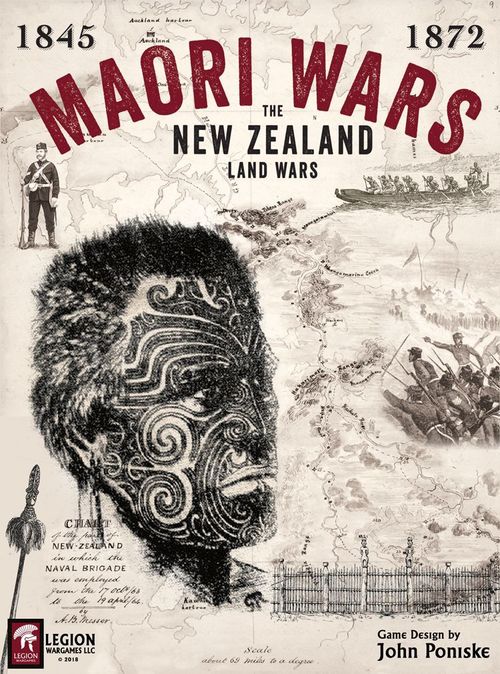
Maori Wars: The New Zealand Land Wars, 1845-1872
Maori Wars: Errata and Questions and Answers
Table of Contents
Table of Contents
Errata and Clarification
- Evasion Attempt (9.0 - 2): Units that have evaded a prior attack may be attacked again by a different enemy force.
- Battle Dispatch Chit #27 is not on the BDS sheet. Effects: British receive a +1 DRM in this combat.
- Hone Heke scenario: Add Special instruction 5: Automatic Game Turn 1 reinforcements may overstack, as long as it is sorted out at the end of the coming Movement Phase.
- Combined Waikato & Tauranga scenario: Remove the sentence "Place back in the cup BD Chits: 31 & 32 when drawn, after their effects are applied" from Special Instruction 1.
Questions and Answers
Battle Dispatch Report Chart
Q1. Battle Dispatch Chit #16 "Engine Troubles": You have to back up the units and leaders to their starting hexes. What about any game state changes that have occurred in the meantime? What happens if an Alliance was made with a neutral tribe? A. Game state changes stay as they are. Consider the return as being done the moment the BD chit is drawn.
Q2. Battle Dispatch Chit #19-22 "Improved Defenses": Please confirm that the restriction of not being applicable to a space under attack applies to both sides, rather than just the Maori. A. Yes, both factions are restricted from upgrading a hex currently under attack.
[1.0] Victory/Scoring
Q1. Is there any difference between destroyed and eliminated when it comes to structures? A. No.
Q2. Does the Maori player get VP for destruction/elimination of Queenite Pa or Village structures? A. No, Maori player do not get VP for Queenite structures.
[4.0] Stacking Rules
Q1. Can settlements and forts be stacked during game play or scenario setup? Rules state they stack for free? A. No. Settlements, forts, villages, and Pas may NOT be stacked, although a Fort may be added to a town (see 14.0). Stacking for free refers to the fact that structures do not count against combat unit stacking.
[6.0] Movement Phase
Q1. By "sole leader" you mean a leader with no other units in the hex, right? A. Correct.
Q2. Does movement into a structure on rough terrain mean you need to use the rough terrain movement cost? A. Correct.
Q3. Can gunboats finish their movement, by themselves, on a coastal hex? A. Yes.
Q4. Gunboats using sea movement costs 0 movement. How many times can a Gunboat transport units? A. Once per Movement phase.
Q5. Can a Gunboat transport units then move again, to possibly bombard a neutral or Maori unit? A. No.
Q6. Canoes and Gunboats: "Canoes which have can, by paying 1mp per hex..." Do you mean canoes pay 1mp per hex entered when they move? A. Yes, sorry for the typo.
Q7. It seems that a unit cannot both carry canoes and be transported by canoes in the same turn? A. Correct.
Q8. Canoes that are carried are destroyed if alone in a hex, but canoes alone in a hex can also be captured. Do you mean that canoes alone in an all land hex, carried and then dropped for whatever reason, are destroyed, but canoes on a river may be dropped and potentially captured? A. Correct.
[7.0] Rally Phase
Q1. Can only leaders perform rally on units? A. No, a unit may rally on their own on a roll of "6".
[9.0] Combat Phase
Q1. If units must retreat and the only space they can retreat to is a fully stacked hex, what happens? A. Then the hex will become overstacked. In this case, immediately move any exceeding units according to the instructions in rule 4.0.
Q2. How far can a unit retreat? Should it also be to the closest eligible hex? A. No, a unit retreats 1 hex (but see the question above).
Q3. Does advancing or retreating use a unit's available move points? A. No.
Q4. Is it correct to say that a single enemy hex may be attacked by multiple adjacent friendly units in one large combined attack, or if the attackers occupy multiple hexes, each attacking stack could attack separately? A. Both are correct.
Q5. May newly allied units (after bombardment, for instance) mount an attack in the same Combat Phase? A. Yes.
Q6. Hex A contains a Gunboat that wishes to bombard adjacent hex B. Hex C contains a British unit that wishes to attack hex D. Are these two separate attacks that can take place in an order chosen by the phasing player? A. Correct.
Q7. Do leaders add to the size of a unit for force size or for "Abandon Defenses" (retreat if attacking force is larger than your own)? A. No, leaders do not add to stacking/size.
Q8 (7 in sheet). If I have a stack of 4 units, could each unit attack individually (4 attacks), or must they operate as a single unit? A. Units in the same stack may attack individually or together in any combination. But units stacked together may not attack different hexes.
[9.2] Evasion
Q1. If I have a mixed stack of unit types, is the single die roll applied to each unit individually, or is a "lead unit" chosen to determine whether the stack may evade? A. That would be your choice. You can bank it all on one roll or take your chances - one at a time.
[9.3] BD-Chits
Q1. Battle Chit 5: "Change sides" explicitly says choose an enemy unit and village stacked together. Does this mean I cannot choose a village alone or unit alone and have them change sides? A. Correct.
Q2. For chit 32, does the stack of 3 or greater not have to be the attacking stack, but any stack on the map? A. The intention is for the attacking stack to be moved, but if it is less than three, then any stack on the map is eligible.
Q3. During my first turn of the first scenario I drew battle chit 32. Supply breakdown (return one stack containing 3 or more units to nearest fort). The only stack I had that qualified was my large stack in Auckland and thus had to move the stack to the nearby starting fort. Should towns also be included on this Battle report or did I play correctly? A. You played correctly.
Q4. Would a settlement be considered a source of supply for chit 32? A. No.
Q5. Battle Chit 33. Are the British required to upgrade two settlements to forts, or may they elect not to? A. Players are required to do the upgrades.
Q6. I drew the "send in the Marines" chit as Britain was attacking with a Queenite force led by Pomare. Since queenites cannot command British soldiers, does that mean the naval Marine unit is NOT allowed to join Pomare's forces? A. Not at all. You can send them in.
[9.4] Bombardment
Q1. Am I correct in assuming that Gunboats and artillery only bombard when attacking, NOT when defending? A. Correct.
Q2. When performing bombardment do you ONLY roll against the Pa, or could you choose to instead roll against the Maori within? A. You choose the target, troops OR Pa.
Q3. Can a Gunboat ferry units in the Movement Phase and then subsequently perform a Bombardment in the Combat Phase? A. Yes.
Q4. Are Maori able to counter-attack a bombardment? A. No.
Q5. Gunboats may bombard any ADJACENT hex correct? A. Gunboats can only bombard if there is a "water connection" between target and Gunboat (same river etc).
Q6. Hex A contains a Gunboat and a British unit that both wish to attack adjacent hex B. This is a single attack, of stacked units that attack a single hex. Does this simply follow Combat Procedure where Bombardment will not happen till step 4 after steps 1-3 have been executed? A. Correct.
[9.6] Defensive Counter-Attack
Q1. If the attacker has 3 units in a hex but has declared that the attack will only be mounted with 1 of those units, is that 1 unit the sole eligible target of any Defensive Counter-Attack? A. No, the strengths of all 3 units are added together when a counter-attack is directed towards that hex.
Q2. Are the Counter-attack (step 6) and Attack (step 7) of each "single combat" resolved with a single dieroll each? Or does each non-disrupted unit roll individually? A. Single dieroll in each single combat (not per unit).
[9.7] Attack
Q1. Are all attacks declared at once? A. No, one at a time.
Q2. Must all attacking units advance if an advance after combat is taking place, or can the attacker advance with just some of the attacking units? A. Any advancement is voluntary.
Q3. When attacking an unoccupied town, settlement or village, am I correct in thinking that the attacking unit rolls on the greater force column and any result other than NE allows that unit to advance into the settlement or village and destroy it (or occupy it, in case of town)? A. Correct.
Q4. Does attacking a village on rough terrain add -2 drm? A. Not if it is undefended. A lone Village or Settlement does not roll at all and therefore has no DRM.
Q5. If a village was defended, would the attackers suffer a -2 DRM if it was on rough terrain? But if they attacked an undefended Pa or Fort on rough terrain they would only get the -1 DRM? A. Yes to both. A defended village uses the terrain DRM. A defended Pa or Fort uses its own DRM.
Q6. Do Pa/Forts add to a unit's strength when calculating whether attacker is greater/lesser/equal? If 3 units attack 2 units in a fort/pa, do both sides roll as equal? A. A Pa adds no strength and will always roll on "Lesser Force". A Fort adds no strength as such, but it will (unoccupied or not) always have a strength of at least 2 (Examples: a unit + Fort has a total strength of 2, two units + Fort also have a total strength of 2, three units + Fort have a total strength of 3).
Q7. I attacked a defended Pa and killed the occupants. Can I then immediately advance into it and destroy the village for free with no additional rolls needed? Or can I not do that till an additional combat phase or with a separate adjacent unit? A. You can advance into the hex where the Pa/Fort was, if its occupants are gone. By advancing, you automatically destroy the Village/Settlement that should have replaced the Pa/Fort (see rule 9.0-7).
Q8. You must attack an enemy settlement to "enter"/destroy it, correct? Forts and Pa roll defensively and get a DRM when attacked, but other structures do not. What is considered a successful attack against an unoccupied structure? A. That you get a result that is anything but "No Effect".
Q9. Is a player free to choose which unit within a stack receives disruption without restriction? For example, if a stack contains 3 units and 1 of those units is already disrupted, can the player choose to make the already disrupted unit take any new disruption (resulting in a Panic roll) or must the disruption first be applied to any units without disruption? A. Disruption is distributed by the units' owning player, but any un-disrupted unit is targeted first.
[10.0] Bush Raider Phase
Q1. When raiding it seems normal combat rules do not apply. Do both attacker AND defender ignore retreat effect, or just attacker? A. Both attackers and defenders ignore retreat effects.
Q2. When it says "then raided defenders roll", does that mean they get to attack even if disrupted? A. No, Disrupted units do not attack.
Q3. The reference to raiding units raiding "by themselves or together with other units" means other units in the Raid Box/Raid Map, correct? A. Correct.
Q4. The DRMs listed for raiding apply to both types of raids, against units in the Raid box and against those on the main map? A. Yes.
[13.0] Attrition Phase
Q1. When doing British supply, it states that you choose one unit to become disrupted. Is that one unit per out of supply HEX, or only one single unit from the total of ALL units and hexes out of supply? A. Only one unit, in total.
Q2. Do leaders count as "units" for Maori supply requirements? A. No.
[14.0] Scenarios
Q1. Can the Maori player receive the 2vp more than once for occupying a specific town? For example: If the Maori occupy a town at the end of successive game turns, or if they occupy it again in a later turn. A. No, you get the VP once only.
Q2. Does the Maori player move first in all scenarios? A. Yes.
Q3. For the Maori structures to be placed on the Waikato River, can they be put in hexes in the Northern Interior region? A. No - the designated areas indicates this.