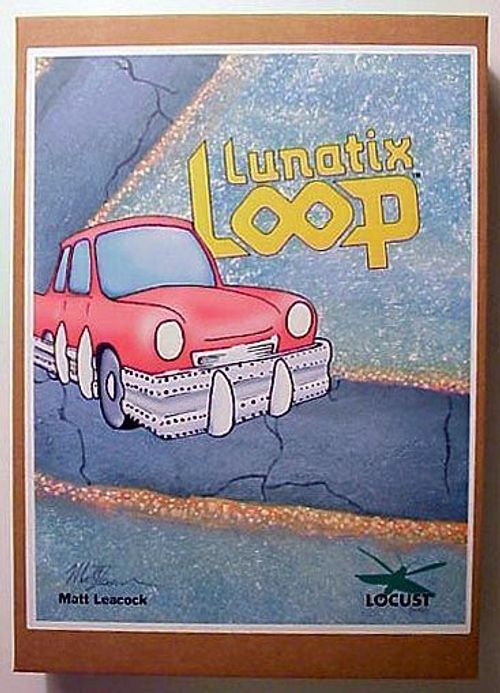
Lunatix Loop
Lunatix Loop FAQ
Table of Contents
Table of Contents
- Frequently Asked Questions
- When I exit the pit, which exits can I use?
- What happens when I play the ram action card, but there is nobody around to ram? The rules state that I can only play the card when there is an eligible target.
- Do I have to reduce speed when I take damage on turns that I Turbo?
- Sometimes when taking damage from hazard cards I end up slowing down, either by braking or by taking damage. Do I reduce the number of hazard cards that I need to take in these situations?
- What happens when (for example) a car that was going 100 m.p.h. moves 10 squares and is then forced to brake because of a hazard card or glue chip? Does the car need to move back since it could not end up making it that far down the track at the new speed?
- How many times may I change lanes during my turn?
- Do you draw Hazard Cards for each square that your car moves through over the safe speed, or do you just draw cards when you enter a curve?
- Why can't I play the Ram card when I'm in front? It often means that I can't win the race when I'm in the lead on the last turn.
Frequently Asked Questions
When I exit the pit, which exits can I use?
You must exit the pit in either of the two exits opposite the the entrance that you entered it. When using the Basic Rules, you may only enter and exit using the entrance and exit pictured on the board diagram.
What happens when I play the ram action card, but there is nobody around to ram? The rules state that I can only play the card when there is an eligible target.
At the beginning of a round, you may play the ram card if you are able to reach an eligible target at your current speed. On your turn however, if your target also played the ram card, he may move out of range - potentially leaving you with no one to ram. If this happens, just move normally. There is no penalty.
Do I have to reduce speed when I take damage on turns that I Turbo?
Since you ignore your maximum speed on turns that you turbo, you never need to slow down -- even when taking massive amounts of damage -- on turns that you turbo. Simply move the red (maximum speed) pawn down, but leave the silver (current speed) pawn where it is.
Sometimes when taking damage from hazard cards I end up slowing down, either by braking or by taking damage. Do I reduce the number of hazard cards that I need to take in these situations?
No. Calculate the total number of cards you'll need to draw when you enter the curve and apply all of them, one at a time, regardless of the effects. It may help to pull the total number of cards off the deck first. The only exception to this is the supreme control card which lets you to immediately discard any remaining hazard cards that you have not yet applied to your car.
What happens when (for example) a car that was going 100 m.p.h. moves 10 squares and is then forced to brake because of a hazard card or glue chip? Does the car need to move back since it could not end up making it that far down the track at the new speed?
No. Braking caused by hazard cards and glue does limit the final speed of the car (and thereby the total number of squares moved on the turn), but braking should never cause a car to back up. In these cases, simply leave the car in the square where it encountered the final hazard or glue chip.
How many times may I change lanes during my turn?
You many change lanes as often as you wish. Changing lanes many times on one turn can be a good way to use up extra movement before a sharp turn.
Do you draw Hazard Cards for each square that your car moves through over the safe speed, or do you just draw cards when you enter a curve?
Hazard Cards are drawn when you enter a curve over the safe speed. Once these cards are drawn, you need not draw any additional hazard cards unless you: 1) accelerate when in the curve or 2) move in a lane when in the curve. (See Curves.)
Why can't I play the Ram card when I'm in front? It often means that I can't win the race when I'm in the lead on the last turn.
The order of play was designed to keep everyone in the race until the bitter end. You may want to try the Alternate Winning Conditions (an optional rule) for a more 'realistic' endgame.