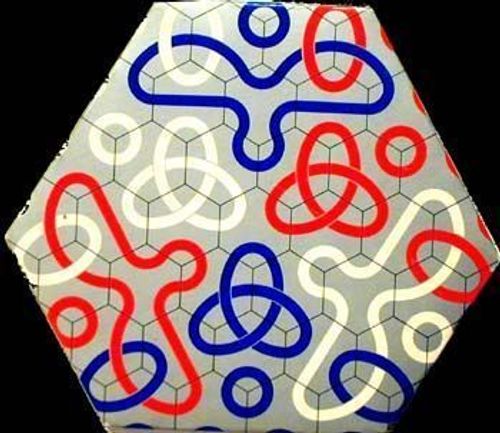
Kaliko
Kaliko Play Examples
Source: "Kaliko Play Examples" page by Four Papayas and a Fnord Software (4PF, 2002); the diagrams are not reproduced.
Examples of Plays
Example 1. A red scoring path is formed. Tile 1 provides the segment that joins two existing ends, and tiles 2 and 3 extend the path. This play scores 7, 1 point for each segment in the path.
Example 2. The red scoring path is connected to the pattern in two different locations: tiles 1 and 2 connect one pair of ends, and tile 3 connects another pair; tile 4 extends the path. This play scores 12.
Example 3. The red scoring path is closed by forming a complete loop. The path consists of 5 segments; because a closed path scores double, this play scores 10.
Example 4. The blue scoring path is connected to the pattern using all three tiles. Two additional segments from the tiles extend and cross over the path. With 7 segments plus 1 crossover, the score for this play is 10.
Example 5. The red scoring path is the main path, using both of the tiles in the play. A blue scoring path is also formed, and counts towards the score. Additional tiles could be added to the red path, but not to the blue. The red path, with 4 segments and a crossover, scores 7; the blue scores 6, for a total of 13.
Example 6. A number of tiles are used to connect two widely separated red ends. Note that the pattern now contains a hole that is impossible to fill: there are no tiles with one red edge and three white ones.
Example 7. This play forms two scoring paths; the main, white, path is closed, scoring 8, while the incidental blue path scores 14, including the crossover bonus, for a total of 22.
Example 8. This play forms three scoring paths; the blue, closed path is the main one, while the red and white paths are incidental.
Common Mistakes
No Scoring Path. In this play, it might seem that a scoring path has been formed, but it has not: the two blue ends already in the pattern have not been connected by the new tiles.
No Main Path. In this play, all the tiles are part of a scoring path, but neither the white nor blue path uses all the tiles.