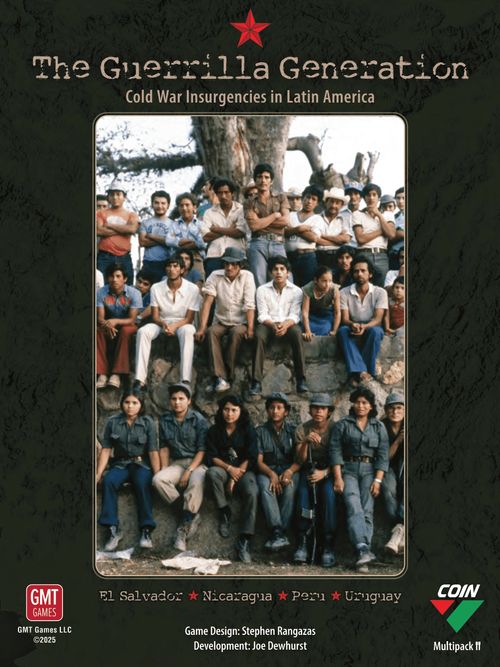
The Guerrilla Generation: Cold War Insurgencies in Latin America
The Guerrilla Generation Scenario Book
Table of Contents
Table of Contents
Introduction
The Guerrilla Generation is the second COIN multipack, providing four two-player games on insurgencies in Latin America from 1968 to 1992. Facing the common experience of economic inequality and state repression, a generation of youth joined insurgent movements across Central and South America in the second half of the 20th century. The broader Cold War loomed over two of the conflicts, El Salvador and Nicaragua, while democracies in Uruguay and Peru faced leftist insurgencies. The historical simulations that comprise The Guerrilla Generation multipack are designed to depict a wide variety of different types of insurgencies, focusing on four types: a militarized insurgency capable of taking on government forces (FMLN), a brutal ideologically rigid insurgency (Shining Path), a clandestine urban guerrilla movement (Tupamaros), and cross-border raiders funded by external powers (Contras).
This multipack is intended to help synthesize a crucial part of Latin American history, as well as encourage players to think more broadly about variation across insurgent groups. Armed actors, represented by roles taken on by players, often adopted unethical strategies such as the intentional targeting of civilians to coerce them to their side or weaken the opposing side. The Salvadoran military used scorched earth tactics and the systematic bombing of guerrilla zones. The military in Uruguay utilized extensive torture to crush the Tupamaros before going on to end the country's democracy. Insurgents, such as the Contras and Shining Path, deliberately terrorized civilians to advance their goals. Engaging in an interactive exploration of these strategies can be deeply uncomfortable; however, I would argue that interacting with these strategies is central to understanding the conduct of both these specific historical conflicts and, unfortunately, many contemporary ones. More importantly, I hope the games are useful for illustrating why many of these unethical strategies struggle to "work" as the armed actors intended, often even backfiring. I would encourage players to engage seriously with the games and the conflicts that they depict and to think carefully about the historical analogs of their actions while they play.
Cover image: Contras with weapons on a tractor, Nicaragua, 1983 (Richard Cross Photography Collection)
Box cover image: A crowd of guerrillas and civilians, La Palma, Chalatenango, 1983 (Richard Cross Photography Collection)
This booklet serves several functions. First, it provides the rules for the connected Resisting Reagan scenario that allows players to combine the El Salvador and Nicaragua games, along with additional Scenario Events and mechanics, to explore the higher-scale dynamics between the Reagan administration and Central America Peace Movement (CAPM) that shaped the American posture toward the Central American conflicts. The booklet also provides Pre-War Options tables for each game, which modify the starting setup in either random or player selected ways. It then outlines Faction Personas that provide players with an additional way to play, particularly for "multi-hand" solo play. Finally, it concludes with extensive Designer and Developer Notes and the full bibliography used to research the multipack.
Component Manifest
A complete set of The Guerrilla Generation includes:
- Two 17”x22” mounted game boards, each double-sided.
- Four decks of 53 (El Salvador), 39 (Nicaragua), 40 (Peru), and 39 (Uruguay) Event cards.
- One deck of 29 Resisting Reagan Scenario cards.
- 20 dark blue cubes, 20 light blue cubes, 12 red cubes, 20 pink cubes, 20 red embossed octagonal cylinders, 20 dark blue embossed octagonal cylinders, 7 flat dark blue disks, 4 flat red disks, 1 embossed flat red disk, 7 embossed cylinders (4 red, 3 dark blue).
- Six black and ten white pawns.
- One and a half counter sheets.
- Twelve double-sided player aid sheets.
- Four double-sided player mats.
- Three six-sided dice (two red, one blue).
- Four rules booklets.
- This scenario booklet.
The Rules of Play booklet for each game in the multipack includes a list of which components you should use when playing that game. A spare of each wooden piece is also included.
Resisting Reagan Scenario
The Resisting Reagan scenario allows players to connect the El Salvador and Nicaragua games into a single combined game. The scenario allows players to explore how debates in the United States between the Reagan Administration and the opposing social movement broadly known as the Central America Peace Movement (CAPM) affected the civil wars in Central America. The two games will be played side by side with additional rules, cards, and a display to cover the new mechanics described below. The scenario can be experienced as either a two-player game, with each player controlling two factions, or a four-player game with two teams. In addition, the Pre-War Options tables for El Salvador and Nicaragua found later in this booklet may optionally be used with the Resisting Reagan scenario.
NOTE: It is strongly recommended that all players be familiar with the rules for the individual El Salvador and Nicaragua games prior to attempting the scenario, given the additional rules overhead. In addition, although an effort was made to make the scenario roughly balanced, the scenario is mainly included as an additional narrative experience, rather than a finely tuned competitive game, due to the additional randomness from the Scenario Events and Pre-War Options tables (if used).
Scenario Alliances. For the purposes of the Resisting Reagan scenario the four Factions in the El Salvador and Nicaragua games are split into two "Alliances": the Reagan Administration and the Central America Peace Movement. The Reagan Administration, referred to as the "Administration", will control the two "blue" Factions: Government in El Salvador and Contras in Nicaragua. The Central America Peace Movement, referred to as the "CAPM", will control the two "red" Factions: FMLN in El Salvador and Government in Nicaragua.
If playing with two players, each player will control both of their Alliance's Factions, alternating between campaigns of each game. If playing with four players, each player will control one Faction, allowing for simultaneous play of the individual game campaigns. The scenario rules are written from a two-player perspective, with additional four-player rules found in section 9.0.
DESIGN NOTE: The Resisting Reagan scenario provides broader context on how actors within the United States played a major role in escalating and de-escalating the civil wars in Central America, at the expense of shifting attention away from the agency of local actors in the affected countries by engaging in an abstraction of grouping actors within the United States and the region into aggregate "sides". As mechanics within the specific games of El Salvador and Nicaragua demonstrate, there was significant preference divergence between local actors and actors in the United States. For instance, although some activists were quite vocal in their support for the Sandinista regime, others were more critical of the regime's policies, seeing their primary goal as only constraining US-sponsored Contra violence.
1.0 Scenario Components
The components listed here will be used throughout the scenario, in addition to the components required for each game:
- The Resisting Reagan Political Display.
- The Resisting Reagan Scenario Sequence of Play aid sheet.
- Additional markers from the countersheet: 1 × El Salvador Aid, 1 × Contra Aid, 1 × Public Opinion, 1 × Reagan's Prestige, 2 × WFP, 6 × Refugees.
- One deck of 29 Resisting Reagan cards, separated into a Reagan Administration deck (R1-R9) Central America Peace Movement deck (R10-R18), a Regional Events deck (R19-R27), and two External Support cards (R28 and R29).
2.0 Scenario Setup
Set up the scenario as follows:
- Conflict Setup. Set up the El Salvador and Nicaragua games normally, with the El Salvador map ideally to the left of the Nicaragua map (to reflect their geographical locations). If desired, roll on the relevant Pre-War Options tables for each game (it is recommended not to use the Faction Personas while playing the scenario).
- Political Display Preparation. Set the Resisting Reagan Political Display within easy view of each player. Set the Public Opinion marker on the "Start" space of the Public Opinion track, the El Salvador Aid marker on the "ES Start" space on the Congress track, the Contra Aid marker on the "Contra Start" space of the same track, and the Reagan's Prestige marker on the "6" space of the Reagan's Prestige track.
- Deck Preparation. Shuffle the Administration, CAPM, and Regional Event decks separately, then set each near to the Political Display. In addition, set the blue External Support card near the Administration player and the red External Support card near the CAPM player.
3.0 Reagan's Prestige
The outcomes of both individual games contribute to the overall scenario score, Reagan's Prestige, that determines which of three outcomes players receive at the end of the scenario (8.0).
3.1 Tracking Reagan's Prestige. Reagan's Prestige is tracked on the Political Display and will always range from 0-12 (it may never go below 0 or above 12, any additional movement beyond those values is lost). Reagan's Prestige is moved by the outcome of each game (3.2), by certain Scenario Events (4.0), and by the Congressional Aid markers at the end of the scenario (3.3). The position of Reagan's Prestige at the end of the scenario determines which scenario outcome occurs (8.0).
DESIGN NOTE: Reagan's Prestige is focusing only on the legacy of his administration's response to the Central America Crisis, specifically the intense debates around supporting the Government of El Salvador and the Contra insurgents as part of the broader Reagan Doctrine. Realistically, even a low Prestige outcome in the scenario would have likely dented but not overturned Reagan's broader approval rating and legacy.
3.2 Conflict Scoring. The Political Will outcomes of each of the individual games (El Salvador and Nicaragua) will generate one of four possible results relative to the Reagan Administration's ability to roll back "communism" in the country: Communism Survived, Checked, Stopped, or Defeated. These results will shift Reagan's Prestige (3.1). The size of the shift in Prestige from these results is modified by the current position of Public Opinion (5.1).
DESIGN NOTE: The labels for the outcomes of the conflicts are framed from the perspective of the Reagan Administration. The Reagan Administration framed the conflicts as originating from external factors, particularly Cuban or even Soviet meddling in America's "backyard". The CAPM emphasized that the conflicts were being driven by internal factors, particularly legitimate economic grievances, and challenged the notion that the leftist insurgents and Nicaraguan government posed a "communist" threat to the United States. Although evidence then and subsequently uncovered confirms the CAPM's framing, the Resisting Reagan scenario is modeling the contest that determined how the Central American Crisis is framed and remembered in the United States today, while also demonstrating the real effects of the contest on Central America in the 1980s.
El Salvador Scoring:
- Communism Survived (–1 Prestige): If the FMLN achieves an early victory (1st or 2nd Propaganda Round) or the game ends with 0-2 Political Will.
- Communism Checked (+1 Prestige): If the game ends with 3-9 Political Will.
- Communism Stopped (+2 Prestige): If the game ends with 10-17 Political Will.
- Communism Defeated (+3 Prestige): If the Government achieves an early victory (1st or 2nd Propaganda Round) or the game ends with 18-20 Political Will.
Nicaragua Scoring:
- Communism Survived (–1 Prestige): If the game ends with Political Will 5 or greater.
- Communism Checked (+1 Prestige): If the game ends with 1-4 Political Will.
- Communism Stopped (+2 Prestige): If the game ends with a Contra victory at 3rd Propaganda Round (0 Political Will).
- Communism Defeated (+3 Prestige): If the game ends with an early Contra victory (1st or 2nd Propaganda Round at 0 Political Will).
Effect of Public Opinion on Conflict: Modify both Prestige outcomes above by the value of the current position of the Public Opinion Track (5.1) when each game ends: –1 Prestige if Disagree, no effect if Indifferent, +1 Prestige if Agree.
3.3 Congress Scoring. At the end of the scenario (7.5), adjust Prestige by the position of the Congressional Aid markers on the Congress Track (5.2): –1 Prestige for each marker on the Oppose side, +1 Prestige for each marker on the Support side, and no effect for any markers in the Skeptical space at the middle of the track.
4.0 Scenario Events
The Resisting Reagan scenario adds a deck for each Alliance and a shared Regional Events deck used by both Alliances.
4.1 Alliance Decks. There are two Alliance decks which will be separated and shuffled at setup (2.0). Over the course of a game, players use cards from their respective decks by either playing the Event to directly affect the game or discarding them during the Resolution Round to augment their Public Opinion and Congress rolls (7.3).
4.2 Regional Event Deck. Unlike the two Alliance decks, the Regional Event deck is shared by the players, with each Alliance drawing a Regional Event during the Preparation Round of each Act (7.1). Regional Events may hinder or help one or both sides.
4.3 Event Effects. There are generally three types of Events across the three Decks: Permanent (Personality, Organization, or Honduras), Momentum, and Immediate. When played or drawn, a player must implement each Event's effect to its full extent possible, unless the card explicitly specifies the player may choose how to implement it.
- Permanent Events possess deck-specific flavor: "Personality" for Administration, "Organization" for CAPM, and "Honduras" for Regional. Once played or drawn, these Events permanently modify existing game mechanics. Permanent Events should be set aside within reach of both players for easy reference. Personality and Organization Events, once in play, can only be discarded by specific Immediate Regional Events. Honduras Events are never discarded once in play.
- Momentum Events have a lasting effect until the next Reset Phase, when they are discarded. Momentum Events should be set within reach of both players for reference until discarded.
- Immediate Events have an immediate effect. Once resolved, Immediate Events are discarded and will have no additional effect on play.
4.4 Playing Alliance Events. Immediate Events may be played at any time from a player's hand. Permanent (Personality/Organization) and Momentum Events may only be played from a player's hand during the Execution Phase of the Preparation Round (7.1), but may also be spent during the Resolution Round (7.3) to enhance Public Opinion and Congress rolls. If used for the latter effect the card's text is ignored, except for the numerical value next to its type that indicates the die roll bonus (+3 for Personality/Organization, +2 for Momentum, +1 for Immediate).
5.0 Congress and Public Opinion
In addition to the civil wars in El Salvador and Nicaragua, players will compete over two tracks on the Political Display representing the position of the United States Congress and Public Opinion. The position of the tracks can directly affect the resources available to the Reagan Administration's allies in Central America and the final scoring of the scenario (3.2, 3.3).
5.1 Public Opinion Track. The Public Opinion track represents the American public's opinion of the Reagan Administration approach to the conflicts in Central America. The current position of the Public Opinion track modifies the Reagan Administration's Congress Rolls during the Resolution Round (7.3). The less the public agrees with Reagan's policies the harder it will be for the Administration to sway Congress in their favor. In addition, the position of the Public Opinion Track at the time of scoring a conflict modifies the Prestige gained or lost from the outcome (3.2).
5.2 Congress Track. The Congress track has two Congressional Aid Markers that represent the willingness of Congress to authorize aid to the Reagan administration's allies in Central America: an El Salvador Aid marker and a Contra Aid marker. The position of the Congressional Aid markers changes the resolution of the Propaganda Round in the individual El Salvador and Nicaragua games:
- El Salvador: During the US Congress step of the Resources Phase, if Political Will is less than 11, the Government instead gains Aid equal to the current position of the El Salvador Aid marker on the Congress Track.
- Nicaragua: During the Congressional Pressure step of the Redeploy Phase, instead shift the US Aid Track as dictated by the current position of the Contra Aid marker on the Congress track.
In addition, the positions of the Congressional Aid markers affect Reagan's Prestige at the end of the scenario (3.3).
5.3 Shifting Congress and Public Opinion. The markers on the Congress and Public Opinion Tables are primarily shifted during the Lobbying and Appeals Step of the Resolution Round (7.3). The markers may also be shifted by specific Scenario Events (4.0).
6.0 External Support
Each Alliance possesses an "External Support" card that may be granted by their Government Faction to their Insurgent Faction, allowing them to enhance one Limited Operation with a Special Activity.
6.1 Granting External Support. During the Preparation Round (7.1) each Alliance can decide to spend 2 Resources from their Government Faction to pass their External Support card to their Insurgent Faction (from El Salvador Government to Contras for Administration, from Nicaragua Government to FMLN for CAPM). Each External Support card, whether used or not, is always returned to its respective Government Faction during the Reset Phase and can be granted again in the next Preparation Round.
6.2 Using External Support. If granted External Support by their Government ally, an Insurgent Faction may use the card once to add an allowed Special Activity to a Limited Operation when resolving the Limited Operation space of the Initiative Track. Limited Operations granted by Events are not eligible for the use of External Support. Once used the External Support card is passed back to the respective Government Faction.
EXAMPLE: The FMLN conducting a Limited Operation could use the External Support Card to add a Govern or Raid Special Activity to a Limited Sabotage.
7.0 Sequence of Play
The Resisting Reagan scenario alters the normal flow of the individual games of El Salvador and Nicaragua with its own Sequence of Play that adds several additional steps and breaks apart the Campaigns and Propaganda Rounds of the individual games. The scenario is played over three Acts each involving the following steps:
- Preparation Round
- Planning
- Execution
- Regional Event
- External Support
- Campaign Rounds
- El Salvador
- Nicaragua
- Resolution Round
- Propaganda Rounds
- El Salvador
- Nicaragua
If the Propaganda Round for El Salvador or Nicaragua ends that individual game, score the conflict: calculate the Prestige adjustment from the Conflict Outcome with any modifications based on the current position of Public Opinion Track (3.2). If one of the individual games ends early and is scored, remove the game and its components from play. Skip any steps of the scenario Sequence of Play or any Event text that refers to that specific game.
Once both El Salvador and Nicaragua have ended and been scored (3.2) conduct Final Scoring (7.5).
NOTE: A Campaign refers to the series of Event cards leading up to a Propaganda Round in an individual game of El Salvador or Nicaragua. In the Resisting Reagan scenario, when players reach an El Salvador Propaganda Round they should immediately pause and play a Campaign of Nicaragua, then when they reach a Nicaragua Propaganda Round they should immediately pause and conduct the Resolution Round, before finally resolving the Propaganda Rounds for each game and then continuing play with the next Preparation Round.
7.1 Preparation Round. At the start of each Act, players resolve a Preparation Round before conducting a Campaign of El Salvador and then Nicaragua. The Preparation Round consists of four sequential steps:
- Planning: Each player draws cards from their respective Alliance decks (Administration, CAPM): four cards in the first Preparation Round, three cards in the second round, and two cards in the third round. There is no limit to the number of scenario cards that may be in a player's hand.
- Execution: Starting with the Administration, each player may play up to two Personality/Organization and/or Momentum cards from their hand (Immediate cards may be played at any time).
- Regional Event: Starting with the Administration, each player draws a card from the Regional Event deck and resolves its effect, then discards it.
- External Support: Starting with the Administration, each player may decide to spend 2 Resources from their Government Faction to hand their respective External Support card to their Insurgent Faction (place it on or near the Insurgent Faction mat).
7.2 Campaign Rounds. Play a Campaign of El Salvador and then Nicaragua, pausing each game at the start of its Propaganda Round. Once both conflicts (if not yet resolved) have reached their Propaganda Round, proceed to the Resolution Round.
NOTE: Resolve the Resolution Round before resolving each Propaganda Round.
7.3 Resolution Round. After playing a Campaign of El Salvador and then Nicaragua, but prior to resolving the Propaganda Round of each game, conduct a Resolution Round.
Starting with the Public Opinion marker (5.1), both players roll a die to see how the marker shifts. The player with the greater roll shifts the marker one space, or if at least double the opponent's roll, shifts the marker two spaces. Then, repeat this process for the El Salvador Aid marker and the Contra Aid marker (5.1).
The roll for each marker may be modified by several factors. Modifiers are cumulative and calculated prior to rolling:
- Lobbying and Public Appeals. Before rolling, each player, starting with the Administration, may choose to commit a card facedown from their hand to modify the roll (+1 for Immediate, +2 for Momentum, and +3 for Personality/Organization). Reveal and resolve the modifiers once both players choose to commit a card or not, then discard any committed cards.
- Permanent or Momentum Events. Several Events have lasting effects that modify rolls.
- Human Rights Abuses. If there are four or more Terror markers on a single map (El Salvador or Nicaragua), add +1 to CAPM Public Opinion Rolls.
- Public Opinion. Subtract or add the value of the current position of the Public Opinion marker from each Administration Congressional Aid Roll (El Salvador Aid and Contra Aid).
- Soft on Communism. If El Salvador Political Will is less than 10 and Nicaragua Political Will is above 12, add +1 to Administration Congressional Aid Rolls (El Salvador Aid and Contra Aid).
7.4 Propaganda Round. After resolving the Resolution Round, conduct the Propaganda Round for El Salvador and then Nicaragua, scoring conflicts as needed (3.2). Each Propaganda Round is modified in the following ways:
- Interdict Supplies. At the beginning of the Political Will Phase the Insurgent Faction may lose a Base depending on a condition in the other conflict:
- FMLN Supply: If two or more Port spaces are Sabotaged in Nicaragua, FMLN must remove any one FMLN Base on the El Salvador map. Increase El Salvador Government Political Will by 1 if an FMLN Base is removed.
- Contra Supply: If there are fewer than two Government Bases on the map in El Salvador, Contras must remove any one Contra Base on the Nicaragua map. Increase Nicaragua Government Political Will by 1 if a Contra Base is removed.
- Congressional Support. The US Congress and Congressional Pressure steps are modified by the current position of the relevant Congressional Aid markers:
- El Salvador: During the US Congress step of the Resources Phase, if Political Will is less than 11, the Government instead gains Aid equal to the current position of the El Salvador Aid marker on the Congress Track.
- Nicaragua: During the Congressional Pressure step of the Redeploy Phase, instead shift the US Aid Track as dictated by the current position of the Contra Aid marker on the Congress track.
- Reset. Return both External Support cards to the Government Factions (5.0). Discard all Momentum cards in play (4.3).
If both conflicts are now resolved, proceed to Final Scoring (7.5), and then read the Scenario Outcome (8.0). If one or both conflicts have not yet ended, instead return to the start of the Sequence of Play with the Preparation Round (7.1).
7.5 Final Scoring. Once both El Salvador and Nicaragua have ended, whether by automatic victory or Final Propaganda Round, and have been scored (3.2), modify Prestige by the final position of the Congressional Aid Markers (3.3). Then, check the Scenario Outcome (8.0).
8.0 Scenario Outcomes
The final position of Reagan's Prestige marker (3.1) decides the outcome of the Scenario. There are three possible Scenario Outcomes:
- Backyard Secured!: Prestige 9-12.
- Stalemate in Central America: Prestige 4-8. (Historical Result)
- Reagan Resisted!: Prestige 0-3.
Backyard Secured! and Reagan Resisted! are clear wins or losses for the Administration player respectively. Players may discuss whether Stalemate in Central America represents a draw or minor Administration victory depending on how the games progressed. It is strongly recommended that players consider not only the final Prestige but also how each side conducted itself when evaluating the legacy of the more ambiguous Stalemate result.
DESIGN NOTE: High Prestige outcomes represent Reagan's Central America policy boosting his legacy and the ability of the executive branch to guide American foreign policy unhindered by domestic constraints. In contrast, a low Prestige outcome would likely dampen Reagan's overall legacy while encouraging further domestic constraints on the executive branch's ability to intervene abroad, like those that followed the Vietnam War. The more ambiguous outcome of Stalemate in Central America allows each side to "claim" a partial victory. The ambiguity of the historical result allowed each side to use the lessons and framings of the period to further their position in future debates on foreign intervention, such as references to the "Salvador Option" in debates around the conflicts in Iraq and Afghanistan. Regardless of the outcome for Reagan's legacy or debates on the proper role of the United States in the world, the human costs of the civil wars in Central America were unambiguously horrific. That fact is why players are strongly encouraged to consider the conduct of each side over the course of the scenario, rather than just its outcome.
9.0 Multiplayer Variant
The Resisting Reagan scenario can also be played as a four-player team game, with two players on each side controlling one of their Alliance's Factions (9.1). The four-player variant involves a number of mechanical tweaks to the rules presented above (9.2), and also slightly adjusts the interpretation of the outcome of the scenario (9.3).
9.1 Alliance Teams. Rather than having each player control a single Alliance with two Factions, each side is now a team including an El Salvador player (Government for Administration, FMLN for CAPM) and a Nicaragua player (Contra for Administration, Government for CAPM). Each player will possess their own hand of scenario cards and make all decisions when playing out their respective conflict.
9.2 Sequence of Play Changes
- Preparation Round (Planning): The player on each team whose conflict has lower Political Will, El Salvador if tied, draws all the cards for their team. Then, that player selects one card for their hand and passes the rest to their teammate, who will select one for their hand and pass the remaining cards back. Players will repeat this process until all the drawn cards for each team have been selected.
- Preparation Round (Execution): Starting with the Administration team, each player on the team may only play at most one Personality/Organization or Momentum Card. The Government player on each team should decide first if they will play a card, followed by the Insurgent player.
- Preparation Round (Regional Event): Only one member of each team draws a Regional Event. The player on each team whose conflict has lower Political Will, El Salvador if tied, draws the Regional Event.
- Preparation Round (External Support): Each Government player decides whether to pay 2 Resources to hand their External Support card to their Insurgent partner.
- Campaign Rounds: Instead of playing a Campaign of El Salvador then Nicaragua, it is strongly encouraged that the respective players from each team simultaneously play a Campaign of each game, pausing to consult with their teammate and play Immediate Events as necessary.
- Resolution Round (Lobbying and Public Appeals): Players on a team may discuss who will commit a face down card to modify a roll, but only one Event card may be discarded for each team on a specific roll. If players cannot decide, the Government player on each team should decide first if they will play a card, followed by the Insurgent player. Either player may make the roll.
9.3 Scenario Outcome Changes. When playing the four-player variant, each player takes on the role of administration officials or activists focusing on one particular country. An individual player does not only care whether their team wins but also wants to ensure the desired outcome in their specific conflict. Instead of the normal Scenario Outcomes, evaluate the following for each player:
- Major Victory: Country Won and Alliance Won.
- Minor Victory: Country Won and Alliance Lost or Drew.
- Minor Defeat: Country Lost and Alliance Won or Drew.
- Major Defeat: Country Lost and Alliance Lost.
Determine Alliance Outcomes based on the usual Scenario Outcome (Backyard Secured! is a win for Administration Alliance and loss for CAPM Alliance, Reagan Resisted! is a win for CAPM Alliance and a loss for Administration Alliance, Stalemate in Central America! is a draw for both Alliances). Determine Country Outcomes based on the usual victory or loss for the individual games of El Salvador and Nicaragua.
NOTE: Treat a Political Will 10 result in El Salvador as a Government Win when evaluating the outcomes above.
DESIGN NOTE: When playing the multiplayer variant of the Resisting Reagan scenario, players take on the role of actors whose individual prestige and concerns primarily focus on one of the two countries, such as bureaucrats in charge of executing the Administration's policy or activists in a social movement focusing on mitigating the harm in either El Salvador or Nicaragua. This creates a tension between helping the broader Administration or CAPM goals versus focusing just on each player's specific conflict.
Photo note: Civilians fleeing for refuge, Usulután, El Salvador, 1982 (Richard Cross Photography Collection)
Scenario Event Tips & Backgrounds
The card backgrounds below provide brief summaries of the historical events and the rationale behind the effects on the Resisting Reagan scenario cards. Those looking to read more about the Central America Peace Movement (CAPM)'s efforts to resist Reagan should seek out Christian Smith's Resisting Reagan: The U.S. Central America Peace Movement. Smith's book gives an excellent overview and inspired the scenario's name. In addition, William LeoGrande's Our Own Backyard: The United States in Central America, 1977-1992 provides a nice discussion of all three battlegrounds and their connections.
The images on cards R4 and R9 are from the Richard Cross Photography Collection, courtesy of the Tom & Ethel Bradley Center at California State University, Northridge.
R1. William Casey Directs CIA — PERSONALITY (+3)
Oversees sabotage operations: Nicaragua: Contra Sabotage in Coastal spaces may place all markers in an adjacent Port space if desired.
Tips: All spaces aside from Highlands and Managua City are Coastal.
Background: William Casey served as director of the CIA during the main years of the Resisting Reagan scenario (1981-1987). Casey approved the CIA's support of the Contras, including direct covert operations against Nicaragua such as amphibious raids on ports to disrupt the flow of international aid and trade into the country (Nicaragua Event N3). There is some evidence of Casey's involvement in the Iran-Contra Affair (Regional Event R27 and Nicaragua Event N20), but his hospitalization and death in 1987 prevented further investigation into his role in the affair.
Casey's lasting Personality effect allows the Contra player in Nicaragua to permanently gain the assistance of amphibious raids, with the only way of removing this effect being the Congressional Hearing Announced Regional Event (R27).
R2. Alexander Haig Gives Statement on Central America — PERSONALITY (+3)
Notorious administration hawk: At the end of each Political Will Phase the Administration may increase or decrease Political Will by 1 (before checking for Victory).
CAPM adds 1 to all Public Opinion rolls.
Tips: The Administration will want to decrease Political Will in Nicaragua and increase it in El Salvador (unless they are very desperate for additional Congressional aid).
Background: From 1981 to 1982, Alexander Haig served as Secretary of State for the Reagan administration. Haig played a critical role in the administration's aggressive stance toward conflicts in Central America, frequently making statements advocating for more escalatory acts to decisively end the insurgency in El Salvador and topple the new Sandinista government in Nicaragua. Haig's statements frightened the American public who worried that greater escalation could lead to another Vietnam (Regional Event R24).
Haig's statements led to his quick removal from the position of Secretary of State. Appearing before Congress, Haig downplayed the slaughter of American Catholic missionaries by death squads in El Salvador, leading to widespread criticism. Additional poorly received statements during the attempted assassination of Reagan and other crises eventually led to his resignation in July 1982.
Haig provides a mixed effect for the Administration player. Haig's aggressive statements can bolster Political Will in El Salvador while lowering it in Nicaragua. However, those same aggressive statements undermine the Reagan administration's efforts to sell its Central America policy to the public, aiding CAPM Public Opinion rolls.
R3. Ronald Reagan Offers Support — PERSONALITY (+3)
"I guess that makes me a contra too": During each Resolution Round the Administration may add 2 to a single Congress or Public Opinion roll (chosen before rolling the die). Reduce Prestige by 1 if CAPM wins the roll.
Tips: The Administration must declare which roll they are modifying before making that roll.
Background: Although there remained consistently low public support for intensive US involvement in the Central American conflicts, likely over fears of another Vietnam (Regional Event R24), Ronald Reagan remained popular during his presidency. Reagan could leverage his personal popularity by making highly profile public statements in support of aid requests to Congress. For instance, Reagan famously referred to the Contras as "freedom fighters" going as far as to claim that:
So I guess in a way they are counterrevolutionary and God bless them for being that. And I guess that makes them contras and so it makes me a contra, too.
Rather than empty rhetoric, such framing proved critical for securing sufficient public approval to win a number of Congressional aid votes on an otherwise unpopular policy.
R4. Executive Evades Restrictions — MOMENTUM (+2)
Works around Congress: El Salvador: Government Limited Operations cost 0 Resources until the next Reset Phase.
Tips: This effect only applies to the El Salvador Government, not Nicaragua.
Background: In both conflicts, the Reagan administration sought to circumvent Congressional restrictions on its aid to the Salvadoran government and Contra insurgency. Since the administration's efforts to avoid restrictions on Contra aid are extensively modeled through the Iran-Contra mechanics and events in Nicaragua, this momentum card focuses on its tactics in El Salvador.
Congress placed strict restrictions on the number of "trainers" (a term used to avoid the Vietnam-laden "advisor") operating in the country. However, the Reagan administration avoided these limitations by operating training centers within Honduras or by quickly cycling trainers in and out of El Salvador to avoid permanently stationing too many there. Additionally, the Reagan administration repeatedly found ways to certify progress in El Salvador despite continued abuses by the military. This card removes the cost of Government Limited Operations to reflect either improved effectiveness (from additional training) or additional resources (continued flow of military aid).
R5. Show of Force in Central America — MOMENTUM (+2)
Military exercises in Honduras: Nicaragua: Government must move 3 Troops from anywhere to this card. Return Troops to Available during the next Reset Phase or if this card is discarded.
Tips: This effect only applies to the Nicaragua Government, not El Salvador. If the card is discarded by Pledge of Resistance Mobilizes Public (R18), immediately return the three Troops on it to Available.
Background: To force the Sandinista government to divert scarce resources to military spending and to deter incursions into neighboring countries where the Contras operated, the Reagan administration conducted a number of major military operations or exercises in Central America. The US military repeatedly conducted exercises in Honduras, such as Big Pine II and Golden Pheasant (pictured on this card), to raise the threat of a potential invasion. Even more concerning for the Sandinistas, Operation Urgent Fury (Nicaragua Event N27) toppled Grenada's Marxist regime after factional fighting broke out and threatened US citizens. The Central America Peace Movement (CAPM) responded to these escalatory acts with the Pledge of Resistance (R18) against any US invasion of Nicaragua.
This card forces the Nicaragua Government player to decide whether to divert Troops from the war against the Contras or undermine its economy (reduced Political Will) by further expanding its military through Mobilizing additional Troops from the Out of Play box.
R6. Office of Public Diplomacy Established — MOMENTUM (+2)
Guides public opinion: CAPM must discard Human Rights Report Published if it is currently in their hand.
El Salvador: FMLN may not draw from the Atrocity deck until the next Reset Phase.
Tips: None.
Background: The Office of Public Diplomacy became the administration's tool for spreading its Cold War framing of the conflicts in Central America, including the false rumors of Soviet MiGs being delivered to Nicaragua (R8). Its messaging downplayed the alternative framing offered by the CAPM that the conflicts in the region were driven by internal issues and genuine grievances (R17). The Office of Public Diplomacy eventually answered directly to the National Security Council, whose personnel included Oliver North (Nicaragua Event N23), the staffer highly involved in the Iran-Contra Affair. By countering CAPM claims of atrocities committed by the Salvadoran military and Contra insurgents, the Office of Public Diplomacy helped maintain congressional support for the Reagan administration's aid requests.
The Office of Public Diplomacy shields the Administration player from the effects of atrocities across the two conflicts. The CAPM player must discard Human Rights Report Published (R14), which is capable of drawing attention to human rights violations in the region to undermine Reagan's prestige. Furthermore, the FMLN is temporarily prevented from drawing cards from the Atrocity deck to expose crimes by the Salvadoran government.
R7. Advisors and Agents Sent Abroad — IMMEDIATE (+1)
Low-intensity warfare: Government (El Salvador) or Contras may immediately conduct an additional Limited Operation after conducting a Limited Operation on the Initiative Track.
Tips: This card may not be used to enhance a Limited Operation granted by an Event.
Background: Hoping to prove the United States had fully learned its lesson from defeat in Vietnam, the Reagan administration deployed experts in "low-intensity warfare" to assist with defending the government of El Salvador and bolstering the insurgency in Nicaragua. US advisors (El Salvador Event E6) trained the Salvadoran military, gradually improving its military effectiveness. CIA agents offered advice on insurgent tactics, including the infamous "CIA Terror Manual", to the Contra insurgents (Nicaragua Event N19).
R8. Rumors of MiGs for Sandinistas — IMMEDIATE (+1)
Misinformation spreads: Nicaragua: Cancel any shift to the US Aid Track during the Congressional Pressure step of the Redeploy Phase.
Tips: This card cannot be used to cancel other shifts to the US Aid Track, such as from an Event or if the Iran-Contra Affair is uncovered.
Background: A core strategy of the Reagan administration was to secure its aid requests through framing the Central American conflicts as part of the broader Cold War. Communism had to be stopped in America's "own backyard". One prominent example of furthering the Cold War framing involved spreading rumors of Soviet MiG aircraft or missiles being sent to the Sandinista government in Nicaragua. These rumors likely sought to recreate fears of another Cuban Missile Crisis scenario (see The Guerrilla Generation developer Joe Dewhurst's Resisting Revolution expansion for GMT's Cuba Libre).
Despite repeated administration statements about how the United States would not tolerate advanced MiGs in Nicaragua, there is little evidence of any aircraft being delivered. In 1986, the CIA concluded that the Soviet Union was "unlikely to send MiGs to Nicaragua in the near term". The fears, raised by the Reagan administration, of advanced Soviet weaponry supplied to Nicaragua threatening regional security seeped into popular conceptions of the period, including Victory Games' Central America (1987) with its many counterfactual scenarios.
R9. Elections and Reforms in El Salvador — IMMEDIATE (+1)
Democratic transition possible: El Salvador: Increase Prestige by 1 if the Government Posture Track is at the Reformist 4 space.
Tips: This card may be played immediately when the Government Posture Track reaches Reformist 4, even if a Reform card that may shift it back to the right is about to be drawn.
Background: A major metric for the Reagan administration of progress in El Salvador was its holding of elections, particularly those won by reformist candidates such as José Napoleón Duarte (El Salvador Event E40) in 1984. With Congress requiring certifications (El Salvador Event E53) for further aid to El Salvador, the Reagan administration needed a way of demonstrating continued progress moving El Salvador toward a stable electoral democracy. Many officials also hoped such an approach would undercut the insurgency by allowing the population to address their grievances through "normal" politics.
However, the simple theorized relationship between elections and progress proved more complex in practice. In the early 1980s, only meddling by the United States prevented the electoral victory of a rightist anti-reform candidate in El Salvador. In the late 1980s, Duarte's reformist Christian Democrat party lost the 1989 presidential election to a more centrist candidate. Elections also did not end the violence, and the political left only seriously returned to the electoral system after the civil war ended.
R10. Witness for Peace Established — ORGANIZATION (+3)
Discourages Contra attacks: Nicaragua: Place the Witness for Peace (WFP) markers in any 2 Departments. During each Political Will Phase, reduce Prestige by 1 for each space with a WFP marker and a Terror marker. During each Reset Phase, place the WFP markers in any 2 Departments. Remove the WFP markers if this card is discarded.
Tips: The WFP markers have no other effect except indicating where Contra Terror will reduce Prestige.
Background: Founded in 1983, the Witness for Peace (WFP) movement sent American peace activists to Nicaragua to serve as a deterrent to Contra attacks against civilian targets there. More than four thousand American citizens traveled to Nicaragua to serve as witnesses. This card allows the CAPM to protect spaces in Nicaragua from Contra terror. The Administration player may ignore these markers at the cost of lowering Reagan's prestige due to insurgent terrorism harming American activists, as happened with the slaying of Ben Linder (along with two Nicaraguan colleagues) in 1987.
R11. Sanctuary Movement Formed — ORGANIZATION (+3)
Shelters refugees: El Salvador: Place a Refugees marker on this card each time a space is selected for Air Strike.
CAPM adds 1 to Public Opinion rolls for every 2 Refugees markers on this card.
Tips: A single Air Strike Special Activity could place two Refugees counters if two spaces were selected.
Background: Inspired by Christian theology, the Sanctuary movement offered support to refugees fleeing from the conflicts in Central America, particularly the hundreds of thousands displaced in El Salvador. The movement responded to the Reagan administration's efforts to deny migrants political asylum. By denying asylum, the administration hoped to obscure the reason for their flight. More than seventy thousand Americans participated in Sanctuary activities in the clandestine support network. The Sanctuary movement also organized opportunities for refugees to give testimony about state terror back in Central America.
This card allows the CAPM to support the refugees created by government saturation bombing in El Salvador (El Salvador Event E51). By giving refugees an opportunity to give testimony about their reasons for fleeing, this card boosts the CAPM's ability to sway public opinion in line with the severity of the refugee crisis in the region.
R12. Central America Working Group — ORGANIZATION (+3)
Lobbies in Washington: During each Resolution Round, CAPM may roll twice for each Congress roll and select the higher result.
Tips: Whichever result is selected would then be adjusted by any other modifiers, such as a discarded CAPM card.
Background: The Central America Working Group (CAWG) was a lobbying group that aimed to build opposition among members of Congress against the Reagan administration's aid requests. CAWG coordinated lobbying from different parts of the broader movement that included leftist, religious, and peace groups. A major divide within CAWG was whether to protest all aid requests or only focus on blocking lethal aid. This card improves the CAPM player's ability to lobby in Congress against aid to the El Salvador government and Contra insurgents.
R13. Humanitarian Assistance En Route — MOMENTUM (+2)
Mitigates devastation: Nicaragua: During the next Resources Phase, increase Government Resources by 2 for each Sabotaged Port.
El Salvador: During the next Resources Phase, increase FMLN Resources by 2 for each FMLN Base in Honduras.
Tips: None.
Background: The Contra insurgency's central strategy was to devastate the economy of Nicaragua. Their violence destroyed civilian targets all along the border. Similarly, the Salvadoran military aimed to devastate areas controlled by the FMLN insurgency. To respond to this economic destruction, the CAPM and other sympathetic movements organized significant humanitarian assistance to alleviate civilian suffering in both countries. This card provides additional resources to the FMLN insurgency and the Sandinista government, responding specifically to Salvadoran refugees (FMLN Bases in Honduras) and sabotaged Nicaraguan ports.
R14. Human Rights Report Published — MOMENTUM (+2)
Reveals crimes: During the next Resolution Round, reduce Prestige by 1 for every 4 Terror markers across both maps (including on Bombing Worsens Mass Displacement if in play).
Tips: None.
Background: A goal of the CAPM and other human rights groups in the region was to highlight atrocities committed by the Salvadoran military, Contra insurgents, and escalatory acts by the Reagan administration. By revealing atrocities, human rights reports could undermine the Reagan administration's framing of the conflicts as a noble cause necessary to defend security in the region. This card reduces Reagan's Prestige in proportion to the number of Terror markers on the map. However, the Administration can block it from being played by using propaganda to pre-emptively discredit the validity of the human rights reports (R6).
R15. International Solidarity Movement — IMMEDIATE (+1)
Aid for Nicaragua flows in: Nicaragua: Remove a Sabotage marker from each Port space.
Tips: This effect removes only one Sabotage marker from each Port space.
Background: Although the CAPM player focuses on the efforts of peace activists in the United States and Central America, the Sandinista government in Nicaragua received aid from sympathetic countries throughout the world, particularly other communist states in Eastern Europe such as East Germany. This aid proved critical for mitigating economic sabotage by the Contras and also efforts by the Reagan administration to isolate Nicaragua by preventing international loans (Nicaragua Event N34) and establishing an economic embargo (Nicaragua Event N6).
R16. World Court Decision Reached — IMMEDIATE (+1)
Decision favors Nicaragua: Nicaragua: Reduce Prestige by 1 if the US Aid Track is at Offensive.
Tips: This card may be played immediately when the US Aid Track reaches Offensive.
Background: In 1986, the World Court delivered a blow to the Reagan administration by siding with Nicaragua. The court found that the United States violated international law by supporting the Contra insurgency, violating the principle of non-intervention. Although the World Court decision could not stop the United States from aiding the insurgency, flagrant evidence of American support for the Contras (Aid Track at Offensive) could result in an embarrassing legal defeat for Reagan (reducing Prestige).
R17. Alternative Framing on Central America — IMMEDIATE (+1)
Legitimate grievances fuel conflicts: If the Government Posture Track (El Salvador) is not at Reformist or if there are no Contra Bases in Nicaragua, shift Public Opinion 1 step toward Disagree.
Tips: This card can be played if either condition is met.
Background: The Central America Peace Movement (CAPM) tried to offer an alternative framing of the conflicts in Central America to the Cold War framing offered by the Reagan Administration (R8). The CAPM argued that the conflicts originated from legitimate grievances in the region, such as economic inequality and state repression, rather than external meddling by the Soviet Union and Cuba. The CAPM framing suggested that victories by leftists in Central America did not pose a threat to the region, and certainly not to the United States itself. This resonated with Americans in the post-Vietnam War era, concerned about growing United States involvement in combating local movements rather than resisting actual Soviet expansion (Regional Event R24). If conditions support the alternative CAPM framings (lack of reforms in El Salvador and lack of local support for the Contras in Nicaragua), the movement can shift Public Opinion directly towards Disagree.
R18. Pledge of Resistance Mobilizes Public — IMMEDIATE (+1)
Preparations for mass protests underway: If Show of Force in Central America is in play, discard it and shift Public Opinion 1 step toward Disagree.
Tips: This card does not have any effect unless Show of Force in Central America (R5) is in play.
Background: A major concern of peace activists was that Reagan's Central America policy would lead to the direct deployment of American forces to the region. The Pledge of Resistance organized a preparatory pledge to quickly mobilize mass protests against any direct use of American military forces. The movement gained tens of thousands of signatures and organized several large countrywide protests against increased aid for the Contra insurgency. Altogether the Pledge of Resistance organized eight campaigns against Contra aid, numerous votes on El Salvador aid, and five major public-awareness campaigns.
The Pledge of Resistance helped to undermine the Reagan administration's threat of deploying American forces against Nicaragua (R5). The card can force the Administration player to remove Show of Force in Central America (R5) while also shifting public opinion against Reagan's policies.
R19. Death Squads Formed — HONDURAS
Battalion 316 targets "rebels": El Salvador: FMLN must remove 1 Base from Honduras if possible (+1 PW if a Base is removed). Rally may only select up to 1 Honduras space.
Tips: The ongoing effect of this card is permanent once it has been drawn.
Background: During the 1980s, Honduran military officers, such as General Gustavo Álvarez Martínez (Nicaragua Event N24), formed the 316 military intelligence battalion, which operated as a death squad, to target political opponents and rebels operating in Honduras. The Reagan administration refused to criticize repression by these units due to early Honduran military support for the Contras and their targeting of FMLN insurgents in the country.
This card immediately targets the FMLN presence in Honduras (removal of an FMLN Base) and restricts their operations there (Rally limited to one space).
R20. Contra Camps Shut Down — HONDURAS
Contras viewed as problem: Nicaragua: Contras must remove 1 Base from Honduras if possible (+1 PW if a Base is removed). Organize may only select up to 1 Honduras space.
Tips: The ongoing effect of this card is permanent once it has been drawn.
Background: Although initially supportive of Contra activity, the Honduras military cracked down on Contra activity after the overthrow of General Álvarez Martínez (Nicaragua Event N24). Honduras tried to navigate a middle ground between restricting Contra activity, so as not to provoke Nicaragua, while not completely banning their presence, so as not to anger the United States. The card image shows a young Michael Johns, now an American conservative commentator, visiting a Contra camp in Honduras in 1984.
This card immediately cracks down on Contra presence (removal of a Contra Base) and limits their ability to build up their forces in Honduras. If the other Honduran regional event (R19) also occurs, the two cards together model a counterfactual where Honduran officials pursue a neutral approach, limiting the use of its territory by either insurgency.
R21. Civil War in Guatemala — MOMENTUM
State massacres undermine insurgency: El Salvador: If the Government Track is at Rightist, Reprisal sets selected spaces to Neutral and places an additional Terror marker in each space (to max 2 per space). Discard during next Reset Phase.
Tips: This card remains in play even if the Government Posture Track isn't Rightist when it is drawn, but will only have an effect on Reprisal while the track is Rightist. The effect means that Reprisal can place a second Terror marker in a space that already has one, or two in a space with none.
Background: The Guatemalan Civil War (1960-1996), particularly its deadliest period during the late 1970s and early 1980s, is the major conflict of the Central American crisis omitted from the multipack. During the early 1980s, the Guatemalan government faced a serious threat from the Guatemalan National Revolutionary Units (UNRG) insurgency, but crushed them through the use of systematic massacres against civilian communities supporting the insurgency. The violence, escalated by the Ríos Montt regime, reached genocidal proportions with some estimates suggesting as many as 75,000 civilians were killed during the period. The Reagan administration downplayed the violence and human rights violations in Guatemala. In a 1982 trip to the region, President Reagan defended Guatemala's approach and suggested Ríos Montt was "getting a bad rap".
The brutal counterinsurgency methods deployed by the Guatemalan government severely reduced the UNRG insurgency. Such methods encouraged rightists in El Salvador that extreme repression could overwhelm the FMLN insurgency without the need for reforms that threatened the existing status quo. The card boosts the effectiveness of rightist repression in El Salvador as the Government attempts to copy the Guatemalan military's approach to counterinsurgency.
R22. Óscar Arias Peace Plan — MOMENTUM
Regional pressure to de-escalate: All Operations may only select up to 2 spaces until the next Reset Phase.
Tips: This card affects all four Factions while it is in play.
Background: With devastating civil wars in El Salvador, Nicaragua, and Guatemala (R21), alongside escalating instability in Honduras (R19), several regional initiatives aimed to help de-escalate the violence. In the early 1980s, a group of foreign ministers across Latin America formed the Contadora group to move toward negotiating an end to the conflicts. Their efforts failed due to a lack of United States support and from US diplomats blocking the raising of the issue at international organizations such as the United Nations.
However, in 1986, an alternative effort led by Óscar Arias, the president of Costa Rica (1986-1990), succeeded at achieving the Esquipulas Peace Agreement in 1987 that began the steps to bringing peace to the region. For his efforts, Arias won the Nobel Peace Prize in 1987. This card limits all four Factions while peace negotiations take place.
R23. Lack of Leadership — IMMEDIATE
Decentralized social movements struggle: If any Organization cards are in play, CAPM must discard one.
Tips: This card only has an effect if any Organization cards are in play when it is drawn.
Background: As reflected in the CAPM Organization cards (R10, R11, and R12), the "movement" consisted of a collection of different social movements, each with their own goals, strategies, and resources. Although capable of cooperating, none of the movements could exert leadership over the others, hindering their coordinated resistance to the Reagan administration's Central America policy. To model its lack of centralized decision-making, this event forces the CAPM player to discard one of its organizations.
R24. Vietnam Syndrome — IMMEDIATE
Fears of another quagmire: El Salvador: If Political Will is less than 10, shift Public Opinion 1 step toward Disagree.
Tips: None.
Background: Reagan's Central America policy never became popular with the American public, largely due to fears that involvement could escalate into another Vietnam War. In the early 1980s, Gallup polls found that 62% to 74% of Americans thought the war in El Salvador would develop into "a situation like Vietnam". The CAPM heavily leaned on the Vietnam framing to intensify opposition to the Reagan administration's escalatory policies. In response, the Reagan administration downplayed analogies to Vietnam and suggested that the successful invasion of Grenada in 1983 (N27) served as proof that the US had overcome its Vietnam syndrome.
This card effect illustrates the disapproval among the American public from the fear that a deteriorating situation in El Salvador could lead to the direct deployment of American troops to once again rescue a corrupt government from a leftist insurgency.
R25. Swing Votes in the Balance — IMMEDIATE
Votes swing the other way: Shift any Congress Aid markers in the leftmost or rightmost spaces each 1 step toward Skeptical.
Tips: None.
Background: Centrist Democrats could be swayed to vote with Reagan's Central America aid requests to appear tough on communism. Alternatively, they could also vote against his policies to avoid concerns over broadening American involvement (R24), to punish attempts by the executive to circumvent congressional restrictions (R4), or due to opposition to supporting actors in the region repeatedly committing atrocities (R14). This card represents the swings in Congress away from either side as centrists try to navigate competing pressures and refuse to take a strong stance.
R26. Cold War Escalation — IMMEDIATE
Proxy wars in Central America: El Salvador: Increase Aid by 2 for each FMLN Base.
Nicaragua: Increase Government Resources by twice the US Aid Track value. If Government Resources already at 20, instead increase Political Will by 1.
Tips: The Nicaragua effect only increases Political Will if Resources are already at 20 when it is drawn, not after it is resolved.
Background: Although the conflicts in Central America originated from local issues, they quickly became intertwined with the broader Cold War, with each superpower feeling the need to "match" support provided by the other side. The United States provided support for the government of El Salvador to prevent the perceived spread of Soviet and Cuban influence through the FMLN insurgency, while in the face of United States' support for the Contra insurgency, the Soviet Union provided military aid to Nicaragua to prevent the overthrow of a leftist government.
R27. Congressional Hearing Announced — IMMEDIATE
Investigation into clandestine activity: If any Personality cards are in play, the Administration must discard one.
Tips: This card only has an effect if any Personality cards are in play when it is drawn.
Background: This event represents a congressional investigation into the activities of Reagan administration officials engaging in questionably legal policies, such as during the Iran-Contra Affair (Nicaragua Event N20), in backlash to the Corinto port raid (Nicaragua Event N3), or as part of the many hearings over aid certification in El Salvador (El Salvador Event E53). The discarding of an Administration Personality card reflects the forced halt to any illegal policy and the personality being distracted by the resulting scandal. The Administration player may choose which Personality card "takes the fall" to offer the option of protecting Reagan from any political fallout.
R28. External Support Offered — EXTERNAL SUPPORT
Contras receive aid from Honduras and El Salvador: Contras may use this card to add a Special Activity to a Limited Operation on the Initiative Track. Return this card to the Government (El Salvador) after use or during the next Reset Phase.
Tips: This card may not be used to enhance a Limited Operation granted by an Event. It is returned to the El Salvador Government during the next Reset Phase even if it has not yet been used.
Background: Although the United States provided much of the material assistance to the Contras, the insurgents also received aid from other anti-communist regimes in the region including El Salvador, Guatemala, and Honduras. During the early years of the conflict, the Contras even received training from Argentina (Nicaragua Event N29). Flights of aerial supply drops for the Contras also operated out of Honduran and Salvadoran airports, such as at Ilopango outside of San Salvador (El Salvador Event E12).
R29. External Support Offered — EXTERNAL SUPPORT
FMLN receives aid from Cuba and Nicaragua: FMLN may use this card to add a Special Activity to a Limited Operation on the Initiative Track. Return this card to the Government (Nicaragua) after use or during the next Reset Phase.
Tips: This card may not be used to enhance a Limited Operation granted by an Event. It is returned to the Nicaragua Government during the next Reset Phase even if it has not yet been used.
Background: The FMLN insurgency primarily received external assistance from Cuba and Nicaragua. Cuba served a critical role in encouraging the five smaller insurgent groups in El Salvador to merge into the FMLN in 1980 (El Salvador Event E26). Nicaragua assisted with shipping weaponry to the FMLN insurgents and served as a sanctuary for some of their leadership. The Reagan administration used Nicaragua's assistance to the FMLN to initially justify its support of the Contra war as a means of interdicting the flow of aid to the FMLN. Beyond Cuba and Nicaragua, Vietnam provided significant training and Western weaponry, captured during the fall of South Vietnam, to the FMLN.
Pre-War Options Tables
The Pre-War tables explore alternative historical setups and counterfactuals that add some variability to the start of each game. For each Pre-War table, players may roll a die and implement the result before beginning the game, or may optionally choose to begin with a certain result if both agree.
NOTE: You will want to roll on the table before constructing the deck for each game as some results may cause Capability Events to start in play.
Each Pre-War Table is centered around a core issue in the run up to each conflict. The 2 and 5 results of each table represent slight variations from the historical result (the 3-4 result), favoring one Faction or the other. The 1 and 6 results of each table represent major alternative courses to the beginning of each conflict, with mixed effects for both Factions.
Officer Coup (El Salvador)
- Negotiate with Rebels: Reduce Political Will by 2 and discard FMLN Pivotal Event. Game begins with FMLN 1st Eligible on a regular Event.
- Begin Reforms: Shift each City 1 level toward Active Support. 3-4) Government Disunity (Historical): No change.
- Cancel Reforms: Shift each City 1 level toward Active Opposition.
- Widespread Repression: FMLN must relocate all Guerrillas in Cities to FMLN Bases. Place a Terror marker in each City and shift Government Posture 1 step to the right.
In October 1979, a group of junior officers overthrew President Carlos Humberto Romero, establishing the Revolutionary Government Junta of El Salvador (JRG). The officers in the JRG pursued reformist policies as a means of undercutting the growing leftist insurgent threat. The officers believed such measures were necessary to avoid a rapid insurgent victory, as had happened in Nicaragua with the fall of Somoza that year. Despite the promises of reforms, political repression continued, including widespread death squad activity. A year later, five smaller leftist groups merged to form the FMLN insurgency.
The 2 and 5 results reflect whether the junior officers successfully begin implementing reforms (2) or the reforms are blocked by rightist terror (5). The 1 result models a more conciliatory approach toward the insurgency by the officers, leading to negotiations and delaying the FMLN's historical "first" final offensive in January 1981. The 6 result represents a more repressive approach taken by the junior officers that expedites the insurgency's flight from the cities to their countryside bases.
Fall of Somoza (Nicaragua)
- Somoza Fights to the End: Reduce Political Will by 2 and shift US Aid Track 1 step toward Cutoff.
- Sandinistas Exhausted: Government must remove 3 Troops from map to Out of Play. 3-4) Ex-Guardsmen Lead Contras (Historical): No change.
- Guardsmen Surrender: Remove 1 Commando from each Foreign Country space.
- Somoza Immediately Flees: Place 1 Commando in each space with Contras, then place 1 Militia in each Nicaragua space without Contras.
In July 1979, the long-standing Somoza dictatorship (1936-1979) fell to the Sandinista insurgency (FSLN). With aid cuts from the United States over human rights violations, Somoza fled the country, along with much of his National Guard. The Sandinista's victory inspired insurgents in other countries, such as Guatemala and El Salvador, and led to serious tensions with the soon to be elected Reagan administration. The nature of Somoza's defeat had a major impact on the future trajectory of the insurgency against the Sandinistas as many former National Guardsmen served as Contras (results 3-4).
The 2 result deviates only slightly from the historical path, with the war against Somoza lasting longer and delaying the Sandinistas transition from insurgency into professional military. In contrast, if more of the National Guardsmen surrendered to the insurgency, less would be available to serve as Contras (5). The 1 and 6 result offer more drastic deviations from history. The 6 results models the possibility of Somoza fighting to the end leading to a more fragile Sandinista government but also less United States support for the Contra insurgency over disgust with Somoza's brutal tactics to delay his defeat. Alternatively, the 1 result shows the possibility of Somoza immediately fleeing in the face of resistance in 1978. Somoza's quick flight may have allowed more of the Guardsmen to escape and thereby strengthen the emerging Contra insurgency. However, the rapid end to the fight against Somoza means more Sandinista insurgents could transition into militias ready to defend Nicaragua.
Ayacucho Uprising (Peru)
- Insurgency Ignored: Increase Political Will by 1 and remove the Emergency Zone marker from Ayacucho.
- Local Resistance to Shining Path: Place 2 Rondas in Ayacucho and shift it 1 level toward Active Support. 3-4) Emergency Zone Declared (Historical): No change.
- Local Sympathy for Shining Path: Replace 2 Police in Ayacucho with Guerrillas.
- Insurgency Expands: Place an Emergency Zone marker and 2 Guerrillas each in Junín and Cusco, adding Shining Path Control to both and therefore reducing starting Political Will by 2.
The Shining Path insurgency originated in the department of Ayacucho. In the years leading up to its first public act in 1980, Shining Path guerrillas expanded their influence in civilian communities throughout the department. The historical outcome (3-4) reflects the state of emergency declared in 1982 that led the way for the military intervention into the department. Results 2 and 5 reflect whether local communities extensively joined the insurgency (replace police with Guerrillas) or resisted the insurgency's initial spread (place Rondas in the space). The 1 and 6 result represent the Government's awareness of the threat posed by the early Shining Path. The Government initially underestimated the threat posed by the insurgency in Ayacucho (1), discounting it as local acts by cattle rustlers. This increased Government confidence (increased Political Will) but also delayed the police response (no Emergency zone). The (6) result represents the Government rushing to recognize the insurgency as a serious threat, resulting in more emergency zones but also a recognition of the insurgency's expanding scope (additional Guerrillas in Junín and Cusco, which also adds Shining Path Control and reduces Political Will).
Democratic Backsliding (Uruguay)
- Military Repression: Increase Coup Threat by 2. The top Metropolitan Guard Patrols Intensify (U7) Capability begins in play.
- Police Repression: Government must remove 1 Cell from the map to the Prison box. 3-4) Fragile Democracy (Historical): No change.
- Student Protest: Tupamaros must place 1 Cell each into 2 different spaces adjacent to the University.
- Mass Protest: Shift Public Sympathy 1 step toward Support and remove 1 Cell to Available from each space with a Safe House.
Due to its political stability, robust economy, and established democracy, Uruguay had the reputation of the "Switzerland of South America" during much of the 20th century. However, in the 1960s, economic instability led to labor unrest and insurgent activities that put pressure on Uruguay's democratic institutions. This table represents the start of democratic backsliding in the late 1960s.
The 2 and 5 results represent more historical developments, such as worsening police repression (2) and larger student protests (5). The 1 and 6 results offer more extreme developments occurring earlier at the start of the insurgency. The (1) result reflects greater military involvement in the early war against the insurgency but at the cost of increasing the risk of a military coup. The 6 result, mass protests, illustrates a major social backlash to the economic conditions and growing repression that restored Uruguay's democracy from military rule in 1984.
Faction Personas
Faction Personas offer an additional method for judging outcomes in The Guerrilla Generation. They can be used both when playing two-handed solo and in two-player opposed games (if desired, as an additional challenge for just one player). The goal of the Personas is to evaluate players not only on whether they win, but also on how they go about achieving victory. Often key personalities on each side altered the way a Faction would approach a conflict, even at times proving detrimental to ultimate victory.
To encourage players to explore this aspect of a conflict, they can assign one of two possible Personas to either or both of the Factions in each game (after implementing any result from the Pre-War Options tables). Then, each Faction using a Persona will track 'Persona Points' (PP), to allow evaluation at the end of the game on how well they pursued their Personas' favored approach to the conflict (each Faction gains Persona Points according to the conditions listed below). Keep track of Persona Points by using Persona Point markers in each Faction color on the numbered edge track. If the game ends early, both Factions gain 1 PP for each Propaganda Round that was skipped (so +2 PP if the game ends at the first Propaganda Round, +1 PP if it ends at the second Propaganda Round).
Persona Outcome
At the end of the game, each Faction is graded on how well they fulfilled their Persona's conditions:
- 4+ Persona Points: Approach Followed (Achieved)
- 0-3 Persona Points: Approach Blocked (Failed)
Overall Outcome for Persona Faction
If only one Faction is using a Persona, then determine the Overall Outcome of the game by comparing their Persona Outcome with the Final Victory result. Persona Outcomes amplify or attenuate Final Victory:
- Victory for Persona Faction + Approach Followed: Major Victory
- Victory for Persona Faction + Approach Blocked: Minor Victory
- Defeat for Persona Faction + Approach Followed: Minor Defeat
- Defeat for Persona Faction + Approach Blocked: Major Defeat
If both Factions are using Personas, then simply attenuate or amplify their outcomes separately, depending on the result of the game and whether or not they achieved or failed their Persona Outcome. For instance, if both Factions failed to achieve their Persona Outcomes, then the winner of the game achieves a Minor Victory while the loser faces a Major Defeat.
Two Personas are available for each Faction. The Personas are labeled with thematic names that roughly correspond to historical approaches taken during each conflict. Each Persona has two conditions that grant Persona Points, one granting Points immediately during the regular course of play and the other granting Points during each Political Will Phase. Any condition that requires a specific Operation or Special Activity will grant a maximum of one Persona Point during the turn that it is carried out.
El Salvador Personas
FMLN Personas
- Economic Sabotage: a. Each Sabotage that shifts a City to Neutral. b. Each Political Will Phase if all LoCs are Sabotaged.
- Military Dominance: a. Each Assault that removes at least three Government pieces. b. Each Political Will Phase if FMLN Control in at least one City.
Government Personas
- Christian Democrats: a. Each Reform that adds a Government Capability. b. Each Political Will Phase if at least one City at Active Support.
- Rapid Reaction Infantry Battalions: a. Each time Radio Venceremos Base is removed. b. Each Political Will Phase if Government Control in at least two Highland Departments.
The two FMLN Personas cover the two major strategies of the insurgency: economic sabotage and military dominance. The FMLN launched a systematic campaign of economic sabotage to undermine the Salvadoran economy, hindering the government's war effort and raising political instability. Historically, only massive amounts of American economic aid kept the government afloat. The second FMLN Persona reflects those favoring a military solution to the conflict. As with the initial "final" offensive in 1980, in the first few years of the conflict the insurgency strove to achieve a military victory that took the fighting to the government-controlled major cities of El Salvador.
The Government Personas for El Salvador cover the reformist approach presented by Christian Democrat politicians like José Napoleón Duarte, or the more aggressive approach of a commander of the elite American-trained Rapid Reaction Infantry Battalions, such as Domingo Monterrosa. The Christian Democrat approach favors implementing Reforms and achieving Active Support in the Cities of El Salvador to undercut popular sympathy for the insurgency. In contrast, the military approach aims to dominate the northern highlands, which served as the insurgency's historical stronghold, and capture the elusive Radio Venceremos to stop the spread of rebel propaganda.
Nicaragua Personas
Contra Personas
- MILPAS: a. Each Organize that places a Contra Base in a Mountain Department. b. Each Political Will Phase if Unrest in at least three Mountain Departments.
- CIA: a. Each Attack that removes any Troops. b. Each Political Will Phase if US Aid is at least three.
Government Personas
- Militia: a. Each Assault that uses Militia to remove Contras. b. Each Political Will Phase if Militia in at least five Mountain and/or Jungle Departments.
- Army: a. Each Bombard that removes a Contra Base. b. Each Political Will Phase if no Troops are Out of Play.
The Contra personas juxtapose the domestically rooted MILPAS faction of the Contra insurgency with those receiving extensive backing from the US Central Intelligence Agency (CIA). Based in the northern mountain departments, the MILPAS guerrillas sought to build connections with local communities (place Contra Bases) and undermine the Sandinista government's presence in their local areas (Unrest in Mountain spaces). With its parochial interests, MILPAS guerrillas were far less concerned with the southern Costa Rican front or sabotage along Nicaragua's western coast. In contrast, the CIA Persona aims to maintain US aid to ensure its budget and the expansion of future covert operations. Furthermore, the CIA Persona aims to attrition the Sandinista military to demonstrate its success at building a viable insurgency capable of seriously threatening the regime.
The Sandinista (Government) Personas compare a more popular approach relying on militias to contain the insurgency with a highly militarized approach focusing on aggressive operations by the Sandinista People's Army. The Militia Persona requires using militias to combat the insurgency (Assault) while providing security across the majority of the country facing Contra incursions (Mountains and Jungles). This reflects the early Sandinista approach before the army's role steadily expanded over the course of the 1980s. The Army approach takes a more active stance by heavily relying on firepower and incursions into foreign country spaces to undermine the Contra's logistics (remove Bases with Bombard) while implementing conscription to vastly expand the number of troops available to combat the insurgency. Although risking hits to Political Will, the Army approach hopes to quickly overwhelm any Contra groups that enter the country.
NOTE: The Government, while using either Persona, may choose to remove fewer pieces than necessary with Assault, in order to set up the conditions for achieving their Persona goals. This would reflect a deliberate decision by the military to "stand by" in order to encourage militia participation or demonstrate the prowess of their heavy artillery.
Peru Personas
Shining Path Personas
- Revolutionary Governance: a. Each Govern that removes any Rondas. b. Each Political Will Phase if at least three Highland Departments are at Active Opposition.
- Surround the Cities: a. Each Terror that places a Terror marker in Lima. b. Each Political Will Phase if SP Control in at least three spaces in or adjacent to Lima.
Government Personas
- Democracy: a. Each Investigate that shifts the Hunt Track. b. Each Political Will Phase if no more than one Emergency Zone on the map.
- Autogolpe: a. Each Reprisal that places a Terror marker. b. Each Political Will Phase if at least four Troops in Lima.
The Shining Path Personas illustrate the strategy of establishing revolutionary governance in the highlands of Peru or Guzmán's later theory of "strategic equilibrium" that aimed to surround the coastal cities. The Revolutionary Governance Persona aims to placate peasant resistance (remove Rondas with Govern) and to shift at least half of the Highland spaces fully to Active Opposition. This Persona reflects the earlier more positive relationship between the insurgency and rural population that steadily declined as the Shining Path became more authoritarian and reliant on violence. The Surround the Cities strategy aims to bring terror to the streets of Lima while Shining Path guerrillas militarily seize the spaces around Lima to launch the "final" drive on the city. Historically, the insurgency managed to escalate terror in the capital but failed to build sufficient strength to capture any major cities.
The Government Personas compare strategies of working within democratic restrictions or favoring a more repressive approach that restores the military's role as the critical actor in resolving domestic issues, possibly even joining an "autogolpe" (self-coup) against the democratic government. Immediately prior to the start of the Shining Path insurgency in 1980, Peru had transitioned from military rule to a democracy, making civilian elites initially reluctant to involve the military in the conflict. The Democratic approach seeks to preserve civilian restrictions on the military by relying on police investigations to find the Shining Path's leader while placing limits on the military's emergency powers in highland spaces. The Autogolpe Persona strives to use collective reprisals to contain opposition in highland spaces while keeping a large number of troops in Lima to launch a coup when the opportunity arises. In 1992, with the help of the military, President Alberto Fujimori dissolved the congress and judiciary and seized full control of the country.
Uruguay Personas
Tupamaros Personas
- Armed Propaganda: a. Each Propagandize if Public Sympathy is already at 4. b. Each Political Will Phase if at least three Strategic Centers are Sabotaged.
- Insurgency: a. Each Sabotage that spends an Arms chit. b. Each Political Will Phase if Unrest in at least two Rural spaces.
Government Personas
- Democratic: a. Each Arrest that uses Police to remove a Safe House. b. Each Political Will Phase if Public Sympathy is below 3.
- Authoritarian: a. Each Interrogate that draws at least two Intel chits. b. Each Political Will Phase if Coup Threat is greater than 0.
The Tupamaros Personas contrast an urban movement seeking to conduct daring acts of armed propaganda with one striving to establish a broader, more militarized insurgency across the country. The Armed Propaganda Persona, typified by the insurgency in its early years, focuses on using Propagandize to maintain public opinion while circumventing the government's attempts at censorship. Sabotaging key strategic sites across the city is more important than establishing widespread general unrest. Alternatively, the Insurgency Persona aims to accomplish Raúl Sendic's dream of a broad insurgent movement with both urban and rural fronts. This Persona wants to demonstrate its military strength (using Arms chits to add additional Sabotage markers) while also spreading unrest to other parts of the country besides the capital Montevideo. Historically, Sendic first tried to establish a rural insurgency, only turning to the capital once he failed. In the early 1970s, Sendic again tried to establish a rural front using tatú hideouts, a strategic choice criticized by members favoring the urban armed propaganda approach.
As with Peru, the two Personas for the Government are a Democratic approach to the insurgency and an Authoritarian one. The Democratic Persona reflects the government's initial response to the insurgency which heavily relied on the police to root out safe houses and emergency regulations to control public sympathy toward the Tupamaros. In contrast, the Authoritarian Persona reflects the military approach, the strategy used in the early 1970s, which relied on mass torture to extract intelligence and the heavy involvement of the armed forces that increased the risks of a coup (note that some Events can be used to increase Coup Threat before Military Intervention).
Photo note: Monument to Raúl Sendic in Trinidad, Uruguay (Aracely Lilian Torres Monzon CC BY-SA 3.0)
Designer Notes
Here I provide design notes covering several of the multipack's themes and a broader discussion of my views on the limits of COIN series games for modeling conflict. These notes will hopefully provide the curious player or aspiring game designer some insights into the design of the multipack and its link to the history of Cold War insurgencies in Latin America.
I should note that The Guerrilla Generation does not include background historical articles for several reasons. First, as will be discussed further below, more passive mediums (e.g., books, documentaries, videos, etc…) are much better at providing background information. Those looking for such information should check out the recommended reading found at the beginning of the Event Backgrounds section in each game's rulebook. I also list all the sources used when designing the games in the Bibliography later in this booklet. Documentaries also exist online for several of the games' topics, such as those by PBS Frontline on El Salvador (1984) and Nicaragua (1987).
Second, players wanting immediate information on a specific card should seek out the extensive Event Backgrounds provided for each game. In addition to these card backgrounds, players can find brief a discussion of each individual game and the Resisting Reagan scenario on GMT's blog InsideGMT (links to these can be found on GMT's page for The Guerrilla Generation). By omitting historical background articles, I hope to divert curious gamers to the many superb works by regional experts, academics, and journalists. As I discuss further in the final section of these design notes, I view the educational role of "summary" style historical games like those provided here as inspiring players to seek out more information about these conflicts. Rather than definitive overviews, I hope these games jumpstart players' interest and lower the barrier of entry to learning more.
Photo note: Guerrillas moving on the offensive, Usulután, El Salvador, 1982 (Richard Cross Photography Collection)
A Generation of Guerrillas
For many Central Americans who came of age between the 1960s and 1980s, the solution to mass poverty, discrimination, and social exclusion lay in taking up arms against the entrenched structures of authoritarian militarism and oligarchic elites.
— Dirk Kruijt, Guerrillas (2008)
The first COIN multipack, The British Way, sought to achieve two tasks. First, it offered the overarching theme of exploring a series of linked British counterinsurgency campaigns during the era of decolonization. Second, I designed the multipack to illustrate the considerable variation in "counterinsurgency" campaigns compared to the popular "hearts and minds" model (building Support) presented in most "modern" GMT COIN series volumes (e.g., Andean Abyss, Cuba Libre, A Distant Plain, Fire in the Lake, and Colonial Twilight).
Even among the relatively successful British counterinsurgency campaigns, building widespread support among the population was a contributing factor in only one of games featured in the multipack (Malaya). In Kenya, the British relied on brute force violence to crush the rebellion, with any apparent "support" from the population being more of a pragmatic decision to avoid reprisals or earn favor. Winning or losing widespread popular support also did not play a critical role against the clandestine urban insurgents in Cyprus and Palestine. By synthesizing modern scholarship that exposes the myth of enlightened British counterinsurgency, the first multipack sought to critique the COIN series' romanticized and mostly uniform view of counterinsurgency.
This second multipack, The Guerrilla Generation, continues the trend by providing two major themes. As illustrated by Dirk Kruijt's quote above, an entire generation throughout Latin America shared the common experience of insurrection during the Cold War. The widespread phenomenon of insurgency in the region inspired the multipack's first theme.
It offers players four games on conflicts in Latin America (1968-1992), with two linked Cold War battlegrounds, El Salvador and Nicaragua, and two thematically linked conflicts of fledgling democracies facing leftist insurgencies in South America, Uruguay and Peru. Unlike The British Way, the insurgents in this multipack pose a far greater threat, some bolstered by Cold War motivated external aid, while the counterinsurgents face greater restrictions on their use of force (or at least face more severe consequences for falling back on repression).
Additionally, this multipack focuses on variation in insurgencies. As with counterinsurgents, modern COIN series volumes provide a relatively uniform model of rebellion within its "red" (sometimes black) factions, focusing on spreading Opposition to achieve victory (FARC, M26, Taliban, Viet Cong, FLN). These factions generally follow the same loop of Rally, Terror, and Agitate to expand their position. Yet there is huge variability among insurgent organizations (not to mention other types of armed groups depicted in the COIN series, such as criminal or paramilitary groups). As prominent political scientists such as Jeremey Weinstein (Inside Rebellion) and Paul Staniland (Networks of Rebellion) have demonstrated, insurgent organizations operate in a number of different ways, varying their organizational structure, strategies, and relationship with the civilian population.
I chose the four conflicts in The Guerrilla Generation to maximize differences among the insurgent factions. These include small clandestine urban guerrillas (Tupamaros in Uruguay), a militarized insurgency capable of going head-to-head with government forces (FMLN in El Salvador), cross-border raiders (Contras in Nicaragua), and a highly centralized insurgency dependent on a specific leader's rigid ideology (Shining Path in Peru). Veteran players familiar with the "red" factions in classic multiplayer COIN volumes will need to adjust their play style across each of the four games to fully optimize the unique features of each insurgency.
Below, I highlight some of the more specific themes of this multipack, beginning with a discussion of the design behind the four types of insurgent organizations.
Photo note: Contra completes a radio call, Nicaragua, 1983 (Richard Cross Photography Collection)
Insurgent Organizations
Some rebel groups abuse noncombatant populations, while others exhibit restraint, discipline, and control. Insurgent leaders in some countries transform local structures of governance, engaging civilians in the process of affecting political change; others build administrative machineries that do nothing more than extract resources. In some contexts, rebel groups kill their victims selectively; while in others violence appears indiscriminate, even random. Movements sometimes loot and destroy the property of civilian populations, while at other times they protect it from government attacks.
— Jeremy Weinstein, Inside Rebellion (2007)
With each multipack I strive to include significant variety across the games. The variety ensures players are getting four different gameplay experiences and also illustrates different approaches to counterinsurgency and insurgency. As noted above, the key variety for this second multipack is variation across insurgent organizations.
When designing a multipack, I usually start with the topics I most want to design and then pick related conflicts to fit the multipack's overarching theme. Here, I first chose El Salvador and Peru, inspired by Cynthia McClintock's book Revolutionary Movements in Latin America that compares the two groups. Despite both being rural leftist insurgencies who governed territory under their control (red factions pursuing Opposition), the two groups varied significantly on several factors. First, the FMLN exercised restraint toward civilians, generally refusing to attack them or make excessive demands. The FMLN extensively sabotaged infrastructure but rarely engaged in indiscriminate terror attacks against civilians. Therefore, the FMLN faction does not possess any Operations that place Terror markers. They build Opposition by providing governance services (Govern Special Activity) and through achieving military victories (Assault and Final Offensive Pivotal Event).
In contrast, the Shining Path's core strategies revolved around launching terror attacks because of their ideology that celebrated the use of violence. The Shining Path is infamous as the only group in Latin America responsible for killing the majority of its conflict's civilian victims, particularly when compared to the very small number killed by the FMLN. The Shining Path faction can launch "free" Terror Operations in Highland spaces to reflect their routine use of violence to coerce civilians there. The main cost of Terror is that the violence drives civilians to slowly build up "rondas campesinas" self-defense militias. Lacking the external assistance of the FMLN to build up its military strength, the Shining Path also strikes against the Government's strongholds of Lima and Coastal Districts with Terror attacks. By bringing the war to the cities, their terror can lower the government's stability, even if few people there ever became sympathetic to the insurgency. Unlike the FMLN's similar Special Activity, Shining Path Govern is mainly used to keep the population from revolting against them (removing Rondas).
In summary, those two insurgencies represent different archetypes of the classic COIN series "red" faction rural insurgency. To capture the FMLN, I removed the series' usual method of gaining Opposition, Terror Operations, while forcing the insurgent player to think more seriously about launching military attacks against fairly ineffective government forces (Assault, Raid, and Final Offensive Pivotal Event). The Shining Path will initially feel at home for COIN players who spread Terror markers across the board with reckless abandonment. However, while playing the Shining Path, they now face real consequences for their actions (i.e., widespread terror is rarely popular, nor effective for achieving insurgents' goals, as scholar Page Fortna finds). Terror will spread Rondas in highlands and multiple Event cards have pro-government effects illustrating backlash to Terror in Lima.
After designing those two factions, I turned to another type of insurgency: cross-border raiders in Nicaragua. Unlike the FMLN and Shining Path, who developed widespread ties with the population within their respective countries, the Contra insurgency operated mostly from bases in foreign countries where they received external aid from the United States. US aid meant the Contras did not need to worry about resources for launching Operations. However, the insurgency's dependency on US aid meant any cutoff could severely curtail their operations. Furthermore, by operating from foreign countries, Contra players face the challenge of getting into Nicaragua. The Contra faction lacks the standard insurgent Rally Operation and instead must Organize Commandos abroad and then Infiltrate or Raid them across the border. Establishing Contra Bases in Nicaragua may extend their in-country operations, but severe redeployments each Propaganda Round will return most of their forces to Foreign Country spaces.
The Contra's strategy primarily focused on inflicting economic harm to put pressure on the Sandinista Government, rather than building popular opposition. To reflect economic deterioration from prolonged Contra presence (planting mines and ambushing major roads) and Sabotage operations over an entire Department space, I created the concept of "Unrest" markers that compare Contra pieces plus Sabotage markers to Government pieces. Possessing an overwhelming presence in an area allows the Government to contain any economic damage to the space, restoring a sense of normalcy. However, a major Contra presence in an area is sufficient to deny the government an area's economic activity. Sabotage markers are required to shut down port activity, a frequent target of Contra attacks. If the Government fails to restore order to a space, Unrest markers flip and apply greater hits to Political Will to model prolonged economic collapse. The Contra's characteristics as an externally backed and fragmented insurgency meant it never seriously threatened to seize "Control" of territory (any insurgent-dominated territory is instead modeled by the flipped Unrest markers).
With former ties to Somoza's infamous National Guard, the Contras only possessed limited pockets of support among alienated northern communities and minorities on the Atlantic Coast. Rather than building Opposition like the other two insurgencies, the game tracks where the Contras commit extensive terror attacks, pushing the population to help local government militias and prevent the establishment of Contra bases. Therefore, the battle over the civilian population matters far less to the Contra insurgents, who instead focus on maintaining US aid, infiltrating into Nicaragua, and destroying Nicaragua's economy.
With two major insurgencies of the Central American Crisis modeled in the multipack (El Salvador and Nicaragua), the next obvious choice was the Guatemalan Civil War during the 1980s. Merging several smaller groups in 1982, the Unidad Revolucionaria Nacional Guatemalteca (URNG) posed a major threat to the Guatemalan state. The state responded with a counterinsurgency campaign involving widespread and systematic massacres, reaching genocidal levels, that crushed the insurgency. Beyond ethical concerns with the highly abstract COIN series' ability to handle extreme counterinsurgency violence, Guatemala did not serve the multipack's theme of illustrating four different insurgencies. The URNG had many similarities with the FMLN, while the Guatemalan counterinsurgency strategy offered a model for rightist proponents of the highly repressive Government strategy in El Salvador. Instead, I looked for another regional conflict that offered a different experience for players, maximizing the pack's variation. I quickly settled on the famous Tupamaros urban guerrillas in Uruguay.
The other three insurgencies in the multipack primarily operated in rural areas, stretching over the entire country. The FMLN and Shining Path launched attacks into Government-controlled cities, but not in sufficient numbers to warrant more detailed city mini-maps. In contrast, the Tupamaros almost entirely operated in Uruguay's capital of Montevideo. Uruguay's countryside possessed few areas to organize an insurgency, being mostly flat and open, and urbanization meant a major portion of the country's population lived in the capital. Therefore, I focused the map on the capital, highlighting different levels of urban density and key strategic centers around the city. Yet, I also include three abstract "rural" spaces to reflect the insurgency's repeated attempts to establish rural bases. Like historically, insurgent forces in those spaces are highly vulnerable. In this way, the game flips the COIN series' usual approach of depicting highly abstracted urban spaces in favor of a large variety of rural ones.
Capturing the granularity of a single major city required a number of new mechanics. The Public Sympathy Track captures the population's attitude toward the Tupamaros insurgents (similar to a countrywide Active Opposition to Active Support rating), with specific consequences for each side (Intel chits, Supply chits, and Safe Houses). Despite the insurgents' flexibility in moving around the city, its geography also played a key role in the conflict. Strategic Centers are located across the city, all real Tupamaros targets, which generate unique effects when Sabotaged (such as breaking Cells out of Prison). Although Tupamaros may move quickly around the city, they must Travel to spaces with Safe Houses to flip back Underground (or use an Escape Supply chit). One of the Safe Houses also possesses the secret People's Prison, holding any captured hostages. Finally, in the chaotic years of the late 1960s, a lot of events (e.g., student protests, strikes, etc…) occurred in Montevideo that fell outside the Government or Tupamaros' control. Breaking News events occur at the end of each turn to capture these happenings around the city. At best, players can distract from these events by censoring (Government) them or capturing headlines with daring acts of armed propaganda (Tupamaros).
As an urban clandestine insurgency, largely confined to the capital city, the Tupamaros proved far more vulnerable to attrition than the other three larger rural insurgencies (all removed Cells go to Prison). As historically, once the military intervenes in the conflict, it's not uncommon for the Government player to nearly wipe the insurgency from the board. To mitigate this attrition, the insurgency may expand its organization (gaining additional Cells and Safe Houses), exchanging control over its subordinates for a larger organization (random Supply draws and restricted Propagandize Special Activity). Overall, the Tupamaros player is under pressure to quickly produce sufficient Sabotage and Unrest around Montevideo to undermine Political Will before being ground down by Government forces.
Players will need to adapt to the challenges presented by the four types of insurgencies depicted in the multipack. Despite several shared concepts (Opposition for FMLN and Shining Path, Unrest for Contras and Tupamaros), the unique mechanics across the games will push players to explore different methods of lowering Political Will, expanding their forces, striking back at the government, and interacting with the civilian population.
Photo note: Guerrillas watching a performance outdoors, La Palma, 1983 (Richard Cross Photography Collection)
Women's Role in Latin American Insurgencies
In the 1980s, thousands of Salvadoran women joined the Farabundo Marti National Liberation Front (FMLN), a revolutionary guerrilla army engaged in combat with the oppressive Salvadoran state. These women, like their counterparts around the world, defied patriarchal traditions, abandoned their homes and families, and became militant members of rural guerrilla insurgencies.
— Jocelyn Viterna, "Pushed, Pulled, and Persuaded" (2006)
Although often relegated by insurgent leaders to support roles, women play a crucial role in nearly every insurgency. Relying on informal logistics, insurgents depend on civilian supporters for the mundane but critical task of keeping their forces supplied. Even insurgencies with extensive foreign aid, such as the Contras, depended on women in civilian support networks along both sides of the border to keep operating.
Players should not forget women's role when collecting Resources, placing Guerrillas and Cells, and benefiting from Opposition or Bases. To remind players of their vital but sometimes overlooked contribution to support roles, the Event decks include cards explicitly referencing female insurgents in general (E24, U9), and others highlighting their implicit role in civilian support networks (E5, N8, P13, U19).
Some insurgencies, particularly leftist groups in Latin America (see Karen Kampwirth's Women and Guerrilla Movements), do not discriminate against women by restricting them to only support roles. Instead, they allow women to highlight their skills by participating in combat and leadership roles. Prominent women rose to important leadership positions in several of the insurgent organizations featured in the multipack. Alicia Rey Morales became a Tupamaros column leader (U4) and two women served as the second-in-command of the Shining Path, Augusta La Torre (P14) and Elena Yparraguirre (P32). Despite these women being skilled insurgents (e.g., Alicia Rey trained her fellow Tupamaros in marksmanship), all three needed proximity to male commanders to avoid being passed over, illustrating the limits to gender equality even among more progressive groups.
Beyond leadership, women served in active combat roles in all three leftist insurgencies in the multipack. An estimated 30% of the FMLN's officially demobilized members and 50% of the Shining Path's combatants were women. Overcoming traditional gender roles, they served in the special forces of the FMLN (E31) and Shining Path (P17). Women also operated in the Tupamaros' elite "Column 15" that launched many of the most daring acts of armed propaganda (U4). Women helped run the FMLN's Radio Venceremos, which evaded continual assaults to keep broadcasting atrocities by government forces. When given the chance to contribute beyond support roles, women consistently rose to the occasion. Although the Contras did not give women the same opportunities to serve, their role in the insurgency is confirmed by the Sandinistas' frequent use of women as spies, providing critical information on insurgent activities (N32).
Women also played an active role in shaping politics outside of the insurgent forces. Women challenged the male-dominated militaries and insurgents as electoral candidates (e.g., Violetta Chamorro, N35), community organizers (e.g., María Elena Moyano, P1), and policy advisors (e.g., Jeane Kirkpatrick, E21). Overcoming discrimination, they also impacted the conflicts through local civil society organizing (N36), participating in the Central America Peace Movement (R10-18), voting (E20, N35, P21, U22), and striking (U8).
Finally, beyond their role as active participants, women often faced the brunt of state repression. With combat roles disproportionately devoted to men and support roles to women, they often faced the consequences of government forces targeting insurgent supporters. Government air strikes, arrests, assaults, raids, and reprisals largely fell upon the women abstracted into Opposition markers and Insurgent Bases.
Including a set of event cards devoted to women is not about token representation but about reminding players of women's broader contribution to nearly all the game's existing mechanics. Beyond the vocal grumblings of some out of touch grognards, it should not be surprising that women and other overlooked minorities play a critical role in history, despite attempts to exclude them from politics.
Highlighting their contributions in a game's narrative is easy, if one puts in a modicum of effort to do so. Although sometimes depicted in the hobby as a matter of political correctness or muddling wargaming with "politics", it's a fairly straightforward matter of whether the hobby wants to take history seriously or only experience highly curated fantasies. For instance, despite a vast Event deck of 120 events in the base game and another 80 in the Fall of Saigon expansion, Fire in the Lake barely mentioned the role of women in the Vietnam War until the Sovereign of Discord expansion. Such a choice seems historically absurd when one considers the Viet Cong's chief diplomat and leading international figure after Ho Chi Minh's death was Nguyễn Thị Bình, who played a crucial role in the Paris Peace Accords (a central new mechanic in the Fall of Saigon expansion).
As I argue in the last section of these design notes, the primary educational benefit of this type of "historical" game is providing an overview summary of a topic, often by heavily relying on event decks. Therefore, failing to devote a portion of that deck to highlighting women's roles in relevant historical topics risks omitting them entirely from a player's mind. Even unintentional omissions will often mislead players or, at a minimum, leave them ignorant to important dimensions of a topic.
Photo note: Protest against the Salvadoran Civil War, Chicago, 1989 (Linda Hess Miller CC BY 3.0)
"Resisting Reagan" in Central America
In this movement [Central America Peace Movement], more than one hundred thousand U.S. citizens mobilized to contest the chief foreign policy initiative of the most popular U.S. president in decades. Ordinary Americans marched in the streets, illegally housed refugees fleeing persecution, traveled to Central American war zones, committed civil disobedience at demonstrations, and hounded their political representative to stop the U.S.-sponsored war in Central America.
— Christian Smith, Resisting Reagan (1996)
The Resisting Reagan scenario offers players a means of linking the El Salvador and Nicaragua games into an expanded experience (possibly adding additional player roles). In contrast to the first multipack's campaign scenario that sequentially linked British counterinsurgency campaigns, this scenario presents a more complex "side-by-side" experience. The normal sequence of play is broken up by new mechanics to introduce the external effect of the Reagan administration's efforts to secure increased aid for the Salvadoran government and Contra insurgency, while the Central America Peace Movement (CAPM) aims to block aid and highlight atrocities committed against the civilian population in El Salvador and Nicaragua. Those looking for more discussion of the design decisions around the scenario should seek out the relevant InsideGMT article. To avoid repetition, I instead present below some thoughts on why I insist on including campaign modes in all my GMT games.
Beyond offering an "epic" gaming experience, campaign modes provide greater context on how higher scale processes affected the scale depicted in the main game(s). Wargames are generally limited to a specific scale, either a real-world scale of decision-making or an abstract one constructed by the designer. Procedures within a game abstract lower-scale processes (specific rules around Activating Guerrillas with Sweep or resolving the procedures of firing in a tactical game), while higher scale effects are generally modeled in even more abstract ways, often through exogenously affecting resources, available forces, or victory points (e.g., shifting Political Will). Events happen but without significant context about why.
Campaign modes offer designers an opportunity to provide glimpses into why those higher-scale effects happen. Just as decisions in the "main" game provide context around the decisions that shape lower-scale procedures, campaign modes allow players to explore the decision-space one scale higher. For instance, the Resisting Reagan campaign provides context for why US aid to the Contras strongly fluctuated during the conflict, forcing the administration to pursue other means of keeping them supplied (i.e., the Iran-Contra Affair). In the first multipack, British governments during decolonization weighed broader trends across the empire for deciding how hard to fight for a given colony, impacting the British approach to counterinsurgency across specific campaigns.
Campaign modes also highlight how outcomes in the main game shape higher-scale decisions about resources and priorities. Extensive use of Terror by the Salvadoran government and Contra insurgents can make it much harder for Reagan to sell his Central America policy to U.S. Congress. Similarly, an embarrassing colonial retreat for the British empire in one conflict could encourage officials to stand firm in the next in a gamble to recoup their lost prestige.
At the same time, designers must remember that campaign modes provide additional context, not a fully fleshed model of higher-scale processes. It's a framework for understanding how higher-scale choices affect the main game's decision-space. There are several reasons for treating campaign modes as frameworks rather than an additional game. First, campaign modes already layer decisions on top of another game. If made too complex, they can quickly become impractical in terms of time, table space, or information overload.
Second, to not confuse players, designers should be intentional about what the core processes being modelled are. As I explain in the next section, the COIN series is a bit of an abstract mess about scale, but it's still consistently trying to model counterinsurgency campaigns. To fully model the debate in the United States over Reagan's Central America policy or the British government's retreat from empire, I'd need to design completely different games, where counterinsurgency only plays a minor role.
Finally, setting modest goals for campaign modes helps ensure researching the game remains manageable. Understanding how higher-scale decisions affect lower-scale ones is already plenty of work. Designers attempting to fully capture higher-scale decision-making vastly expand the research required to possess a minimal understanding of the topic. It introduces many factors highly relevant to the higher-scale, but largely unrelated to the focus of the lower-scale main game. Despite sometimes presenting impressive bibliographies, wargames are already generally under-researched given the vast scope of many games on the market. Further expanding that scope without sufficient accompanying research only leads to even less grounded depictions.
By taking scale seriously and carefully scoping, campaign modes offer an exciting way of providing greater context for players and an additional gameplay experience. In the last section below, I make the case for why attention to "scale and scope" is at the core of historical game design and how I reached the limits of the COIN series.
Photo note: Close up of Fire in the Lake by GMT Games (photograph by Scott Mansfield)
The Limits of Abstraction
So much is happening in Vietnam, simultaneously, at so many different places, that the panoramic approach- dominant in literature on Vietnam - has the effect of harnessing the observer's senses to a powerful centrifugal pull that sends impressions and conclusions spinning outward… A single province provides the missing context. Insights that in the Big Picture environment explode outward now become susceptible to containment, and even dissection. Statistical measurements can be examined critically at the source. The events of yesterday, last week, last month, can be correlated directly with the events of today, tomorrow, and next month. The observer who concentrates on one province develops a mastery of his material not possible on the scale of the Big Picture.
— Harvey Meyerson, Vinh Long (1970)
Harvey Meyerson, writing on how to make sense of the Vietnam War, hit upon an important lesson for historical game designers. Abstraction, or "purposeful simplification" as the COIN series founding designer Volko Ruhnke defines it, is a crucial and necessary step for modeling. Designers must think carefully about what to include and what to omit. However, as the Meyerson quote above suggests, abstracting highly complex topics comes at its own risk of sending "impressions and conclusions spinning outward". Abstracting may be a necessary part of design, but it also heightens the chances of misleading players about a topic's history, whether through simplification, omission, or aggregation. Heavy amounts of abstraction may make a game more digestible but will rapidly strip out its educational benefit or thematic flavor.
Wargamers appeal ad nauseam to the famous aphorism, "All models are wrong, but some are useful", yet rarely attempt to define what makes one useful. If abstraction comes with risks, then addressing the issue of usefulness is at the core of design. As a historical game designer, I approach this issue by trying to answer the question, what type of experience am I providing for the players? Without having a clear player experience in mind, it becomes nearly impossible to make decisions around which abstractions are "useful" (i.e., am I abstracting to provide a more fun gaming experience, to succinctly summarize the essential parts of a historical topic, or to provide a historical sandbox for players to explore specific dynamics?).
Below, I explore this question using illustrations from my experiences designing within the COIN series. Then, I conclude by discussing why, like Meyerson's quote, I'm moving away from highly abstract "panoramas" of historical topics toward "sandbox" games scoped to a specific scale that devote closer attention to modeling the decision-space of real historical actors. I conclude with my thoughts on why that type of game is the most useful approach for providing a rich educational experience for players.
Three Approaches to Historical Game Design
One of the factors likely driving the continued popularity of the COIN series is that what the series aims to achieve is fairly unclear. A quick survey of COIN reviews indicates a variety of players come to the series expecting different experiences. For some, the series offers crunchy asymmetric euro-games that happen to be set in a specific historical setting (or fantasy setting, with the release of Red Dust Rebellion and A Gest of Robin Hood). Others see the games as a useful means of summarizing a specific historical topic, often aided by extensive card backgrounds. Finally, others see the COIN series games as a sandbox for exploring how different types of armed actors interact. Rather than re-enact history, these gamers hope to explore historical counterfactuals or simply discover what interesting interactions can arise. Many fans likely enjoy the series' flexibility at delivering several of these different experiences at the same time. Some may even wonder what the point is of distinguishing these different types of experiences at all!
As a designer and developer of many COIN series games, I've found the series' vague approach to its primary intended experience to be one of the most difficult aspects of designing and evaluating prototypes. Adding to the confusion is that many designers within the series emphasize different experiences. COIN games vary in how much they bend history to provide simpler gameplay or more interesting faction interactions. Some volumes introduce new mechanics to construct an overarching narrative bounded by history, while others strive to offer more generic sandboxes.
There is no "wrong" answer to these different approaches. However, greater clarity about what a given designer in the series aims to achieve would help guide design choices while also better informing player expectations. Engaging in extensive abstraction for "gameplay conceits" but framing a game as an educational and informative experience may mislead many players who have little background on the topic. Thinking clearly about design goals and transparently communicating them to players extends beyond the COIN series as general principles of historical game design.
I posit there are generally three types of historical games based on what experience they provide for players: setting, summary, and sandbox. Setting games use history as a backdrop for fun gameplay. Similar to many movies "inspired" by historical events, the games aim to provide little to no educational benefit and are not overly concerned with careful historical research. In other words, gameplay trumps accuracy. A premium is placed on achieving "victory" since there is little meaning to what is being represented. Designers of these games use abstraction to provide an accessible and streamlined gameplay experience that may evoke, but does not aspire to accurately represent, history.
Complaints of inaccuracy or unrealistic mechanics against setting games make little sense because that is not what they aim to achieve. So long as the game is transparent about its goal of treating history as a theme or setting, it's on publishers and players to decide if they find it appropriate and compelling.
In contrast, summary games aim to provide a general overview of a historical topic (e.g., war, conference, battle, campaign, social movement, etc…) in a compelling and interactive experience. Like in person historical re-enactments, they generally stay close to history and emphasize historical "events", whether through cards, tables, or special rules. Events may occur out of order and players can push back against historical scripting; however, summary games bind players closely to "what happened". To provide an educational overview of the topic, designers are hesitant to deviate too far from history.
Designers of summary games use abstraction to synthesize a topic into a digestible overview. Rather than modeling the decision-space of specific actors, these games provide players a gamified version of a history book, merging multiple scales of decisions together to provide a "panorama" for the player. For instance, players of The Guerrilla Generation: El Salvador are thrust into the aggregated factions of the "Government" and "FMLN" and play out the entire countrywide conflict. For players seeking to learn more about the Salvadoran Civil War (1979-1992), such roles make sense. However, if one wants to understand specific historical dynamics, such an abstraction is completely fanciful.
Sandbox games also aim to provide an educational experience but take a drastically different approach than summary games. A designer treats history from the point of view of a specific historical actor and allows players to explore that actor's decision-space rather than re-create events as they happened. In essence, sandbox games are the closest to role-playing as they give players the freedom to step into the shoes of a specific decision-maker. As players explore the agency of those decision-makers, the course of the game will inevitably deviate from the historical record. In other words, historical fidelity for these types of games cannot be judged based on how closely they follow history but instead on whether the choices and processes presented to players closely resemble those of the historical actor.
Although many summary games advertise themselves as putting you into the role of a key general or politician (i.e., "can you do better than history" framings), the gameplay itself blends historical roles or aggregates decision-makers, such as "the German player" or "British faction". For instance, the "United States" faction in the Fire in the Lake COIN Volume on Vietnam aggregates decisions ranging from the White House to division commanders into a single player position. Such an abstraction is useful for providing a general overview, but is unhelpful for exploring the decision-space of a specific historical actor in Vietnam (e.g., President Johnson, 9th Division Commander, Province Senior Advisor, USAID official, etc…). An effective sandbox game does not engage in such abstractions.
As one may have guessed from my examples, I view the COIN series as primarily summary games and my own designs in the series approach them as such. I want my COIN games to provide excellent introductory overviews of each conflict (key actors, strategies, events, external influences). However, attention to historical details makes them far too fiddly and poorly balanced to compete with setting games in terms of pure gameplay. It's much harder to provide a smooth gameplay experience when trying to also convey an accurate overview of a topic.
Additionally, my COIN games are fairly limited sandboxes, even more so than some of the multiplayer volumes. To give an overview of the whole conflict, they don't allow players to explore a specific scale of decision-making, instead relying on abstract appeals to broad countrywide factions: "Government", "Contras", "Shining Path". The strategies of each side are usually tightly restricted by historical accuracy, reducing players ability to explore alternative ways of operating. Similarly, their event decks are mostly chosen from specific moments that range across many scales of the conflict (e.g., strategic, operational, tactical).
For some readers, my typology of design approaches may seem like an academic exercise. In a hobby that can't even agree on what is a "wargame", why bother categorizing different historical games? In practice, games will not neatly fit the ideal types outlined above. I'd recommend readers not get hung up on trying to exactly classify their historical game collections in that way. However, as an abstraction, I find categorizing the different types of game useful for thinking through what experience I'm trying to create for players.
I find it useful because the main issue I've wrestled with while designing COIN games is that different types of experience present conflicting design choices. Trying to capture two or three different experiences at once often leads to accomplishing none in a satisfactory way, because what is a useful abstraction varies across the three types. Furthermore, the abstractions needed for producing different experiences often conflict with each other.
For instance, a common problem in the historical design space I've personally encountered and seen with other designers' prototypes is the temptation to aim for a summary game while also trying to provide the gameplay experience of a setting game. A lack of clarity on the purpose of a design can lead to a doubly negative outcome. Severely abstracting history for the sake of gameplay undermines the central purpose of providing an accurate historical overview. Yet, by not entirely reducing history to achieve highly accessible gameplay, the experience remains clunky compared to games found in the mainstream hobby. The end result is a fairly bad summary of the history with little benefit to gameplay.
Given the remarkable patience and trust of players in the historical games niche, such games sometimes even succeed as products. However, there remains the missed opportunity of either a more accessible setting game or a more informative summary game, had the designer stuck to a single approach. Without a developer as skillful as Joe, I can personally attest to how difficult it can be to stick to a single approach, particularly when given diverging playtester feedback.
By thinking carefully about what the goal of the game is from the start, designers can make more careful decisions on what to abstract, focus their development on moving toward that goal, and communicate to players the type of experience to expect from the game. While I wouldn't necessarily recommend first-time designers worry about these distinctions (achieving anything playable is a good start), thinking seriously about what a historical game is trying to do has helped me become more intentional about what type of historical games I want to design going forward.
Sandbox Over Summary
Although both "sandbox" and "summary" historical games aim to provide an educational experience for the player, I've strongly shifted toward the former in my upcoming designs and games that I most want to play. Given my academic background, I take the "educational" benefit of games seriously. Serious games have an enormous potential as an educational tool; however, games are also only one part of a larger learning tool kit. The question is not whether games offer any educational value, but rather what is their value relative to other methods of learning? The first step in answering such a question is identifying what different approaches to historical games hope to achieve. Here, I now turn to advocating for why one type, sandbox games, has a distinct educational advantage.
First, summary games often provide an excellent interactive overview of a historical topic. I'd argue The Guerrilla Generation offers such an experience. However, other passive mediums of learning such as books, documentaries, videos, podcasts, or lectures have a comparative advantage at summarizing history. If the goal is to get an introductory overview of a topic, learning a historical game is almost always slower, more cumbersome, and more expensive than seeking out other mediums. Even the most accessible historical game struggles against a well-crafted book or video. This is particularly true since the educational content provided by many summary games on the market could be summarized in a few pages or a relatively short video. Games are also expensive! Even used games from the secondary market often cost far more than alternative methods of learning. Summary games are generally a very inefficient way of achieving their intended outcome.
Some may argue that summary games are essential because people don't like to consume those other mediums of learning. However, justifying the educational benefit of games because players have no interest in reading or listening about history is flawed. The educational benefit of many summary games severely drops if players are not willing to read a designer's card backgrounds or playbook articles. To be truly educational, it's well established in the hobby that summary games already need to be supplemented with passive mediums anyway.
Additionally, if the goal of summary games is to inspire otherwise disinterested players to learn more about a topic, then far more accessible "setting" games would be sufficient. Players would be better off playing games focused on gameplay and then seeking out more reliable passive mediums to learn about a historical topic. Passive mediums like books and videos already have a built-in solo mode. One reason why my games avoid solo modes is that if players want to learn more about historical topics by themselves, then why not read a book! In conclusion, summary games, at best, serve as an introductory step for learning from other mediums. Such a step is still useful on more obscure topics, such as those found in this multipack, but players and designers should approach the educational benefit of many summary games with far greater skepticism.
What is the educational comparative advantage of games over those other methods of learning? Games are an active method of learning that require players to take on a role and explore dynamics in ways that the other methods of learning cannot compete with. Sandbox games have players take on the role of a specific historical decision-maker and give them the agency to explore that decision-maker's plausible choices at a defined scale. Not concerned with "what happened" historically, the educational benefit of such games is about process, not summary. It's difficult for passive mediums to replicate such an experience for the player. Only highly specialized books or videos often even focus on a specific scale of decision-making. For instance, to effectively read about such processes from the perspective of actual historical actors, one frequently needs primary sources that remain inaccessible for most players.
By offering a complementary rather than supplementary educational benefit, sandbox games pair particularly well with passive mediums. The wargame practice of pairing books with games works incredibly well in this case, as the book commonly provides the overview of a topic while the game explores specific historical dynamics. For example, during my doctorate program, I read a handful of books overviewing strategic bombing of Germany during World War II. I gained a good perspective on the broad strokes of the Allied bombing campaign, but only by carrying out RAF night raids in Lee Brimmicombe-Wood's superb Bomber Command (GMT, 2012) did I gain a better appreciation of the difficulties encountered during each raid. The game illustrates how those difficulties could worsen raids' effects on civilians. In contrast, a summary style historical game covering all Allied strategic bombing (1939-1945) would have lost most of its educational benefit after I read my first overview history.
In other words, the advantage of sandbox games over summary ones is that they scope themselves to the dynamics of a specific scale and give players the agency to truly explore a wide variety of possible strategies and outcomes at that scale. Beyond its educational comparative advantage, I also find sandbox games deliver a richer gameplay experience for the following reasons.
First, sandbox games involve more explicit roleplaying. They force the player to be a specific historical decision-maker and scope the challenges they face to a realistic scale. This grounds the game in a more concrete representation of reality. Time, space, actors, and effects are clearly defined. In contrast, summary games often engage in "double" abstraction. As stated above, all games must abstract real-world processes. Yet, summary games often first abstract the scale of the game to aggregate many scales together to provide an overview of a topic. By vastly expanding the scope of the game, such abstractions became almost meaningless (e.g. what does it mean for a space representing multiple provinces to be at "Support"?). In contrast to books and videos that can effortlessly navigate different scales of a conflict (e.g. Ken Burns' Vietnam documentary bouncing from President Johnson to a Marine on the DMZ), summary games construct a single abstracted scale, merging many different ones together but offering insight on none. Any players who find themselves struggling to visualize what a COIN series game is depicting are not alone. I study counterinsurgency for a living and often struggle interpreting the games too!
Second, sandbox games excel at giving players greater agency to explore different strategies. A major problem with using games to "summarize" a topic is that to provide a useful historical overview one must put guardrails on players' strategies. The fear is that the more players deviate from history, the lower the educational benefit of the game as a summary. Yet allowing deviations from history is much better for offering players a wide array of possible strategies to explore. Such exploration is the entire purpose of a sandbox game where players are encouraged to try a widely different approach from their previous plays.
When one looks across the niche of historical games, sandbox games are generally overshadowed by setting and summary games. However, sandbox games offer the best opportunity for highlighting the educational comparative advantage of games and providing richer gaming experiences that seriously explore rather than simply re-enact history. As the Meyerson quote at the start of this section suggests, exploring a specific scale can greatly assist one's mastery of a historical topic. I hope players will join me in further investigating games offering such an experience.
Photo note: A late prototype of the Resisting Reagan scenario in progress at Circle DC 2025
Acknowledgements
As with my other games, The Guerrilla Generation could not have happened without the contributions of many individuals. Gene and the staff at GMT deserve credit for publishing a game that takes an unflinching view of horrific conflicts, including several with ethically questionable American involvement. These games would also not be possible without the many playtesters who took their time to play less polished versions with my painfully ugly prototype art (the photo above showcases our demo of the Resisting Reagan scenario at Circle DC 2025). Peter Evans offered repeated tests of early versions of the game, particularly Peru.
Matthew Wallhead once again delivered an excellent job on the game's final art. Each COIN multipack requires a lot of art, which also means a lot of art revisions and proofing. Without Matthew's speed and willingness to experiment with suggestions from Joe and me, The British Way and The Guerrilla Generation would have taken far longer to release. California State University Northridge Library's Digital Collections staff helped us purchase the rights to twenty Richard Cross photos, expanding our numbers of pictures while also honoring a journalist who died covering the conflicts depicted in the game.
Getting COIN multipacks over the finish line requires a lot of work. I get the "easy" job of designing four standalone games, a linked campaign mode, and writing tens of thousands of words of card backgrounds all within one box. However, the really hard work is done by Joe Dewhurst. With everything I insist on cramming into my games, it's astonishing that Joe is able to keep the development process smooth and repeatedly ensure a high-quality final product. If one puts research aside, Joe without question puts more work into my games than me. As a crucial co-contributor, you'll always find his name on my games' box covers. The failure to recognize the developers who make these games happen is a bad habit of the hobby. All my games are a team effort and I'm lucky enough to have wargaming's "most valuable developer" on my design team.
Two other individuals contributed to The Guerrilla Generation by continually pushing me to evolve and refine my philosophy of game design. Most of my thoughts on game design discussed in these notes come from constant conversation about historical game design with Non-Breaking Space (designer of Cross-Bronx Expressway, Solitaire Tac-Ops: Ortona, and a seemingly infinite number of additional prototypes). Together, Non-Breaking Space and I co-designed my first step in shifting toward "sandbox" historical games, GMT's upcoming Combat Commander: Vietnam.
Finally, my partner Jordan Malone is a source of constant support for my academic and game design work. She created two of the prototype maps for The Guerrilla Generation (the two that didn't look like garbage). Her repeated frustrations with "summary" style historical games, like those found in the COIN series, led me to seriously reconsider what the comparative advantage is of games for learning, versus other mediums such as books, videos, documentaries, or podcasts. I hope she continues her goal of designing her own games and manages to learn a few lessons from my five years of exploring the limits of the COIN series.
— Stephen Rangazas, Washington D.C., August 2025
Developer Notes
One of my favourite parts of working on games with Stephen is how much I am able to learn in the process, and The Guerrilla Generation has been no exception. Before working on these games I was only vaguely aware of the conflicts in Central America and the Shining Path in Peru, and I knew practically nothing about the Tupamaros in Uruguay. Learning more about these topics while working on the games has been a fascinating process, facilitated by Stephen's in-depth knowledge and willingness to discuss possibly stupid questions with me at great length. I've since become especially interested in the Uruguayan Anarchist Federation, contemporaries of the Tupamaros, whom you may hear more about in the future…
I've also enjoyed learning more about contemporary Central and South American music, especially Peruvian cumbia and chicha. I enjoy listening to topically relevant music while I work, and this fusion of traditional Andean music with 1960s surf rock and psychedelic rock especially appeals to me. The Cumbias Chichadélicas anthology albums published by Peruvian label Infopesa have been a constant accompaniment while I edited The Guerrilla Generation, and I highly recommend giving them a listen.
While working on these four games I have been especially moved by the moral courage and selfless conviction of the many local political activists and foreign volunteers killed or wounded during these conflicts. To name but a handful of these:
- Líber Walter Arce Risotto, a student activist killed by the police in Uruguay in 1968.
- Maura Clark, Ita Ford, Dorothy Kazel, and Jean Donovan, Catholic aid workers raped and murdered by members of the El Salvador National Guard in 1980.
- Ben Linder, a US aid volunteer killed by a Contra ambush in Nicaragua in 1987.
- Brian Wilson, a US peace activist and Vietnam veteran whose legs were crushed by a train while protesting aid to the Contras in California in 1987.
- María Elena Moyano Delgado, a Peruvian community activist and deputy mayor killed by the Shining Path in 1992.
These individuals, and countless others whose names may never be as well known, all knowingly put their lives on the line for a cause that they believed in and to help others less fortunate than themselves. May we all hope that we could exhibit such courage if called upon to do so.
— Joe Dewhurst, Glasgow, August 2025
A Note on Richard Cross
For the El Salvador and Nicaragua games we were lucky to be able to license some images from the excellent Richard Cross Photography Collection, hosted by the Tom & Ethel Bradley Center at California State University, Northridge. The card notes for those games indicate which cards use these images, and we also used four of them for this booklet cover, the El Salvador and Nicaragua booklet covers, and the box cover.
Richard Cross was a Pulitzer Prize-nominated photojournalist who spent several years documenting the civil wars and refugee crises in Central America, capturing many evocative and intimate images of both civilians and combatants from all sides, before tragically dying in 1983 after his car struck a land mine in Honduras. He also spent four years in Colombia as a Peace Corps worker, where he began a collaboration with anthropologist Nina de Friedemann to document the current inhabitants of Palenque de San Basilio, one of the first communities of former slaves in the Americas.
This kind of conflict photojournalism requires a unique variety of courage, placing yourself at direct risk of physical harm for no other reason than to document it for others to see. Cross himself was humble and perhaps realistic about his motivations and aspirations, writing,
Photographs cannot end wars, cure maladies, or right social wrongs. They can sometimes, however, arouse emotions and stimulate a human being to thought and to a higher awareness of his own values and potential.
It is our hope that the games in this multipack might be able to have a similar, although no doubt lesser, impact on those who play them.
Photo note: Richard Cross posing for his press pass, Nicaragua, 1979 (CC0)
Bibliography
General Sources
Brands, Hal. Latin America's Cold War. 2010. Kampwirth, Karen. Women and Guerrilla Movements: Nicaragua, El Salvador, Chiapas, Cuba. 2002. Kruijt, Dirk. Guerrillas: War and Peace in Central America. 2008. Kruijt, Dirk, Eduardo Rey Tristán, and Alberton Martín Álvarez. Latin American Guerrilla Movements: Origins, Evolution, Outcomes. 2020. McClintock, Cynthia. Revolutionary Movements in Latin America: El Salvador's FMLN and Peru's Shining Path. 1998. Meyerson, Harvey. Vinh Long. 1970. Reif, Linda. "Women in Latin American Guerrilla Movements: A Comparative Perspective." Comparative Politics, 1986. Staniland, Paul. Networks of Rebellion: Explaining Insurgent Cohesion and Collapse. 2014. Weinstein, Jeremy. Inside Rebellion: The Politics of Insurgent Violence. 2006. Wickham-Crowley, Timothy. Guerrillas & Revolution in Latin America: A Comparative Study of Insurgents and Regimes Since 1956. 1992. Wickham-Crowley, Timothy. "Terror and Guerrilla Warfare in Latin America, 1956-1970." Comparative Studies in Society and History, 1990. Wickham-Crowley, Timothy. "Two 'Waves' of Guerrilla-Movement Organizing in Latin America, 1956-1990." Comparative Studies in Society and History, 2014. Wright, Thomas C. Latin America in the Era of the Cuban Revolution and Beyond. 2018.
Resisting Reagan Scenario Sources
Arnson, Cynthia. Crossroads: Congress, the President, and Central America, 1976-1993. 1993. Carothers, Thomas. In the Name of Democracy: US Policy Toward Latin America in the Reagan Years. 1991. Héctor, Perla, Jr. "Grassroots Mobilization against US Military Intervention in El Salvador." Socialism and Democracy, 2008. Héctor, Perla, Jr. Sandinista Nicaragua's Resistance to US Coercion: Revolutionary Deterrence in Asymmetric Conflict. 2016. LeoGrande, William M. Our Own Backyard: The United States in Central America, 1977-1992. 1998. Peace, Roger. A Call to Conscience: The Anti-Contra War Campaign. 2012. Peace, Roger. "The Anti-Contra-War Campaign: Organizational Dynamics of a Decentralized Movement." International Journal of Peace Studies, 2008. Schulz, Donald and Deborah Schulz. The United States, Honduras, and the Crisis in Central America. 1994. Scott, James. Deciding to Intervene: The Reagan Doctrine and American Foreign Policy. 1996. Smith, Christian. Resisting Reagan: The U.S. Central America Peace Movement. 1996.
El Salvador Sources
America's Watch. El Salvador's Decade of Terror: Human Rights Since the Assassination of Archbishop Romero. 1991. America's Watch and LCHIR. Free Fire: Human Rights in El Salvador. 1984. America's Watch and LCHIR. El Salvador's Other Victims: The War on the Displaced. 1984. Bacevich, A. J., James Hallums, Richard White, and Thomas Young. American Military Policy in Small Wars: The Case of El Salvador. 1988. Binford, Leigh. The El Mozote Massacre: Human Rights and Global Implications. 2016. Bosch, Brian. The Salvadoran Officer Corps and the Final Offensive of 1981. 1999. Byrne, Hugh. El Salvador's Civil War: A Study of Revolution. 1996. Ching, Erik. Stories of Civil War in El Salvador. 2016. Crandall, Russell. The Salvador Option: The United States in El Salvador, 1977-1992. 2016. Corum, James. "The Air War in El Salvador." Air & Space Power Journal, 1998. Courtney, Jocelyn. "The Civil War That Was Fought by Children: Understanding the Role of Child Combatants in El Salvador's Civil War, 1980-1992." The Journal of Military History, 2010. Danner, Mark. The Massacre at El Mozote: A Parable of the Cold War. 1994. D'Haeseleer, Brian. "'Drawing the Line' in El Salvador: Washington Confronts Insurgency in El Salvador, 1979–92." Cold War History, 2018. D'Haeseleer, Brian. The Salvadoran Crucible: The Tragedy of US Counterinsurgency in El Salvador, 1979-1992. 2017. Dickey, Christopher. "Behind the Death Squads." New Republic, 1983. Fish, Joe, and Cristina Sganga. El Salvador: Testament of Terror. 1988. Henríquez Consalvi, Carlos. Broadcasting the Civil War in El Salvador a Memoir of Guerrilla Radio. 2010. Lundgren, Rebecka Inga and Robert Lang. "There is no sea, only fish: Effects of United States Policy on the Health of the Displaced in El Salvador." Social Science Medicine, 1989. Montgomery, Tommie Sue. Revolution in El Salvador: From Civil Strife to Civil Peace. 1995. Moroni Bracamonte, José Angel., and David E. Spencer. Strategy and Tactics of the Salvadoran FMLN Guerrillas: Last Battle of the Cold War, Blueprint for Future Conflicts. 1995. Meyers, Barton. "Defense Against Aerial Attack in El Salvador." Journal of Political & Military Sociology, 1994. Pearce, Jenny. Promised Land: Peasant Rebellion in Chalantenango El Salvador. 1986. Peceny, Mark, and William D Stanley. "Counterinsurgency in El Salvador." Politics & Society, 2010. Prisk, Courntey (Editor). The Comandante Speaks: Memoirs of an El Salvadoran Guerrilla Leader. 1991. Schwartz, Benjamin. American Counterinsurgency Doctrine and El Salvador: The Frustrations of Reform and the Illusions of Nation Building. 1991. Sollis, Peter. "Displaced Persons and Human Rights: The Crisis in El Salvador." Bulletin of Latin American Research, 1992. Todd, Molly. Beyond Displacement Campesinos, Refugees, and Collective Action in the Salvadoran Civil War. 2010. United Nations. From Madness to Hope: The 12-Year War in El Salvador: Report of the Commission on the Truth for El Salvador. 1994. Viterna, Jocelyn. "Pulled, Pushed and Persuaded: Explaining Women's Mobilization into the Salvadoran Guerrilla Army." American Journal of Sociology, 2006. Viterna, Jocelyn. Women in War: The Micro-Processes of Mobilization in El Salvador. 2013. Wood, Elisabeth. Insurgent Collective Actions and Civil War in El Salvador. 2003.
Nicaragua Sources
Bayard de Volo, Lorraine. Mothers of Heroes and Martyrs: Gender Identity Politics in Nicaragua 1979-1999. 2001. Brody, Reed. Contra Terror in Nicaragua: Report of a Fact-Finding Mission, September 1984-January 1985. 1985. Brown, Timothy C. The Real Contra War: Highlander Peasant Resistance in Nicaragua. 2001. Cody, Edward. "Nicaraguans Shift Peasants: Forced Evacuations Clearing Battle Zone Nicaragua Moves Peasants Away From War." The Washington Post, 1985. Cupples, Julie. "Between Maternalism and Feminism: Women in Nicaragua's Counter-Revolutionary Forces." Bulletin of Latin American Research. 2006. Dickey, Christopher. With the Contras: A Reporter in the Wilds of Nicaragua. 1985. Dillon, Sam. Commandos: The CIA and Nicaragua's Contra Rebels. 1991. Garvin, Glenn. Everybody Had His Own Gringo: The CIA & the Contras. 1992. Hale, Charles. Resistance and Contradiction: Miskitu Indians and the Nicaraguan State, 1894-1987. 1994. Hoekstra, Quint. "Helping the Contras: The Effectiveness of U.S. Support for Foreign Rebels During the Nicaraguan Contra War (1979-1990)." Studies in Conflict and Terrorism, 2021. Horton, Lynn. Peasants in Arms: War and Peace in the Mountains of Nicaragua, 1979-1994. 1998. Jarquín, Mateo Cayetano. "Red Christmases: The Sandinistas, Indigenous Rebellion, and the Origins of the Nicaraguan Civil War, 1981-82." Cold War History, 2018. Kinzer, Stephen. Blood of Brothers: Life and War in Nicaragua. 2007. LeoGrande, William M. "Making the Economy Scream: Us Economic Sanctions Against Sandinista Nicaragua." Third World Quarterly, 1996. McCarl, James M. Sandinista Counterinsurgency Tactics. 1990. Pardo-Maurer, R. The Contras, 1980-1989: A Special Kind of Politics. 1990. Prevost, Gary. "The 'Contra' War in Nicaragua." Conflict Quarterly, 1987. Travis, Philip W. Reagan's War on Terrorism in Nicaragua: The Outlaw State. 2017. Stoll, David. "The Nicaraguan Contras: Were They Indios?" Latin American Politics and Society, 2005. United States Department of State. "Documents on the Nicaraguan Resistance: Leaders, Military Personnel and Program." Bureau of Public Affairs, 1986. Walker, Thomas (Editor). Reagan versus the Sandinistas: The Undeclared War on Nicaragua. 1987. Walker, Thomas (Editor). Revolution & Counterrevolution in Nicaragua. 1991. Yordanov, Radoslav. "Outfoxing the Eagle: Soviet, East European and Cuban Involvement in Nicaragua in the 1980s." Journal of Contemporary History, 2020.
Peru Sources
Americas Watch. In Desperate Straits: Human Rights in Peru after a Decade of Democracy and Insurgency. 1990. Amnesty International. Peru: Human Rights in a Climate of Terror. 1991. Berg, Ronald. "Sendero Luminoso and the Peasantry of Andahuaylas." Journal of Interamerican Studies and World Affairs, 1987. Degregori, Carlos Iván., Nancy P. Appelbaum, and Steve J. Stern. How Difficult It Is to Be God: Shining Path's Politics of War in Peru, 1980-1999. 2012. De La Calle, Luis. "Compliance vs. constraints: A theory of rebel targeting in civil war." Journal of Peace Research, 2017. Dreyfus, Pablo. "When All the Evils Come Together: Cocaine, Corruption, and Shining Path in Peru's Upper Huallaga Valley, 1980 to 1995." Journal of Contemporary Criminal Justice, 1999. Fumerton, Mario. "Rondas Campesinas in the Peruvian Civil War: Peasant Self-defense Organizations in Ayacucho." Bulletin of Latin American Research, 2001. Gorriti Ellenbogen, Gustavo. The Shining Path: A History of the Millenarian War in Peru. 1999. Hatun Willakuy: Abbreviated Version of the Final Report of the Truth and Reconciliation Commission. English Edition, 2014. Jordan, Jenna. "The Shining Path: The Organization and Support of a Left-Wing Group" in Leadership Decapitation. 2019. Kent, Robert B. "Geographical Dimension of the Shining Path Insurgency in Peru." The Geographical Review, 1993. Koc-Menard, Sergio. "Switching from Indiscriminate to Selective Violence: The Case of the Peruvian Military (1980-95)." Civil Wars, 2006. La Serna, Miguel. With Masses & Arms: Peru's Tupac Amaru Revolutionary Movement. 2020. Mauceri, Philip. "Military Politics and Counter-Insurgency in Peru." Journal of Inter-American Studies and World Affairs, 1991. McClintock, Cynthia. "Why Peasants Rebel: The Case of Peru's Sendero Luminoso." World Politics, 1984. McCormick, Gordon H. From the Sierra to the Cities: The Urban Campaign of the Shining Path. 1992. McCormick, Gordon H. The Shining Path and the Future of Peru. 1990. Miron, Marina. "The 'strategy bridge' as the forgotten dimension of effective COIN: the case of Peru and Sendero." Small Wars & Insurgencies, 2020. Palmer, David Scott. The Shining Path of Peru. 1992. Ron, James. "Ideology in Context: Sendero Luminoso's Tactical Escalation." Journal of Peace Research, 2001. Schubiger, Livia. "State Violence and Wartime Civilian Agency: Evidence from Peru." Journal of Politics, 2021. Starn, Orin, and Miguel La Serna. The Shining Path: Love, Madness, and Revolution in the Andes. 2019. Stern, Steve J. Shining and Other Paths: War and Society in Peru, 1980-1995. 1998. Taylor, Lewis. "Counter-Insurgency Strategy, the PCP-Sendero Luminoso and the Civil War in Peru, 1980–1996." Bulletin of Latin American Research, 1998. Taylor, Lewis. Shining Path: Guerrilla War in Peru's Northern Highlands, 1980-1997. 2006.
Uruguay Sources
Arraras, Astrid. "Armed Struggle, Political Learning and Participation in Democracy: The Case of the Tupamaros." ProQuest Dissertations Publishing, 1998. Bermeo, Nancy. "The Slow-Motion Coup in Uruguay." In Ordinary People in Extraordinary Times: The Citizenry and the Breakdown of Democracy. 2003. Brum, Pablo. The Robin Hood Guerrillas: The Epic Journey of Uruguay's Tupamaros. 2014. Brum, Pablo. "Revisiting Urban Guerrillas: Armed Propaganda and the Insurgency of Uruguay's MLN-Tupamaros, 1969-70." Studies in Conflict and Terrorism, 2014. Buchert, Beverly. "The Tupamaros: Anomalies of Guerrilla War." ProQuest Dissertations Publishing, 1979. Churchill, Lindsey. Becoming the Tupamaros: Solidarity and Transnational Revolutionaries in Uruguay and the United States. 2014. Gillespie, Richard. "A Critique of the Urban Guerrilla: Argentina, Uruguay, and Brazil." Journal of Conflict Studies, 1980. Godfrey, F.A. "The Latin American Experience: The Tupamaros Campaign in Uruguay, 1963-1973." In Armed Forces & Modern Counter-insurgency, 1985. Kohl, James and John Litt. Urban Guerrilla Warfare in Latin America. 1974. Labrousse, Alain. The Tupamaros. 1973. Markarian, Vania. Uruguay, 1968: Student Activism from Global Counterculture to Molotov Cocktails. 2016. Moore, Thomas. "The Tupamaros: Uruguay's Urban Guerrillas," 1979. Porzecanski, Arturo C. Uruguay's Tupamaros: The Urban Guerrilla. 1973. Waldmann, Peter. "How Terrorism Ceases: The Tupamaros in Uruguay." Studies in Conflict and Terrorism, 2011.
Countersheet Manifest
The final pages of the booklet lay out the one-and-a-half counter sheets included in the multipack, illustrating every marker and piece by sheet position; the manifest is presented as a diagram rather than text.