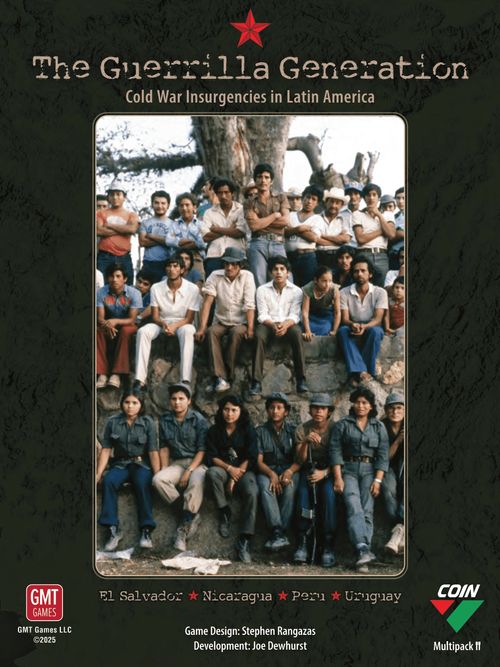
The Guerrilla Generation: Cold War Insurgencies in Latin America
The Guerrilla Generation: Peru Rulebook
Table of Contents
Table of Contents
1.0 Introduction
The Guerrilla Generation: Peru is a game in The Guerrilla Generation COIN multipack. Alongside its accompanying games El Salvador, Nicaragua, and Uruguay, this historical simulation strives to depict insurgencies in Central and South America during the Cold War era.
The Guerrilla Generation: Peru focuses on the civil war in Peru between the Sendero Luminoso (Shining Path) insurgency and the Peruvian Government with its military forces. It covers the period from the entry of the military into the conflict in late 1982 to the weakening of the insurgency following the capture of its leader, Abimael Guzmán, in 1992. The game omits the early years of the insurgency from 1980-1982, when the conflict was largely confined to Ayacucho Department. It depicts smaller actors such as the MRTA (Túpac Amaru Revolutionary Movement) insurgency through Event cards. The civil war in Peru cost the lives of over 69,000 people, mostly civilians. Unlike most other civil wars in the region during this period, the Shining Path insurgency, not the government, caused the majority of the deaths (54%), due to its systematic and massive use of terrorism against civilians. In departments declared as emergency zones the Peruvian military also committed widespread abuses against civilians. The Guerrilla Generation: Peru attempts to model these dynamics with care and depict the conflict with a high degree of fidelity, even if the simulation is at times more unpleasant than fun.
The historical simulations that comprise The Guerrilla Generation multipack are designed to cover a wide range of different types of insurgent organizations that operate during civil wars. They include examples ranging from popular, restrained groups to ideologically rigid, highly violent groups. Learning to identify the differences between how insurgents operate is important for understanding variations in insurgent tactics, violence against civilians, governance, and vulnerabilities to different counterinsurgent strategies. This multipack is intended to help synthesize and present academic scholarship on insurgencies in Latin America and the broader political science literature on how armed groups operate. Many of the strategies used by the Government and Insurgent factions to advance their political goals are highly unethical and violate international laws on protecting civilians during conflict. The purpose of this pack is to approach these dynamics honestly, improve players' understanding of insurgencies through thoughtful play, and encourage them to seek out the discussion of sources and historical background material in the Event notes and Scenario booklet.
Cover image: Rondas campesinas (peasant self-defense militia) in an Andean village
1.1 General Course of Play
In The Guerrilla Generation: Peru, one Event card at a time is revealed from the shared draw deck, and both players will have an opportunity to either execute that Event or perform an Operation from a unique menu, possibly adding a Special Activity. Propaganda cards mixed in with the Event cards provide periodic interruptions where the general board state is assessed and Government Political Will is adjusted, possibly triggering an instant victory for either side, after which both players receive an opportunity to collect additional assets and redeploy their forces.
1.2 Components
The following components from the multipack are required to play The Guerrilla Generation: Peru:
- A 17”x22” mounted Peru game board (1.3).
- A blue Government (Peru) and a red Shining Path mat, used to hold Available Forces (1.4.1).
- A deck of 40 Peru Event cards (5.0).
- 20 light blue cubes ('Police'), 10 dark blue octagonal cylinders ('Rondas'), 16 dark blue cubes ('Troops'), 20 red embossed octagonal cylinders ('Guerrillas'), 4 red disks ('Shining Path Bases'), 1 red embossed disk ('Guzmán Directives Base'), 4 embossed cylinders (two blue and two red)—note that this is fewer than the total number of wooden pieces included in The Guerrilla Generation multipack, any excess should be set aside while playing Peru.
- Six black and six white pawns (3.1.1).
- Specific markers from the countersheets: 1x blue Political Will (Peru flag), 1x Hiding/Captured, 6x Emergency Zone, 13x Government/Shining Path Control, 10x Passive/Active Opposition, 10x Passive/Active Support, 15x Sabotage/Terror, 8x Capability—all other markers should be set aside while playing Peru.
- Two Peru player aid sheets.
- One Peru Propaganda Round aid sheet.
- Two six-sided dice (one red, one blue).
- This rules booklet.
1.3 The Map
The map shows the whole country of Peru, with many of its smaller departments aggregated into single spaces on the board, along with the capital city, Lima.
1.3.1 Map Spaces. Map spaces include Departments (Highland, Jungle, or Coastal), Lima, and Lines of Communication (LoCs). All map spaces can hold forces (1.4). Several foreign countries are marked for flavor purposes and are not playable map spaces.
1.3.2 Departments. The twelve large irregular spaces are Departments. Each Department is marked with a numerical Population value (either '0', '1', or '2') that affects Political Will (1.10) via changes of Control (1.7) and Support or Opposition (1.6) during the Propaganda Round (6.2), and can also modify the Shining Path Rally Operation (3.3.1). Each Department also has a larger space for a Control marker (1.7) and a smaller space for a Support or Opposition marker (1.6) in Populated Departments (with Population value '1' or '2'). Departments are further distinguished as Highlands (brown), Jungle (green), or Coastal (light tan), affecting Government Sweep (3.2.3) and Assault (3.2.4) Operations, several Special Activities (4.0), and certain Events (5.0).
1.3.3 Lima. The large circular space is the capital city, Lima. Like Departments, Lima is marked with a Population value ('4') and can contain Control and Support or Opposition markers (although there are no marked holding boxes for these). Support and Terror markers in Lima have an additional effect on Political Will during the Propaganda Round (6.2).
1.3.4 LoCs. Each thin gray Line of Communication (commonly abbreviated 'LoCs') shows an Economic value of 2 that affects Government Resources (1.8) during the Propaganda Round (6.3).
NOTE: LoCs are spaces that can hold forces, but they cannot be Controlled or shifted to Support or Opposition.
1.3.5 Adjacency. Adjacency affects the movement of forces and implementation of certain Events (5.0). Any two spaces meeting one of the following conditions are adjacent:
- Spaces that border on (touch) one another.
- Departments separated by LoCs.
- LoCs or Departments separated by Towns (black circles).
NOTE: Towns (black circles) are not spaces; they merely terminate LoCs.
1.4 Forces
The wooden pieces represent the two Factions' various forces: Government Troops (dark blue cubes) and Police (light blue cubes), and Rondas (dark blue octagonal cylinders), Shining Path Guerrillas (red octagonal cylinders) and Shining Path Bases (red discs). The Shining Path also possess one additional Base embossed with a yellow star, called the Guzmán Directives Base (1.4.4).
Piece key: Government cubes — Troops, Police. Rondas (Underground / Active). Shining Path Guerrillas (Underground / Active). Shining Path Base. Guzmán Directives Base.
Important! The Government in Peru uses only 16 dark blue cubes and 10 dark blue octagonal cylinders. The remaining 4 dark blue cubes and 10 dark blue octagonal cylinders should be set aside and not used while playing Peru. Also set aside all red and pink cubes and dark blue disks; these are not used in Peru.
1.4.1 Availability and Removal. Each Faction has a separate mat showing an inventory of forces. The numbers indicated here limit the number of pieces that a Faction may have in play. Keep a Faction's forces not on the map on its mat, within easy view of both players—such forces are said to be Available.
- Unless otherwise instructed (by Event, 5.1.1), forces may only be placed from or replaced with those Available on the Faction mats. A piece to be replaced by a piece that is unavailable is simply removed.
- The Shining Path mat also includes slots for their four regular Base disks and their fifth Guzmán Directives Base (1.4.4), with the rightmost revealed slot indicating how many Resources they will gain during the Propaganda Round (6.3).
- Available Rondas, while broadly aligned with the Government and counting as Government pieces, are kept in a separate Rondas box on the board.
Important! Factions, while executing an Operation, Special Activity, or Event to place their own forces, may take them from elsewhere on the map if the desired force type is not Available. EXCEPTION: Guzmán Directives Base (1.4.4).
EXAMPLE: The Shining Path without Available Guerrillas could remove Guerrillas from the map during a Rally (3.3.1) to place them Underground, either in the same space or a different space.
1.4.2 Stacking. No more than two Bases (1.4) may occupy a single space, and no Bases may ever be placed on LoCs.
- Bases placed (such as via the Rally Operation [3.3.1] or Event [5.0]) may never violate stacking.
- More than one Sabotage or Terror marker may be placed in a space by Events (5.0), but never by the Terror Operation (3.3.4), or Reprisal Special Activity (4.2.2), which only place up to a maximum of one Sabotage or Terror marker in selected spaces. EXCEPTION: There is no limit on the number of Terror markers that may be placed in Lima (1.3.3).
1.4.3 Underground/Active. Guerrillas and Rondas are either Underground—symbol end down—or Active—symbol end up. Actions and Events flip them from one state to the other. Bases, Troops, and Police are always Active. Always set up and place new Guerrillas and Rondas Underground (including if replacing a piece), unless otherwise specified.
Active Rondas count toward Control (1.7), remove Shining Path pieces during the Conflict Phase of the Propaganda Round (6.1), and modify Government Assault (3.2.4) and Shining Path March (3.3.2) Operations.
NOTE: Unless instructions specify "Underground" Guerrilla, it is sufficient to "Activate" already Active Guerrillas (they stay Active). Also, "moving" or "relocating" Guerrillas does not affect Underground status unless specified. The Guzmán Directives Base is flipped down to hide its embossed side but is not Underground. It is treated as a normal Active Base and its other side is only revealed when removed or during the Propaganda Round (6.1).
1.4.4 Guzmán Directives Base. The embossed red Guzmán Directives Base is a secretly placed Base that, if remaining on the map at the start of each Propaganda Round, grants the Shining Path player additional actions before the Political Will Phase (6.2). The Shining Path player must secretly swap the Guzmán Directives Base, embossed side down, with any of their Bases on the map during Setup (2.1), and again during each Guzmán Directives Phase (6.5.3); the Guzmán Directives Base may not otherwise be placed or moved.
If the Base is revealed during the Conflict Phase of the Propaganda Round (6.1), then the Shining Path may conduct a free Limited Operation in the space with the Base and another free Limited Operation in any adjacent space. However, if the Government removes the Guzmán Directives Base during the Campaign, the Hunt Track (6.7) is advanced one space towards Captured. Once Guzmán is Captured (6.7.2) by reaching the end of the Hunt Track, the Guzmán Directives Base may no longer be swapped back onto the map.
The Shining Path may only ever have a maximum of four Bases in play, including the Guzmán Directives Base. When the Guzmán Directives Base is on the map, place one of the Shining Path's other Bases in the Guzmán Directives box on the Shining Path's mat as a reminder that they may not place the fifth Base. When the Guzmán Directives Base is taken off the map place it in the Guzmán Directives box to illustrate that it may not be placed normally with Rally (3.3.1) or by Events (5.0).
DESIGN NOTE: The Shining Path was a highly centralized insurgency organized around its leader, Abimael Guzmán, who led a cult of personality and dominated decision-making. The Guzmán Directives Base highlights the tradeoffs of such an organizational structure. By sending out orders to subordinate commanders, Guzmán Directives allows the Shining Path to conduct additional Operations to improve its strategic position; however, those communications may be captured by Government forces, assisting them in the hunt for Guzmán. Due to its centralized structure, the potential decapitation of the group's leadership (as occurred historically) will result in severe consequences for the insurgency.
1.4.5 Overflow Counters. Three pairs of circular and rectangular overflow counters marked 'A', 'B', and 'C' are provided in case any map spaces become too crowded during play. Simply place one counter in the crowded space, then move all the forces there to the side of the map with the matching counter placed near them to indicate where they are currently located. Overflow counters otherwise have no game effect, and their use is not compulsory.
1.5 Players & Factions
The game requires two players, each playing as one Faction: the Government (blue), and the Shining Path (red, sometimes abbreviated 'SP' on Event cards and player aids).
1.6 Support and Opposition
Support and Opposition markers may be placed in Populated Departments and Lima, affecting some Operations and Special Activities and Political Will during the Propaganda Round (6.2). Lima (1.3.3) and Populated Departments (1.3.2) always show one of five levels of Support for, or Opposition to, the Government in Peru, that can shift during play. Each space may be either at Active or Passive Support, Active or Passive Opposition, or Neutral. Different levels of Support or Opposition are indicated with the two sides of appropriate markers and Neutral is indicated by the absence of any marker.
A shift toward Active Support or Active Opposition either flips the opposing marker to Passive, or if already Passive removes the marker, or places the specified marker at Passive if a space is already Neutral, or flips the matching Passive marker to Active. Some Events (5.0) may instruct you to set a space to a level of Support or Opposition, in which case you should remove any other marker and simply place the specified marker on its correct side.
NOTE: 0 Population Jungle Departments (1.3.2) and LoCs (1.3.4) are never at Support or Opposition and should always be treated as though they are Neutral. Unlike other games in the COIN series, spaces at Active Support or Active Opposition do not double the Population Value of spaces for victory purposes. Instead, they act as an additional buffer level that must be removed before changing Support/Opposition status, and affect some Operations (3.0).
1.7 Control
Departments and Lima are always either Uncontrolled (indicated by the absence of any marker) or Controlled by either the Government or the Shining Path (indicated by a Control marker of either Faction). The Government and Shining Path each Control a space if their wooden forces pieces (1.4) in the space outnumber those of their opponent. Underground Rondas (1.4) do not count towards Government Control (or against Shining Path Control), but Active Rondas do. Adjust Control markers immediately when Control changes due to placement, removal, or movement of pieces. Gaining or removing Shining Path Control immediately shifts Political Will (1.10) down or up by an amount equal to the Population value of the space (see 7.0 Victory). Control also affects certain Operations (3.0) and Special Activities (4.0).
Important! Underground Rondas pieces do not count toward Government Control, or against Shining Path Control. Only Active Rondas pieces contribute to Government Control in a space.
1.8 Resources
At any moment each Faction has between 0 and 20 Resources that it uses to pay for Operations (3.0). Mark Resources on the edge track with a cylinder of that Faction's color (1.5).
1.9 Sabotage and Terror
Sabotage and Terror markers are placed by the Shining Path Terror Operation (3.3.4), Government Reprisal Special Activity (4.2.2), and some Events (5.0). Terror markers in Lima and Coastal Departments affect Political Will during the Political Will Phase of the Propaganda Round (6.2), and Sabotage markers on LoCs affect Government earnings during the Resource Phase (6.3). Terror markers also inhibit Shining Path Agitation and Government Civic Action (6.4). Terror markers are not intended to be component limited, as any number may be placed in Lima during play.
1.10 Government Political Will
Government Political Will is tracked with a marker on the edge track. The position of this counter will determine Victory (7.0) for either side. The marker is moved during the Campaign and during the Political Will Phase of the Propaganda Round (6.2). It may never be lower than 0 or greater than 20.
1.11 Hiding/Captured Marker
The current status of the Government's Hunt for Guzmán is tracked with a marker on the Hunt Track (6.7). The marker begins on its 'Hiding' side and is flipped to the 'Captured' side when it reaches the Captured space of the Hunt Track, triggering several effects (6.7.2).
1.12 Emergency Zones
Emergency Zone markers are placed during Setup (2.1), the Redeploy Phase (6.5) of each Propaganda Round, and by certain Events (5.0). Emergency Zone markers may only be placed in Highland Departments (1.3.2) and allow the Government to conduct the Reprisal (4.2.2) and Organize (4.2.3) Special Activities there. At the Propaganda Round (6.2), Government Control of Emergency Zone spaces affects Political Will. Emergency Zones are only removed during the Redeploy Phase (6.5) or by certain Events. Emergency Zone markers remain in place even if there are no Government forces in their space.
DESIGN NOTE: In 1980, Peru transitioned to a democracy from military rule. The newly formed democracy was reluctant to commit its military to fighting the Shining Path and relied on the police to contain the insurgency in Ayacucho Department. As the insurgency spread, President Belaúnde allowed the military to enter the conflict and declared emergency zones over certain areas. Emergency zones granted the military significant authority in an area, allowing them to punish communities or organize them into self-defense groups. Most human rights violations by the military occurred in the emergency zones, and by the late 1980s much of the Peruvian highlands were under emergency zones.
2.0 Sequence of Play
2.1 Setup
Follow the instructions on the second to last page of this booklet to prepare the draw deck and set up markers and forces. A full setup diagram can be found on the back page of this booklet.
2.2 Start
Begin play by revealing the top card of the Event draw deck and placing it onto a played cards pile. All played cards and the number of cards in the draw decks are open to inspection.
NOTE: Unlike in most previous COIN series volumes, only one Event card is revealed at a time.
RECORD STEPS: As the steps of each Event card play are completed, place the Eligibility cylinder of the acting Faction's color (1.5) into the Initiative Track's appropriate box.
Photo note: Abimael Guzmán, leader of the Shining Path
2.3 Initiative Track
One player takes the Government Faction and the blue Eligibility cylinder, the other the Shining Path Faction and the red Eligibility cylinder.
When playing an Event card, the Government or Shining Path player will execute Operations or the Event described on the card. At all times one player will be First Eligible, and the other will be Second Eligible. In each Event card round, the First Eligible player is first to choose what they will do, followed by the Second Eligible—whose choices are limited by what the First Eligible player did.
2.3.1 Eligibility. Each player puts one cylinder (blue and red respectively) on the First or Second Eligible spaces of the Initiative Track.
NOTE: The Shining Path always start the game in the 1st Eligible box. Eligibility order should remain untouched during each Propaganda Round (6.0).
2.3.2 Options for Eligible Factions.
First Eligible: The First Eligible player may perform a Limited Operation (2.3.4), execute the Event (5.0), perform an Operation (3.0) with Special Activity (4.0), or Pass (2.3.3).
The player selects their desired box and places their Eligibility cylinder in the appropriate box on the Initiative Track, then immediately executes the chosen action (Limited Operation, Event, or Operation with Special Activity) or Passes.
Second Eligible: The Second Eligible player may then choose one of the boxes not containing the First Eligible player's cylinder and conduct the action in the box selected (or Pass).
2.3.3 Passing. After selecting a box, players may forgo the action in the box to Pass. If Government pass, they gain 2 Resources, and if Shining Path pass they gain 1 Resource (1.8). Both players may pass and the order of cylinders in the Initiative Track will still decide eligibility (2.3.5).
2.3.4 Limited Operation. A Limited Operation is an Operation in just one space, with no Special Activity. If the Limited Operation is a Patrol (3.2.2), Sweep (3.2.3), or March (3.3.2) it can involve pieces from multiple origin spaces but only one destination space.
2.3.5 Adjust Eligibility. After both players have selected and executed their actions, replace the Eligibility cylinders on the Initiative Track with the cylinder in the furthest left box becoming First Eligible, and the other cylinder becoming Second Eligible.
DESIGN NOTE: Selecting the Limited Operation box guarantees the player first eligibility on the next card. Likewise, selecting the Operation & Special Activity box guarantees second eligibility on the next card. Eligibility after selecting the Event space will depend on what the other player has chosen. The only way to block Events in The Guerrilla Generation is to select the Event box and then either play the Event or Pass.
2.3.6 Next Card. After eligibility has been reset, reveal the draw deck's next card and continue play.
2.4 Propaganda Card
When a Propaganda card is revealed, first place the card in the box marked "Current President" (see below), then conduct a Propaganda Round (6.0).
2.4.1 Current President. The top (most recently played or placed during setup) Propaganda card shows the current President of Peru. Any lingering effects noted for that President are in effect, as if it is the text of a lingering Capability Event (5.3).
2.4.2 Final Propaganda. The third and final Propaganda card does not possess a President on the card, but instead triggers a Propaganda Round with only the Conflict (6.1) and Political Will (6.2) Phases, before proceeding to Game End (6.2.6).
NOTE: Each series of Event cards leading up to a Propaganda Round is called a "Campaign."
3.0 Operations
3.1 Operations in General
A Faction executing an Operation (Op) chooses one of the four Operations listed on its Faction sheet and selects the map spaces (typically several) to be involved. Select a given space only once for a given Operation.
Operations usually cost Resources (1.8), often paid per space selected; the paying Faction must have enough Resources to pay for the Operation in each selected space. Operations are generally allowed in any number of spaces (Resources permitting) unless the Operation is Limited (2.3.4), in which case they are allowed in only one space.
The executing Faction chooses the order of the spaces in which the Operation is resolved, the enemy pieces to be affected (targeted), and the friendly pieces to be placed, replaced, or moved. Once targeted, a Faction's pieces are affected to the maximum extent possible. Actions affecting another Faction's pieces do not require that Faction's permission.
3.1.1 Pawns. If desired, mark spaces selected for Operations (3.0), Special Activities (4.0), or other actions with white and black pawns. The pawns are for convenience, not a limit on play.
3.1.2 Free Operations. Certain Events grant free Operations or Special Activities, costing no Resources (5.4). Any Civic Action performed as part of a free Train Operation (3.2.1) still costs Resources. All other requirements or procedures apply as normal, unless specifically modified by Event text (5.1.1, 5.4).
3.2 Government Operations
The Government chooses from Train, Patrol, Sweep, or Assault Operations.
3.2.1 Train. Train adds Government forces and can build Support via Civic Action. Select Lima and/or any Departments, and pay 2 Resources for each space where cubes are placed.
PROCEDURE: If Lima, place up to 6 cubes. Then, in one selected space (even if Limited Operation), if Government Control, Troops, and Police, may Civic Action to remove any Terror markers and shift up to once toward Active Support. Civic Action costs 2 Resources per Terror marker removed and to shift toward Active Support, even if the Train Operation was free (3.1.2, 5.4).
3.2.2 Patrol. Patrol protects LoCs and repositions Government forces among critical spaces. Pay 2 Resources total (not per space selected).
PROCEDURE: Move any number of cubes from any spaces. Each cube may move into any adjacent LoC, Coastal Department, and/or Lima, and may keep entering any such spaces until the player chooses to stop moving it or it enters a space with any Shining Path piece. Then, in each LoC (whether or not a cube just moved there), Activate one Guerrilla for each cube there. Then, if desired, Assault (3.2.4) on one LoC at no added cost. If a Limited Operation, may only reveal and Assault on a LoC if it was selected as the single destination space.
3.2.3 Sweep. Sweep may move Troops and can reveal Guerrillas. Select any Departments and/or Lima as destinations. Pay 2 Resources per selected destination space.
PROCEDURE: First, simultaneously move any adjacent Troops desired into selected destination spaces. In addition, each group of Troops may first move onto an adjacent LoC (1.3.5) that is free of Guerrillas and then into an adjacent selected destination space. Then, in each selected space, Activate (1.4.3) one Guerrilla for every cube (moved or already there, even if no cubes moved). In Jungle Departments or spaces with Active Opposition, instead only Activate one Guerrilla for every two cubes there.
3.2.4 Assault. Assault removes Shining Path pieces. Select any spaces with cubes and Active Shining Path pieces. Pay 2 Resources per selected space.
PROCEDURE: In each selected space, remove one Active Shining Path piece for every Troop present, or one for every two Troops in Highland Departments without Active Rondas, or one for every cube in Lima, Coastal Departments, and LoCs. First remove Active Guerrillas, then remove Shining Path Bases only once no Guerrillas remain (even Underground). Shift the Hunt Track (6.7) one step toward Captured if the Guzmán Directives Base is removed (reveal each removed Base to confirm).
NOTE: Underground Guerrillas in a space prevent removal of Shining Path Bases until all Guerrillas are Activated and removed. Active Rondas in Highland Departments allow Government to remove one Active enemy piece for every Troop present, instead of one for every two Troops. Removing Shining Path Bases does not directly increase Political Will, unlike the removal of Insurgent Bases and Safe Houses in the other Guerrilla Generation games.
3.3 Shining Path Operations
Shining Path chooses from Rally, March, Attack, or Terror Operations.
3.3.1 Rally. Rally adds Shining Path forces. Select any Departments without Support and/or Lima (even with Support). Pay 1 Resource per space selected.
PROCEDURE: In each selected space, place one Guerrilla or replace two Guerrillas with a Shining Path Base (respecting stacking, 1.4.2). If the space already has at least one Shining Path Base, may instead place Guerrillas up to the space's Population plus number of Shining Path Bases there, or flip all Guerrillas there Underground (1.4.3).
3.3.2 March. March moves Guerrillas. Select any spaces as destinations. Pay 1 Resource per non-LoC destination space (LoCs may be selected as destination spaces for free).
PROCEDURE: Simultaneously move any Guerrillas desired into adjacent destination spaces. Set Guerrillas moving from one origin space to one destination space Active (1.4.3) if:
- The destination is a LoC or is at Support and
- The number of moving Guerrillas plus the number of cubes and Active Rondas in that destination exceeds three.
Otherwise, moving Guerrillas retain their current orientation (Active or Underground).
NOTE: Active Rondas count toward the threshold for Activating Guerrillas moving into Support spaces.
3.3.3 Attack. Attack attempts to eliminate Government forces. Select any spaces with Guerrillas and Government pieces. Pay 1 Resource per selected space.
PROCEDURE: In each selected space, Activate (1.4.3) all Guerrillas and roll one die: if the result is equal to or less than the number of Guerrillas there, remove up to two Government pieces (Police before Troops). If the roll was a "1" add a Guerrilla to the space. If any Rondas are removed, Activate any remaining Rondas in the space and shift it one level toward Active Support.
NOTE: Attack may remove Rondas even if they are Underground, and may remove them before removing Police or Troops if desired.
3.3.4 Terror. Terror shifts Lima and Departments toward Active Opposition and places Terror markers that hinder further attempts to build Support. On LoCs, Terror places Sabotage markers that block Government Resource earnings (6.3.2). Terror markers in Coastal Departments and Lima also affect Political Will during the Propaganda Round (6.2). Select any spaces with at least one Underground Guerrilla. Pay 1 Resource per non-LoC and non-Highland space selected (LoCs and Highlands may be selected for free).
PROCEDURE: In each selected space, Activate an Underground Guerrilla. If a Department or Lima, place a Terror marker (in Departments only if none already there) and shift the space one level toward Active Opposition. If a LoC, place a Sabotage marker, if none. Government places one Rondas in each Highland Department selected for Terror, or may choose to move one from elsewhere if none are Available.
DESIGN NOTE: The Shining Path heavily utilized Terror as part of their strategy for ensuring the collaboration of the local population in rural highland areas and coercing the government in urban and coastal areas. The lack of a restriction on Terror markers in Lima models the Shining Path strategy of committing frequent high-profile attacks in the capital to cause disorder and demonstrate the government's inability to protect citizens there.
4.0 Special Activities
4.1 Special Activities in General
When a Faction per the Initiative Track (2.3) executes an Operation (3.0), it may also execute one Special Activity (EXCEPTION: Limited Operations, 2.3.4). As with Operations, the executing Faction selects spaces and pieces affected, and the order of actions. Select a given space only once as a location for a given Special Activity. Events may grant free Special Activities (not further affecting Eligibility, 2.3.1).
Important! A Faction may execute its Special Activity at any one time immediately before, during, or after its Operation.
EXAMPLE: Shining Path may Rally in one space, then pause to Govern to gain Resources before continuing to Rally in other spaces.
4.1.1 Accompanying Operations. Some Special Activities specify that they may only accompany certain types of Operations (3.0). Certain Special Activities must occur where their Accompanying Operation occurred. If not otherwise specified, Special Activities may accompany any Operations and take place in any otherwise valid spaces.
4.2 Government Special Activities
The Government chooses from Investigate, Reprisal, or Organize Special Activities.
4.2.1 Investigate. Investigate advances the Hunt for Guzmán (6.7) and protects Lima. It may only accompany Train (3.2.1), Patrol (3.2.2), or Sweep (3.2.3).
PROCEDURE: Unless Guzmán Captured (6.7.2), roll one die—if the result is greater than the next space to the right on the Hunt Track (6.7), shift the marker one step to the right (toward 'Captured'). Then, may remove one Police in Lima to either Activate a Guerrilla there or make a second roll as above.
NOTE: The top effect of Event P32 grants an Investigate roll that additionally increases Political Will by 2 if successful, representing the capture of Guzmán's second-in-command, Elena Yparraguirre. If Guzmán has already been captured, Government may still use this Event to make an Investigate roll against a target value of '4'.
4.2.2 Reprisal. Reprisal reduces Opposition and relocates Guerrillas. It may select up to two Emergency Zone Departments (1.12) with Troops. Reprisal may only accompany Patrol (3.2.2), Sweep (3.2.3), or Assault (3.2.4).
PROCEDURE: In each selected space, place a Terror marker, if none, and shift the space one level toward Neutral. Then, relocate one Guerrilla from each selected space to an adjacent space. Remove half Rondas (round down) in each selected space, then flip any remaining Rondas there Underground.
4.2.3 Organize. Organize places or activates Rondas (1.4). It may occur in any Emergency Zone Department (1.12) without Active Opposition. It may accompany any Government Operation (3.2).
PROCEDURE: If the selected space has Government Control, may place 1 Active Rondas or, if Troops in the selected space, may instead Activate all Rondas there and remove any Terror markers.
DESIGN NOTE: During the Peruvian civil war, rondas campesinas ("peasant rounds") were peasant self-defense groups that originally formed in response to Shining Path abuses that threatened their communities. Over the course of the conflict, many more such groups were directly organized by the Peruvian military in emergency zones. The placement of Underground Rondas represents growing peasant resentment against the Shining Path, and the activation of Rondas represents them actively operating against the insurgency, either through a spontaneous local uprising or after encouragement by the military.
4.3 Shining Path Special Activities
Shining Path chooses from Govern, Evade, or Ambush Special Activities.
4.3.1 Govern. Govern allows the Shining Path to gain Resources and remove Rondas. It may select up to two Departments with Shining Path Control and Underground Guerrillas. Govern may accompany Rally (3.3.1), March (3.3.2), or Terror (3.3.4).
PROCEDURE: In each selected Department, activate 1 Underground Guerrilla, then, if Highland Department, either increase Shining Path Resources by twice the Population and shift the space one level toward Active Support, or remove 1 Underground Rondas. If Jungle or Coastal Department, increase Shining Path Resources by 1.
4.3.2 Evade. Evade allows Shining Path to move and hide Guerrillas and protect Guzmán from capture. It may select one space with Guerrillas. Evade may only accompany Rally (3.3.1) or March (3.3.2).
PROCEDURE: Move a Guerrilla in the selected space to one adjacent space and flip the moving Guerrilla Underground. Then, may remove one Guerrilla in Lima to roll one die—if the result is greater than the next space to the right on the Hunt Track (6.7), shift the marker one step to the left (away from 'Captured').
4.3.3 Ambush. Ambush allows the Shining Path to Attack in one space with guaranteed success and avoid exposing all their Guerrillas there. It may occur in one space already selected for Attack where there is an Underground Guerrilla. Ambush may only accompany Attack (3.3.3), and the selected Attack space must be paid for as usual.
PROCEDURE: Instead of the usual Attack procedure, Activate only one Underground Guerrilla in the selected space and remove up to two Government pieces without rolling a die. Add a Guerrilla to the space.
5.0 Events
Each Event bears a title headline, capitalized flavor text, and Event text. Flavor text provides historical interest and has no effect on play.
5.1 Executing Events
When a Faction executes an Event, it carries out the Event text literally and in order (sometimes involving actions or decisions by the other Faction). Unless otherwise specified, the executing Faction makes all selections involved in implementing the text, such as which pieces are affected. If another Faction is specified or selected to take an action, that Faction decides the details of the action. Some Events with lasting effects have markers as aids to play.
5.1.1 Where Event text contradicts rules, the Event takes precedence. However:
- Events may not violate stacking (and so may never place more than two Bases in one space).
- Events place only Available pieces (1.4.1); they remove rather than replace if the replacement is not Available or if stacking (1.4.2) would be violated.
- Events may not raise Resources or Political Will beyond 20 or reduce them below 0 (1.8, 1.10).
5.1.2 If two Events contradict, the currently played Event takes precedence.
5.1.3 An executed Event's text that can be implemented must be. If not all of its text can be carried out, implement that which can.
5.2 Dual Use
Many Events have both top and bottom Event text. The executing Faction may select either the top or bottom text to carry out (not both). While the top text often favors the Government, a player may select either text option regardless of Faction.
DESIGN NOTE: Dual-use events represent opposed effects of the same cause, forks in the historical road, or instances subject to alternative historical interpretation.
5.3 Capabilities
Events labeled "Government Capability" or "SP Capability" have lasting effects mainly relating to that Faction, either positive or negative. The label is for flavor only, and both Factions may play Capability Events with either label. A Capability Event's effects last for the rest of the game.
NOTE: Set out executed Capabilities Event cards near the board as added reminders, using a Capability marker to indicate which option was selected.
5.4 Free Operations
Some Events allow a Faction to perform an immediate Operation or Special Activity that interrupts the usual sequence of play and is typically free: it bears no Resource cost and does not affect Eligibility (2.3.1, 3.1.2), though other procedures and restrictions remain unless modified by Event text (5.1.1).
NOTE: Civic Action costs Resources even if part of a free Train Operation (3.2.1). A free Ambush Special Activity occurs as if a free Attack is occurring in the space (4.3.3).
6.0 Propaganda Round
Conduct a Propaganda Round in the sequence of phases below when each Propaganda card is revealed. The Propaganda Round aid sheet also lists this sequence.
6.1 Conflict Phase
The Conflict Phase involves carrying out several actions prior to checking the Political Will conditions below (6.2).
6.1.1 DIRCOTE Investigates. Unless Guzmán Captured (6.7.2), the Government makes one roll as if carrying out an Investigate Special Activity (4.2.1; they may not remove a Police cube to make a second roll or Activate a Guerrilla in Lima).
6.1.2 Guzmán Directives Executed. Unless Guzmán Captured (6.7.2), flip all Shining Path Bases on the map. If the Guzmán Directives Base is revealed, the Shining Path may conduct two free Limited Operations: one in the same space as the Guzmán Directives Base and one in an adjacent space.
6.1.3 Rondas React. Roll a die for each space with Rondas—if the result is less than or equal to the total number of Rondas in the space, Activate all Rondas there and shift the space one level toward Active Support (even if all Rondas were already Active). Then, in each space with Rondas, remove one Guerrilla for every two Active Rondas (either just Activated or already Active).
6.2 Political Will Phase
Calculate the net effect to Political Will of the following adjustments before shifting the marker:
6.2.1 Andean Mountains. Subtract the total Population of Highland Departments at Opposition from the total Population of Highland Departments at Support. Adjust Political Will by the difference, increasing it if positive and decreasing it if negative.
DESIGN NOTE: The major battle over the "hearts and minds" of peasants or, at a minimum, population control, occurred in the highland departments of central Peru. The Shining Path found far less popular support in the major urban centers, coastal departments, or sparsely populated eastern jungles, even if they could still intimidate the population there.
6.2.2 Shining Path Leadership. Reduce Political Will by 1 for every two Shining Path Bases on the map.
6.2.3 "Strategic Equilibrium". Reduce Political Will by 1 for each Terror marker in Lima and/or Coastal Departments. Increase Political Will by 2 if Lima is at Support.
6.2.4 Emergency Zones. If at least half the spaces with an Emergency Zone marker (round up) have Government Control (1.7), or there are no Emergency Zones on the map, increase Political Will by 2.
NOTE: It's important to calculate the net shift in Political Will during these steps before moving the marker and checking victory, rather than adjusting the marker one step at a time.
6.2.5 Victory? If Political Will is now at 0, 1, or 2, the game immediately ends with a Shining Path victory. If Political Will is now 18, 19, or 20, the game immediately ends with a Government victory. Otherwise, continue play.
6.2.6 Game End? If this is the final Propaganda card, then end the game and check scores per Victory (7.0) to determine the winner.
6.3 Resources Phase
Follow these steps to add to Factions' Resources to a maximum of 20 (1.8).
6.3.1 Sabotage. Place a Sabotage marker on each LoC without one where there are more Guerrillas than cubes.
6.3.2 Government Earnings. Government gains Resources equal to the Population value of Coastal Departments and Lima with Government Control, plus the Economic value of LoCs without Sabotage markers.
6.3.3 Shining Path Earnings. Shining Path gains Resources equal to the number of spaces with Shining Path Control and the number of Bases on the map.
6.3.4 Drug Trade. Shining Path gains 1 additional Resource for each of Amazonas and Huánuco with Shining Path Control.
DESIGN NOTE: The Shining Path gained resources from their involvement in the drug trade once they established a presence in the Upper Huallaga Valley.
6.4 Support Phase
Government and Shining Path may spend Resources to affect Support and Opposition (1.6).
6.4.1 Civic Action. Government may spend Resources to build Support. Each space must have Government Control (1.7), Police, and Troops. Every 2 Government Resources spent removes a Terror marker or—once no Terror remains in a space—shifts the space once toward Active Support, up to one shift per space.
DESIGN NOTE: Troops and Police (or local militias) together provide the security needed to gain popular support, or at least the local population's collaboration. Terror by Shining Path or the military hurts the Government's credibility to provide protection and requires additional resources to recover from the damage and reassure the local population.
6.4.2 Agitate. Shining Path may spend Resources to build Opposition in spaces with Shining Path Control (1.7). Every 1 Shining Path Resource spent removes a Terror marker or—once no Terror remains in a space—shifts the space once toward Active Opposition, up to two shifts per space.
6.5 Redeploy Phase
6.5.1 Government Redeploy. Do not adjust Control during this step. Government must move its Troops from LoCs and Departments with Shining Path Control to Departments with Government Control or Lima. Then, Government may move any Police to any LoCs, Departments with Government Control, or Lima. Then adjust Control (1.7) to reflect the above moves.
6.5.2 Emergency Zones. Government must remove all Emergency Zone markers (1.12) from spaces with Government Control, Support, and no Shining Path pieces. Then, Government may place Emergency Zone markers in any Highland Departments with Shining Path pieces.
6.5.3 Guzmán Directives. Unless Guzmán Captured, Shining Path must secretly swap the Guzmán Directives Base with any Shining Path Base currently on the map, placing it facedown so its location is hidden from the Government. If it is already on the map it may stay in its current location, but should be flipped facedown. If there are no Shining Path Bases on the map, the Guzmán Directives Base will remain out of play until the next Redeploy Phase.
6.5.4 Control. Now adjust Control (1.7) to reflect the above moves.
6.6 Reset Phase
Then prepare for the next card as follows:
- Remove all Terror and Sabotage markers from the map.
- Flip all Guerrillas (but not Rondas) Underground (1.4.3).
- Reveal the next card from the draw deck and continue play (2.3.2).
6.7 The Hunt Track
Alongside the war in the countryside, the Peruvian intelligence services, notably the Counter-Terrorist Directorate (DIRCOTE), devoted much of their resources toward attempting to track down and capture the Shining Path's leadership, especially Abimael Guzmán. Due to needing access to medication for his health conditions, Guzmán spent much of his time evading capture in the capital, Lima. In 1992, Peruvian police finally captured Guzmán, dealing severe damage to the insurgency given the organization's highly centralized structure. The Hunt Track captures these dynamics.
6.7.1 Moving the Track. The Hiding marker on the Hunt Track is moved to the right, toward Captured, by the Government making successful rolls with the Investigate Special Activity (4.2.1), removing the Guzmán Directives Base from the map with Assault Operations (3.2.4), and by certain Events (5.0). The Hiding marker is moved to the left, away from Captured, by the Shining Path making successful rolls with the Evade Special Activity (4.3.2) and by certain Events (5.0).
6.7.2 Capturing Guzmán. Guzmán is captured when the Hiding marker reaches the final Captured box of the Hunt Track. When Guzmán is captured, flip the Hiding marker to its Captured side and implement the following effects:
- Increase Political Will by 5.
- Remove half (round down) Shining Path Guerrillas in each space.
- Ignore any Hunt Track rolls or shifts for the rest of the game.
- Reveal the Guzmán Directives Base, if on map, and replace it with a normal Shining Path Base. The Guzmán Directives Base may no longer be secretly swapped in during the Redeploy Phase (6.5).
Photo note: Abimael Guzmán after being captured in 1992
7.0 Victory
Victory is determined by the level of Government Political Will (1.10). Political Will is measured on the edge track and can range from 0-20.
7.0.1 Early Victory. At the victory check during the Political Will Phase of a Propaganda round, the Shining Path wins if Political Will is 0-2 and the Government wins if Political Will is 18-20.
7.0.2 Final Victory. If neither player has won at the end of the Political Will phase of the final Propaganda Round, the Shining Path win if Political Will is less than 10 and the Government wins if Political Will is greater than 10. If Political Will is exactly 10 the game is tied.
DESIGN NOTE: Early victories in Peru represent Shining Path gaining enough strength to seriously challenge the cities, or the Government gaining a strong enough position to contain the insurgency and let the threat subside over time. Final victory results between 3 and 17 Political Will represent the level of threat the Shining Path will pose throughout the rest of the 1990s. Historically, after being seriously threatened during the late 1980s, the Government ended the game with a high amount of Political Will after the capture of Guzmán and the growing pressure of their counterinsurgency campaign severely weakened the insurgency.
7.1 Raising Political Will
Government Political Will is raised in the following ways:
- Removing Shining Path Control (+ Population of space to PW)
- Events (+1 to +2 PW)
- Guzmán Captured (+5 PW)
- At Propaganda Round, more Highland Support Population than Highland Opposition Population (+ difference to PW)
- At Propaganda Round, at least half (round up) Emergency Zones with Government Control, or no Emergency Zones (+ 2 PW)
- At Propaganda Round, if Lima at Support (+2 PW)
7.2 Lowering Political Will
Government Political Will is lowered in the following ways:
- Adding Shining Path Control (– Population of space from PW)
- Events (–1 to –2 PW)
- At Propaganda Round, more Highland Opposition Population than Highland Support Population (– difference to PW)
- At Propaganda Round, every two Shining Path Bases on map (–1 PW per two Bases)
- At Propaganda Round, each Terror marker in Lima or Coastal Departments (–1 PW per Terror marker)
8.0 Example of Play
Set up the game as indicated in section 2.1 (consult the setup diagram on the back of this booklet), but construct only the first part of the deck with these cards in the following order, facedown from top to bottom: MRTA Rural Front (P36), Gonzalo Thought Analyzed (P9), Jiménez and Miyashiro Lead Guzmán Search (P8), Rondas Resist Rebels (P12), President Attempts "Autogolpe" (P33), Fighting Intensifies in Ayacucho (P18), and Propaganda (E38/President García).
Before play begins, Shining Path also have to secretly replace one of their three Bases on the board with their special Guzmán Directives Base (marked with a gold star). They choose to place this in Junín, facedown so the Government player doesn't know where it is, then place the original Base back in the 'Guzmán Directives' spot on their player mat to indicate that it is not currently Available. We are now ready to begin.
Reveal the first card, MRTA Rural Front, from the top of the deck. Shining Path are 1st Eligible and decide to perform a Rally Operation with the Govern Special Activity. We place their red Eligibility cylinder into the 'Op & Special Activity' box on the Initiative Track to indicate what they are doing. Rally can select any Departments without Support, and can always select Lima, even if it has Support (as it does now). Shining Path decides to Rally as follows:
- Place one Guerrilla each in Loreto, Ucayali, Madre de Dios, Amazonas, Huánuco, Puno, and Lima.
- Place two Guerrillas each in Junín and Cusco, as having a Base in a selected space allows them to place Guerrillas up to the number of Bases plus the Population of the space.
This costs them 1 Resource per selected space, so 9 in total (down to 1). It also removes Government Control in Amazonas, Huánuco, and Puno, and adds Shining Path Control in Loreto, Ucayali, Madre de Dios, Junín, and Cusco, which reduces Political Will by 2 (down to 11) for the two additional Population now under Shining Path Control (Loreto, Ucayali, and Madre de Dios all have 0 Population, so gaining Control there does not affect Political Will).
They then select Loreto and Cusco for Govern, which requires Shining Path Control and an Underground Guerrilla. In Loreto they Activate their Underground Guerrilla to gain 1 Resource (as it is a Jungle Department), while in Cusco they Activate one Underground Guerrilla to gain 2 Resources and shift it to Neutral (as it is a Highland Department). This increases their Resources to 4 total. Their turn is now complete.
This leaves Government to choose from the other two boxes on the Initiative Track, Limited Operation or Event. They are not interested in the Event, so instead decide to perform a Limited Sweep Operation, which allows them to move Troops into one destination from any adjacent spaces, then Activate Guerrillas in the destination. They select Ayacucho as the destination and move in five Troops from Lima and one from Arequipa, which replaces Shining Path Control with Government Control (increasing Political Will by 1, to 12). Sweep normally Activates one Guerrilla per cube in the destination (after moving), but only Activates one Guerrilla for every two cubes in destinations that are Jungle or have Active Opposition. Ayacucho does have Active Opposition, but there are now nine cubes there, more than enough to Activate all three Guerrillas. This costs Government 2 Resources, down to 18 total.
Illustration: Government Sweeps into Ayacucho
The Government turn is now complete, and as both players have completed their turns we reset Eligibility. The Faction whose cylinder is furthest to the left, in this case Government, becomes 1st Eligible, and the other Faction becomes 2nd Eligible.
Illustration: Eligibility is reset at the end of each round
Reveal the next card: Gonzalo Thought Analyzed. Government is 1st Eligible and decides to perform an Assault Operation with the Reprisal Special Activity. They will carry out their Reprisal first, which can select up to two spaces with Emergency Zone markers and Troops. However, in this case there is only one Emergency Zone on the map, in Ayacucho, so they can only carry out Reprisal there. Reprisal places a Terror marker in the space, shifts it one level toward Neutral (in this case, to Passive Opposition), and allows them to relocate one Guerrilla to an adjacent space. They move one of the Active Guerrillas to Cusco.
Illustration: Government Reprisal in Ayacucho
Next, they will Assault in Ayacucho only, which costs them 2 Resources (down to 16 total). Assault can usually remove one Shining Path piece per Troop (or per cube in Lima, Coastal Departments, and LoCs), but in Highland Departments it can only remove one Shining Path piece per two Troops, unless there is an Active Rondas present (which there is not). Despite this the six Troops in Ayacucho are still sufficient to remove the two Active Guerrillas and the Base (which can only be removed once there are no Guerrillas remaining in the space). Whenever a Base is removed by Assault it needs to be flipped over to check whether it is the starred Guzmán Directives Base, in which case Government would also shift the Hunt Track one step to the right. This one is not, so they just return all three pieces to the Shining Path player mat, where the Base can be placed on the numbered Available Bases track (which indicates how many Resources Shining Path will gain during the Propaganda Round). The Government turn is now complete.
Illustration: Government Assault in Ayacucho
Shining Path decide to perform the Event, which is a Capability that will remain in play for the rest of the game, enhancing the effect of their Guzmán Directives Base during the Propaganda Round. Place the Event near the board, with a red 'Capability Bottom' marker on it to indicate which version of the Capability is in effect (usually the bottom half of each Event favors Shining Path, while the top half favors Government). We then reset Shining Path to 1st Eligible and Government to 2nd Eligible.
Reveal the next card: Jiménez and Miyashiro Lead Guzmán Search. Shining Path is 1st Eligible and decides to perform the Terror Operation with another Govern Special Activity. Terror can select any spaces with Underground Guerrillas, and is free in Highland Departments and LoCs (it costs 1 Resource in Lima and Coastal Departments, and isn't effective in Jungle Departments as they are unpopulated). In each space selected for Terror Shining Path will Activate one Underground Guerrilla, place a Terror marker (or a Sabotage marker on LoCs), and shift the space one level toward Active Opposition if possible. Terror markers are usually limited to one per space, but Lima can contain any number of Terror markers. In Highland Departments selected for Terror the Government then also places one Underground Rondas piece, indicating local backlash against the Shining Path. Underground Rondas don't count towards Government Control (or against Shining Path Control), but they will count once Activated, and can also assist the Government in other ways.
Shining Path decide to Terror in every Highland Department aside from Ayacucho (where they don't have any Guerrillas), and in Lima, costing them only 1 Resource in total (down to 3). This shifts Lima to Passive Support, Junín to Active Opposition, and Amazonas, Huánuco, Cusco, and Puno all to Passive Opposition; and places one Terror marker in each of those spaces and one Underground Rondas in every Highland Department other than Ayacucho.
They then select Junín and Cusco for Govern. In Junín they Activate one Guerrilla to gain 2 Resources (up to 5) and shift the space to Passive Opposition, while in Cusco they Activate one Guerilla to instead remove the Rondas there. The Shining Path turn is now complete.
Government decides to execute the Event, which allows them to remove two Police cubes from Lima to advance the Hunt Track two steps to the right, bringing them close to capturing Guzmán. We then reset Government to 1st Eligible and Shining Path to 2nd Eligible.
Illustration: Jiménez and Miyashiro begin the hunt for Guzmán
Reveal the next card: Rondas Resist Rebels. Government will perform a Train Operation with the Organize Special Activity. They will Organize first, which can select one Emergency Zone space without Active Opposition. Ayacucho is again their only choice, but they have two options there: either place one Active Rondas (if there is Government Control), or Activate all Rondas there and remove any Terror markers (if there are any Troops). In this case they decide to do the latter option even though there are no Rondas present, just removing the Terror marker.
Next they will Train, which can select Lima and any Departments, but is only able to place cubes in Lima, with Departments being selected just for Civic Action (as we will see shortly). They select Lima first, paying 2 Resources (down to 14) to place four Troops and two Police there. Then they select Ayacucho, which is eligible for Civic Action as it has Troops, Police, and Government Control. This allows Government to pay 2 Resources (down to 12) to shift it one level toward Active Support, to Neutral. If there had been a Terror marker present, they would have had to first pay 2 Resources to remove it, but they were able to use Organize to remove it for free instead. The Government turn is now complete.
Shining Path are feeling a little Resource-starved, so they decide to pass, placing their Eligibility cylinder in either available box on the Initiative Track to gain 1 Resource (up to 6) instead of performing the indicated action. We then reset Shining Path to 1st Eligible and Government to 2nd Eligible.
Reveal the next card: President Attempts "Autogolpe". Shining Path is 1st Eligible and decides to perform the March Operation with an Evade Special Activity. They will March first, which allows them to move Guerrillas to adjacent spaces, and costs them 1 Resource for each non-LoC destination selected (LoCs are free). Any Underground Guerrillas moving into a space that is a LoC or has Support will also flip Active if the number of moving Guerrillas plus cubes and Active Rondas in the space is greater than three. Shining Path decides to March as follows:
- One Underground Guerrilla from Ucayali to the adjacent LoC. (there are no cubes on the LoC so it remains Underground). This removes Shining Path Control from Ucayali, but does not add Control on the LoC, as LoCs cannot be Controlled by either Faction.
- Two Active Guerrillas from Cusco to Arequipa, removing Government Control from Arequipa. Had these Guerrillas been Underground they would have become Active due to moving into a space with Support and sufficient cubes.
- One Active Guerrilla from Puno to Arequipa, adding Government Control to Puno and Shining Path Control to Arequipa, which reduces Political Will by 2 (to 10).
They only selected a single non-LoC destination, Arequipa, so they reduce their Resources by 1 (to 5).
Illustration: Shining Path March into Arequipa
Next they will Evade, which first allows them to move a Guerrilla to an adjacent space and flip it Underground. They move the Active Guerrilla in Amazonas to Piura, then flip it Underground there (even though Marching in would have Activated it due to the Support and cubes there). This also adds Government Control back to Amazonas. Finally, Evade also allows Shining Path to (optionally) remove a Guerrilla from Lima in order to a roll a die against the next Hunt Track value to try and shift it left. They remove the Active Guerrilla from Lima and roll a die, getting a '4', which is higher than the next Hunt Track value of 2, so shifts it back one step to the left. The Shining Path turn is now complete.
Government will perform a Limited Patrol Operation, which allows them to relocate forces among Lima, Coastal Departments, and LoCs, as well as potentially Activating Guerrillas on LoCs and free Assaulting on one LoC. Patrol always costs 2 Resources regardless of the number of destinations chosen, but in this case they can only choose one destination because the Operation is Limited. Government just pays 2 Resources (down to 10) to move two Troops from Lima to the LoC heading out of it northwest, then Activates the Guerrilla there and free Assaults to remove it. We then reset Government to 1st Eligible and Shining Path to 2nd Eligible.
Illustration: Government Limited Patrol
Reveal the next card: Fighting Intensifies in Ayacucho. Government decides to perform the Train Operation with the Investigate Special Activity. They Investigate first, which allows them to roll a die to try and advance the Hunt Track, with any result greater than the next value shifting it to the right. They roll a '5', which is greater than 2, so shifts it one step toward 'Captured'. They can then normally remove a Police from Lima to either roll again or Activate a Guerrilla there, but the effect of the President Belaúnde card in the Current President box prevents them from doing this for a second roll, so they just remove a Police to Activate the Guerrilla in Lima.
For Train they pay 2 Resources (down to 8) to place all their Available cubes (two Troops and one Police) in Lima, then select Ayacucho for Civic Action again, paying 2 Resources (down to 6) to shift it to Passive Support (which will prevent Shining Path from Rallying there). The Government turn is now complete.
Shining Path will perform a Limited Attack Operation, paying 1 Resource (down to 4) to select Arequipa. Attack first Activates all Guerrillas in the selected space (but in this case they are already Active), then rolls a die, removing two Government pieces if the roll is less than or equal to the number of Guerrillas. Police must be removed before Troops, and if the roll is a '1' then an Underground Guerrilla is placed as well. Shining Path roll a '2', so they just remove the two Police from Arequipa. We then reset Shining Path to 1st Eligible and Government to 2nd Eligible.
The next card revealed is the Propaganda card, triggering a Propaganda Round. The new Propaganda card is first placed in the Current President box, immediately replacing the old effect with the effect on the new card, then we work through each phase in turn, starting with the Conflict phase:
- Conflict:
- Government makes an Investigate roll, getting a '3' and advancing the track one step to the right.
- Shining Path then reveals that their Guzmán Directives Base is in Junín, which allows them to perform one Limited Operation in Junín and one in an adjacent space, combined with one Special Activity due to the bottom Capability effect on card P9. They decide to Attack in Junín, enhancing it with the Ambush Special Activity to Activate their Underground Guerrilla there, remove one Police and one Rondas, then place one new Guerrilla. They also Rally in Huánuco, placing another Guerrilla there and adding Shining Path Control, reducing Political Will by 1, to 9.
- Government then rolls a die for each space with any Rondas, with each result equal or less than the number of Rondas in the space Activating all those Rondas and shifting it one level toward Active Support. They then remove one Shining Path piece for every two Active Rondas in each space, whether or not they were just Activated. They roll a '2' in Amazonas (no effect), a '1' in Huánuco (Activating the Rondas, shifting it to Neutral, and removing Shining Path Control due to the Rondas now being Active, which increases Political Will back to 10), and a '4' in Puno (no effect).
- Political Will: Political Will is reduced by a net total of –1 (–3 because there is 4 Highland Department Population with Opposition compared with 1 Highland Department Population with Support, –1 because there are two Shining Path Bases on the map, –1 because there is one Terror marker in Lima, +2 because Lima is at Support, and +2 because at least half the Emergency Zone spaces have Government Control), down to 7. If Political Will was now at 0-2 or 18-20 then Shining Path or Government would win respectively.
- Resources:
- Government gains 8 Resources for LoCs without Sabotage markers (2 per LoC), plus 8 Resources for Lima and Coastal Departments with Government Control (only Arequipa lacks Government Control), bringing them to the maximum of 20 Resources.
- Shining Path gains 2 Resources for their Bases on the map (1 per Base, as indicated by the revealed spaces on the Available Bases track), plus 5 from the spaces they Control (1 per space with Shining Path Control), up to 11 total Resources. They would have gained an additional 1 Resource if they had managed to keep Control in Huánuco, due to the drug trade there.
- Support:
- Government may now Civic Action in any spaces with Troops, Police, and Government Control, paying 2 Resources per Terror marker removed and then to shift up to one level toward Active Support. They just pay 2 Resources (down to 18 total) to shift Ayacucho to Active Support.
- Shining Path may now Agitate in any spaces they Control, paying 1 Resource per Terror marker removed and then to shift up to two levels toward Active Opposition. They just pay 2 Resources (down to 9 total) to shift Arequipa to Neutral.
- Redeploy:
- Government must move all its Troops from LoCs and Departments with Shining Path Control to Lima or Departments with Government Control, and just move the two Troops from the LoC back to Lima. They can also move Police to any LoCs, Lima, or Departments with Government Control, but do not decide to move any. Finally, they must remove Emergency Zone markers from any spaces with Government Control, Support, and no Shining Path pieces, then may place Emergency Zone markers in any Highland Departments with Shining Path. They remove the Emergency Zone marker from Ayacucho and place one each into Huánuco, Junín, and Cusco.
- Unless Guzmán is Captured, Shining Path must then secretly replace the Guzmán Directives Base with any Base on the map (it may stay where it is if already on the map, but should be hidden so the Government doesn't know where it is). They swap it with the one in Cusco, then flip it star-side down.
- Reset: Remove all Terror and Sabotage markers from the map. Flip all Guerrillas (but not Rondas) Underground. Then reveal the next card and continue play.
This example of play is now complete. You can continue the current game by constructing the rest of the deck (two stacks of eight random Event cards, each with a Propaganda card shuffled in with the bottom two Event cards, using card P39 before card P40) and revealing the next Event card. Government Political Will has suffered during the first campaign, but they are now in a good position to push back against the Shining Path in the highlands and continue hunting Guzmán, whose capture will give them a potentially decisive advantage.
Illustration: A Shining Path propaganda poster calling for an electoral boycott
9.0 Event Tips and Background
Photo note: President Alan García with Spanish Prime Minister Felipe González in 1987 (Spanish Government)
The card backgrounds below provide brief summaries of the historical events and the rationale behind the effects on the cards. For those looking to read more on the Peruvian Civil War (1980-2000), I'd recommend Orin Starn and Miguel La Serna's excellent popular history The Shining Path: Love, Madness, and Revolution in the Andes. For those wanting an account focusing less on personalities and more on broader trends and data, I'd instead recommend downloading the summary report of the Truth and Reconciliation Commission: https://www.ictj.org/sites/default/files/subsites/peru-hatun-willakuy-en/
P1. María Elena Moyano Murdered
Popular deputy mayor mourned: Remove 1 Terror marker from Lima and shift it 1 level toward Active Support.
Assassinated by Shining Path: SP may free Terror in Lima, placing 2 Terror markers.
Tips: The bottom effect would still require the Activation of an Underground Guerrilla in Lima.
Background: Moyano grew up in the Villa Salvador neighborhood of Lima, where she became a community leader and activist. Villa Salvador was one of the many poor neighborhoods of Lima, home to the huge wave of displaced persons seeking refuge that settled in shanty towns known as barriadas (P2). She strove to improve the conditions within the city and led many initiatives to help the urban poor, including education programs, food drives, and promotion of women's rights. She remained an outspoken critic of the Shining Path and Peruvian government, viewing both as failing to meet the needs of everyday people in Lima.
The Shining Path did not tolerate critics, particularly those hindering their expansion into the poorer neighborhoods of Lima. In 1992, the Shining Path murdered Moyano in front of her children and then blew up her body to send a clear message to those speaking out against the insurgency. The slaying of Moyano triggered a massive public backlash against the Shining Path, with over 300,000 people attending her funeral. In 2017, to honor her service, she was posthumously awarded the Peruvian Order of Merit.
This card reflects broader Shining Path terrorism in Lima and the potential backlash of targeting popular figures such as Moyano. The top effect captures how Shining Path terror could backfire and drive the population to support efforts to crush them. The bottom effect illustrates the brutality of the insurgency's attempts to expand its influence in the city, motivated by a warped ideology that celebrated the use of violence (P9).
P2. War Displacement Expands Barriadas — SHINING PATH CAPABILITY
Reject violent movements: SP Operations in Lima cost 2 Resources.
Recruiting ground: SP Operations in Lima cost 0 Resources.
Tips: None.
Background: Over half a million people were displaced by the fighting in the highlands of Peru, with many finding their way to squalid makeshift neighborhoods in Lima to avoid the violence in the countryside. Government services in the squatter settlements, known as barriadas, became overwhelmed by the sheer number of people fleeing to the city.
The capital Lima, as with most civil wars, remained a stronghold for the government. Nonetheless, the massive influx of people into the barriadas gave the Shining Path opportunities to infiltrate the city and expand its influence among the displaced. This Capability effect represents whether the barriadas reject the Shining Path (top effect) through leaders like María Elena Moyano (P1), or become captured by the Shining Path, lowering their costs to operate in the city.
P3. Blackouts Cover Lima After Powerlines Cut
Tactic unpopular: Shift Lima 1 level toward Active Support if any Terror marker there.
Sabotage cuts power: SP may free Terror in Lima using an adjacent Underground Guerrilla.
Tips: The bottom effect Activates an Underground Guerrilla in an adjacent space but places Terror and shifts toward Active Opposition in Lima.
Background: Most of the fighting during the Peruvian civil war occurred in the highland departments of Peru. 85% of the total deaths and disappearances recorded by the Truth Commission occurred in six highland departments (only 25% of the total departments). To bring the costs of the war to the government's stronghold in the coastal cities, particularly the capital Lima, an urban terror campaign became a major part of the Shining Path's strategy (P1 and P5).
One method for terrorizing the cities while operating in the countryside was to attack the rural powerlines supplying them (bottom effect). By severing the powerlines and destroying transmission towers, the Shining Path could trigger blackouts, demonstrating their ability to "reach" the population in the capital. However, the indiscriminate blackouts, affecting everyone in the city, became highly unpopular and further eroded the public's opinion of the insurgency (top effect).
P4. Government Bets on New "Fujishock" Plan
Economy improves: Government may conduct 2 Free Limited Operations.
Urban poor suffer: Place 2 Guerrillas total in Lima and/or on adjacent LoCs.
Tips: The two free Limited Operations granted by the top effect may be of different types, are carried out one after the other, and may potentially use the same pieces twice.
Background: In response to the economic crisis of the 1980s, worsened by Alan García's heterodox policies (P27), the Fujimori administration (P39) implemented an austerity program during the early 1990s. The shock of austerity, known as "Fujishock", eventually managed to alleviate the crisis but with severe short term effects on the poor. The austerity measures helped Peru secure a loan from the IMF and the country's macroeconomic trends dramatically improved in the mid-1990s.
The top effect illustrates how a resolution of the economic crisis could enable more resources for the military effort against the Shining Path. Historically, Fujimori's first term was characterized by these economic policies and an escalation of the war against the Shining Path. However, the effect of the austerity measures on urban poor created further space for Shining Path infiltration into cities such as Lima (P2).
P5. Tarata Bombing Shocks Lima
Plotters captured: Remove all Active Guerrillas in Lima, then Activate all Underground Guerrillas there.
Terror offensive in Lima: SP may free Terror in Lima up to 2 times.
Tips: The bottom effect would still require the Activation of an Underground Guerrilla in Lima for each free Terror Operation.
Background: As part of the Shining Path's strategy to bring the cost of the war to the government's stronghold in the capital of Lima, in 1992 the group launched a major bomb attack on Tarata Street, located in an affluent business district. The bombing killed 25, wounded several hundred, and devastated businesses along the street, including a national bank. The attack served to demonstrate that the Shining Path could target anywhere in Lima (bottom effect) but also led the Fujimori administration (P39) to intensify its crackdown on insurgents operating within the city. The intensified efforts ultimately led to the capture of Guzmán a few months later (P10).
P6. DIRCOTE Police Unit Announced — GOVERNMENT CAPABILITY
Elite intelligence unit: Add 1 to all Investigate rolls.
Limited resources: Investigate costs 2 Resources.
Tips: The Resource cost from the bottom effect does not apply to Investigate rolls made during the Propaganda Rounds or from other Events, but does still apply to full Investigate Special Activities, such as that granted by the top effect of P10.
Background: The Dirección Contra el Terrorismo (DIRCOTE) was formed in 1983 as a special counter-terrorism police unit, particularly devoted to investigating and detaining members of the Shining Path. The unit became famous for its role in Operation Victoria (P10), which led to the capture of Guzmán, the Shining Path's leader, in September 1992. The DIRCOTE museum located in Lima, although not open to the public, contains many materials captured from the Shining Path and MRTA (P15 and P36).
This Capability reflects whether the Peruvian government provides extensive resources to DIRCOTE. The top effect improves the Government's Investigation rolls to model the dedication of officers to the pursuit of Guzmán (P8). In contrast, the bottom effect represents the Government refusing to invest in the elite police unit, leading to costly and inefficient investigations into the insurgency.
P7. Guzmán Rumors Abound
Rumors narrow search: If any space with Police and Active Guerrillas, Government may make an Investigate roll.
False leads: Shift the Hunt Track 1 step to the left.
Tips: None.
Background: After developing a cult of personality, Guzmán became the face of the Shining Path, and until his capture many rumors circulated about his whereabouts and health. Given his poor health, Guzmán spent most of the conflict evading the police in the capital Lima, not in the remote highlands where the majority of insurgents operated. This card reflects how rumors could lead the police away from Guzmán's true location (bottom effect) or assist their search in Lima (top effect).
P8. Jiménez and Miyashiro Lead Guzmán Search
Track down Guzmán: Government may remove 2 Police from Lima to shift the Hunt Track 2 steps to the right.
Guzmán evades capture: SP may remove 1 Guerrilla from Lima to shift the Hunt Track 1 step to the left.
Tips: None.
Background: Benedicto Nemesio Jiménez Bacca and Marco Enrique Miyashiro Arashiro were two Peruvian detectives in the Special Intelligence Group (GEIN) of the elite DIRCOTE police unit (P6). In 1992, they played a critical role in Operation Victoria (P10), which finally captured Abimael Guzmán in a Lima safehouse. In 1996, Miyashiro was also one of the hostages held in MRTA's seizure of the Japanese embassy (P15).
The top effect reflects the detectives closing in on Guzmán's safehouse while the bottom effect models the failed attempts at capturing Guzmán that encouraged him to shift his location to another safehouse.
P9. Gonzalo Thought Analyzed — SHINING PATH CAPABILITY
Paper trail: Government may make an Investigate roll when a non-Directives Base is removed by Assault.
Centralized cells: SP may also add a Special Activity in one space selected for Guzmán Directives during the Conflict Phase.
Tips: None.
Background: The body of writings known as "Gonzalo Thought" articulated the Shining Path's unique Marxist ideology. Guzmán, known as Chairman Gonzalo, framed the Shining Path's ideology as a direct successor to Marx, Lenin, and Mao. Although borrowing elements from each, Gonzalo Thought also strongly emphasized the use of violence to overcome difficulties. By advocating for "blood quotas", Guzmán ensured that the Shining Path would use substantial violence against civilians. The Shining Path holds the infamous record of being the only insurgency in Cold War Latin America to commit more violence than the government they were fighting against. The Truth and Reconciliation Commission in Peru found the Shining Path responsible for 54% of deaths and disappearances during the conflict.
The Capability reflects the advantages and limitations of the Shining Path relying on a rigid ideology. The bottom effect reflects how Gonzalo Thought gave Guzmán tight control over his committed followers. However, the insurgency's centralized structure and dependence on Guzmán also created a trail of clues for the police to hunt down the Shining Path's core leadership (P6 and P8).
P10. Operation Victoria Focuses on Guzmán
Houses raided: Government may Investigate, adding 2 to their rolls.
Near miss at Monterrico: SP may remove 1 Guerrilla from Lima to shift the Hunt Track 1 step to the left.
Tips: The top effect would cost Government 2 Resources if the bottom effect of P6 is in play, as it is a full Investigate Special Activity.
Background: Conducted in September 1992, Operation Victoria was the police operation headed by DIRCOTE's Special Intelligence Group (P6 and P8) that finally captured Guzmán. Due to his poor health, Guzmán spent most of the conflict hiding in safehouses within the capital Lima. Previous police raids on these safe houses arrived too late to make "the capture of the century". However, after a long period of surveillance, the police finally narrowed down Guzmán's location. During the raid, the police also captured Elena Yparraguirre (P32), Guzmán's second wife and a key Shining Path leader.
The top effect reflects the net closing around Guzmán. If the Hunt Track is progressed far enough, the enhanced Investigation roll may even lead to Guzmán's historical capture. The bottom effect helps the Shining Path delay Guzmán's capture with another lucky near miss, such as occurred with an earlier raid in the Monterrico district of Lima.
P11. Uchuraccay Deaths Investigated
Peasants rise up: Activate all Rondas in 1 space with any, then set it to Neutral.
Journalists killed: Remove all Rondas from 1 space and reduce Political Will by 1.
Tips: The top effect may only target a space with Rondas.
Background: In 1983, the rural community of Uchuraccay in Ayachucho department (P18) formed one of the first "rondas campesinas" (peasant self-defense groups). However, the community became infamous that year when ronderos there attacked and killed eight journalists visiting to investigate the conflict. The incident became a national tragedy that received widespread news attention. A major investigation of the murders at Uchuraccay was headed by Mario Vargas Llosa, a famous author, winner of the 2010 Nobel Prize in Literature, and a presidential candidate who lost to Fujimori in the 1990 election (P39).
The bottom effect reflects the national scandal around the slaying of the journalists, lessening government support for nearby militias (removal of all Rondas from the space). The top effect illustrates the more common process, which occurred in nearby communities, of the spontaneous uprisings eliminating Shining Path members rather than innocent observers.
P12. Rondas Resist Rebels — GOVERNMENT CAPABILITY
Formed to stop reprisals: Reprisal places 1 Rondas rather than removing any.
Intimidated by guerrillas: Organize in spaces with Terror places Rondas Underground rather than Active.
Tips: The bottom effect does not change the Organize option to Activate Rondas in a space with Troops.
Background: In 1982, the brutality of the Shining Path sparked the spontaneous formation of peasant self-defense groups known as "rondas campesinas". These communities began to attack members of the Shining Path "popular committees" (P13) who ensured the insurgency's control over rural communities. The Peruvian military eventually began organizing the formation of additional rondas to resist the return of the Shining Path from areas cleared by military offensives.
By the late-1980s, the rondas played a major role in the reversal of the Shining Path's strong presence in the Peruvian highlands. In the early 1990s, President Fujimori passed measures to legalize and formalize the rondas, paving the way for the expanded arming of rural communities (P39).
The military's use of indiscriminate terror to combat the Shining Path produced diverging effects on the organization of rondas. The two plausible effects are represented by this Capability. The top effect illustrates the argument by scholar Livia Schubiger that the military's threat of collective reprisals encouraged communities to form rondas to signal their opposition to the Shining Path. In contrast, the bottom effect shows how terror by the Shining Path and the military alike could weaken communities' willingness to form organized opposition, due to either being intimidated by the insurgency or frustrated with state forces.
P13. Shining Path Forms Popular Committees — SHINING PATH CAPABILITY
Spark backlash: Agitate also places 1 Rondas in each selected space.
Shadow government: Organize may not select spaces at Opposition.
Tips: The top effect places Underground Rondas.
Background: To ensure the collaboration of local communities, the Shining Path set up "popular committees" across its controlled territory. Popular committees were usually run by the youth of a community, displacing existing village leaders. Popular communities organized civilian production (P34), justice services, recruitment, and the isolation of civilians from the government.
This Shining Path Capability models the central strength and weakness of the popular committees. As with many insurgencies, popular committees allowed the Shining Path to establish a shadow government that filled the vacuum left by the collapse of government presence. Shadow governments also commonly prevented the state from re-establishing its presence, reflected here by the Capability blocking the Government player from using the Organize Special Activity (connecting with local self-defense militias) in Opposition spaces (those with popular committees).
Yet popular committees quickly became deeply unpopular among highland communities. First, they dramatically reversed the existing status quo by removing local elites from their privileged position. Second, popular committees made harsh demands, such as forbidding trade with government areas (P34) or demanding youths join the movement. Finally, and most importantly, popular committees relied heavily on violence to enforce their control over civilians (P9). To illustrate civilian backlash to these unpopular policies, the top effect places a Rondas each time Shining Path Agitates in a space.
P14. Augusta La Torre Killed?
Mysterious death: Remove 1 Base, then if it was the Directives Base, shift the Hunt Track 1 step to the right.
Comrade Norah: SP may conduct 2 free Limited Operations in Departments.
Tips: The two free Limited Operations granted by the bottom effect may be of different types, are carried out one after the other, and may potentially use the same pieces twice.
Background: Augusta Deyanira La Torre Carrasco, known as Comrade Norah, served as the Shining Path's second-in-command until her death in 1988. La Torre was an early member of the Shining Path and Abimael Guzmán's first wife. Her leadership helped ensure that the Shining Path possessed some of the best gender equality of any insurgency in Latin America. La Torre served as a combat leader and became deeply involved in the formation of the insurgency's overall strategy (bottom effect). Her death (top effect) in 1988 is shrouded in mystery, with some suggesting that Guzmán ordered her to be killed because she criticized his leadership. Augusta La Torre's life and relationship with Guzmán is expertly recounted in Orin Starn and Miguel La Serna's book, The Shining Path: Love, Madness, and Revolution in the Andes.
P15. MRTA Urban Front
Competes with Shining Path: Remove up to 2 Guerrillas and a Terror marker from Lima.
Storms embassy: Place 1 Guerrilla in Lima, then SP may free Terror there up to 2 times.
Tips: The bottom effect would still require the Activation of an Underground Guerrilla in Lima for each free Terror Operation.
Background: Formed in the early 1980s, the Túpac Amaru Revolutionary Movement (MRTA) was a more moderate leftist alternative to the Shining Path. The movement's name referenced the famous 18th century insurgent leader, Túpac Amaru II, who led a rebellion against Spanish rule (also referenced by the name of the Tupamaros featured in Uruguay). The MRTA mostly operated in urban areas, though the group did attempt to establish rural fronts (P36).
Despite its smaller size, the MRTA strove to distinguish itself from the Shining Path by using far more restraint with its actions toward noncombatants. The Truth Commission found that the MRTA only committed 1.5% of the deaths and disappearances during the civil war, compared with the Shining Path's 54%. The MRTA conducted far less attacks than the Shining Path, but committed high profile acts capable of garnering widespread media attention.
One of MRTA's last and most daring acts involved the seizure of the Japanese embassy, with hundreds of Peru's elite held hostage (bottom effect). The hostage crisis ended with a raid by Peruvian police, with one hostage, two police, and all the MRTA militants being killed. The top effect reflects the MRTA's conflict with the Shining Path in urban areas, resulting in less insurgents there (remove Guerrillas) and a decline in terror operations directed toward the state (remove Terror marker).
P16. Traffickers Complicate Conflict
Drug trade in Upper Huallaga: Remove a Guerrilla or cube from each of Amazonas and Huánuco, then shift each 1 level toward Neutral.
Tips: Either player may want to use this effect, but a piece must be removed from each space if possible.
Background: Drug trafficking became an important part of the conflict in the departments connected to the Huallaga River Valley, one of the most fertile areas for cocaine production in the world. In the mid-1980s, the United States began aiding Peru to bolster its capacity to curb production in the valley (P23). The Shining Path insurgency raised funds by taxing the production and trade of drugs in the area. However, drug traffickers there would also violently push back against government or Shining Path presence. The card enables either player to use drug traffickers to target their opponent's presence in the two departments adjacent to the Huallaga Valley.
P17. Shining Path Special Detachments Launch Risky Raids — SHINING PATH CAPABILITY
High casualties: Remove 1 Guerrilla after resolving each space selected for Attack or Ambush.
Elite squads: Evade may select up to 2 spaces to move Guerrillas from.
Tips: The bottom effect would still only allow one Guerrilla to be removed from Lima to make a Hunt Track roll.
Background: As with the special forces of the FMLN insurgency in El Salvador (E31), the Shining Path formed "special detachments" of elite teams to conduct difficult missions. Members of the special detachments carried out the deadly Tarata bombing in an affluent neighborhood in Lima (P5). The top effect reflects the high casualties such units could suffer during attacks on government strongholds, while the bottom effect highlights how better trained insurgent units possessed greater mobility, helping to evade government forces or infiltrate into government-controlled areas like Lima.
P18. Fighting Intensifies in Ayacucho
Birthplace of rebellion: The executing Faction may conduct 2 free Limited Operations in Ayacucho, combined with 1 Special Activity there if possible.
Tips: The two free Limited Operations may be of different types, are carried out one after the other, and may potentially use the same pieces twice. The Special Activity may be combined with either Operation, but must be of a type normally allowed with that Operation.
Background: The Shining Path insurgency originated in the highland department of Ayacucho. The insurgency's earliest activity occurred there, and the department was the first to receive a state of emergency (P35) and the deployment of the Peruvian army. Some of the first rondas (P12) formed in Ayacucho to resist the Shining Path. Given its role as the insurgency's initial stronghold, Ayacucho experienced the largest share of deaths and disappearances during the conflict, with 40% of the total 69,000 fatalities estimated by the Truth Commission having occurred there.
P19. Prison Break at Huamanga
Assault resisted: Remove all Active Guerrillas from 1 Department with cubes and increase Political Will by 1.
Surprise attack: SP may free Ambush in 1 Department, placing 2 Guerrillas instead of 1.
Tips: The bottom effect would still require an Underground Guerrilla to Ambush.
Background: The Shining Path launched its first act in 1980 by burning election boxes to demonstrate its rejection of the new democratic system in Peru. Low-level insurgent activity continued over the next two years, particularly in Ayacucho department (P18). Peruvian authorities initially downplayed the threat posed by the Shining Path, and the Belaúnde administration refused to deploy the military (P37).
In March 1982, a massive prison break forced the government to change its policy. The Shining Path launched a large attack and freed over 250 inmates from the prison at Huamanga. The shocking attack demonstrated the threat posed by the Shining Path and eventually led Belaúnde to declare a state of emergency and deploy the army to Ayacucho. Over time states of emergency expanded to other departments, broadening the army's role in the conflict (P35).
The top effect reflects the counterfactual of the government successfully protecting the prison and gaining prestige for defeating a large insurgent attack. The bottom effect represents the prison attack and the freeing of the inmates to bolster Shining Path forces.
P20. Major Offensive Launched
Coordinated operations: Government may free Sweep into 1 space then free Assault there, or SP may free March into 1 space then free Attack there. The executing Faction may also perform any 1 Special Activity in the selected space.
Tips: The Special Activity must be of a type normally allowed in the selected space, but can be performed before or after either Operation as usual.
Background: Each side launched major offensives that led to substantial changes in the strategic situation. The Shining Path insurgency's 1982 major offensive in Ayacucho (P18) led to the declaration of a state of emergency and the introduction of the military into the conflict. Subsequent offensives by the Peruvian army and marines, alongside the formation of rondas self-defense groups (P12) reduced the Shining Path's presence in rural highland areas. This reduction led Guzmán to shift the focus of the war to urban operations aimed at disrupting life in the capital, Lima (P40).
P21. Election Captures National Attention
Underdog wins: Increase Political Will by 1 if more Population is at Support than Opposition.
Disrupted by insurgency: SP may free Terror in up to 2 spaces.
Tips: The bottom effect would still require an Underground Guerrilla in each space selected for Terror.
Background: In 1980, Peru transitioned from military rule to a democracy, right before the start of the Shining Path insurgency. As reflected in the President Propaganda cards (P37-P39), elections could lead to a change in strategy if a new president took office. With a worsening economic crisis throughout the late 1980s (P27), the 1990 election gained particular national attention. Alberto Fujimori (P39) faced off against the prominent author Mario Vargas Llosa (P11). Fujimori's refusal to commit to austerity measures helped boost his campaign's popularity leading to a surprise victory. However, upon taking office, Fujimori implemented even more severe austerity measures than proposed by Vargas Llosa (P4).
The card reflects either a successful election without major disruption (top effect) or the success of the Shining Path at hindering the electoral process by intimidating voters from going to the polls (bottom effect).
P22. Reports of Deaths at El Frontón Island
Remote prison: Government may free Assault in 1 space, placing all removed Guerrillas on this card. Return them to Available during next Reset Phase.
Prison massacre: Reduce Political Will by 2 and shift Lima 1 level toward Neutral.
Tips: If the top effect is selected keep this card out with the removed Guerrillas on it until the next Reset Phase.
Background: El Frontón prison island held many members of the Shining Path insurgency in the early 1980s. In June 1986, the imprisoned Shining Path militants led an uprising. The uprising triggered a brutal government response that crushed the rebellion and killed 111 of the prisoners (with 250 prisoners killed across all the prisons where uprisings took place). The prison massacre occurred under Alan García's administration, which had attempted to curb atrocities by the military through exerting more civilian control over the war effort (P38). El Frontón closed after the massacres and remains unused today.
The card's top effect models the mass detention of Shining Path insurgents to the remote island prison (removing Guerrilla pieces to the card) while the bottom effect reflects the enormous national and international political fallout from the massacre of the prisoners.
P23. "War on Drugs" Brings New Resources
US aid pours in: Increase Government Resources by 8, then free Train in Lima placing only Police.
Drug trade profitable: Increase SP Resources by 2 for each of Amazonas and Huánuco with any SP forces.
Tips: None.
Background: Declared by President Richard Nixon in 1971, the "war on drugs" is the global anti-drug campaign by the United States government that includes providing military and police assistance to foreign countries where the drugs originate. Although the United States did not become invested in the Peruvian civil war as a Cold War proxy conflict (P30), the Bush administration (1989-1993) increased aid to Peru as part of the "war on drugs". The Upper Huallaga Valley became a major producer of drugs during the war (P16) and the United States hoped that aiding Peru's counter-terrorism efforts would also serve its anti-narcotics goals (a similar rationale motivated US aid to Colombia in GMT's Andean Abyss, COIN Volume 1).
The top effect models US aid focused on bolstering efforts to combat the drug trade rather than build up Peru's military (may only place Police). The bottom effect illustrates the enormous resources the Shining Path could raise by taxing drug traffickers in the Upper Huallaga Valley.
P24. Sinchis Deploy to Mountains — GOVERNMENT CAPABILITY
Elite police units: Assault may treat Police as Troops in 1 selected Emergency Zone.
Abusive tactics: Sweep that selects an Emergency Zone with Police also shifts 1 level toward Active Opposition.
Tips: The bottom effect applies to any Emergency Zone that contains Police after a Sweep there is completed.
Background: The Sinchis (Quechua for strong or brave) are Peru's elite mobile police force, deployed in highland departments to combat the Shining Path. Sinchi units were more militarily effective than normal police (top effect) but were also accused of repeated abuses and atrocities against the civilian population (bottom effect). The Truth Commission found the Sinchis to be involved in several massacres in the early 1980s (P28), including the murder of 32 people on November 13, 1983. Sinchi may have also provoked the slaying of eight journalists by rondas at Uchuraccay (P11). A few days before the killings, a Sinchi unit arrived in the village and ordered the peasants to kill any strangers arriving by foot.
P25. Repentance Law Passed
Guerrillas surrender: Remove up to 2 Guerrillas from any spaces (up to 4 if Guzmán Captured).
Offer rejected: Place 1 Guerrilla at each Base.
Tips: None.
Background: Amnesties are a common counterinsurgency method for depleting an insurgency of its members, particularly during periods of great difficulties, through encouraging them to surrender. In May 1992, during the Fujimori administration (P39), Peru passed the "repentance" law that allowed members of the Shining Path to surrender, reduce their sentence, and then rejoin society.
The repentance law became particularly effective after the capture of Guzmán in September 1992 (P10). Highly dependent on Guzmán's leadership, many members of the Shining Path used the repentance law to surrender. However, others rejected the offer that only reduced rather than eliminated their sentences (bottom effect).
P26. Ecuador Border Conflict Erupts
Agreement reached: Government may place up to 4 Troops in any Department and conduct 1 free Limited Operation there.
Troops tied down: Place 3 Troops from anywhere on this card until next Reset Phase, then return them to Lima.
Tips: If the bottom effect is selected keep this card out with the removed Troops on it until the next Reset Phase.
Background: Peru and Ecuador had a longstanding border dispute, with a war and subsequent treaty tentatively resolving the issue in 1941-1942. However, the dispute remained unsettled, with a brief week-long border clash breaking out in 1981 and a month-long war in 1995. In 1998, the two countries signed a comprehensive peace agreement that finally achieved a lasting resolution to the dispute.
This card reflects the counterfactual that an earlier cease-fire or agreement may have freed up Peruvian military resources to fight the Shining Path (top effect). Alternatively, an escalated crisis with Ecuador could have drawn forces away from counterinsurgency for conventional fighting at the border (bottom effect).
P27. Peruvian Economic Crisis Worsens
Regime weathers the storm: Increase Government Resources by 4 and remove Sabotage from all LoCs without Guerrillas.
Heterodox policies fail: Reduce Government Resources by 6 and place Sabotage on any 2 LoCs.
Tips: None.
Background: During the 1980s, on top of containing a brutal insurgency, the Peruvian government also faced the challenge of a major economic crisis. In the 1980s, Latin American countries broadly experienced a debt crisis, known as La Década Perdida (the Lost Decade). IMF policies to resolve the crisis led to free-market reforms that exacerbated inequality and poverty in the region.
To respond to the economic crisis, the government of Alan García (P38) implemented "heterodox" policies that aimed to raise wages and impose price controls. Although temporarily alleviating pressure on workers, the policies quickly led to hyperinflation that intensified the economic crisis. The deteriorating economic situation helped ensure the election of Alberto Fujimori (P39) in 1990, who later reversed his election promises and implemented severe austerity measures (P4). The event reflects how fluctuations in the severity of the economic crisis could expand or restrict the resources available for counterinsurgency.
P28. Mass Graves Discovered
Brutal killings revealed: Increase or decrease Political Will by 1 for each Emergency Zone with Terror markers, up to a maximum of 2.
Tips: The player executing the Event chooses whether to increase or decrease Political Will.
Background: Each side of the conflict committed horrific massacres of highland communities, to intimidate civilians into supporting their side or to punish defection to their opponent's cause. The Shining Path committed most of the massacres, but many others were committed by the military and the government's elite Sinchi police forces (P24). One of the worst Shining Path massacres occurred at Lucanamarca, where insurgents killed 69 peasants to punish the town for ejecting the prior Shining Path presence. Government forces committed similar massacres, such as at Accomarca in 1985. The image on the card is from the village of Santa Bárbara, where the Peruvian military massacred fifteen people in 1991.
This card allows either player to reveal massacres committed by the other side in the most intense areas of the conflict (Emergency Zones). Revealing mass graves undermines the political legitimacy of the other side (change in Political Will).
P29. New Crackdown on Terror Suspects
Decree Law 046: Place an Emergency Zone marker in 1 Highland space, then remove 1 Guerrilla from each Emergency Zone.
Mass arrests: Shift 1 Emergency Zone 1 level toward Active Opposition, then place 1 Guerrilla there.
Tips: None.
Background: As part of the expansion of emergency zones across the country (P35), the Peruvian government passed anti-terrorism Law 046 in 1981. The law defined what activity the state thought qualified someone as a "terrorist":
[Provokes or maintains] a state of anxiety, alarm or terror in the population or a sector of it, committing acts that could endanger people's life, health or property or that are aimed at destroying or damaging public or private buildings, roads, communication systems, transportation, or the flow of energy […] disrupting public tranquility or affecting international relations or state security […].
The law loosened legal restrictions on the use of force when pursuing terrorists, contributing to a rise in "disappearances" and torture in emergency zones (top effect). Yet, indiscriminate repression also risked driving individuals to support the insurgency (bottom effect).
P30. Soviet Aid Arrives
Military aid to government: Increase Government Resources by 4 and place all Available Troops in Lima.
Poorly equipped for counterinsurgency: Shift 2 Departments with Troops each 1 level toward Active Opposition.
Tips: None.
Background: Outside of Peru's role in the war on drugs (P23) later in the conflict, the United States government never developed a strong interest in the civil war in Peru. Despite combating a leftist insurgency, the government did not receive significant military aid from the United States as part of the Cold War. Instead, as it had during the 1970s, Peru received military assistance from the Soviet Union that it used for its border conflicts with Ecuador (P26) and its fight against the Shining Path. The top effect represents the expansion of the Peruvian military through Soviet aid while the bottom effect models how much of the aid was not useful for counterinsurgency.
P31. General Huamán's New Approach — GOVERNMENT CAPABILITY
Focus on development: Civic Action in Emergency Zones may shift up to 2 levels.
Abuses by army: Each Assault in an Emergency Zone also shifts the space 1 level toward Active Opposition.
Tips: None.
Background: The introduction of the military into the conflict in 1982 (P37) generally led to a rise in abuses against the civilian population and repressive measures. However, one prominent general pursued a different approach. In December 1983, General Adrián Huamán took command and quickly implemented measures to lower military abuses and provide benefits to improve the local population's economic and social condition. Huamán argued that the military needed to fill the governance vacuum created when the Shining Path's hold over an area was broken. In 1984, he articulated his strategic vision to subordinate commanders:
The solution is not military, because if it were military I would resolve it in minutes […] if it were only a matter of killing, Ayacucho would cease to exist in half an hour, the same thing with Huancavelica […] but we are talking about human lives, of forgotten people who have been making demands for 160 years without a response, and we are now seeing the results…
The top Capability effect reflects Huamán's intensive strategy of focusing on civic action, greatly assisting the Government player's ability to build Support rapidly in Highland spaces. However, even under Huamán, abuses by the military continued against the civilian population, with 1984 marking the highest number of deaths and disappearances (bottom effect).
P32. Elena Yparraguirre Identified
Captured and interrogated: Government may make one Investigate roll and increase Political Will by 2 if successful.
Second-in-command: SP may conduct 1 free Limited Operation and then Evade.
Tips: If the Hunt Track is already at Captured the top effect may still be used to make an Investigate roll against the value '4', increasing Political Will by 2 if successful.
Background: After the death of Augusta La Torre (P14), Yparraguirre served as the second-in-command of the Shining Path. She also replaced La Torre as Guzmán's wife. The bottom effect reflects Yparraguirre's role in organizing Shining Path operations while the top effect highlights how her capture could serve as a major political victory for the government. Historically, Yparraguirre was captured with Guzmán in September 1992 (P10).
P33. President Attempts "Autogolpe"
Self-coup to lift restrictions: Roll a die—if the result is less than the number of Emergency Zones on the map, reduce Political Will by 2 and place an Emergency Zone marker in every Highland space.
Tips: None.
Background: President Fujimori (P39) performed an "autogolpe", or self-coup, in 1992 with the support of the military. He dissolved the legislature and supreme court, allowing him to govern as dictator of Peru. A new constitution was drafted in 1993 and Fujimori was re-elected in the 1995 election.
The military supported the coup to further weaken restrictions on their war against the Shining Path insurgency. The card's effect reflects how the greater the military's involvement in the war (number of Emergency Zones on map), the more likely an autogolpe will occur. However, if the Government player already heavily involves the military, then the self-coup will achieve little (few more Emergency Zones to place) while increasing political instability on the government's side (reduced Political Will).
P34. Guzmán Declares "War Economy"
Policy angers peasants: Place 1 Rondas in each Highland space with SP Control.
Autonomous zones: Increase SP Resources by 1 for each space with SP Control.
Tips: The top effect places Underground Rondas.
Background: As part of "Gonzalo Thought" (P9), Guzmán sought to make Shining Path areas economically autonomous from government-controlled towns and cities. This meant that rural communities governed by insurgent "popular committees" faced restrictions on their economic production and trade. Such policies could ensure that civilian production primarily went to further the Shining Path's war effort (bottom effect). Yet the policy also greatly angered peasants already under great strain from disruptions caused by the war. The top effect illustrates the possible formation of self-defense militias (P12) to ensure an end to the insurgency's economic restrictions.
P35. State of Emergency Expands to New Regions
Emergency zones change: Government may add or remove an Emergency Zone marker in 1 Highland space.
Fails to halt insurgency: SP may place 1 Guerrilla in each Emergency Zone.
Tips: None.
Background: Declaring a state of emergency allowed Peru's democratic government to suspend certain rights and expand military authority in select parts of the country facing significant insurgent activity. Belaúnde (P37) declared the first state of emergency in Ayacucho department (P18) in October 1981, and expanded it in December 1982. The number of emergency zones rapidly expanded to follow the growth of the insurgency to other highland areas (top effect). Emergency zones often became the personal fiefdoms of military officers with loosened restrictions, and most of the military's abuses against civilians occurred there. The emergency zones often had a mixed effect on the insurgency. They increased military pressure but also alienated communities, possibly pushing them to further support the insurgency (bottom effect).
P36. MRTA Rural Front
Clashes with Shining Path: Remove up to 2 Guerrillas from 1 Highland space.
Support rural insurgency: SP may conduct up to 2 free Limited Operations in 1 Highland space.
Tips: The two free Limited Operations may be of different types, are carried out one after the other, and may potentially use the same pieces twice.
Background: The MRTA, the other much smaller leftist insurgency in Peru, strove to expand beyond its urban presence into rural areas (P15). Establishing a small presence in the north and central highland departments of Peru, the MRTA quickly engaged in direct competition with the Shining Path for support of rural communities (top effect), but struggled to outpace the more radical and violent Shining Path.
Its efforts to establish a rural front also largely ended when it attempted to seize towns, exposing itself to the government's firepower. The bottom event reflects how the MRTA's rural presence could distract the government, providing an opportunity for expanded Shining Path operations.
P37. Propaganda
President Belaúnde limits intelligence agencies: Investigate may not remove a Police to make a second Hunt Track roll.
Tips: This card is placed in the "Current President" box during setup. A Police may still be removed to Activate a Guerrilla in Lima.
Background: Fernando Belaúnde Terry first served as president from 1963-1968, before being overthrown by a military coup in 1968. He served again as president from 1980-1985, after the end of military rule. Due to the twelve years of military rule, Belaúnde was reluctant to introduce the military into the war against the Shining Path. In 1982, after the Shining Path escalated its operations (P19), Belaúnde declared a state of emergency and permitted the military's deployment to Ayacucho. In the final years of Belaúnde's administration the military's involvement continued to expand, leading to increased accusations of abuses against civilians. As part of his reluctance to expand the military's role in domestic political affairs, Belaúnde also limited the expansion of intelligence agencies, plausibly hindering their search for Guzmán.
P38. Propaganda
President García focuses on human rights: Reprisal may only select 1 space.
Tips: The space selected for Reprisal must still be an Emergency Zone.
Background: Alan García (pictured on the left of the card image) served as president after Belaúnde from 1985 to 1990, and again from 2006 to 2011. During the mid-1980s García's administration pursued two major policies relevant to the conflict. First, with rising military abuses against the civilian population in the last years of the Belaúnde administration, García hoped to reassert civilian control over the war against the Shining Path. He committed his administration to focusing on protecting human rights (limit on Reprisal Special Activity) and fired several prominent military officers associated with atrocities, yet massacres continued. One of the most controversial moments of his administration involved the massacre of Shining Path prisoners during the crushing of a prison riot in 1986 (P22).
García's other major policy involved his economic response to Peru's worsening debt crisis. He pursued a heterodox policy (P27) that triggered hyperinflation and led to the severe austerity measures of the early 1990s (P4).
P39. Propaganda
President Fujimori promotes rondas: Organize may select up to 2 spaces.
Tips: Both spaces selected for Organize must still be Emergency Zones.
Background: In 1990, Alberto Fujimori was elected president in a highly publicized election, despite being the initial underdog (P21). He served as president from 1990 to 2000. Fujimori is prominently known for his austerity economic policies, known as "Fujishock", that led Peru out of its 1980s debt crisis (P4), his intensification of the war against the Shining Path (P35), and his seizure of power through an "autogolpe" or "self-coup" in 1992 (P33). With a new constitution introduced in 1993, Fujimori was re-elected in 1995 and again, controversially, in 2000. Mounting scandals and accusations of human rights violations forced Fujimori's flight to Japan in 2000. He was arrested in Chile in 2005, before being extradited to Peru in 2007 and convicted later that year. Fujimori was pardoned in 2017 and released in 2023, avoiding the remainder of his 25 year sentence. The effect on this card represents Fujimori officially legalizing, organizing, and arming the rondas campesinas self-defense militias (P12) as part of his drive to crush the Shining Path.
P40. Propaganda
Chairman Gonzalo announces strategic equilibrium: Conduct Conflict Phase and Political Will Phase, then determine Victory.
Tips: Determine final victory immediately after concluding the Political Will Phase.
Background: This Propaganda card conducts the final phases of the game before determining victory. It represents the years after the election of Fujimori (P39) and a couple of years beyond the capture of Guzmán in the fall of 1992 (P10). Historically, the size and scope of Shining Path activities dramatically fell after the capture of Guzmán and his second-in-command, Elena Yparraguirre (P32). Between the decapitation of its highly centralized leadership and the intensification of repression by President Fujimori, the Shining Path simply could not sustain its previous momentum. Between 1980 and 2000, an estimated 69,000 people died in the conflict.
The flavor text on this card refers to "strategic equilibrium", Guzmán's planned advanced stage of the insurgency where insurgent forces would match those of the Peruvian state, allowing the rebels to conquer the capital Lima. The Shining Path never reached parity with the military but did manage to intensify the conflict in the coastal areas of the country, particularly Lima, in the years immediately before Guzmán's capture.
Illustration: Areas of Peru under a state of emergency between 1981 and 1990 (from a 1991 Peruvian senate report cited in Kent 1993)
Illustration: Deaths and disappearances in Peru between 1980 and 1995 (data from Hatun Willakuy Report, 2014), shown by period: 1981-1984, 1985-1989, 1990
Key Terms Index
- Accompanying: Operation required for a Special Activity. (4.1.1)
- Activate: Flip Guerrillas or Rondas Active. (1.4.3)
- Active Pieces: Troops, Police, Active Guerrillas and Active Rondas (symbol end up), and Bases. (1.4.3)
- Adjacent: Spaces next to each other for actions or Events. (1.3.5)
- Agitate: Shining Path action to increase Opposition. (6.4.2)
- Ambush: Shining Path Special Activity that modifies one Attack to Activate only one Guerrilla and guarantee success. (4.3.3)
- Assault: Government Operation to remove Active Shining Path pieces. (3.2.4)
- Attack: Shining Path Operation to remove Government pieces. (3.3.3)
- Available: Pieces on Faction mats, waiting to be placed. (1.4.1)
- Base: Static Shining Path forces that increase Resources and reduce Political Will at Propaganda Round. (1.4, 7.0)
- Bottom: 2nd choice of Dual-Use Event, typically favors Shining Path. (5.2)
- Campaign: Event card series leading up to a Propaganda Round. (2.4)
- Capability Events: Events with a lasting effect on the game. (5.3)
- Civic Action: Government action to increase Support. (3.2.1, 6.4.1)
- Conflict Phase: Propaganda Round phase where additional actions are resolved before Political Will Phase. (6.1)
- Control: More friendly pieces than enemy pieces in a space, not counting Underground Rondas. (1.7)
- Cube: Government Troops or Police piece. (1.4)
- Current President: Card in the Current President box that has a lasting effect and is replaced with the first two Propaganda cards when revealed. (2.4.1)
- Cylinder: Token to mark a Faction's Eligibility on the Initiative Track and Resources. (2.3, 1.8)
- Dual Use: Event with two alternative effects. (5.2)
- Department: Rural space, either Coastal, Highland or Jungle. (1.3.2)
- Emergency Zones: Marker designating a Highland space an Emergency Zone that enables Government Reprisal and Organize Special Activities and may affect Political Will during the Propaganda Round. (1.12)
- Evade: Shining Path Special Activity that allows a Guerrilla to move and flip Hidden, and may allow a roll to shift the Hunt Track away from Captured. (4.3.2)
- Event: Card with text a Faction may execute. (5.0)
- Execute: Implement Event or conduct Operation or Special Activity. (2.3)
- Faction: Player role: Government or Shining Path. (1.5)
- Flip: Switch Guerrillas or Rondas between Underground and Active. (1.4.3)
- Forces: Troops, Police, Guerrillas, Rondas, and Bases. (1.4)
- Friendly: Forces belonging to the executing Faction. (1.4)
- Govern: Shining Path Special Activity that increases Shining Path Resources or removes Underground Rondas. (4.3.1)
- Government: A Faction committed to defeating the Shining Path insurgency. (1.5)
- Government Political Will: Marker on edge track indicating Government stability and willingness to make concessions, position determines victory. (1.10, 7.0)
- Guerrilla: Mobile Shining Path forces that are required for several Operations and Special Activities, and may be Underground or Active. (1.4)
- Guzmán Captured: Effects triggered when the Hunt Track reaches the Captured space. (6.7.2)
- Guzmán Directives Base: Special embossed Base secretly swapped for another Shining Path Base at setup and during each Redeploy Phase; grants Shining Path additional Operations during Conflict Phase but advances Hunt Track if removed. (1.4.4)
- Hunt Track: Track indicating how close the Government is to capturing the Shining Path leadership. (6.7)
- Initiative Track: Track indicating which Faction is 1st and 2nd Eligible, and to mark actions performed on an Event card. (2.3)
- Investigate: Government Special Activity allowing rolls to advance the Hunt Track, may also be used to Activate a Guerrilla in Lima. (4.2.1)
- Lima: Urban space. (1.3.3)
- Limited Operation: Operation in one space with no Special Activity. (2.3.4)
- LoCs: Lines of Communication spaces vulnerable to Terror Operations. Sabotaged LoCs affect Government Resources at the Propaganda Round. (1.3.4)
- March: Shining Path Operation to move Guerrillas to adjacent spaces. (3.3.2)
- Operation (Op): Core action a Faction takes with its pieces. (3.0)
- Opposition: A space's Population favoring the Shining Path, may be Active or Passive. (1.6)
- Organize: Government Special Activity to place or Activate Rondas in Emergency Zones. (4.2.3)
- Pass: Forgo the action in the selected Initiative Track box to either gain 2 Resources as Government or 1 as Shining Path. (2.3.3)
- Patrol: Government Operation to reposition forces and protect LoCs from Guerrillas. (3.2.2)
- Pawn: A token to designate spaces selected for Operation or Special Activity. (3.1.1)
- Phase: Part of a Propaganda Round. (6.0)
- Place: Move a piece from Available to the map. (1.4.1)
- Police: Government forces that provide static defense and may be moved with Patrol. (1.4)
- Political Will Phase: Propaganda Round phase in which Political Will is adjusted and victory is checked. (6.2)
- Populated: Spaces with a Population value greater than zero. (1.3)
- Propaganda Round: Interruption to usual play, during which Political Will is adjusted, victory is checked, and other status phases are carried out. (6.0)
- Rally: Shining Path Operation to place new Guerrillas and Bases. (3.3.1)
- Redeploy Phase: Propaganda Round phase in which Government moves pieces and shifts Emergency Zones. (6.5)
- Remove: Take from the map and return to Available. (1.4.1)
- Replace: Remove pieces to place others in their stead. (1.4.1)
- Reprisal: Government Special Activity in Emergency Zones to shift toward Neutral, place Terror, and relocate Guerrillas. (4.2.2)
- Reset Phase: Propaganda Round phase to ready for the next card. (6.6)
- Resources: Factions' wherewithal for Operations and other actions. (1.8)
- Resources Phase: Propaganda Round phase in which both Factions may gain Resources. (6.3)
- Rondas: Self-defense units placed by Shining Path Terror Operation and Government Organize Special Activity; Active Rondas modify Assault and March Operations, and Rondas potentially Activate to shift spaces toward Support during the Conflict Phase. (1.4)
- Sabotage marker: Marker placed on LoCs by Shining Path Terror Operations and Events. (1.9)
- Shining Path: A Faction committed to defeating the Government of Peru. (1.5)
- Space: A map area holding pieces in play: Lima, Departments, and LoCs. (1.3.1)
- Special Activities: Actions accompanying Operations; unique to each Faction. (4.0)
- Stacking: A limit of two total Bases that can occupy a space. (1.4.2)
- Support: A space's Population favoring the Government, may be Active or Passive. (1.6)
- Support Phase: Propaganda Round phase in which Government may perform Civic Action and Shining Path may Agitate. (6.4)
- Sweep: Government Operation to move Troops to adjacent spaces and Activate Guerrillas. (3.2.3)
- Target: Faction or piece that is the object of an action. (3.1, 4.1)
- Terror: Shining Path Operation to place Terror and Sabotage markers and shift Populated spaces toward Active Opposition. (3.3.4)
- Terror marker: Marker placed by Reprisal Special Activity, Shining Path Terror Operation, and Events. (1.9)
- Top: 1st choice of Dual-Use Event, typically favors Government. (5.2)
- Train: Government Operation to place cubes in Lima and to perform Civic Action in up to one space. (3.2.1)
- Troops: Government forces that may Sweep and Assault. (1.4)
- Underground: Guerrilla or Rondas, symbol end down: Underground Guerrillas are not usually subject to removal from Assault and are capable of performing Terror and Ambush. (1.4.3)
Photo note: Peruvian Army soldiers at Uchuraccay, 1983
Setup Instructions (2.1)
Peruvian Civil War: 1982-1992
Deck Preparation. Gather the Peru Event cards, remove the four Propaganda cards (E37-E40), and shuffle the remaining cards. Place Propaganda card E37 (President Belaúnde) in the "Current President" box on the board. Form three piles of 8 regular Event cards and set aside the remaining 12 regular Event cards (they will not be used). In each pile, shuffle a Propaganda card with 2 of the Event cards and place these 3 cards under the remaining 6 Event cards, using the following Propaganda cards in this order: E38 (President García), E39 (President Fujimori), and E40 (Chairman Gonzalo). Stack the resulting three 9 card piles so the President García pile is on top of the President Fujimori pile which is on top of the Chairman Gonzalo pile, to form the complete Event deck of 27 cards.
Before drawing the first Event from the Event Deck, the Shining Path player must secretly swap any of the Shining Path Bases on map with the Guzmán Directives Base (1.4.4), keeping it facedown so the Government player does not know where it is.
NOTE: The Government only uses 16 dark blue cubes and 10 dark blue octagonal cylinders, set the other 10 pieces of each type aside. Set aside all red and pink cubes and dark blue disks.
Set up the map as follows (see back page of this booklet for a full setup diagram):
- Hunt Track: "Start" box
- Government Political Will: 13
- Government Resources: 20
- Shining Path Resources: 10
- Initiative: Shining Path 1st Eligible, Government 2nd Eligible
Available: Shining Path—1 Base, 14 Guerrillas; Government—6 Troops; Rondas Box—10 Rondas
Lima: Government Control, Active Support; Shining Path—1 Guerrilla; Government—7 Troops, 4 Police
Piura, Ancash, Arequipa: Government Control, Active Support; Government—1 Troop, 2 Police
Amazonas, Huánuco, Puno: Government Control, Neutral; Government—1 Police
Junín, Cusco: No Control, Passive Opposition; Shining Path—1 Base, 1 Guerrilla; Government—2 Police
Ayacucho: Shining Path Control, Active Opposition, Emergency Zone; Shining Path—1 Base, 3 Guerrillas; Government—3 Police
Loreto, Ucayali, Madre de Dios: No Control (empty)
NOTE: When playing multi-handed solo, we recommend shuffling the Guzmán Directives Base as one of the three Shining Path Bases placed at setup and then placing them facedown without knowing the location of the Base. Repeat this procedure during each Redeploy Phase (6.5) if the Guzmán Directives Base should be secretly placed. Although this variant allows less strategic planning than in a two-player opposed game, it still captures the spirit of the rule and arguably better models Guzmán's often sub-optimal decision-making.
The final page of the booklet is a full board Setup Diagram illustrating the piece placements listed above.