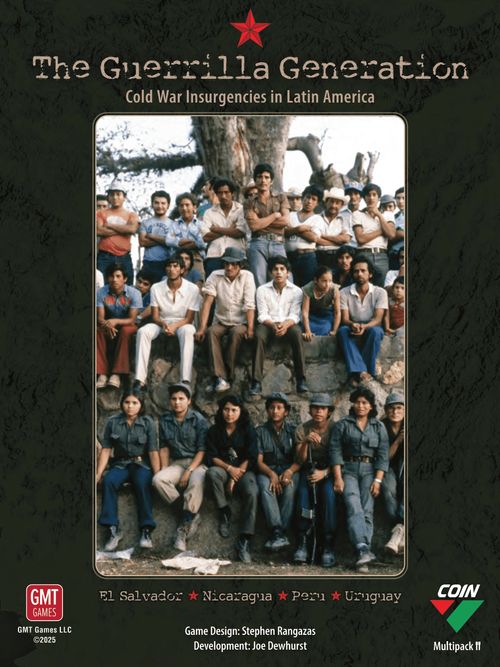
The Guerrilla Generation: Cold War Insurgencies in Latin America
The Guerrilla Generation: Nicaragua Rulebook
Table of Contents
Table of Contents
1.0 Introduction
The Guerrilla Generation: Nicaragua is a game in The Guerrilla Generation COIN multipack. Alongside its accompanying games Peru, El Salvador, and Uruguay, this historical simulation strives to depict insurgencies in Central and South America during the Cold War era.
The Guerrilla Generation: Nicaragua focuses on the civil war in Nicaragua between the Contra insurgency and the Nicaraguan Government with its military forces. It covers the period from the formation of the Nicaraguan Democratic Force in 1981 to the 1990 general election. The smaller Contra subgroups, who did not always work well together, are represented through Event cards. The civil war in Nicaragua cost the lives of over 30,000 people, including many civilians. The Contras committed most of the civilian targeting as part of their campaign against the Nicaraguan economy. However, the government's use of heavy firepower and isolated instances of forced relocation also increased civilian suffering. The Guerrilla Generation: Nicaragua attempts to model these dynamics with care and depict the conflict with a high degree of fidelity, even if the simulation is at times more unpleasant than fun.
The historical simulations that comprise The Guerrilla Generation multipack are designed to cover a wide range of different types of insurgent organizations that operate during civil wars. They include examples ranging from popular, restrained groups to ideologically rigid, highly violent groups. Learning to identify the differences between how insurgents operate is important for understanding variations in insurgent tactics, violence against civilians, governance, and vulnerabilities to different counterinsurgent strategies. This multipack is intended to help synthesize and present academic scholarship on insurgencies in Latin America and the broader political science literature on how armed groups operate. Many of the strategies used by the Government and Insurgent factions to advance their political goals are highly unethical and violate international laws on protecting civilians during conflict. The purpose of this pack is to approach these dynamics honestly, improve players' understanding of insurgencies through thoughtful play, and encourage them to seek out the discussion of sources and historical background material in the Event notes and Scenario booklet.
1.1 General Course of Play
In The Guerrilla Generation: Nicaragua, one Event card at a time is revealed from the shared draw deck, and both players will have an opportunity to either execute that Event or perform an Operation from a unique menu, possibly adding a Special Activity. Propaganda cards mixed in with the Event cards provide periodic interruptions where the general board state is assessed and Government Political Will is adjusted, possibly triggering an instant victory for the Contras, after which both players receive an opportunity to collect additional assets and redeploy their forces.
Cover image: Emilio Castellón, an 87-year-old old veteran of the first Sandino war, stands beside an 18-year-old Sandinista (Richard Cross Photography Collection)
1.2 Components
The following components from the multipack are required to play The Guerrilla Generation: Nicaragua:
- A 17”x22” mounted Nicaragua game board (1.3).
- A red Government (Nicaragua) mat and a blue Contras mat, used to hold Available Forces (1.4.1).
- A deck of 39 Nicaragua cards (5.0).
- 12 red cubes ('Troops'), 20 pink cubes ('Militia'), 20 dark blue octagonal cylinders ('Commandos'), 5 dark blue discs ('Bases'), 3 embossed cylinders (one blue and two red)—note that this is fewer than the total number of wooden pieces included in The Guerrilla Generation multipack, any excess should be set aside while playing Nicaragua.
- Six black and six white pawns (3.1.1).
- Specific markers from the countersheet: 1x red Political Will (Nicaragua flag), 1x Aid, 6x Iran-Contra, 1x 0 Econ Value, 1x Available/Not Available, 1x Western Honduras Out of Play, 1x Western Costa Rica Out of Play, 13x blue Unrest/+1 Unrest, 22x Sabotage/Terror, 8x Capability—all other markers should be set aside while playing Nicaragua.
- Two player aid sheets.
- One Propaganda Round aid sheet.
- Two six-sided dice (one red, one blue).
- This rules booklet.
1.3 The Map
The map shows Nicaragua with several of its departments aggregated into single spaces, border areas in Honduras and Costa Rica, and the capital city, Managua.
1.3.1 Map Spaces. Map spaces include Departments (Lowland, Mountain, or Jungle), Foreign Country spaces (Honduras or Costa Rica), and Managua City. All map spaces can hold forces (1.4).
1.3.2 Departments. The thirteen large irregular spaces inside of Nicaragua are Departments. Each Department is marked with a numerical Economic value (either '1' or '2') that affects Political Will (1.9) via placement of Unrest (1.6) during the Propaganda Round (6.3), and can also modify Government Resource earnings at the same time (6.4). Departments are further distinguished as Lowlands (light green), Mountains (brown), or Jungle (dark green) affecting Government Sweep (3.2.3) and Assault (3.2.4) Operations, as well as certain Events (5.0). Three Departments also include labelled white-on-blue anchor symbols that signify them as Port spaces. Sabotage markers in Port spaces affect Political Will during the Propaganda Round (6.3).
NOTE: The three Port Departments are Chinandega, Léon, and Zelaya South. A 0 Econ Value marker is included in the game for an Event (N18) that lowers the Economic Value of a '1' Department to 0. The faint dotted line running from Managua through Boaco, Chontales and Zelaya South is a reminder of the effect of Event N16, and can be ignored unless this Event is played.
1.3.3 Managua City. The large circular space is the capital city, Managua. Like Departments, Managua City is marked with an Economic value ('2') and may hold an Unrest marker (1.6). Sabotage markers in Managua City have an additional effect on Political Will during the Propaganda Round (6.3).
1.3.4 Foreign Country Spaces. The two spaces north of Nicaragua in Honduras and the two spaces south of Nicaragua in Costa Rica are Foreign Country spaces. These spaces provide a refuge for Contra forces where they may Organize (3.3.1), Infiltrate (3.3.2) to or from, and Raid (4.3.2) to or from. Government forces may never enter Foreign Country spaces, except for one Event (N10) that allows them to briefly enter Honduras. Foreign Country spaces do not have an Economic Value and are not considered Departments. Events may remove Western Honduras from play or add Western Costa Rica to play. Two "Out of Play" markers are provided to track their changing status.
NOTE: Western Costa Rica begins out of play until Event N2 is played. Western Honduras is removed from play by Event N24. No pieces may be placed into a Foreign Country space that is out of play by any means.
1.3.5 Adjacency. Adjacency affects the movement of forces and implementation of certain Events (5.0). Any spaces that border one another are adjacent.
1.4 Forces
The wooden pieces represent the two Factions' various forces: Government Troops (red cubes) and Militia (pink cubes), Contra Commandos (dark blue octagonal cylinders) and Bases (dark blue disks).
DESIGN NOTE: To highlight the operational differences of the Contra insurgents compared to insurgents in other COIN volumes, this game refers to them as Commandos rather than Guerrillas.
Piece key: Government cubes — Troops, Militia. Contra pieces — Commandos (Underground / Active), Contra Base.
Important! The Government in Nicaragua uses the red and pink cubes, while the Contras use the dark blue octagonal cylinders and five dark blue disks. Set aside all of the blue cubes (dark and light), two dark blue disks, and all the red octagonal cylinders and disks; these are not used in Nicaragua.
1.4.1 Availability and Removal. Each Faction has a separate mat showing an inventory of forces. The numbers indicated here limit the number of pieces that a Faction may have in play. Keep a Faction's forces not on the map on its mat, within easy view of both players—such forces are said to be Available.
- Unless otherwise instructed (by Event, 5.1.1), forces may only be placed from or replaced with those in the Available boxes. A piece to be replaced by a piece that is unavailable is simply removed.
- The Government (Nicaragua) mat contains an "Out of Play" box that begins the game with some Troop cubes in it. These Troops may not be used until they are released into play by the Mobilize Special Activity (4.2.1) or an Event effect (5.0). Troops may be moved to the Out of Play box during the Redeploy Phase of the Propaganda Round (6.5.1) and by some Event effects.
Important! Factions, while executing an Operation, Special Activity, or Event to place their own forces, may not take them from elsewhere on the map if the desired force type is not Available.
DESIGN NOTE: Unlike other games in the COIN series (including El Salvador and Peru), pieces that are not Available (on a Faction's mat) may not be taken from those on the map to place elsewhere.
1.4.2 Stacking. No more than two Bases (1.4) may occupy a single space.
- Bases placed (such as via the Organize Operation [3.3.1] or Event [5.0]) may never violate stacking.
- More than one Sabotage or Terror marker may be placed in a space, whether by Sabotage (3.3.3) or Events (5.0).
1.4.3 Underground/Active. Commandos are either Underground—symbol end down—or Active—symbol end up. Actions and Events flip them from one state to the other. Bases, Troops, and Militia are always Active. Always set up and place new Commandos Underground (including if replacing a piece).
NOTE: Unless instructions specify "Underground" Commando, it is sufficient to "Activate" already Active Commandos (they stay Active). Also, "moving" or "relocating" Commandos does not affect Underground status unless specified.
1.4.5 Overflow Counters. Three pairs of circular and rectangular overflow counters marked 'A', 'B', and 'C' are provided in case any map spaces become too crowded during play. Simply place one counter in the crowded space, then move all the forces there to the side of the map with the matching counter placed near them to indicate where they are currently located. Overflow counters otherwise have no game effect, and their use is not compulsory.
1.5 Players & Factions
The game requires two players, each playing as one Faction: the Government (red), and the Contras (blue).
1.6 Unrest
Unrest markers are placed during the Unrest Phase of the Propaganda Round (6.1) in spaces where Contra pieces (1.4) plus Sabotage markers (1.7) outnumber Government pieces, and by some Events (5.0). They may be removed during the Unrest Phase (6.1) and Reset Phase (6.6). Unrest markers reduce Political Will by the Economic Value of each space during the Political Will Phase of the Propaganda Round (6.3). Unrest markers that remain on the map between Campaigns also flip to their darker "+1" side, reducing Political Will by an additional 1 during the next Political Will Phase (6.3).
DESIGN NOTE: Unrest represents a decline in economic activity and increase in instability due to Contra sabotage operations and presence in areas beyond the ability of Government forces to restore order. The shaded side of Unrest markers has additional Political Will effects due to the compounding economic damage of failing to secure an area.
1.7 Sabotage and Terror
Sabotage and Terror markers are placed by the Contra Sabotage Operation (3.3.3) and some Events (5.0). Sabotage markers contribute to the placement of Unrest (1.6) and affect Government earnings during the Resource Phase (6.4). Sabotage markers in Port Departments and Managua City also directly affect Political Will during the Political Will Phase of the Propaganda Round (6.3), and Terror markers augment Government Train (3.2.1) and inhibit Contra Organize (3.3.1) and Infiltrate (3.3.2). Sabotage and Terror markers are not intended to be component limited, and any number may be placed during play.
1.8 Resources
At any moment the Government has between 0 and 20 Resources that it uses to pay for Operations (3.0). Mark Resources on the edge track with a red cylinder (1.5).
1.9 Government Political Will
Government Political Will is tracked with a marker on the edge track. The position of this counter will determine Victory (7.0) for either side. The marker is moved during the Campaign and during the Political Will Phase of the Propaganda Round (6.3). It may never be lower than 0 or greater than 20.
1.10 Aid Marker
The current status of US aid to the Contras is tracked with a marker on the US Aid Track (6.7), affecting the number of Contra Bases available and some of their Operations (3.3) and Special Activities (4.3).
1.11 Iran-Contra Markers
Iran-Contra markers are placed in the Iran-Contra Affair box located on the map, by the Iran-Contra Pass option (2.3.4) and by some Events (5.0). During the Iran-Contra Affair Phase of the Propaganda Round (6.2), and triggered by some Events (5.0), the Government player will make a roll against the number of Iran-Contra markers in the box. If the roll is equal to or less than the number of markers, the Iran-Contra Affair is exposed with several immediate effects (6.2.1). After the Iran-Contra Affair is exposed, ignore any further references to Iran-Contra markers.
DESIGN NOTE: Iran-Contra markers represent the increasing evidence documenting the Reagan administration's efforts to supply the Contras by circumventing Congressional restrictions. The more evidence that accumulates the greater the chances of getting caught and the greater the political fallout. Despite the risks, without bending the Congressional restrictions Contra players will struggle to maintain sufficient US aid to threaten the Sandinista regime.
2.0 Sequence of Play
2.1 Setup
Follow the instructions on the second to last page of this booklet to prepare the draw deck and set up markers and forces. A full setup diagram can be found on the back page of this booklet.
2.2 Start
Begin play by revealing the top card of the Event draw deck and placing it onto a played cards pile. All played cards and the number of cards in the draw deck are open to inspection.
NOTE: Unlike in most previous COIN series volumes, only one Event card is revealed at a time.
RECORD STEPS: As the steps of each Event card play are completed, place the Eligibility cylinder of the acting Faction's color (1.5) into the Initiative Track's appropriate box.
2.3 Initiative Track
One player takes the Government Faction and the red Eligibility cylinder, the other the Contra Faction and the blue Eligibility cylinder.
When playing an Event card, the Government or Contra player will execute Operations or the Event described on the card. At all times one player will be First Eligible, and the other will be Second Eligible. In each Event card round, the First Eligible player is first to choose what they will do, followed by the Second Eligible—whose choices are limited by what the First Eligible player did.
2.3.1 Eligibility. Each player puts one cylinder (blue and red respectively) on the First or Second Eligible spaces of the Initiative Track.
NOTE: The Contras always start the game in the 1st Eligible box and return there during the Reset Phase (6.6) of each Propaganda Round.
2.3.2 Options for Eligible Factions.
First Eligible: The First Eligible player may perform a Limited Operation (2.3.5), execute the Event (5.0), perform an Operation (3.0) with Special Activity (4.0), or Pass (2.3.3 and 2.3.4).
The player selects their desired box and places their Eligibility cylinder in the appropriate box on the Initiative Track, then immediately executes the chosen action (Limited Operation, Event, or Operation with Special Activity) or Passes.
Second Eligible: The Second Eligible player may then choose one of the boxes not containing the First Eligible player's cylinder and conduct the action in the box selected (or Pass).
2.3.3 Passing. After selecting a box, players may forgo the action in the box to Pass. If Government pass, they gain 2 Resources (1.8), and if Contras pass, they may Organize (3.3.1) in a Foreign Country space (1.3.4). Both players may pass and the order of cylinders in the Initiative Track will still decide eligibility (2.3.6).
2.3.4 Iran-Contra Pass. Instead of the normal pass option, the Contras may instead choose the Iran-Contra pass option, so long as the "Available" marker is showing in the Iran-Contra Affair box. Iran-Contra pass shifts the US Aid Track (6.7) two steps toward Offensive but also places an Iran-Contra marker in the Iran-Contra Affair box (1.11). Once the Government makes a successful Iran-Contra Affair roll through an Event (5.0) or the Iran-Contra Affair Phase of the Propaganda Round (6.2), flip the marker to its "Not Available" side to indicate the Contras can only conduct their normal pass option for the rest of the game.
2.3.5 Limited Operation. A Limited Operation is an Operation in just one space, with no Special Activity. If the Limited Operation is a Garrison (3.2.2) or Sweep (3.2.3) it can involve pieces from multiple spaces but only one destination space. A Limited Infiltrate (3.3.2) Operation may move Commandos from one selected origin space to several adjacent spaces.
2.3.6 Adjust Eligibility. After both players have selected and executed their actions, replace the Eligibility cylinders on the Initiative Track with the cylinder in the furthest left box becoming First Eligible, and the other cylinder becoming Second Eligible.
DESIGN NOTE: Selecting the Limited Operation box guarantees the player first eligibility on the next card. Likewise, selecting the Operation & Special Activity box guarantees second eligibility on the next card. Eligibility after selecting the Event space will depend on what the other player has chosen. The only way to block Events in The Guerrilla Generation is to select the Event box and then either play the Event or Pass.
2.3.7 Next Card. After eligibility has been reset, reveal the draw deck's next card and continue play.
2.4 Propaganda Card
When a Propaganda card is revealed, conduct a Propaganda round (6.0).
NOTE: Each series of Event cards leading up to a Propaganda Round is called a "Campaign".
3.0 Operations
3.1 Operations in General
A Faction executing an Operation (Op) chooses one of the four Operations listed on its Faction sheet and selects the map spaces (typically several) to be involved. Select a given space only once for a given Operation.
Operations usually cost Resources (1.8) for the Government, often paid per space selected; the Government must have enough Resources to pay for the Operation in each selected space. Government Operations are generally allowed in any number of spaces (Resources permitting) unless the Operation is Limited (2.3.5), in which case they are allowed in only one space.
The Contras do not possess Resources (1.8) and instead may select spaces for Operations up to the US Aid Track value (6.7) unless the Operation is Limited (2.3.5), in which case they may select only one space.
The executing Faction chooses the order of the spaces in which the Operation is resolved, the enemy pieces to be affected (targeted), and the friendly pieces to be placed, replaced, or moved. Once targeted, a Faction's pieces are affected to the maximum extent possible. Actions affecting another Faction's pieces do not require that Faction's permission.
3.1.1 Pawns. If desired, mark spaces selected for Operations (3.0), Special Activities (4.0), or other actions with white and black pawns. The pawns are for convenience, not a limit on play.
3.1.2 Free Operations. Certain Events grant free Operations or Special Activities to the Government, costing no Resources (5.4). Removing Sabotage as part of a free Train (3.2.1), Sweeping with Militia as part of a free Garrison (3.2.2) or adding Militia to a free Assault (3.2.4) all still cost Resources. All other requirements or procedures apply as normal, unless specifically modified by Event text (5.1.1, 5.4).
3.2 Government Operations
The Government chooses from Train, Garrison, Sweep, or Assault Operations.
NOTE: Government Operations may never place or move Government pieces into Foreign Country spaces (1.3.4).
3.2.1 Train. Train adds Militia and can remove Sabotage. Select any Departments with more Government pieces than Contra pieces, and/or Managua City. Pay 2 Resources per space without Terror where Militia are placed (Militia may be placed in selected spaces with Terror for free).
PROCEDURE: Place up to two Militia in each selected Department, or up to four Militia in Managua City (if selected). Then as desired, in one space selected for Train with Troops and Militia, Government may pay 2 Resources per Sabotage marker to remove any number of Sabotage markers.
3.2.2 Garrison. Garrison repositions Militia and may activate Commandos in one selected space. Pay 2 Resources total (not per space selected).
PROCEDURE: Move up to 6 Militia from any spaces to any other spaces in Nicaragua. A Limited Operation (2.3.5) Garrison may select only a single destination space, but may move Militia from multiple origin spaces. Then in one selected space, Government may pay 2 additional Resources to Sweep (3.2.3) with Militia there.
NOTE: Using Garrison to Sweep with Militia functions as a normal Sweep Operation, but Troops do not contribute to activating Commandos there. Militia may not be moved with Sweep, so this option is only useful to Activate Commandos.
3.2.3 Sweep. Sweep may move Troops and can reveal Commandos. Select any spaces in Nicaragua as destinations. Pay 2 Resources per selected destination space.
PROCEDURE: First, simultaneously move any adjacent Troops desired into selected spaces. Then, in each space selected, Activate (1.4.3) one Commando for every cube (moved or already there, even if no cubes moved). In Jungle Departments, instead Activate only one Commando for every two cubes there.
3.2.4 Assault. Assault removes Contra pieces. Select any spaces with cubes and Active Contra pieces. Pay 2 Resources per selected space.
PROCEDURE: In each selected space, remove one Active Contra piece for every Troop present, or one for every two Troops in Mountain Departments. Government may pay 2 additional Resources per space to also remove one Active Contra piece for every two Militia present. First remove Active Commandos, then remove Bases only once no Commandos remain (even Underground). Increase Political Will by 1 for each Base removed.
NOTE: Underground Commandos in a space prevent removal of Bases until all Commandos are Activated and removed.
3.3 Contra Operations
Contras choose from Organize, Infiltrate, Sabotage, or Ambush Operations.
3.3.1 Organize. Organize adds Contra forces in Foreign Countries and can build Bases in Nicaragua. Select Foreign Country spaces and/or Departments without Terror markers (1.7), up to the US Aid Track value (6.7).
PROCEDURE: In each selected Foreign County space, place one Commando, plus up to two additional Commandos for each Base there. In any selected space, may instead replace two Commandos with a Base.
NOTE: Organize in Departments may only place Bases, never Commandos.
DESIGN NOTE: Unlike insurgencies in other COIN volumes, the Contras, as a primarily cross-border group, may only use Organize to place Commandos in Foreign Country spaces. They may also use Organize to establish logistical Bases in Nicaragua, but to get Commandos into Nicaragua they must either Infiltrate or place them directly using the Supply Special Activity. These dynamics model the Contras' heavy reliance on external support and supply lines to continue operations, given their difficulties gaining extensive support from the local population inside Nicaragua.
3.3.2 Infiltrate. Infiltrate moves Commandos. Select origin spaces with Commandos, up to the US Aid Track value (6.7). A Limited Operation (2.3.5) Infiltrate may select only a single origin space, but may move Commandos from that origin to multiple destination spaces.
PROCEDURE: Move any Commandos in each selected origin space to any adjacent spaces. Set Commandos moving from one origin space to one destination space Active (1.4.3) if:
- The destination is a Department with a Terror marker or Managua City and
- The number of moving Commandos plus the number of cubes in that destination exceeds three.
Otherwise, moving Commandos retain their current orientation (Active or Underground).
3.3.3 Sabotage. Sabotage places Sabotage markers and potentially Terror markers. Select spaces with more Commandos than Militia, up to the US Aid Track value (6.7).
PROCEDURE: In each selected space, Activate an Underground Commando and either place one Sabotage marker, or if no Terror marker, may instead place two Sabotage markers and a Terror marker.
DESIGN NOTE: Unlike the FMLN or Tupamaros' use of Sabotage in El Salvador and Uruguay, which generally avoided significant civilian deaths, the Contras intentionally targeted civilians as part of their war against the Nicaraguan economy. Civilian targets associated with the Sandinista regime's social programs, such as agricultural cooperatives or schools, were frequently targeted. The Sabotage Operation reflects the tradeoff between more selective targeting that avoids alienating the local population and more indiscriminate terror that commits greater economic damage at the cost of pushing civilians into supporting the Government's counterinsurgency campaign.
3.3.4 Ambush. Ambush uses Commandos to eliminate Government forces. Ambush may select spaces with Underground Commandos and Government forces, up to the US Aid Track value (6.7).
PROCEDURE: In each selected space, Activate an Underground Commando and remove one cube (Militia before Troops).
NOTE: Unlike the Contra Attack Special Activity, removing a Troop cube with Ambush does not reduce Political Will by 1.
4.0 Special Activities
4.1 Special Activities in General
When a Faction per the Initiative Track (2.3) executes an Operation (3.0), it may also execute one Special Activity (EXCEPTION: Limited Operations, 2.3.5). As with Operations, the executing Faction selects spaces and pieces affected, and the order of actions. Select a given space only once as a location for a given Special Activity. Events may grant free Special Activities (not further affecting Eligibility, 2.3.1).
Important! A Faction may execute its Special Activity at any one time immediately before, during, or after its Operation.
EXAMPLE: Contras may Organize in one space to place a Base, then pause to Raid with the remaining Commandos at the newly placed Base, before continuing to Organize in other spaces.
4.1.1 Accompanying Operations. Some Special Activities specify that they may only accompany certain types of Operations (3.0). Certain Special Activities must occur where their Accompanying Operation occurred. If not otherwise specified, Special Activities may accompany any Operations and take place in any otherwise valid spaces.
4.2 Government Special Activities
The Government chooses from Mobilize, Air Lift, or Bombard Special Activities.
4.2.1 Mobilize. Mobilize places Troops on the map. Mobilize may select one 2 Economic Value Department without Contras, or Managua City. It may only accompany Train (3.2.1) or Garrison (3.2.2).
PROCEDURE: Place up to 6 Troops from Available or Out of Play in the selected space.
NOTE: Mobilize may place Troops onto the map directly from the Out of Play box.
4.2.2 Air Lift. Air Lift quickly relocates Troops. It may select any three spaces in Nicaragua. Air Lift may accompany any Government Operation (3.2).
PROCEDURE: Move up to 6 Troops among the selected spaces.
4.2.3 Bombard. Bombard removes Contras, even from Foreign Country spaces (1.3.4). Bombard may select up to two spaces in or adjacent to spaces with at least two Troops. It may only accompany Sweep (3.2.3) or Assault (3.2.4).
PROCEDURE: In each selected Nicaragua space, remove one Active Contra piece. In each selected Foreign Country space, remove one Contra piece (even Underground Commandos) per two adjacent Troops, then roll a die—if the result is lower than the number of adjacent Troops, reduce Political Will by 2. Only remove Bases after all Commandos (Active or Underground) are removed. Increase Political Will by 1 for each Base removed.
DESIGN NOTE: In Nicaragua spaces, Bombard represents the use of close air support and artillery to augment Contra losses. In Foreign Country spaces, Bombard is used to show the tradeoff of limited incursions by the military to clear out Contra concentrations at the risk of international condemnation.
4.3 Contras Special Activities
Contras choose from Supply, Raid, or Attack Special Activities.
4.3.1 Supply. Supply places Commandos directly into Nicaragua. Supply may select any Departments with Contra pieces connected by a route of spaces with Contra pieces to a Base in a Foreign Country space, up to the US Aid Track value (6.7). Supply may accompany Organize (3.3.1) or Sabotage (3.3.3).
PROCEDURE: Place one Commando in each selected space.
4.3.2 Raid. Raid allows the Contras to strike with or recover Commandos adjacent to Bases. Raid may select up to two spaces adjacent to Contra Bases. Raid may only accompany Organize (3.3.1), Infiltrate (3.3.2), or Sabotage (3.3.3).
PROCEDURE: In each selected space, either move up to two Commandos from one adjacent space with a Base to the selected space and if desired conduct a Limited Sabotage (3.3.3) or Limited Ambush (3.3.4) there; or move any Commandos from the selected space to an adjacent space with a Base and flip them Underground (1.4.3).
4.3.3 Attack. Attack allows the Contras to launch a large attack to lower Political Will. Attack may select one Nicaragua space with Commandos and cubes. Attack may not be selected if the US Aid Track (6.7) is at Cutoff. Attack may only accompany Infiltrate (3.3.2), or Ambush (3.3.4).
PROCEDURE: Activate all Commandos in the space and roll a die—if the result is less than or equal to the number of Commandos in the space, remove two cubes (Militia before Troops). If the US Aid Track is at Offensive, instead remove three cubes (Militia before Troops). Reduce Political Will by 1 if any Troops are removed.
5.0 Events
Each Event bears a title headline, capitalized flavor text, and Event text. Flavor text provides historical interest and has no effect on play.
5.1 Executing Events
When a Faction executes an Event, it carries out the Event text literally and in order (sometimes involving actions or decisions by the other Faction). Unless otherwise specified, the executing Faction makes all selections involved in implementing the text, such as which pieces are affected. If another Faction is specified or selected to take an action, that Faction decides the details of the action. Some Events with lasting effects have markers as aids to play.
5.1.1 Where Event text contradicts rules, the Event takes precedence. However:
- Events may not violate stacking (and so may never place more than two Bases in one space).
- Events place only Available pieces (1.4.1); they remove rather than replace if the replacement is not Available or if stacking (1.4.2) would be violated.
- Events may not raise Resources or Political Will beyond 20 or reduce them below 0 (1.8, 1.9).
5.1.2 If two Events contradict, the currently played Event takes precedence.
5.1.3 An executed Event's text that can be implemented must be. If not all of its text can be carried out, implement that which can.
5.2 Dual Use
Many Events have both top and bottom Event text. The executing Faction may select either the top or bottom text to carry out (not both). While the bottom text often favors the Government, a player may select either text option regardless of Faction.
DESIGN NOTE: Dual-use events represent opposed effects of the same cause, forks in the historical road, or instances subject to alternative historical interpretation.
5.3 Capabilities
Events labeled "Government Capability" or "Contra Capability" have lasting effects mainly relating to that Faction, either positive or negative. The label is for flavor only, and both Factions may play Capability Events with either label. A Capability Event's effects last for the rest of the game.
NOTE: Set out executed Capabilities Event cards near the board as added reminders, using a Capability marker to indicate which option was selected.
5.4 Free Operations
Some Events allow a Faction to perform an immediate Operation or Special Activity that interrupts the usual sequence of play and is typically free: it bears no Resource cost and does not affect Eligibility (2.3.1, 3.1.2), though other procedures and restrictions remain unless modified by Event text (5.1.1).
NOTE: Removing Sabotage with Train costs Resources even if part of a free Train (3.2.1), Sweeping with Militia costs Resources even if part of a free Garrison (3.2.2), and adding Militia to a free Assault (3.2.4) always costs Resources. Contras do not use Resources and so Operations are never 'free' for them.
6.0 Propaganda Round
Conduct a Propaganda Round in the sequence of phases below when each Propaganda card is revealed. The Propaganda Round aid sheet also lists this sequence.
6.1 Unrest Phase
The Unrest Phase involves adjusting Unrest markers (1.6) on the map.
6.1.1 Remove Unrest. Remove any Unrest markers from spaces with more cubes than Contra pieces plus Sabotage markers; otherwise, any Unrest remains.
6.1.2 Add Unrest. Add an Unrest marker on its light blue side to each Nicaragua space without an Unrest marker where there are more Contra pieces plus Sabotage markers than cubes.
6.2 Iran-Contra Affair Phase
The Iran-Contra Affair Phase checks whether the Reagan Administration is caught circumventing Congress to supply the Contras.
6.2.1 Iran-Contra Affair Roll. If there are any Iran-Contra markers in the Iran-Contra box, the Government player rolls a die. If the result is less than or equal to the number of Iran-Contra markers in the box (1.11), the Iran-Contra Affair is uncovered, with the following immediate effects:
- Increase Political Will by half the number of Iran-Contra markers in the box (round down).
- Shift US Aid Track (6.7) two steps toward Cutoff.
- Remove all Iran-Contra markers from the game.
- The Iran-Contra Pass option (2.3.4) is no longer available (flip the marker to "Not Available").
- Any further Iran-Contra Affair rolls should be ignored.
Otherwise, continue without removing any markers.
6.3 Political Will Phase
Calculate the net effect to Political Will of the following adjustments before shifting the marker:
6.3.1 Unrest. Reduce Political Will by the Economic Value of each space with an Unrest marker (1.6). Then, reduce Political Will by 1 more for each dark blue Unrest marker (on the +1 side).
6.3.2 Economic Sabotage. Reduce Political Will by 1 for each Port space and/or Managua City with at least one Sabotage marker.
6.3.3 Contras Contained. Increase Political Will by 2 if there are no Contra Bases in Nicaragua.
6.3.4 Defense Spending? Increase Political Will by 1 for every three Troops in the Out of Play box on the Government mat (1.4.1).
NOTE: It's important to calculate the net shift in Political Will during these steps before moving the marker and checking victory, rather than adjusting the marker one step at a time.
6.3.5 Victory? If Government Political Will is now at 0, the game immediately ends with a Contra victory.
6.3.6 Game End? If this is the final Propaganda card, and Contras have not won, the game immediately ends with a Government Victory.
6.4 Resources Phase
Follow the steps below to add to Government Resources to a maximum of 20 (1.8).
6.4.1 Government Earnings. Government gains Resources equal to the Economic Value of each space without any Sabotage or Unrest markers.
6.4.2 External Aid. Increase Government Resources by the value of the US Aid Track (6.7).
DESIGN NOTE: As US aggression against the Sandinista regime increased, other countries, and even transnational organizations, became more willing to help compensate for the economic losses inflicted by the Contras and US policies.
6.5 Redeploy Phase
6.5.1 Government. Government must remove half of the Militia in each Department (round down) and may return up to six Troops from any map spaces to the Out of Play box (1.4.1). Then, Government may move any Troops remaining on the map to any Nicaragua spaces without Contra pieces.
6.5.2 Contras. Contras may keep Commandos in a number of Nicaragua spaces up to the US Aid Track value (6.7), then must move all remaining Commandos in Nicaragua to any Foreign Country spaces (1.3.4).
6.5.3 Congressional Pressure. Shift the US Aid Track one step toward Cutoff. Remove Contra Bases from Available then map to Track positions greater than the current position of the US Aid marker, until all Base spaces are filled. Increase Political Will by 1 for each Base removed from the map in this way.
6.6 Reset Phase
Carry out the following steps to prepare for the next Campaign.
- Remove all Terror and Sabotage markers from the map.
- Remove any Unrest markers from spaces where there are now more Government pieces than Contras pieces, and from spaces without any Contra pieces.
- Flip any remaining Unrest on the map to its dark blue (+1) side.
- Flip all Commandos Underground (1.4.3).
- Set Contras to 1st Eligible and Government to 2nd Eligible.
- Reveal the next card from the draw deck and continue play (2.3.2).
6.7 US Aid Track
Although the United States did not create the Contra insurgency, US aid played a crucial role in augmenting and arming the Contra groups, eventually turning them into a major threat to the Sandinista regime. Without US assistance, the Contras would have remained a collection of disgruntled ex-National Guard and peasant groups in northern Nicaragua and the Atlantic coast. The heavy dependency on US aid would become both a major boon and hindrance for the insurgency as the tempo of its operations fluctuated with the ability of the Reagan administration to get aid from Congress. The US Aid Track is designed to capture these dynamics.
6.7.1 Moving the Track. The US Aid Track is moved in either direction by Events (5.0), shifted toward Offensive by the Iran-Contra Pass option (2.3.4), and shifted toward Cutoff during each Propaganda Round (6.5.3). Once per game, the US Aid Track may also be shifted two levels toward Cutoff by the Government succeeding at its roll during the Iran-Contra Affair Phase (6.2).
6.7.2 Effect on Contra Actions. The value of the US Aid Track determines how many spaces the Contras may select for their Operations (3.3). In addition, the value of the US Aid Track determines the number of spaces for the Supply Special Activity (4.3.1) and augments or prohibits the Attack Special Activity (4.3.3).
6.7.3 Effect on Contra Redeploy. The value of the US Aid Track also determines the number of spaces in Nicaragua where Commandos may remain during the Propaganda Round Redeploy Phase (6.5.2).
6.7.4 Effect on Contra Bases. The current position of the US Aid Track determines the number of Bases available to the Contra player. If the US Aid marker advances to a space with a Base, immediately move the Base to the Contra Available Forces display (1.4.1). If the US Aid marker is lowered behind a position with a Base, do not immediately move a Base to the Track. Bases are only removed to the Track during the Redeploy Phase (6.5.3).
DESIGN NOTE: The three types of effects of the US Aid Track each reflect part of the external material support to the Contras. The effect on Contra actions reflects the weapons, ammunition, and supplies needed to equip and launch operations with Commandos. The redeploy and bases effects capture the use of supplies to sustain Contras in Nicaragua. During periods of aid reductions or cutoffs, the Contras were often forced to retreat to border bases in Honduras or Costa Rica and lower their tempo of operations.
7.0 Victory
Victory is determined by the level of Government Political Will (1.9). Political Will is measured on the edge track and can range from 0-20.
7.0.1 Early Victory. At the victory check during the Political Will Phase of a Propaganda round, the Contras win if Political Will is at 0.
7.0.2 Final Victory. If Contras have not won at the end of the Political Will Phase of the final Propaganda Round, the game ends in Government victory.
DESIGN NOTE: A Contra victory represents inflicting enough economic harm to severely undermine the popularity of the Sandinista regime, resulting in their electoral defeat to a candidate outside of the regime, similar to the historical 1990 election. As acknowledged by Reagan administration officials themselves, a Contra victory should not be interpreted as the insurgency toppling the regime by military force. Even under the best circumstances, the Contras would have struggled to trigger a complete collapse. A Government victory at game end represents the Sandinista government successfully containing the damage inflicted by the Contras, allowing them to continue implementing social programs and win electoral victories to remain in power into the 1990s.
7.1 Raising Political Will
Government Political Will is raised in the following ways:
- Removing a Contra Base by Assault, Bombard, Event, or Redeploy (+1 PW)
- Events (+1 to +3 PW)
- At Propaganda Round, no Contra Bases in Nicaragua (+2 PW)
- At Propaganda Round, Troops in Out of Play box (+1 PW per 3 Troops)
7.2 Lowering Political Will
Government Political Will is lowered in the following ways:
- Attack that removes any Troops (–1 PW)
- Bombard in Foreign Country space (–2 PW)
- Events (–1 to –3 PW)
- At Propaganda Round, Economic Value of each Unrest space (–1 to –2 PW per space)
- At Propaganda Round, for each Unrest +1 marker on map (–1 PW per marker)
- At Propaganda Round, for each Sabotaged Port space or Managua City (–1 PW per space with a Sabotage marker)
8.0 Example of Play
Set up the game as indicated in section 2.1 (consult the setup diagram on the back of this booklet), but construct only the first part of the deck with these cards in the following order, facedown from top to bottom: Daniel Ortega Visits Moscow (N14), International Community Debates Loans to Nicaragua (N34), Soviet Union Provides Heavy Weapons (N31), Sandinista Militia Defends Regime (N11), Reagan Seeks Alternative Contra Funding (N26), Negotiations With Miskito Indians Begin (N28), and Propaganda (N39). We are now ready to begin.
Reveal the first card, Daniel Ortega Visits Moscow, from the top of the deck. Contras are 1st Eligible and decide to perform an Organize Operation with the Raid Special Activity. We place their blue Eligibility cylinder into the 'Op & Special Activity' box on the Initiative Track to indicate what they are doing. Organize can select any Foreign Country spaces and any Departments without Terror, up to a total number of spaces equal to the current US Aid Track value (this is true of all Contra Operations). In Foreign Country spaces Organize can either replace two Commandos with a Base, or place one Commando plus up to an additional two Commandos per Contra Base there, while in Departments it can only be used to replace two Commandos with a Base (Organize cannot place Commandos directly into Nicaragua Departments).
The US Aid Track value is currently 3, so Contras will just Organize in each available Foreign Country space (Western Costa Rica is currently out of play, so cannot be selected). They place one Commando in Western Honduras, three Commandos in Eastern Honduras, and three Commandos in Eastern Costa Rica.
Illustration: Contras Organize in Honduras
Next, the Contras will Raid, selecting up to two spaces adjacent to Bases. In each selected space they can either move in one or two Commandos from the adjacent Base space and then Sabotage or Ambush there, or they can move any number of Commandos from the space back to an adjacent Base space and flip them Underground. In this case they Raid as follows:
They move two Commandos into Zelaya North from Eastern Honduras, then Activate one to Ambush, removing the pink Militia cube from the space (Militia must usually be removed before red Troops cubes).
Illustration: Contras Raid into Zelaya North and Ambush there
They move two Commandos into Río San Juan from Eastern Costa Rica, then Activate one to Sabotage, placing one Sabotage marker. Sabotage can only be performed if there are more Commandos than Militia, and can place either one Sabotage marker, or two Sabotage markers and a Terror marker (which can have negative consequences for the Contras).
Illustration: Contras Raid into Río San Juan and Sabotage there
Contras do not pay Resources for their Operations, instead being constrained by the current value of the US Aid Track. The Contra turn is now complete.
This leaves Government to choose from the other two boxes on the Initiative Track, Limited Operation or Event. They are not interested in the Event, so instead decide to perform a Limited Sweep Operation, which allows them to move Troops into one destination from any adjacent spaces, then Activate Commandos in the destination. They select Zelaya North as the destination but do not move in any additional Troops (as there are not any adjacent). Sweep normally Activates one Commando per cube in the destination (even if they didn't move), but only Activates one Commando for every two cubes in Jungle Departments like Zelaya North. There are only two cubes in Zelaya North, so they just Activate one Commando there. This costs them 2 Resources, down to 16 total.
The Government turn is now complete, and as both players have completed their turns, we reset Eligibility. The Faction whose cylinder is furthest to the left, in this case Government, becomes 1st Eligible, and the other Faction becomes 2nd Eligible.
Illustration: Eligibility is reset at the end of each round
Reveal the next card: International Community Debates Loans to Nicaragua. Government is 1st Eligible and decides to perform an Assault Operation with the Air Lift Special Activity. They will carry out their Air Lift first, which can select up to three spaces in Nicaragua and move up to six red Troops cubes between any of them. They select Managua City, Jinotega, and Río San Juan, moving two Troops from Managua City to each Department.
Illustration: Government Air Lift
Next, they will Assault in Zelaya North and Río San Juan, which costs 2 Resources per space and allows them to remove one Active Contra piece per Troops cube, or per two Troops cubes in Mountain Departments. They can also pay 2 additional Resources in any space to remove one Active Contra piece per two Militia there, but in this case do not need to do so. They remove both Active Commandos in Zelaya North and the single Active Commando in Río San Juan, then reduce their Resources by 4, to 12. The Government turn is now complete.
The Contras decide to pass, placing their Eligibility cylinder in either available box on the Initiative Track. When the Contras pass they are usually able to Organize in one Foreign Country space (while Government gains 2 Resources when they pass), but they also have a special option available to them: the Iran-Contra Pass. This allows them to shift the US Aid Track two steps toward Offensive, but also places one Iran-Contra marker in the Iran-Contra Affair box, which increases the risk that the affair will be uncovered. Nonetheless, they decide to use this option, placing one Iran-Contra marker and shifting the US Aid Track to '4' (Offensive), which also unlocks the Base under the second '3' space (so we move it to the Contra mat now). We then reset Contras to 1st Eligible and Government to 2nd Eligible.
Illustration: The Contras pass to gain additional aid through legally dubious means
Reveal the next card: Soviet Union Provides Heavy Weapons. Contras are 1st Eligible and decide to perform the Infiltrate Operation with the Attack Special Activity. Infiltrate allows the Contras to move Commandos out of selected origin spaces into any adjacent spaces, and they are now able to select up to four spaces due to the US Aid Track being at 4. They Infiltrate as follows:
- Three Commandos from Western Honduras to Chinandega.
- One Commando from Jinotega to Matagalpa.
- Two Commandos from Zelaya North to Zelaya South.
- Three Commandos from Eastern Costa Rica to Río San Juan.
Then they Attack in Río San Juan, which Activates all Commandos there and rolls a die—if the result is less than or equal to the number of Commandos in the space they can remove two cubes, or three cubes if the US Aid Track is at Offensive, as it is now. They roll a '3', less than the number of Guerrillas in the space, so they are able to remove the Militia cube (first), then both Troops cubes, also reducing Political Will by 1 (to 17) due to removing a Troops cube. The Contra turn is now complete.
Illustration: Contras Infiltrate into Río San Juan and then Attack there
The Government decides to perform a Limited Train Operation, which selects Departments with more cubes than Contra pieces and/or Managua City, paying Resources to place Militia cubes and/or remove Sabotage markers. In this case the Operation is Limited so they just select Managua City, paying 2 Resources (down to 10) to place four Militia there. We then reset Government to 1st Eligible and Contras to 2nd Eligible.
Reveal the next card: Sandinista Militia Defends Regime. Government is 1st Eligible and decides to perform the Garrison Operation with the Mobilize Special Activity. Garrison allows them to move up to six Militia between any spaces in Nicaragua, paying only 2 Resources even if Militia are moved between multiple spaces, then (if desired) pay 2 additional Resources to Sweep with Militia (only) in one space, which allows them to Activate Commandos but not move any cubes. They move all six Militia out of Managua City, sending two each to Chinandega, Matagalpa, and Zelaya South. Then they Sweep in Chinandega, Activating all three Commandos there (as they have three cubes and it is not a Jungle Department). This costs them 4 Resources in total, down to 6.
Next they Mobilize, which allows them to place up to six Troops from Available and/or Out of Play into one space, which has to be either Managua City or a 2 Economic Value Department with no Contra pieces. They select León and place five Troops there, two from Available and three from Out of Play. They could have placed an additional Troop from Out of Play, but decided not to as they will gain Political Will for every three Troops left in Out of Play during the Propaganda Round. The Government turn is now complete.
Contras will perform the top effect of the Event, which allows them to Ambush in each space with Militia and Underground Commandos. They Ambush in Nueva Segovia, Matagalpa, and Zelaya South, Activating a Commando to remove a Militia in each Department. We then reset Contras to 1st Eligible and Government to 2nd Eligible.
Reveal the next card: Reagan Seeks Alternative Contra Funding. Contras are 1st Eligible and decide to perform an Organize Operation with the Supply Special Activity. They can select four spaces for Organize now, and begin with Río San Juan, where they replace two Commandos with a Base. Next they select Western Honduras, placing one Commando there.
A Special Activity can be performed in between Operation spaces, so they now pause to Supply, which can select Departments in Nicaragua up to the US Aid Track value, each of which must have Contra pieces and be connected to a Base in a Foreign Country space by a route of spaces with Contra pieces, and places one Commando in each selected space. This means that they cannot select Matagalpa, but each other Department with Contra pieces in Nicaragua is eligible, four in total, so they place one Commando each into Nueva Segovia, Chinandega, Zelaya South, and Río San Juan.
They then return to Organize, just placing the three remaining Available Commandos into Eastern Costa Rica. There are no other Commandos available to place, so they do not select a fourth space for Organize, and the Contra turn is complete (they could have chosen to replace two Commandos with a Base in Nueva Segovia, Chinandega, or Zelaya South, but decide not to).
Government will perform the bottom effect of the Event, which adds one Iran-Contra marker to the Iran-Contra Affair box, then removes two Commandos from Eastern Costa Rica. We then reset Government to 1st Eligible and Contras to 2nd Eligible.
Reveal the next card: Negotiations With Miskito Indians Begin. Government is 1st Eligible and decides to perform the Assault Operation with a Bombard Special Activity. They will Bombard first, which allows them to remove Commandos from up to two spaces in or adjacent to spaces with at least two Troops. In each selected Nicaragua space they can only remove one Active Contra piece, while in Foreign Country spaces they can remove one Contra piece for every two Troops in adjacent spaces, even Underground Commandos, but in both cases they can only remove Bases once no Commandos remain. They decide to remove the Active Commando from Matagalpa and two Underground Commandos from Eastern Honduras. Selecting a Foreign Country space also requires them to roll a die—if the result is less than or equal to the number of Troops in adjacent spaces they lose two Political Will. In this case they get lucky and roll a '5', so they do not lose any Political Will.
Next they will Assault, but as they do not have any Troops in spaces with Active Contra pieces they will need to pay extra to use Militia, meaning that it will cost them 4 Resources per space. They can only afford to select one space and choose Chinandega, paying 4 Resources (down to 2) to remove one Active Commando there. This may not look like much, but it is enough to prevent Sabotage, protecting the valuable Port space.
Contras will perform a Limited Sabotage Operation, Activating one Underground Commando in Zelaya South and choosing to place two Sabotage markers and one Terror marker there. We then reset Contras to 1st Eligible and Government to 2nd Eligible.
The next card revealed is the Propaganda card, triggering a Propaganda Round. We will work through each phase in turn, starting with the Unrest phase:
- Unrest: Contras place one Unrest marker in Nueva Segovia, Zelaya South, and Río San Juan, each on their lighter regular (not darker +1) side.
- Iran-Contra Affair: Government rolls a '2', which is equal to the number of markers in the Iran-Contra Affair box, so the affair is uncovered. This shifts the US Aid Track two steps toward Cutoff, increases Political Will by 1 (to 18), then removes all Iran-Contra markers and flips the Iran-Contra Pass marker to its 'Not Available' side (so the Contras will not be able to use this option to increase US Aid for the rest of the game).
- Political Will: Political Will is reduced by a net total of –3 (–3 because there is 3 Population worth of spaces with Unrest markers, –1 because one Port space has a Sabotage marker, and +1 because there are three Troops Out of Play), down to 15. If Political Will was now 0 then the Contras would immediately win the game.
- Resources: Government gains 17 Resources for Nicaragua spaces without Unrest or Sabotage, then an additional 3 Resources for the value of the US Aid Track, putting them at their maximum of 20 Resources.
- Redeploy:
- Government must remove half their Militia from each Department, rounded down, so in this case just removing one Militia from Chinandega and one from Zelaya South. They can then move up to six Troops from the map to Out of Play, and can move any remaining Troops to Nicaragua spaces without Contra pieces; they decide just to move four Troops from León to Chontales.
- Contras can keep pieces in Nicaragua spaces up to the US Aid Track value, and must move all other Contra pieces back to any Foreign Country spaces. They keep their pieces in Nueva Segovia, Zelaya South, and Río San Juan, moving two of the Commandos in Chinandega to Western Honduras and one to Eastern Honduras. Then the US Aid Track is shifted one more step toward Cutoff, and the Contras must return Bases to fill the slots above its current position, in this case two, which they can take from Available (otherwise they would need to take them from the map, increasing Political Will by 1 for each one removed).
- Reset: Remove all Terror and Sabotage markers from the map, and any Unrest markers now in spaces with more cubes than Commandos or without any Commandos. Flip all remaining Unrest markers to their darker +1 sides (these will have an additional effect on Political Will if they are still on the map at the next Political Will phase). Flip all Commandos Underground. Set Contras 1st Eligible and Government 2nd Eligible. Then reveal the next card and continue play.
Illustration: Contra soldier from the Nicaraguan Democratic Force (FDN) stands with laughing civilians, Honduras, 1983 (Richard Cross Photography Collection)
This example of play is now complete. You can continue the current game by constructing the rest of the deck (two stacks of eight random Event cards, each with a Propaganda card shuffled in with the bottom two Event cards) and revealing the next Event card. The Contras have established a sizable presence inside Nicaragua but have struggled to reduce Political Will by much, and with the Iran-Contra Affair uncovered they will have trouble garnering more US Aid moving forward (look out for Events that do this). On the other hand, Government has been forced to deploy reserve Troops and their Militia are thin on the ground, potentially leaving some openings for the Contras to exploit.
9.0 Event Tips and Background
The card backgrounds below provide brief summaries of the historical events and the rationale behind the effects on the cards. For those looking to read more on the Nicaraguan Civil War (1979-1990), there are several accounts by journalists including Christopher Dickey's With the Contras: A Reporter in the Wilds of Nicaragua, Glenn Garvin's Everybody Had His Own Gringo: The CIA & the Contras, or Stephen Kinzer's Blood of Brothers: Life and War in Nicaragua. For a more academic account, see Lynn Horton's Peasants in Arms: War and Peace in the Mountains of Nicaragua, 1979-1994. For those also strongly interested in domestic developments within the United States during the Contra war, I recommend William LeoGrande's Our Own Backyard, which is also the recommended source for the Resisting Reagan combined scenario.
The images on cards N8, N11, N21, N25, and N36 are all from the Richard Cross Photography Collection, courtesy of the Tom & Ethel Bradley Center at California State University, Northridge.
N1. FDN Attracts Recruits in Honduras
Rapid expansion: Contras may place a Base in a Honduras space, then Organize there.
Former National Guard: Increase Political Will by 1 for each Contra Base in Honduras (max 3).
Tips: The top effect cannot place a Base in Western Honduras if it is Out of Play.
Background: The Nicaraguan Democratic Force (FDN) served as the main Contra force during the war. The FDN operated out of bases along the Honduran border and was formed from a merger of groups all aligned against the new Sandinista government. The alliance included many political and military elites previously associated with the toppled Somoza regime, including its military leader, Enrique Bermúdez (N21), who was a former member of Somoza's infamous National Guard.
The top effect illustrates the FDN's rapid expansion through incorporating former members of the National Guard, who provided a ready supply of individuals with pre-existing military training, while the bottom effect reflects the political liability of recruiting ex-Guardsmen.
N2. Edén Pastora's Leadership Questioned — CONTRA CAPABILITY
ARDE expands westward: Contras may place a Base in Western Costa Rica. Western Costa Rica is now in play.
ARDE stagnates: Organize in Eastern Costa Rica may only place 1 Commando.
Tips: Remove the Out of Play marker from Western Costa Rica if the top effect is selected.
Background: Edén Pastora, known as "Commander Zero", became a hero during the Sandinista revolution against Somoza through his daring acts. However, Pastora quickly fell out of favor with the new regime and established his own Contra force, the Democratic Revolutionary Alliance (ARDE), in eastern Costa Rica with assistance from the CIA (N7). Despite Pastora's potential as a more popular insurgent leader than the former National Guardsmen that made up the Honduras-based FDN (N1), the ARDE struggled to make progress under Pastora's leadership.
The bottom Capability effect represents Pastora's poor leadership and the heavy infiltration of the ARDE by Sandinista spies (N32), including Pastora's own girlfriend. The Sandinista government came close to killing Pastora in 1984 when assassins posed as journalists during a press conference. The top effect reflects a counterfactual where Pastora either rose to the occasion or was quickly replaced by a more capable leader, as eventually occurred in 1985, allowing the ARDE to threaten Nicaragua's more economically developed western coast.
N3. Corinto Raid Shocks Nation
Seaborne raiders plant mines: Place a Sabotage marker and a Commando into each of up to 2 Port spaces. Reduce Political Will by 1.
Goldwater condemns raid: Shift US Aid Track 2 steps toward Cutoff and remove 1 Commando from each Port space.
Tips: None.
Background: In one of the most controversial acts of the war, CIA-backed mercenaries launched an amphibious raid using Q-boats against the major port of Corinto on the western coast of Nicaragua. The raid inflicted serious damage, including mining of the port to hinder traffic, but also triggered political backlash in the United States. Critics within Congress included conservatives such as Senator Barry Goldwater, a famous Cold War hawk.
The event's top effect models the threat to the Nicaraguan economy of the Reagan administration escalating its support of the Contras with CIA covert operations. By launching attacks from the sea, CIA direct action threatened the economically vital western coast. Yet, as the bottom effect reflects, escalatory acts could form consensus in Congress for severing military aid to the Contras (N5) and banning any further covert seaborne operations.
N4. Conflicting Reports on Contra Activities
Radio Fifteen praises Contras: Reduce Political Will by 1 for each Contra Base in Nicaragua (max 3).
Brody Report on Contra terror: Shift US Aid Track 1 step toward Cutoff for each space with a Terror marker (max 2).
Tips: None.
Background: An intense debate occurred over the framing of the Contra insurgency, both in Nicaragua and internationally. The Reagan administration strove to frame the Contra insurgents as popular "freedom fighters". To help spread positive propaganda, the CIA assisted the Contras with establishing radio stations, such as Radio Fifteen, in bordering countries. With still high illiteracy rates in the 1980s and a general lack of home televisions, radio broadcasts remained a critical medium for communicating to the rural population of Nicaragua. However, the credibility of such claims depended on the success of the insurgents at maintaining ties within Nicaragua (requiring Contra Bases in Nicaragua for the top effect).
In response, the Sandinista government, foreign reporters, and the Central American Peace Movement (CAPM) all challenged the positive spin on the Contra insurgency, focusing on their dependency on foreign support and violence against civilians. The "Contra Terror in Nicaragua" report, published in 1985 by lawyer Reed Brody, documented Contra terror tactics against civilians, intensifying criticism of Contra aid from the United States.
N5. Boland Amendment Passes Congress
Contra raids continue regardless: Contras may Raid.
Amendment prohibits further aid: Shift US Aid Track 3 steps toward Cutoff.
Tips: None.
Background: The Reagan administration initially justified aid to the Contras as a means of interdicting aid to the FMLN insurgency in El Salvador. As the Contra war expanded and its violence escalated, Congress became increasingly skeptical of why the United States needed to supply military aid to an insurgency committing substantial violence against civilians, while possessing little chance of directly toppling the Sandinista government. In 1982, the Boland amendment, put forth by Edward Boland, banned military assistance to the Contra insurgency. The ban continued until 1986, when Congress resumed aid to the Contras, before again being banned in the wake of the Iran-Contra Affair (N20).
The bottom effect reflects the dramatic and sudden decline in aid to the Contras (three shifts toward Aid Cutoff) due to the Congressional ban, likely encouraging the Contra player to fall back on alternative means of maintaining their operations (Iran-Contra Pass). The top effect illustrates the failure of military assistance bans to fully halt Contra activity. The aid bans often forced Contra units to retreat back to their border bases and limit operations, but never succeeded in completely ending Contra raids into Nicaragua.
N6. Reagan Declares Economic Embargo
Economic damage grows: Place 2 Sabotage markers total in Port spaces and/or Managua City. Reduce Political Will by 2.
International aid increases: Increase Government Resources by 6 and Political Will by 1.
Tips: None.
Background: In May 1985 the Reagan administration announced an embargo of Nicaragua, severing its trade with the United States. Reagan officials hoped the embargo would apply further economic pressure on the Sandinista government, amplifying the economic damage inflicted by the Contras. Between 1985 and 1987, one estimate suggests the embargo cost Nicaragua $187.8 million, on top of $531.5 million in war damages.
The top effect illustrates the damaging economic bite of the sanctions, undermining the Sandinista government in any upcoming election, as happened in 1990 (N35). The bottom effect reflects efforts by the Soviet Union and other countries in Europe to offset the economic damage caused by what many international observers viewed as a highly escalatory act by the Reagan administration.
N7. ARDE Threatens Southern Departments
Airborne attacks: Place a Sabotage marker in Managua City and one other space within two spaces of Eastern Costa Rica.
Driven back: Government may free Sweep into Río San Juan and then free Assault there.
Tips: Rivas, Chontales, Zelaya South, and Río San Juan are all within two spaces of Eastern Costa Rica.
Background: In 1982, the Democratic Revolutionary Alliance (ARDE) formed under the leadership of the former revolutionary fighter Edén Pastora (N2). ARDE operated out of Costa Rica but struggled to expand their operations beyond the southern department of Río San Juan. Despite repeated attempts, the ARDE never formed a lasting alliance with the northern Contra groups making up the FDN (N1).
The bottom effect represents the Sandinista government once again pushing the ARDE back to its bases along the eastern border with Costa Rica. The top effect represents some of the more creative ARDE strategies for bringing the war to the capital city of Managua. The ARDE did succeed in launching a bombing strike against the capital, demonstrating that nowhere in the country remained safe. However, ARDE struggled to replicate the strike more than once.
N8. MILPAS Align With Contras
Northern peasant support: Place up to 2 Commandos each in 2 Mountain spaces.
Disorganized resistance: Remove up to 3 Commandos total from any Mountain spaces.
Tips: None.
Background: In contrast with those serving within the FDN (N1) who had previously been in Somoza's infamous National Guard, many small local groups formed in the northern Nicaraguan highlands to resist unpopular policies by the new Sandinista government. A collection of these groups became known as the Milicias Populares Anti-Somocistas (MILPAS). By the mid-1980s, MILPAS had largely integrated into the FDN and served a critical role in establishing ties between the Contra insurgents and civilian communities along the border with Honduras. MILPAS' connection to civilians is shown through the top effect that allows Contra Commandos to appear among any Mountain spaces in Nicaragua. However, the bottom effect reflects MILPAS' legacy of being a collection of small, disorganized insurgent groups who struggled to coordinate into an effective resistance.
N9. Mi-24 Gunships Devastate Rebels — GOVERNMENT CAPABILITY
Collateral damage: Roll a die for each Nicaragua space selected for Bombard: if 3 or less, also place a Sabotage marker.
Flying tanks: Bombard may remove up to 2 Active Contra pieces from each selected Nicaragua space.
Tips: Neither option has any effect on Bombard in Foreign Country spaces.
Background: As with their use during the Soviet-Afghan War (1979-1989), the Mi-24 Hind helicopter gunship proved a deadly weapon against large concentrations of insurgents. Soviet supply of Mi-24 gunships helped the Sandinista army turn the tide in many engagements against the well-armed Contras. Unlike in the Soviet-Afghan War, where the Mi-24 contributed to intentional Soviet attacks against civilian communities, civilian casualties from the terrifying firepower of the "flying tanks" appear to have been collateral damage. Yet, even collateral damage risked accomplishing the Contra's objective of economic devastation.
N10. Government Launches Incursions Across Honduras Border
Outrage in Congress: Shift US Aid Track 1 step toward Offensive for every 4 Troops adjacent to Honduras.
Contra camps raided: Government may free Sweep into a Honduras space and then free Assault there, then removes all Troops in Honduras to Available.
Tips: The bottom effect allows Troops to enter Honduras, even though this is not normally possible. Any Troops that enter Honduras will be removed to Available immediately after the Event is resolved.
Background: Like the famous 1970 Cambodia incursion during the Vietnam War (1961-1975), rather than waiting for Contra groups to infiltrate into Nicaragua, the Sandinista government sometimes launched incursions into Honduras to destroy Contra bases close to the border. The incursions often involved the Sandinista's special counterinsurgency BLI units (N13). In response to a major drive in 1988, American forces were deployed to Honduras to deter further Sandinista incursions.
The bottom effect allows the Government player to violate the standard rules and launch an operation against Contra pieces in Honduras. However, due to the major strain of operating beyond Nicaragua, any Troops used are then returned to Available. Escalation against the border leading to increased American aid to the Contras is reflected in the top effect. Heavy concentrations of Sandinista troops along the Honduran border supports the Reagan administration's claims of an aggressive Sandinista state threatening regional security.
N11. Sandinista Militia Defends Regime
Carne de cañón: Contras may Ambush in each space with Underground Commandos and Militia.
Mass expansion: Government may place 1 Militia in each space with Troops.
Tips: None.
Background: As with many other counterinsurgency campaigns, the Sandinista government relied on a large network of local militias to protect static targets while freeing up the Sandinista army for more mobile operations against infiltrating groups of Contras (N13). The people's militia often posed little match for the Contras in fights, leading some to label them as carne de cañón (cannon fodder). Yet the advantage of the Sandinista's people's militia was not its military effectiveness but its enormous size, possibly as high as 100,000 in the mid-1980s, which provided an initial line of defense and intelligence gathering (N17) in rural areas. The card image, also used on the cover of this booklet, depicts a young Sandinista next to a veteran of the first Nicaraguan civil war in the 1920s, where he fought under Augusto Sandino, the Sandinistas' namesake and political inspiration.
N12. Rumors of Contra Aerial Resupply — CONTRA CAPABILITY
Expanded weapon drops: Supply may select any Departments in Nicaragua with Contra pieces (no route needed).
Foiled by Sandinista air defense: Supply may not select or trace route through spaces with Troops.
Tips: None.
Background: To supply Contra groups deep within Nicaragua, the CIA organized supply drops from antiquated C-47 transport planes, famously used during the Second World War (1939-1945). The flights launched from airports in Honduras and El Salvador, and aerial supply drops lessened the Contras' need for sympathetic communities along the border to serve as a ground-based logistical supply system. However, the antiquated supply planes remained vulnerable to Sandinista air defenses. The shooting down of a supply plane (N15) eventually played a major role in revealing the Iran-Contra Affair (N20).
N13. BLI Units Take Fight to Guerrillas — GOVERNMENT CAPABILITY
Redeye missiles prove lethal: Remove 1 Troop entering each space with Underground Commandos during Air Lift.
Elite mobile units: Government may Assault in 1 space selected for Air Lift.
Tips: Assault from the bottom effect is not free and still costs the Government 2 Resources.
Background: In 1983, the Sandinista military formed special counterinsurgency units known as Batallón de Lucha Irregular (BLI). BLI units each possessed around 1,000 men and trained to serve as a rapid response to the detection of infiltrating Contras, using Mi-17 transport helicopters. In a few years, the Sandinista military had formed a dozen of the effective BLI units. The bottom Capability effect models the BLI's rapid response training by allowing the Sandinista player to pay for any Assault in one space selected for helicopter insertion with the Air Lift Special Activity. However, the supply of shoulder-launched Redeye surface-to-air missiles to the Contras threatened the effectiveness of such units, eventually making the BLI's rapid helicopter insertions much more dangerous.
N14. Daniel Ortega Visits Moscow
Congress passes aid bill: Shift US Aid Track 1 step toward Offensive, then Contras may perform a Special Activity.
Soviet aid arrives: Increase Government Resources by 2 for each Port space without Sabotage, then Government may Mobilize.
Tips: None.
Background: In 1985, Daniel Ortega, a key leader of the Sandinista revolution and government, made a high-profile state trip to the Soviet Union to secure greater aid for Nicaragua. Soviet economic aid was crucial for responding to the serious economic problems faced by Nicaragua, worsened by the costly war against the Contras. The bottom effect illustrates a successful state visit that secures aid from the Soviet Union and Warsaw Pact countries (N31).
The timing of Ortega's visit to Moscow helped push skeptical members of Congress to vote in 1986 for the Reagan administration's request of resumed military aid to the insurgents. His visit to the Soviet Union helped the Reagan administration frame the conflict as part of the larger Cold War.
N15. "The Enterprise" Exposed — CONTRA CAPABILITY
Alternative aerial supply: Treat the US Aid Track value as 1 higher for all purposes. Add 1 Iran-Contra marker.
Pilot captured: US Aid Track may never go above 3. Add 2 Iran-Contra markers.
Tips: The top effect makes the US Aid Track's minimum value 3 and its maximum value 5. This has no additional effect on Base availability or on the Contra Attack Special Activity at Cutoff or at Offensive. Both options immediately add Iran-Contra markers, in addition to their ongoing effects.
Background: This Capability event models part of the Reagan administration's attempt to circumvent Congressional restrictions on Contra aid (N5) through "private" funding relations (N20). The heart of "the Enterprise" was the airborne supply of Contra forces (N12) in Nicaragua with privately purchased weapons (top effect). Following the Honduran restrictions on Contra activities (N24), the Enterprise continued to operate out of Ilopango Air Force Base in El Salvador.
In 1986, the Sandinista military shot down one of the Enterprise's supply planes. Nicaraguan troops captured Eugene Hasenfus, who had survived the crash. Hasenfus' testimony, alongside captured documents, exposed the activities of the Enterprise and provided definite proof of the Reagan administration's efforts to continue supplying the Contras. The bottom effect illustrates the fallout of these activities being revealed to the American public. US aid to the Contras is prevented from reaching its highest level and additional evidence is added, potentially exposing the Iran-Contra Affair. Acquiring alternative sources of funding (N26) for the insurgents can undo the bottom Capability effect's restriction on external aid.
N16. Fighting Along Rama Road
Key line of communication: At next Political Will Phase, reduce Political Will by 1 for each of Managua, Boaco, Chontales, and Zelaya South Departments with Unrest, then increase Political Will by 1 for each without Unrest.
Tips: The Departments affected by this Event are marked on the map with a faint dotted trail. If executed, keep this Event out as a reminder to check its effect during the next Political Will Phase.
Background: The Rama Road connected Nicaragua's major Atlantic coast port, Bluefields, with the capital Managua (see the dotted trail marked on the map). Given that most Soviet and Warsaw Pact aid (N31) flowed into Bluefields, severing the Rama Road became a major objective for the Contra insurgency. This Event adds an additional objective for the players based on how effectively the Contra player can interdict the Rama Road through Unrest. If the Contras fail to sever the road, the political stability of the Sandinista government improves (increased Political Will) because its lifeline to external aid remains intact, and its confidence is bolstered by the failure of a highly publicized Contra offensive.
N17. Sandinista Defense Committees Denounce "Traitors" — GOVERNMENT CAPABILITY
Local officials eliminated: Sweep in Departments with Sabotage markers only Activates 1 Commando for every 2 cubes.
Information network: Contras may not Sabotage in spaces with 2 or more Militia.
Tips: If the bottom effect is in play, Contras would still need more Commandos than Militia to Sabotage.
Background: To help their intelligence gathering in rural areas, the Sandinistas formed defense committees among the local population to report on subversive activities, known as Comités de Defensa Sandinista (CDS). The bottom Capability effect reflects timely intelligence preventing successful insurgent sabotage operations. However, Contras could damage the Sandinistas' intelligence network by removing local government officials, undermining the intelligence available for sweeps by Sandinista troops.
N18. Government Resettles Rural Communities
Relocated from the border: Reduce the Economic Value of one Department adjacent to Eastern Honduras by 1, then shift the US Aid Track one step toward Offensive. Executing Faction may place either 2 Commandos or 2 Militia in the selected space.
Tips: Use the "0" marker to indicate the impact of the Event on the selected Department.
Background: Given the insurgency's reliance on rural communities along the border with Honduras for supplies and recruits, the Sandinista government fell back on the classic counterinsurgency strategy of forced resettlement to "clear" the border. By concentrating civilian communities along the border into better controlled sites, the insurgency lost a key source of resources and the area became a free-fire zone, facilitating attacks against groups of infiltrating Contras.
For instance, in January 1981, the Nicaraguan military relocated 39 communities, including around 8,500 Miskitos (N28), from areas near the Honduran border into concentrated settlements. The Reagan administration cited the forced relocation as a major human rights violation and used it to justify aid to the Contras as "freedom fighters" against Sandinista repression. In 1985, after negotiations with Miskito resistance leaders, relocated civilians were allowed to return to their homes.
The event illustrates the mixed effects of the Sandinistas' limited use of forced relocation. For aggressive Sandinista Government players, the creation of a buffer department along the Honduran border more than offsets the increase in US aid to the insurgency, particularly with the recruitment of Militia to "protect" relocated civilians. However, a Contra player may wish to exploit the political fallout of the strategy to convince Congress to ease their ban on Contra aid (N5) and gain Commandos within Nicaragua, reflecting those who fled to the insurgency rather than be relocated.
N19. Contra Terror Escalates
CIA terror manual: Contras may Sabotage in up to 2 Departments, placing an additional Sabotage marker in each.
Backlash against terror: Replace up to 2 Sabotage markers with Terror markers in spaces with Contra pieces.
Tips: The top effect would still require the usual conditions for Sabotage to be met, and for an Underground Commando to be Activated in each Department selected for Sabotage.
Background: The central component of the Contra's strategy against Nicaragua involved destroying its economy. By targeting Nicaragua's economy, Contra violence often directly targeted civilians, particularly agricultural cooperatives. Further violence against civilians included indirect violence in the form of ambushing, and the mining of the major lines of communication.
Critics of the Contra war cite the violence against civilians as part of the training provided by the CIA, particularly with the leak of the "CIA Terror Manual" in 1984. Psychological Operations in Guerrilla Warfare discussed the use of violence against civilians, including the use of selective terror against government officials by many insurgencies in history. Contra terror denied the insurgency a popular support base and undermined much of the initial sympathy among northern highland communities frustrated with Sandinista policies.
N20. Investigation of Iran-Contra Affair Continues
Executive bypasses Congress: If Iran-Contra Pass is Available, shift US Aid Track 2 steps toward Offensive, then roll a die: if the result is greater than the number of Iran-Contra markers, reduce Political Will by half the US Aid Track value (round down) and add 1 Iran-Contra marker.
Tips: A die result greater than the number of Iran-Contra markers does not uncover the Iran-Contra Affair. This Event would have no effect if the Iran-Contra Pass is no longer available.
Background: After the Congressional ban on military aid to the Contras enacted by the Boland amendment (N5), the Reagan administration sought alternative funding for the Contras abroad (N26) and circumvented the restrictions by selling arms to Iran to fund "private" purchases of weapons for the Contras (N15). As evidence accumulated of the administration's scheme to get around Congress, investigations began to uncover the plot and its coverup. The investigation of the Iran-Contra Affair led to the 1987 testimony of Oliver North (N23). The Iran-Contra Affair hovered over the last years of the Reagan presidency, as modeled by this Event's effect. If little evidence has accumulated, the event enables the Contra player to increase aid, while also reducing Government Political Will as the Congressional ban fails to halt Contra activity. Yet, the event also adds an additional Iran-Contra marker, potentially revealing the entire scheme during the next Propaganda Round.
N21. Enrique Bermúdez Plans New Offensive
Effective FDN leader: Contras may conduct up to 3 Limited Operations in or adjacent to Honduras spaces.
Leadership struggles: Remove half of all Commandos in Honduras spaces (round down), then shift US Aid Track 1 step toward Cutoff.
Tips: The three free Limited Operations granted by the top effect may be of different types, are carried out one after the other, and may potentially use the same pieces three times.
Background: A former officer in Somoza's National Guard, Enrique Bermúdez led the main Contra group, the FDN (N1), operating out of Honduras (he is not pictured on the card image). US officials viewed Bermúdez as a viable leader for the Contras due to his connections with members of the National Guard but without association with its many atrocities, and he had served as a military attaché to the United States during the fall of Somoza. The top effect illustrates offensive operations launched by Bermúdez's insurgent group, the FDN, operating out of Honduras.
Not all Contra commanders supported Bermúdez's leadership, leading to plots to remove him as leader of the FDN. Bermúdez's US backing helped him defeat these challenges to his leadership. However, infighting among the FDN could hinder insurgent operations. In 1991, after the Contra demobilization (N37-N39), assassins killed Bermúdez in Managua.
N22. Cuban Advisors Deployed to Nicaragua
Expanded draft: Move up to 3 Troops from Out of Play to Available, then reduce Political Will by 1.
Improved effectiveness: Government may conduct up to 2 free Limited Operations, combined with any Special Activity.
Tips: The two free Limited Operations granted by the bottom effect may be of different types, are carried out one after the other, and may potentially use the same pieces twice.
Background: To help the Sandinista government resist pressure from the Reagan administration and the Contra threat, Cuba sent military advisors to Nicaragua. Cuban advisors helped with transforming the former insurgency into an effective armed force capable of counterinsurgency operations, including the training of the specialized BLI counterinsurgency units (N13). This is represented with the bottom effect granting a flexible military offensive with two Limited Operations and any Special Activity.
To respond to the many threats to its security, the Sandinista government used conscription to expand its military to 74,000 by the late 1980s. The top effect models the economic costs of rapidly expanding the military by diverting manpower and resources away from Sandinista social programs (N33). By forcing a major expansion of the Nicaraguan military the insurgency indirectly accomplished its goal of economically devastating Nicaragua.
N23. Oliver North Gives Testimony
Takes the blame: Remove 1 Iran-Contra marker and shift US Aid Track 1 step toward Offensive.
Testifies before congressional inquiry: If at least 1 Iran-Contra marker in play, add 2 Iran-Contra markers and shift US Aid Track 1 step toward Cutoff.
Tips: The bottom effect may only be selected if there is at least one Iran-Contra marker in the Iran-Contra Affair box.
Background: Lieutenant Colonel Oliver North, a National Security staffer, became famous for his role in the Iran-Contra Affair, where the Reagan administration sought to circumvent Congressional restrictions on military aid to the Contra (N5 and N20). He famously gave testimony before Congress on his role in the affair and suggested he was ready to be a scapegoat for higher up officials in the Reagan administration. North was investigated and indicted for his role in the Iran-Contra Affair and its cover up, but he appealed the decision and the convictions were dismissed. He later became a conservative commentator.
The top effect models North taking most of the blame and shielding the administration from greater criticism (removing an Iran-Contra marker) and political fallout in Congressional aid votes (increasing the US Aid Track). The bottom effect reflects the historical outcome of North's famous 1987 testimony that furthered the Iran-Contra Affair (adding two Iran-Contra markers) and reduced Congressional support for further Contra aid (decreasing the US Aid Track).
N24. Álvarez Martínez Backs Contras in Honduras — CONTRA CAPABILITY
Offers sanctuary: Organize in Honduras spaces may place an additional Commando.
Removed by coup: Western Honduras is now Out of Play. Move any Contra pieces there to Eastern Honduras, with excess Contra Bases instead removed to Available (+1 PW per Base removed).
Tips: Place the Out of Play marker in Western Honduras if the bottom effect is selected.
Background: General Gustavo Álvarez Martínez of Honduras became a staunch supporter of the Contras. In the early 1980s, Álvarez Martínez helped organize Honduras' role in the "Tripartita" agreement between Argentina, Honduras, and the United States (N29). Between 1982 and 1984, Álvarez Martínez headed the Honduran armed forces and let the Contras organize base areas all along the border, including those enabling infiltration routes into Nicaragua's western coast (top effect). Up to his removal in 1984, Álvarez Martínez also organized the infamous Battalion 3-16 death squads, which hunted political opponents (R19 in the Scenario booklet).
In 1984, Álvarez Martínez's controversial policies and attempts to consolidate power led to his removal by fellow officers. The officers who replaced Álvarez Martínez proved far less sympathetic to the Contras' war effort. Notably, the officers banned Contra bases from western Honduras, forcing the Contras to launch their activity from the eastern border departments.
N25. Contra Assaults on Jalapa
Relentless attacks: Place an Unrest marker on its +1 side, then Contras may Attack in that space.
Commander obsessed: Activate all Commandos in one space with Militia, then Government may Air Lift into that space or Bombard there.
Tips: The top effect would not place a second +1 Unrest marker in a space that already contains one, but could still be used to Attack there.
Background: To gain legitimacy as an insurgency and demonstrate their military effectiveness, Contra commanders repeatedly attempted to seize towns with the goal of establishing a "liberated zone" in Nicaragua. Jalapa, located in Nueva Segovia department, faced repeated Contra assaults due to its proximity to the border with Honduras.
The relentless Contra attempts to seize a town are reflected by the top effect that lets the Contra player flip an Unrest marker to its lasting damage side and launch a major Attack against any Sandinista forces there. Yet repeated Contra military attacks also exposed their forces to Sandinista firepower, so the bottom effect exposes all the Commandos in a space and then allows Sandinista troops to respond with either firepower (Bombard) or mobility (Air Lift).
N26. Reagan Seeks Alternative Contra Funding
US allies foot the bill: Cancel bottom "The Enterprise Exposed" Capability if in play, then shift US Aid Track 1 step toward Offensive.
Links to drug trade: Add 1 Iran-Contra marker, then remove up to 2 Commandos from Costa Rica.
Tips: None.
Background: In the face of Congressional cuts to Contra aid (N5), the Reagan administration sought alternative sources of funding to keep the war going. The most prominent of these efforts developed into the "Iran-Contra" Affair (N15, N20, and N23), a complex scheme that involved indirectly selling arms to Iran and using those sales to fund weapons for the Contras. Other funding schemes included foreign fundraising trips to sympathetic governments, such as Saudi Arabia, to circumvent bans from Congress.
Another controversial form of funding consisted of rumored Contra ties to drug trafficking. Evidence suggests the Contras' role in drug trafficking remained relatively minor, particularly compared to depictions in popular culture such as the 2017 film American Made. The controversy in the United States over the Contras' link to drug traffickers nonetheless brought greater attention to the Reagan administration's attempts to circumvent Congress, as shown by the bottom effect adding an Iran-Contra marker.
N27. Operation Urgent Fury Overwhelms Grenada
Invasion scare: Remove 3 Troops from Out of Play to this card. Return them to Available during the next Reset Phase.
Troops shifted to defense: Government may move up to 3 Troops from Available and/or map to Out of Play.
Tips: If the top effect is selected keep this card out with the removed Troops on it until the next Reset Phase.
Background: In October 1983 the United States launched Operation Urgent Fury to remove a Marxist regime on the Caribbean island of Grenada and rescue American citizens. US forces invaded the island and quickly toppled the government. The invasion of Grenada sent a clear signal to the Sandinista government of the Reagan administration's willingness to use direct military force to roll back communist regimes in the region. The threat of an American invasion forced a large share of the Sandinista military to be reserved for defense, away from the Contra war.
N28. Negotiations With Miskito Indians Begin
Atlantic coast resistance: Add or remove up to 2 Commandos and a Contra Base in Zelaya North or Zelaya South (+1 PW if Base removed). Reduce Political Will by 1.
Tips: None.
Background: The Miskitos of the Atlantic coast are an indigenous group living in remote eastern areas of Nicaragua. In the 1980s, Miskito communities resisted the Sandinista government over frustration with its policies, particularly on the issue of political autonomy. Miskito groups began engaging in attacks against the government alongside other Contra insurgent groups.
However, by the mid-1980s, negotiations between the Miskitos and government led to an autonomy agreement which lessened the Miskitos' Contra activities. The Event may add or remove Contra pieces from the eastern department of Zelaya (split into two map spaces given its size), depending on the government's current position toward the Miskitos. Even if the Government player uses the event to de-escalate Contra activity, Political Will is reduced by 1 to reflect government concessions on the autonomy issue.
N29. "La Tripartita" Form Secret Agreement
Coordinated support for Contras: Shift US Aid Track 1 step toward Offensive, then Contras may place a Contra Base in a Foreign Country space.
Falklands War breaks out: Shift US Aid Track 1 step toward Cutoff, then remove a Contra Base from a Honduras space (+1 PW if a Base is removed).
Tips: None.
Background: The fiercely anti-communist dictatorship in Argentina provided much of the earliest aid to the fledgling Contra insurgent groups, such as the Fifteenth of September Legion that later formed into the FDN (N1). The newly victorious Sandinista government also became a sanctuary for Argentinian communists fleeing the repressive regime. To punish Nicaragua, Argentina formed a "Tripartita" agreement with Honduras, to provide sanctuary to the Contras, and the United States, to provide them with financial and military assistance. Cooperation among the three countries' intelligence agencies facilitated the rapid early growth of the Contra insurgency.
However, in 1982, cooperation between the three countries broke down over the Falklands War between the United Kingdom and Argentina. Angered by the United States siding with Britain during the Falklands War, Argentina's role rapidly decreased, and the United States took over leadership of the Contra war. Honduran support to the Contras remained steady until the 1984 overthrow of Álvarez Martínez (N24) that led to the restriction of Contra bases to eastern Honduras.
N30. Contrary Reports From Contra Camps
Deep bases established: Place a Contra Base in a Department with Commandos, then Contras may Raid from this Base.
Suicida goes rogue: Place a Terror marker in a Department with Contras, then remove half Commandos there (round down).
Tips: Raid granted by the top effect may target up to two spaces adjacent to the selected Base, but may only move Commandos to and/or from that Base.
Background: Over the course of the war, Contra commanders became more skilled at operating from bases deeper within Nicaragua, beyond their sources of supply along the border. Yet, deeper bases within Nicaragua also gave commanders in the field significant autonomy from the senior leadership safely located in foreign country bases.
The top effect reflects the deep raids by Contra groups operating from bases within Nicaragua, such as the Jorge Salazar Task Force. In contrast, the bottom effect references one of the more counterproductive Contra field commanders, Commandante Suicida, whose paranoia led to the deaths of many civilians and his own Contra commandos. Firsthand coverage of Commandante Suicida can be found within Christoper Dickey's With the Contras (1985).
N31. Soviet Union Provides Heavy Weapons — GOVERNMENT CAPABILITY
Ill-equipped for counter-insurgency: Assault only removes 1 Active Contra piece for every 2 Troops.
Overwhelming firepower: Assault always removes 1 Active Contra piece for every Troop (even in Mountains).
Tips: Neither option has any effect on how many pieces Militia can remove in Assault.
Background: By 1985, the Soviet Union and other Warsaw Pact countries had supplied an estimated $500 million in military aid to the Sandinista government, assisting their war against the Contras. Three major forms of Soviet aid included tanks, artillery (including the famous "Stalin's Organ" Katyusha rocket artillery), and helicopters used as troop transports (N13) and close air support gunships (N9).
Most of the Soviet aid increased the Sandinista's conventional military capabilities, improving their firepower but not necessarily their ability to effectively engage insurgents. The top effect represents how tanks and heavy artillery could slow down Sandinista forces, making them less able to engage Contras. In contrast, the bottom effect illustrates how heavy weaponry, and particularly helicopters, could make the Sandinista military more deadly against Contras, even in rough terrain.
N32. Contras Riddled With Sandinista Spies
Pacific coast infiltrated: Place 1 Commando each in up to 2 Lowland Departments and/or Managua City.
Spies direct Contra units: Government may move up to 4 Commandos from a Foreign Country space to an adjacent space, then Activate all Commandos there.
Tips: None.
Background: The Sandinista government successfully infiltrated the Contra insurgency, gaining valuable intelligence on Contra raids into Nicaragua, preventing Contra attempts to infiltrate into the core areas of Nicaragua such as the capital Managua, and targeting Contra leaders for assassination, such as the attempt to kill Edén Pastora (N2). To reflect the Sandinista infiltration, the bottom effect allows the Government player to control Contra Commandos by using their spies to misdirect them. The top effect illustrates plausible Contra infiltration of the western coast that was prevented historically by the effectiveness of the Sandinista spy network.
N33. Sandinistas Unveil Social Programs
Disrupted by Contra terror: Reduce Political Will by 1 for each space with a Terror marker (max 2).
Bolsters support for regime: Government may spend up to 4 Resources to increase Political Will by 1 for every 2 Resources spent.
Tips: None.
Background: The Sandinista revolution brought many social advances to rural areas of Nicaragua, including education, health, and economic programs. Sandinista education programs made great strides in lowering illiteracy rates, while agrarian reforms and agricultural cooperatives addressed economic inequality. By devoting sufficient resources to these programs, the Sandinista government could bolster its political stability.
Yet, the Contra war undermined these programs in two major ways. First, Contra insurgents directly attacked Sandinista programs, particularly agricultural cooperatives (as illustrated by the image on N25 and the cover of the Scenario booklet). Furthermore, the intensification of the Contra war forced the Sandinista government to redirect resources, manpower, and attention to military spending and away from social programs.
N34. International Community Debates Loans to Nicaragua
US pressure ends loans: Reduce Government Resources by 4 and place a Sabotage marker in any 1 space.
Western Europe ignores US pressure: Increase Government Resources by 6 and remove a Sabotage marker from 1 Port space.
Tips: None.
Background: To offset their difficult economic situation, the Sandinista government sought international loans. The Inter-American Developmental Bank granted loans to Nicaragua despite the opposition of US officials in the Reagan administration. The two effects on the card reflect diverging outcomes on whether Nicaragua manages to secure international loans.
N35. Violetta Chamorro Joins Election
Free and fair election? Roll a die, adding +1 if Political Will is between 6-9, and adding +2 if Political Will is between 0-5. If the modified result is greater than 6, Government immediately loses the game, otherwise increase Political Will by 2.
Tips: It is only possible for this Event to end the game if Political Will is 9 or less, otherwise it will automatically increase Political Will by 2.
Background: Violetta Chamorro served as the first female president of Nicaragua from 1990 to 1997. Chamorro's husband Pedro Joaquín Chamorro Cardenal was a key journalist in the 1970s, whose assassination fueled the Nicaraguan revolution in 1978 that led to the end of Somoza's rule and the formation of the Sandinista government. Violetta Chamorro served in the initial Sandinista government but broke with them over their policies.
During the 1990 general election held by the Sandinista government, Chamorro ran as the opposition candidate and defeated the Sandinistas' candidate, Daniel Ortega. The election of Chamorro served as a popular rejection of the failure of the Sandinista revolution to bring economic stability and also undermined the purpose of further Contra resistance. In June 1990, Chamorro declared an end to the Contra war, with many insurgent commanders disbanding.
This Event models the Sandinista government holding a general election. If Political Will is high, there is a strong chance the election will increase the Sandinista Government's stability (increase Political Will by 2) by providing them with a popular mandate. However, as the Government's Political Will is worn down by the Contra's economic warfare, holding an election becomes increasingly risky as the Sandinista government may lose to an opposition candidate like Violetta Chamorro. Notably the Event states that the Government player loses, not that the Contra player wins. It is up to the Contra player to decide whether the election of a moderate candidate constitutes a "victory" for their side.
N36. Mothers of Heroes and Martyrs March in Managua
Voice frustrations with draft: Reduce Political Will by 2 if fewer than 6 Troops are Out of Play.
Builds support for war effort: Government may free Train in up to 2 spaces, then Mobilize.
Tips: None.
Background: The Mothers of Heroes and Martyrs social movement formed during the Nicaraguan revolution against the Somoza regime in the late 1970s. During the uprising against Somoza, mothers served a crucial role in criticizing the existing regime's repression. Once they had taken power, the Sandinista government called on the movement to help mobilize support for the regime's war effort against the Contras. However, the vast expansion of the Sandinista military and people's militia (N11) led to increasing maternal opposition to the war. The seemingly endless demands for conscripts wore down social movements' support for the Sandinista government, which contributed to its broader electoral defeat in the 1990 election (N35). The two effects of this Event represent the opposing reactions to the Sandinistas' expanding military draft.
N37, N38, N39. Propaganda
Background: In 1990, the Contra war ended after several factors removed the Contras' ability and need to continue its fight. First, despite violence reaching its peak in 1987, Contra and Sandinista forces began negotiating in 1988 as part of regional efforts to end the civil wars in Central America (R22 in the Scenario booklet). These negotiations quickly led to a ceasefire. The decline in United States aid to the Contras in the wake of the Iran-Contra Affair (N20) also contributed to the insurgents' willingness to negotiate.
Additionally, the Sandinista government lost the 1990 election to Violetta Chamorro's opposition party (N35), leading many Contra commanders to conclude that the main objective of the war, the removal of the Sandinista government, had been achieved. In the early 1990s, Contra forces demobilized and returned to Nicaragua. The conflict had imposed enormous costs on Nicaragua, with over 30,000 killed and several billion dollars in economic damage.
Key Terms Index
- Accompanying: Operation required for a Special Activity. (4.1.1)
- Activate: Flip Commandos Active. (1.4.3)
- Active Pieces: Troops, Militia, Active Commandos (symbol end up), and Bases. (1.4.3)
- Adjacent: Spaces next to each other for actions or Events. (1.3.5)
- Air Lift: Government Special Activity to rapidly move Troops within Nicaragua. (4.2.2)
- Ambush: Contra Operation to remove Government pieces. (3.3.4)
- Assault: Government Operation to remove Active Contra pieces. (3.2.4)
- Attack: Contra Special Activity to remove Government pieces to lower Political Will. (4.3.3)
- Available: Pieces on Faction mats, waiting to be placed. (1.4.1)
- Base: Static Contra forces that improve Organize in Foreign Country spaces and whose presence or absence in Nicaragua affects Political Will during the Propaganda Round. (1.4, 3.3.1, 6.3.3)
- Bombard: Government Special Activity to remove Active Contra pieces in Nicaragua and any Contra pieces in Foreign Country spaces, at the risk of reducing Political Will. (4.2.3)
- Bottom: 2nd choice of Dual-Use Event, typically favors Government. (5.2)
- Campaign: Event card series leading up to a Propaganda Round. (2.4)
- Capability Events: Events with a lasting effect on the game. (5.3)
- Commando: Mobile Contra forces that are required for several Operations and Special Activities, and may be Underground or Active. (1.4)
- Contras: A Faction committed to defeating the Government of Nicaragua. (1.5)
- Cube: Government Troops or Militia piece. (1.4)
- Cylinder: Token to mark a Faction's Eligibility on the Initiative Track and Government Resources. (2.3, 1.8)
- Dual Use: Event with two alternative effects. (5.2)
- Department: Rural space, either Lowland, Mountain, or Jungle. (1.3.2)
- Economic Value: Number marked on Departments and Managua City that affects Political Will if Unrest present at Propaganda Round. (1.3.2)
- Event: Card with text a Faction may execute. (5.0)
- Execute: Implement Event or conduct Operation or Special Activity. (2.3)
- Faction: Player role: Government or Contras. (1.5)
- Flip: Switch Commandos between Underground and Active. (1.4.3)
- Forces: Troops, Militia, Commandos, and Bases. (1.4)
- Foreign Country: Spaces in Honduras and Costa Rica that are used as a safe staging ground for Contras and may not usually be entered by Government forces. (1.3.4)
- Friendly: Forces belonging to the executing Faction. (1.4)
- Garrison: Government Operation to reposition Militia and possibly Activate Commandos. (3.2.2)
- Government: A Faction committed to defeating the Contra insurgency. (1.5)
- Government Political Will: Marker on edge track indicating Government stability and willingness to make concessions, position determines victory. (1.9, 7.0)
- Infiltrate: Contra Operation to move Commandos to adjacent spaces. (3.3.2)
- Initiative Track: Track indicating which Faction is 1st and 2nd Eligible, and to mark actions performed on an Event card. (2.3)
- Iran-Contra Affair Phase: Propaganda Round phase in which the Iran-Contra Affair may be revealed. (6.2)
- Iran-Contra marker: Marker placed by Iran-Contra Pass and some Events into the Iran-Contra Box, increasing the chance of the Iran-Contra Affair being revealed. (1.11)
- Iran-Contra Pass: Special Contra pass option to shift the US Aid Track two steps and add an Iran-Contra marker. (2.3.4)
- Limited Operation: Operation in one space with no Special Activity. (2.3.5)
- Managua City: Urban space. (1.3.3)
- Militia: Government forces that provide static defense and may be moved with Garrison. (1.4)
- Mobilize: Government Special Activity to place Troops on the map from Out of Play and/or Available. (4.2.1)
- Operation (Op): Core action a Faction takes with its pieces. (3.0)
- Organize: Contra Operation to place new Commandos and Bases. (3.3.1)
- Pass: Forgo the action in the selected Initiative Track box to either gain 2 Resources as Government or Organize in a Foreign Country space as Contras. (2.3.3)
- Pawn: A token to designate spaces selected for Operation or Special Activity. (3.1.1)
- Phase: Part of a Propaganda Round. (6.0)
- Place: Move a piece from Available to the map. (1.4.1)
- Political Will Phase: Propaganda Round phase in which Government Political Will is adjusted and victory is checked. (6.3)
- Ports: Departments marked with an anchor symbol where Sabotage has an additional effect during the Political Will phase: Chinandega, Léon, and Zelaya South. (1.3.2)
- Propaganda Round: Interruption to usual play, during which Political Will is adjusted, victory is checked, and other status phases are carried out. (6.0)
- Raid: Contra Special Activity to strike spaces adjacent to Bases or to recall Commandos and flip them Underground. (4.3.2)
- Redeploy Phase: Propaganda Round phase in which Government and Contras move pieces and US Aid Track is shifted one step toward Cutoff. (6.5)
- Remove: Take from the map and return to Available. (1.4.1)
- Replace: Remove pieces to place others in their stead. (1.4.1)
- Reset Phase: Propaganda Round phase to ready for the next card. (6.6)
- Resources: Government Faction's wherewithal for Operations and other actions. (1.8)
- Resources Phase: Propaganda Round phase in which Government may gain Resources. (6.4)
- Sabotage: Contra Operation to place Sabotage markers and potentially Terror markers. (3.3.3)
- Sabotage marker: Marker placed by Contra Operations and Events. (1.7)
- Space: A map area holding pieces in play: Managua City, Departments, and Foreign Country spaces. (1.3.1)
- Special Activities: Actions accompanying Operations; unique to each Faction. (4.0)
- Stacking: A limit of two total Bases that can occupy a space. (1.4.2)
- Supply: Contra Special Activity that places Commandos in Nicaragua spaces connected to a Base in a Foreign Country space by a route with Contra pieces. (4.3.1)
- Sweep: Government Operation to move Troops to adjacent spaces and Activate Commandos. (3.2.3)
- Target: Faction or piece that is the object of an action. (3.1, 4.1)
- Terror marker: Marker placed by Contra Sabotage Operations and Events that hinder Contra Operations and augment Government Train. (1.7)
- Top: 1st choice of Dual-Use Event, typically favors Contras. (5.2)
- Train: Government Operation to place Militia and remove Sabotage markers. (3.2.1)
- Troops: Government forces that may Sweep and Assault. (1.4)
- Underground: Commandos, symbol end down: not usually subject to removal from Assault and makes Commandos capable of Sabotage and Ambush. (1.4.3)
- Unrest marker: Markers placed during the Propaganda Round where more Contra pieces plus Sabotage markers than Government pieces; reverse +1 side reduces additional Political Will if still in play by next Propaganda Round. (1.6)
- Unrest Phase: Propaganda Round phase where Unrest markers are placed and/or removed. (6.1)
- US Aid Track: Track that determines the number of spaces selected for most Contra actions and the number of Available Bases. (6.7)
Setup Instructions (2.1)
Nicaraguan Civil War: 1981-1990
Deck Preparation. Gather the Nicaragua Event cards, remove the three Propaganda cards (N37-N39), and shuffle the remaining cards. Form three piles of 8 regular Event cards and set aside the remaining 12 regular Event cards (they will not be used). In each pile, shuffle a Propaganda card with 2 of the Event cards and place these 3 cards under the remaining 6 Event cards. Stack the resulting three 9 card piles to form the complete Event Deck of 27 cards.
NOTE: The Contras only use five dark blue disks. Set aside the other two dark blue disks, and all blue cubes (light or dark), red octagonal cylinders, and red disks.
Set up the map as follows (see back page of this booklet for a full setup diagram):
- US Aid Track: Center 3
- Iran-Contra Affair: No Iran-Contra markers, pass marker on its "Available" side.
- Government Political Will: 18
- Government Resources: 18
- Initiative: Contras 1st Eligible, Government 2nd Eligible
Photo note: A funeral procession for two young men murdered by the Contras, Managua, Nicaragua, 1983 (Richard Cross Photography Collection)
Available: Government—10 Militia; Contras—2 Bases, 10 Commandos
Out of Play: Government—6 Troops
US Aid Track: Contras—1 Base
Managua City: Government—4 Troops, 2 Militia
Chinandega, Léon, Estelí-Madriz, Río San Juan, Zelaya South: Government—1 Militia
Nueva Segovia, Jinotega: Government—1 Militia; Contras—1 Commando
Zelaya North: Government—2 Troops, 1 Militia; Contras—2 Commandos
Western Honduras: Contras—2 Commandos
Eastern Honduras, Eastern Costa Rica: Contras—1 Base, 2 Commandos
Western Costa Rica: Western Costa Rica Out of Play marker
Managua, Rivas, Matagalpa, Boaco, Chontales: Empty
The final page of the booklet is a full board Setup Diagram illustrating the piece placements listed above.