The Guerrilla Generation: Cold War Insurgencies in Latin America
The Guerrilla Generation: El Salvador Rulebook
Table of Contents
Table of Contents
1.0 Introduction
The Guerrilla Generation: El Salvador is a game in The Guerrilla Generation COIN multipack. Alongside its accompanying games Nicaragua, Peru, and Uruguay, this historical simulation strives to depict different kinds of insurgency in Central and South America during the Cold War era.
The Guerrilla Generation: El Salvador focuses on the civil war in El Salvador between the Farabundo Martí National Liberation Front (FMLN) insurgency and the Salvadoran Government with its military forces. While the civil war began in 1979, the game covers the period from the beginning of the FMLN's first "Final Offensive" in January 1981 to the negotiations that ended the war in 1992. Additional actors such as the United States, guerrilla subgroups within the FMLN umbrella organization, and political divisions within the Government are represented through Event cards and by mechanics in the game. The civil war in El Salvador cost the lives of over 75,000 people out of a population of only roughly 4.5 million. The majority of those who died were civilians. After the war, reports found that the government caused the vast majority of civilian deaths (85%) due to its frequent use of extrajudicial killings, scorched earth tactics, and indiscriminate bombing. The Guerrilla Generation: El Salvador attempts to model these dynamics with care and depict the conflict with a high degree of fidelity, even if the simulation is at times more unpleasant than fun.
The historical simulations that comprise The Guerrilla Generation multipack are designed to cover a wide range of different types of insurgent organizations that operate during civil wars. They include examples ranging from popular, restrained groups to ideologically rigid, highly violent groups. Learning to identify the differences between how insurgents operate is important for understanding variations in insurgent tactics, violence against civilians, governance, and vulnerabilities to different counterinsurgent strategies. This multipack is intended to help synthesize and present academic scholarship on insurgencies in Latin America and the broader political science literature on how armed groups operate. Many of the strategies used by the Government and Insurgent factions to advance their political goals are highly unethical and violate international laws on protecting civilians during conflict. The purpose of this pack is to approach these dynamics honestly, improve players' understanding of insurgencies through thoughtful play, and encourage them to seek out the discussion of sources and historical background material in the Event notes and Scenario booklet.
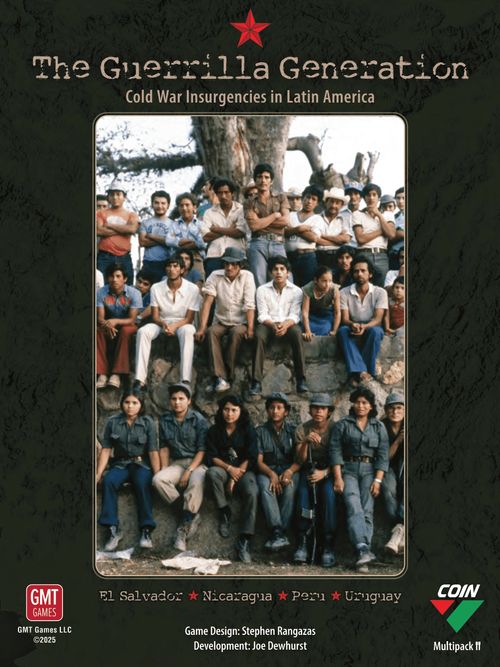
Cover image: FMLN guerrillas watching a performance outdoors, La Palma, Chalatenango, 1983 (Richard Cross Photography Collection)
DESIGN NOTE: While the Government of El Salvador is depicted in the game as ranging politically from "Reformist" to "Rightist", it is important to note that even the reformist governments during this period would be considered right-wing by most standards (and were supported by the Republicans in the US), while the rightists were so extreme in their violent suppression of opposition that the US frequently threatened to withdraw much needed military aid from them. The political left had mostly been forced underground by this rightist violence before the game begins and were driven by state terror into joining the insurgency. It was only after the Chapultepec Peace Accords in 1992 that normal political processes were able to resume.
1.1 General Course of Play
In The Guerrilla Generation: El Salvador, one Event card at a time is revealed from the shared draw deck, and both players will have an opportunity to either execute that Event or perform an Operation from a unique menu, possibly adding a Special Activity. Propaganda cards mixed in with the Event cards provide periodic interruptions where the general board state is assessed and Government Political Will is adjusted, possibly triggering an instant victory for either side, after which both players receive an opportunity to collect additional assets and redeploy their forces.
1.2 Components
The following components from the multipack are required to play The Guerrilla Generation: El Salvador:
- A 17”x22” mounted El Salvador game board (1.3).
- A blue Government (El Salvador) mat and a red FMLN mat, used to hold Available Forces (1.4.1).
- A deck of 41 El Salvador Event cards (5.0).
- One deck of 6 Atrocity cards and one of 6 Reform cards (1.12).
- 16 light blue cubes ('Police'), 20 dark blue cubes ('Troops'), 2 dark blue disks ('Government Bases'), 20 red embossed octagonal cylinders ('Guerrillas'), 4 red disks ('FMLN Bases'), 1 red embossed disk ('Radio Venceremos Base'), 4 embossed cylinders (two blue and two red)—note that this is fewer than the total number of wooden pieces included in The Guerrilla Generation multipack, any excess should be set aside while playing El Salvador.
- Six black and six white pawns (3.1.1).
- Specific markers from the countersheets: 1x blue Political Will (El Salvador flag), 1x Government Posture, 1x Aid, 1x 0 Pop marker, 17x Government/FMLN Control, 15x Passive/Active Opposition, 15x Passive/Active Support, 18x Sabotage/Terror, 8x Capability—all other markers should be set aside while playing El Salvador.
- Two player aid sheets.
- One Propaganda Round aid sheet.
- Two six-sided dice (one red, one blue).
- This rules booklet.
1.3 The Map
The map shows El Salvador and border areas of Honduras, divided into several different kinds of spaces.
1.3.1 Map Spaces. Map spaces include Departments (Lowland or Highland), Cities, Lines of Communication (LoCs), and Honduras spaces. All map spaces can hold forces (1.4), although Honduras may only hold FMLN forces. Guatemala is marked for flavor purposes and is not a playable map space.
1.3.2 Departments. The twelve large irregular spaces inside of El Salvador are Departments. Each Department is marked with a numerical Population value (either '1' or '2') that affects Political Will (1.10) via changes of Control (1.7) and Support or Opposition (1.6) during the Propaganda Round (6.1), and can also modify the FMLN Rally Operation (3.3.1). Each Department also has a larger space for a Control marker (1.7) and a smaller space for a Support or Opposition marker (1.6). Departments are further distinguished as Lowlands (green), or Highlands (dark brown), affecting Government Sweep (3.2.3) and Assault (3.2.4) Operations, as well as certain Events (5.0).
NOTE: A 0 Pop marker is included in the game for an Event (E29) that lowers the Population value of a '1' Department to 0.
1.3.3 Honduras Spaces. The two light brown irregular spaces outside of El Salvador provide a refuge for FMLN forces, where they may Rally (3.3.1), March (3.3.2) to or from, and Govern (4.3.1) in. Government forces may never enter Honduras spaces, and they have 0 Population value and are not considered Departments. They may be Controlled by the FMLN or Uncontrolled, but can never be shifted to Support or Opposition.
1.3.4 Cities. The three large circles are the major Cities of Santa Ana, San Salvador, and San Miguel. Like Departments, Cities are marked with a Population value ('1' or '2') and can contain Control and Support or Opposition markers (although there are no marked holding boxes for these). Government Control and Support in Cities may have additional effects on Political Will during the Propaganda Round (6.1).
1.3.5 LoCs. Each thin gray Line of Communication (commonly abbreviated 'LoCs') shows an Economic value of 2 that affects Government Resources (1.8) during the Propaganda Round (6.2). Sabotaged LoCs also affect Political Will during the Propaganda Round (6.1).
NOTE: LoCs are spaces that can hold forces, but they cannot be Controlled or shifted to Support or Opposition.
1.3.6 Adjacency. Adjacency affects the movement of forces and implementation of certain Events (5.0). Any two spaces meeting one of the following conditions are adjacent:
- Spaces that border on (touch) one another.
- Departments separated by LoCs.
NOTE: Note that a LoC runs through San Miguel District to San Miguel City without separating it into two spaces—the green map areas above and below this LoC should both be considered one space comprising San Miguel District, which is adjacent to Cabañas, San Vicente, Usulután, San Miguel City, La Unión, Morazán, Intibucá-La Paz, and both LoCs terminating in San Miguel City.
1.4 Forces
The wooden pieces represent the two Factions' various forces: Government Troops (dark blue cubes) and Police (light blue cubes), Government Bases (dark blue disks), FMLN Guerrillas (red octagonal cylinders) and FMLN Bases (red disks). The FMLN also possess one additional Base embossed with a yellow star, called the Radio Venceremos Base (1.4.4).
Piece key: Government cubes — Troops, Police. FMLN Guerrillas (Underground / Active). Government Base. FMLN Base. Radio Venceremos Base.
Important! The Government in El Salvador uses only 16 light blue cubes and two dark blue disks. The remaining four light blue cubes and five dark blue disks should be set aside and not used while playing El Salvador. Also set aside all red and pink cubes and dark blue octagonal cylinders; these are not used in El Salvador.
1.4.1 Availability and Removal. Each Faction has a separate mat showing an inventory of forces. The numbers indicated here limit the number of pieces that a Faction may have in play. Keep a Faction's forces not on the map on its mat, within easy view of both players—such forces are said to be Available.
- Unless otherwise instructed (by Event, 5.1.1), forces may only be placed from or replaced with those Available on the Faction mats. A piece to be replaced by a piece that is unavailable is simply removed.
- The Government (El Salvador) mat also includes a reminder that six Troops will need to be returned to the mat during the Propaganda Round if the Government Posture is Rightist (6.4).
- The FMLN mat also includes slots for their four regular Base disks and their fifth Radio Venceremos Base (1.4.4), with the rightmost revealed slot indicating how many Resources they will gain during the Propaganda Round (6.2).
Important! Factions, while executing an Operation, Special Activity, or Event to place their own forces, may take them from elsewhere on the map if the desired force type is not Available. EXCEPTION: Radio Venceremos Base (1.4.4).
EXAMPLE: FMLN without Available Guerrillas could remove Guerrillas from the map during a Rally (3.3.1) to place them Underground, either in the same space or a different space.
1.4.2 Stacking. No more than two Bases (1.4) may occupy a single space, and no Bases may ever be placed on LoCs. Only FMLN forces may be placed in, or move into, Honduras spaces (1.3.3).
- Bases placed (such as via the Train or Rally Operations [3.2.1, 3.3.1] or Event [5.0]) may never violate stacking.
- More than one Sabotage or Terror marker may be placed in a space by Events (5.0), but never by the Sabotage or Sweep Operations (3.3.4, 3.2.3), or the Reprisal Special Activity (4.2.2), which only place up to a maximum of one Sabotage or Terror marker in selected spaces.
1.4.3 Underground/Active. Guerrillas are either Underground—symbol end down—or Active—symbol end up. Actions and Events flip them from one state to the other. Bases, Troops, and Police are always Active. Always set up and place new Guerrillas Underground (including if replacing a piece).
NOTE: Unless instructions specify "Underground" Guerrilla, it is sufficient to "Activate" already Active Guerrillas (they stay Active). Also, "moving" or "relocating" Guerrillas does not affect Underground status unless specified.
1.4.4 Radio Venceremos Base. The red disk embossed with a yellow star is Radio Venceremos. Radio Venceremos counts as a normal FMLN Base for all purposes, but also affects the FMLN's Govern Special Activity (4.3.1) by allowing draws from the Atrocity Deck (1.12), as well as certain Events (5.0). Radio Venceremos may only be placed or moved during the Redeploy Phase (6.4.2).
NOTE: The Radio Venceremos Base should always be kept star side up and is always Active.
The FMLN may only ever have a maximum of four Bases in play, including the Radio Venceremos Base. When the Radio Venceremos Base is on the map, place one of the FMLN's other Bases in the Radio Venceremos box on the FMLN's mat as a reminder that they may not place the fifth Base. When Radio Venceremos is taken off the map place it in the Radio Venceremos box to illustrate that it may not be placed normally with Rally (3.3.1) or by Events (5.0).
1.4.5 Overflow Counters. Three pairs of circular and rectangular overflow counters marked 'A', 'B', and 'C' are provided in case any map spaces become too crowded during play. Simply place one counter in the crowded space, then move all the forces there to the side of the map with the matching counter placed near them to indicate where they are currently located. Overflow counters otherwise have no game effect, and their use is not compulsory.
1.5 Players & Factions
The game requires two players, each playing as one Faction: the Government (blue), and the FMLN (red).
1.6 Support and Opposition
Support and Opposition markers may be placed in Departments and Cities, affecting some Operations and Special Activities and Political Will during the Propaganda Round (6.1). Cities (1.3.4) and Departments (1.3.2) always show one of five levels of Support for, or Opposition to, the Government of El Salvador, that can shift during play. Each space may be either at Active or Passive Support, Active or Passive Opposition, or Neutral. Different levels of Support or Opposition are indicated with the two sides of appropriate markers and Neutral is indicated by the absence of any marker.
A shift toward Active Support or Active Opposition either flips the opposing marker to Passive, or if already Passive removes the marker, or places the specified marker at Passive if a space is already Neutral, or flips the matching Passive marker to Active. Some Events (5.0) may instruct you to set a space to a level of Support or Opposition, in which case you should remove any other marker and simply place the specified marker on its correct side.
NOTE: Honduras spaces (1.3.3), LoCs (1.3.5), and a Department that has been reduced to 0 Population by Event E29 are never at Support or Opposition and should always be treated as though they are Neutral (immediately remove any Support or Opposition marker if a Department is set to 0 Population).
Unlike other games in the COIN series, spaces at Active Support or Active Opposition do not count double the Population value for victory purposes. Instead, they act as an additional buffer level that must be removed before changing Support/Opposition status, and affect some Operations (3.0).
1.7 Control
Departments, Honduras spaces, and Cities are always either Uncontrolled (indicated by the absence of any marker) or Controlled by either the Government or the FMLN (indicated by a Control marker of either Faction). The Government and FMLN each Control a space if their wooden forces pieces (1.4) in the space outnumber those of their opponent. Adjust Control markers immediately when Control changes due to placement, removal, or movement of pieces. Gaining or removing FMLN Control immediately shifts Political Will (1.10) down or up by an amount equal to the Population value of the space (see 7.0 Victory). Control also affects certain Operations (3.0) and Special Activities (4.0).
1.8 Resources and Aid
At any moment each Faction has between 0 and 20 Resources that it uses to pay for Operations (3.0). Mark Resources on the edge track with a cylinder of that Faction's color (1.5). In addition to Resources, the Government Faction possesses an amount of Aid, also between 0 and 20, and marked by a counter on the edge track. Aid may be spent like Resources but only on specific actions: Train Operations (3.2.1), Civic Actions (3.2.1, 6.3.1), and the Air Strike Special Activity (4.2.3). Aid is gained through the Reform Special Activity (4.2.1) when the Government Posture is Reformist (6.6.3), the Government Pivotal Event (2.3.7), other Events (5.0), and sometimes during the Resource Phase of the Propaganda Round (6.2).
DESIGN NOTE: Aid represents the massive amounts of economic and military aid provided by the United States during the conflict. This aid expanded the Salvadoran army, supplied the entire air force, and funded much of government's civic action programs and economic recovery from FMLN sabotage. Since the Vietnam War the disbursement of military aid by the US had been subject to much closer oversight by Congress, which typically required evidence of progress toward government reform before releasing it.
1.9 Sabotage and Terror
Sabotage markers are placed by the FMLN Sabotage Operation (3.3.4) and Terror markers by the Government Sweep Operation (3.2.3) and Reprisal Special Activity (4.2.2), and some Events (5.0). Sabotage markers on LoCs affect Political Will and Government earnings during the Propaganda Round (6.0). Terror markers allow the FMLN to play certain cards from the Atrocity deck (1.12) using the Govern Special Activity (4.3.1). Both Sabotage and Terror markers in Departments and Cities also inhibit Government Civic Action (6.3.1).
NOTE: Unlike in most other COIN volumes, here the Government places Terror markers and the Insurgents (FMLN) do not.
1.10 Government Political Will
Government Political Will is tracked with a marker on the edge track. The position of this counter will determine Victory (7.0) for either side. The marker is moved during the Campaign and during the Political Will Phase of the Propaganda Round (6.1). It may never be lower than 0 or greater than 20.
1.11 Government Posture
The current Government Posture between Reformist and Rightist is tracked with a marker on the Government Posture Track (6.6), affecting the strength and effect of certain Government Special Activities (4.2), and determining the conditions for Political Will gains during the Propaganda Round (6.1).
1.12 Atrocity and Reform Decks
Each player has an additional set of six cards known as the Atrocity and Reform decks. The FMLN player may draw cards from the Atrocity deck using the Govern Special Activity while Radio Venceremos is in play (4.3.1), while the Government player may draw cards from the Reform deck using the Reform Special Activity (4.2.1) when the Government Track (6.6.3) is Reformist, and also by playing their Pivotal Event (2.3.7). The text on cards from each deck should be immediately resolved when drawn. The Atrocity deck generally allows the FMLN to hinder the Government, potentially exposing up to three atrocities that will reduce Political Will at the end of the game (6.1.6)—each Atrocity Exposed card has a condition that is checked when drawn, and if the condition is met it should be kept near to the FMLN mat until the end of the game. The Reform deck allows the Government to gain access to their permanent Capability Events (5.3), but at the risk of sparking Rightist backlash.
DESIGN NOTE: The Atrocity deck represents the FMLN's efforts to identify and broadcast within El Salvador and to the rest of the world atrocities committed by Government forces against the local population. The more the Government relies on civilian victimization strategies, the more vulnerable they become to being exposed by the FMLN.
The Reform deck represents efforts by the Government to improve the counterinsurgency war effort by implementing various reforms. It requires pursuing a Reformist posture and mechanics are included to represent the Rightist backlash to reform attempts that threatened their interests.
2.0 Sequence of Play
2.1 Setup
Follow the instructions on the second to last page of this booklet to prepare the draw decks and set up markers and forces. A full setup diagram can be found on the back page of this booklet.
2.2 Start
Begin play by revealing the top card of the Event draw deck and placing it onto a played cards pile. All played cards and the number of cards in the draw decks are open to inspection.
NOTE: Unlike in most previous COIN series volumes, only one Event card is revealed at a time.
RECORD STEPS: As the steps of each Event card play are completed, place the Eligibility cylinder of the acting Faction's color (1.5) into the Initiative Track's appropriate box.
2.3 Initiative Track
One player takes the Government Faction and the blue Eligibility cylinder, the other the FMLN Faction and the red Eligibility cylinder.
When playing an Event card, the Government or FMLN player will execute Operations or the Event described on the card. At all times one player will be First Eligible, and the other will be Second Eligible. In each Event card round, the First Eligible player is first to choose what they will do, followed by the Second Eligible—whose choices are limited by what the First Eligible player did.
2.3.1 Eligibility. Each player puts one cylinder (blue and red respectively) on the First or Second Eligible spaces of the Initiative Track.
NOTE: FMLN starts the game with their cylinder in the Event box, because the game automatically begins with play of the FMLN's Pivotal Event (2.3.7). The Government cylinder begins in the Second Eligible box. Eligibility order should remain untouched during each Propaganda Round (6.0).
2.3.2 Options for Eligible Factions.
First Eligible: The First Eligible player may perform a Limited Operation (2.3.4), execute the Event (5.0), perform an Operation (3.0) with Special Activity (4.0), or Pass (2.3.3).
The player selects their desired box and places their Eligibility cylinder in the appropriate box on the Initiative Track, then immediately executes the chosen action (Limited Operation, Event, or Operation with Special Activity) or Passes.
Second Eligible: The Second Eligible player may then choose one of the boxes not containing the First Eligible player's cylinder and conduct the action in the box selected (or Pass).
2.3.3 Passing. After selecting a box, players may forgo the action in the box to Pass. If Government pass, they gain 2 Resources, and if FMLN pass they gain 1 Resource (1.8). Both players may pass and the order of cylinders in the Initiative Track will still decide eligibility (2.3.5).
2.3.4 Limited Operation. A Limited Operation is an Operation in just one space, with no Special Activity. If the Limited Operation is a Patrol (3.2.2), Sweep (3.2.3), or March (3.3.2) it can involve pieces from multiple origin spaces but only one destination space.
2.3.5 Adjust Eligibility. After both players have selected and executed their actions, replace the Eligibility cylinders on the Initiative Track with the cylinder in the furthest left box becoming First Eligible, and the other cylinder becoming Second Eligible.
DESIGN NOTE: Selecting the Limited Operation box guarantees the player first eligibility on the next card. Likewise, selecting the Operation & Special Activity box guarantees second eligibility on the next card. Eligibility after selecting the Event space will depend on what the other player has chosen. The only way to block Events in The Guerrilla Generation is to select the Event box and then either play the Event or Pass.
2.3.6 Next Card. After eligibility has been reset, reveal the draw deck's next card and continue play.
2.3.7 Pivotal Events. Each Faction possesses a Pivotal Event card unique to it. Pivotal Events are a type of Event (5.0) that can be played deliberately. Either Faction may play its Pivotal Event to replace a currently played Event card if:
- They are holding the card and any pre-conditions on it are met, and
- The First Eligible player has not yet chosen an option (2.3.2).
If both players want to play Pivotal Events at the same time, the Second Eligible player gets priority and plays their card. The First Eligible player keeps their card to play later.
PROCEDURE: Playing a Pivotal Event card changes the normal sequence of play. The player playing the Pivotal Event card places it on the played Event card and executes the Pivotal Event instead. The Pivotal Event card stays in the played card pile.
The player who played the Pivotal Event card places their cylinder in the Event Box of the Initiative Track after executing the Event. The other player chooses either the Limited Operation or the Operation with Special Activity box of the Initiative Track. Then adjust Eligibility and proceed to the next card as normal.
NOTE: The game begins with the FMLN playing their Pivotal Event, which will then become available to them again at the end of the first Propaganda Round. The FMLN can therefore potentially play their Pivotal Event twice during the game.
2.4 Propaganda Card
When a Propaganda card is revealed, conduct a Propaganda Round (6.0).
NOTE: Each series of Event cards leading up to a Propaganda Round is called a "Campaign".
3.0 Operations
3.1 Operations in General
A Faction executing an Operation (Op) chooses one of the four Operations listed on its Faction sheet and selects the map spaces (typically several) to be involved. Select a given space only once for a given Operation.
Operations usually cost Resources or Aid (1.8), often paid per space selected; the paying Faction must have enough Resources or Aid to pay for the Operation in each selected space. Operations are generally allowed in any number of spaces (Resources and Aid permitting) unless the Operation is Limited (2.3.4), in which case they are allowed in only one space.
The executing Faction chooses the order of the spaces in which the Operation is resolved, the enemy pieces to be affected (targeted), and the friendly pieces to be placed, replaced, or moved. Once targeted, a Faction's pieces are affected to the maximum extent possible. Actions affecting another Faction's pieces do not require that Faction's permission.
3.1.1 Pawns. If desired, mark spaces selected for Operations (3.0), Special Activities (4.0), or other actions with white and black pawns. The pawns are for convenience, not a limit on play.
3.1.2 Free Operations. Certain Events grant free Operations or Special Activities, costing no Resources (5.4). Any Civic Action performed as part of a free Train Operation (3.2.1) still costs Resources or Aid. All other requirements or procedures apply as normal, unless specifically modified by Event text (5.1.1, 5.4).
3.2 Government Operations
Government chooses from Train, Patrol, Sweep, or Assault Operations.
NOTE: Government pieces may never be placed in, or move into, Honduras spaces (1.3.3). Government may spend Aid for Train and Civic Action but must use Resources for the cost of other Operations.
3.2.1 Train. Train adds Government forces and can build Support via Civic Action. Select any Departments and/or Cities, and pay 2 Resources or Aid for each space where cubes are placed.
PROCEDURE: Place up to four cubes in each Department with a Government Base and in each City (even if no Base). Then, in one selected space (even if Limited Operation), may either pay 2 Aid to place a Government Base, or if Government Control, Troops, and Police, may Civic Action to remove any Terror or Sabotage markers and shift up to once toward Active Support. Civic Action costs 2 Resources or Aid per Terror or Sabotage marker removed and to shift toward Active Support, even if the Train Operation was free (3.1.2, 5.4).
NOTE: Resources and Aid may be spent in any combination to meet the costs of Train and Civic Action, except that placing a Base requires Aid only.
3.2.2 Patrol. Patrol protects LoCs and repositions Government forces among cities. Pay 2 Resources total (not per space selected).
PROCEDURE: Move any number of cubes from any spaces. Each cube may move into any adjacent LoC or City and may keep entering adjacent LoCs or Cities until the player chooses to stop moving it or it enters a space with any FMLN piece. Then, on each LoC (whether or not a cube just moved there), Activate one Guerrilla for each cube there. Then, if desired, Assault (3.2.4) on one LoC at no added cost. If a Limited Operation, may only reveal and Assault on a LoC if it was selected as the single destination space.
3.2.3 Sweep. Sweep may move Troops and can reveal Guerrillas. Select any Departments and/or Cities as destinations. Pay 2 Resources per selected destination space.
PROCEDURE: First, simultaneously move any adjacent Troops desired into selected destination spaces. In addition, each group of Troops may first move onto an adjacent LoC (1.3.5) that is free of Guerrillas and then into an adjacent selected destination space. Up to two Troops may also move directly from each Government Base to any selected destination spaces.
Then, in each selected space, Activate (1.4.3) one Guerrilla for every cube (moved or already there, even if no cubes moved). In spaces with Active Opposition, instead Activate only one Guerrilla for every two cubes there. Place a Terror marker in every Highland Department selected as a destination if there is not already one there.
DESIGN NOTE: Government Bases give Troops greater mobility due to the augmentation of the Salvadoran Air Force's helicopter fleet. Sweep places Terror in Highland Departments to model unsanctioned abuses and atrocities by military forces in more remote areas of the country associated with the insurgency.
3.2.4 Assault. Assault removes FMLN pieces. Select any spaces with cubes and Active FMLN pieces. Pay 2 Resources per selected space.
PROCEDURE: In each selected space, remove one Active FMLN piece for every two Troops present, or one for every three Troops in Highland Departments, or one for every two cubes in Cities and LoCs. First remove Active Guerrillas, then remove FMLN Bases only once no Guerrillas remain (even Underground). Increase Political Will by 1 for each FMLN Base removed (7.1).
NOTE: Underground Guerrillas in a space prevent removal of FMLN Bases until all Guerrillas are Activated and removed.
3.3 FMLN Operations
FMLN chooses from Rally, March, Attack, or Sabotage Operations.
3.3.1 Rally. Rally adds FMLN forces. Select any Cities, Departments, or Honduras spaces without Support (1.6). Pay 1 Resource per non-Honduras space selected (Honduras spaces may be selected for free).
PROCEDURE: In each selected space, place one Guerrilla or replace two Guerrillas with an FMLN Base (respecting stacking, 1.4.2). If the space already has at least one FMLN Base, may instead place Guerrillas up to the space's Population plus number of FMLN Bases there, or flip all Guerrillas there Underground (1.4.3).
3.3.2 March. March moves Guerrillas. Select any spaces as destinations. Pay 1 Resource per non-LoC destination space (LoCs may be selected as destination spaces for free).
PROCEDURE: Simultaneously move any Guerrillas desired into adjacent destination spaces. Set Guerrillas moving from one origin space to one destination space Active (1.4.3) if:
- The destination is a LoC or is at Support and
- The number of moving Guerrillas plus the number of cubes in that destination exceeds three.
Otherwise, moving Guerrillas retain their current orientation (Active or Underground).
3.3.3 Attack. Attack attempts to eliminate Government forces. Select any spaces with Guerrillas and Government pieces. Pay 1 Resource per selected space.
PROCEDURE: In each selected space, Activate (1.4.3) all Guerrillas and roll one die: if the result is equal to or less than the number of Guerrillas there, remove up to two Government pieces (Bases last, only once no cubes remain). If the roll was a "1" add a Guerrilla to the space. Reduce Political Will by 1 for each Government Base removed (7.2).
3.3.4 Sabotage. Sabotage shifts Cities and Departments toward Neutral and places Sabotage markers that hinder further attempts to build Support. On LoCs, Sabotage places Sabotage markers that reduce Political Will and block Government Resource earnings (6.1, 6.2.1). Select any spaces with at least one Underground Guerrilla. Pay 1 Resource per non-LoC space selected (LoCs may be selected for free).
PROCEDURE: In each selected space, Activate an Underground Guerrilla. Place a Sabotage marker, if none, and shift the space once toward Neutral if it is a Department or City.
DESIGN NOTE: Unlike insurgent factions in other COIN games, the FMLN uses Sabotage instead of Terror. The FMLN were famous for their restrained use of violence against civilians throughout the war, particularly when compared to the Salvadoran military. The FMLN conducted a systematic sabotage campaign that targeted economic infrastructure instead of civilians themselves. Their sabotage campaign not only drained state resources, but also lowered the population's confidence in the ability of the military to protect them and defeat the insurgency. The damage from sabotage, and the FMLN's selective use of violence against government officials such as mayors, undermined support for the government but generally did not build support for the insurgency.
4.0 Special Activities
4.1 Special Activities in General
When a Faction per the Initiative Track (2.3) executes an Operation (3.0), it may also execute one Special Activity (EXCEPTION: Limited Operations, 2.3.4). As with Operations, the executing Faction selects spaces and pieces affected, and the order of actions. Select a given space only once as a location for a given Special Activity. Events may grant free Special Activities (not further affecting Eligibility, 2.3.1).
Important! A Faction may execute its Special Activity at any one time immediately before, during, or after its Operation.
EXAMPLE: FMLN may Rally in one space, then pause to Govern to gain Resources before continuing to Rally in other spaces.
4.1.1 Accompanying Operations. Some Special Activities specify that they may only accompany certain types of Operations (3.0). Certain Special Activities must occur where their Accompanying Operation occurred. If not otherwise specified, Special Activities may accompany any Operations and take place in any otherwise valid spaces.
4.2 Government Special Activities
Government chooses from Reform, Reprisal, or Air Strike Special Activities.
4.2.1 Reform. Reform shifts the Government Posture Track (6.6) toward Reformist, increases Aid, and allows draws from the Reform Deck (1.12). It may only accompany Train (3.2.1) or Patrol (3.2.2).
PROCEDURE: If Government Posture is already Reformist, increase Aid by the current value of the Government Posture Track and draw one card from the Reform deck (1.12). Then, if possible, shift the Government Posture Track one step to the left.
4.2.2 Reprisal. Reprisal shifts the Government Posture Track (6.6) toward Rightist, reduces Opposition, and removes FMLN pieces. It may select up to two spaces with Government Control. Reprisal may only accompany Patrol (3.2.2), Sweep (3.2.3), or Assault (3.2.4).
PROCEDURE: In each selected space, place a Terror marker, if none, and shift the space one level toward Neutral. If the Government Posture Track is already Rightist, remove FMLN pieces up to the Government Posture Track value from each space (Bases last, only once no Guerrillas remain). Increase Political Will by 1 for each FMLN Base removed (7.1). Then, if possible, shift the Government Posture Track one space to the right.
NOTE: Reprisal, unlike Assault and Air Strike, can remove Underground Guerrillas.
4.2.3 Air Strike. Air Strike removes FMLN pieces and reduces Opposition through population displacement. Air Strike costs 2 Aid (total, not per space) and may select any non-Honduras spaces up to the number of Government Bases on the map. It may accompany any Government Operation (3.2).
PROCEDURE: In each selected space, shift one level toward Neutral and remove up to two Active enemy pieces (Bases last, only once no Guerrillas remain). Increase Political Will by 1 for each FMLN Base removed (7.1).
NOTE: Spaces selected for Air Strike that remove no FMLN pieces still shift toward Neutral.
DESIGN NOTE: Reprisal and Air Strike represent the low- and high-tech strategies used by the Salvadoran government to target the insurgency and its civilian supporters. Reprisals represent the use of massacres by the military and killings by death squads that characterized the early years of the war. Air Strike represents the later extensive use of bombing to disperse FMLN guerrillas and undermine their support base through displacing the population. As the scholar Leigh Binford (2016) notes, the use of bombing to undermine the FMLN's popular support became an "infinitely more deniable version of the same 'empty-the-sea' strategy that precipitated the massacres of the early 1980s". The Aid cost of Air Strike represents US assistance in aircraft, munitions, and relief aid to those displaced by bombing.
4.3 FMLN Special Activities
FMLN chooses from Govern, Assault, or Raid Special Activities.
4.3.1 Govern. Govern allows the FMLN to build Opposition, gain Resources, and use Radio Venceremos (1.4.4) to uncover Government atrocities. It may select up to two spaces with FMLN Control and Underground Guerrillas. Govern may accompany Rally (3.3.1) or Sabotage (3.3.4).
PROCEDURE: In each selected space, activate 1 Underground Guerrilla. Then, shift the space one level toward Active Opposition or increase FMLN Resources by the Population value and shift the space one level toward Neutral. Then, if Radio Venceremos is on the map, the FMLN player may draw one card from the Atrocity deck (1.12).
DESIGN NOTE: Unlike in other COIN games, the FMLN primarily spreads Opposition with Govern rather than Agitate or Terror. The FMLN implemented practical governance measures in areas they controlled, often incorporating local civilians, to win popular support, rather than attempting to shift attitudes with abstract political propaganda or coercive terrorism. Many of these measures focused on protecting civilians or mitigating the damage from government atrocities. However, the FMLN also risked losing support when they demanded too much from the local population.
4.3.2 Assault. Assault allows the FMLN to enhance Attack and ensure success. It may occur in one space already selected for Attack where there are at least three Guerrillas. Assault may only accompany Attack (3.3.3), and the selected Attack space must be paid for as usual.
PROCEDURE: Instead of the usual Attack procedure, Activate all Guerrillas and remove one Government piece for every Guerrilla, to a maximum of four pieces removed (Bases last, only once no cubes remain). Reduce Political Will by 1 for each Government Base removed (7.2). If three or four Government pieces are removed, also shift the space one level toward Active Opposition.
4.3.3 Raid. Raid allows the FMLN to move Underground Guerrillas into spaces and Activate them to remove enemy pieces. It may select any two spaces adjacent to Underground Guerrillas. Raid may accompany March (3.3.2) or Sabotage (3.3.4).
PROCEDURE: Move an adjacent Underground Guerrilla into each selected space. Then, if desired in any selected space, activate an Underground Guerrilla to remove two Government pieces (Bases last, only once no cubes remain). Reduce Political Will by 1 for each Government Base removed (7.2).
5.0 Events
Each Event bears a title headline, capitalized flavor text, and Event text. Flavor text provides historical interest and has no effect on play.
5.1 Executing Events
When a Faction executes an Event, it carries out the Event text literally and in order (sometimes involving actions or decisions by the other Faction). Unless otherwise specified, the executing Faction makes all selections involved in implementing the text, such as which pieces are affected. If another Faction is specified or selected to take an action, that Faction decides the details of the action. Some Events with lasting effects have markers as aids to play.
5.1.1 Where Event text contradicts rules, the Event takes precedence. However:
- Events may not violate stacking (and so may never place more than two Bases in one space).
- Events place only Available pieces (1.4.1); they remove rather than replace if the replacement is not Available or if stacking (1.4.2) would be violated.
- Events may not raise Resources, Aid, or Political Will beyond 20 or reduce them below 0 (1.8, 1.10).
5.1.2 If two Events contradict, the currently played Event takes precedence.
5.1.3 An executed Event's text that can be implemented must be. If not all of its text can be carried out, implement that which can.
5.1.4 Pivotal Events are Events that have preconditions for play and preempt other Event cards. The executing Faction must select the Event box on the Initiative Track to play their Pivotal Event card (see 2.3.7). The FMLN's Pivotal Event is automatically played at the start of the game (2.1) and then returned to them at the end of the first Propaganda Round (6.5).
5.2 Dual Use
Many Events have both top and bottom Event text. The executing Faction may select either the top or bottom text to carry out (not both). While the top text often favors the Government, a player may select either text option regardless of Faction.
DESIGN NOTE: Dual-use events represent opposed effects of the same cause, forks in the historical road, or instances subject to alternative historical interpretation.
5.3 Capabilities
Events labeled "FMLN Capability" have lasting effects mainly relating to that Faction, either positive or negative. The label is for flavor only, and both Factions may play FMLN Capability Events. The Reform deck additionally contains cards with a "Government Capability" label that have a lasting positive effect (only) for the Government. A Capability Event's effects last for the rest of the game.
NOTE: Unlike other games in the multipack, Government Capabilities do not come from the main Event deck. Set out executed Capability Event cards near the board as added reminders, using a Capability marker to indicate which option was selected on FMLN Capabilities.
5.4 Free Operations
Some Events allow a Faction to perform an immediate Operation or Special Activity that interrupts the usual sequence of play and is typically free: it bears no Resource cost and does not affect Eligibility (2.3.1, 3.1.2), though other procedures and restrictions remain unless modified by Event text (5.1.1).
NOTE: Civic Action costs Resources or Aid even if part of a free Train Operation (3.2.1). A free Assault Special Activity occurs as if a free Attack is occurring in the space (4.3.2).
6.0 Propaganda Round
Conduct a Propaganda Round in the sequence of phases below when each Propaganda card is revealed. The Propaganda Round aid sheet also lists this sequence.
6.1 Political Will Phase
Calculate the net effect to Political Will of the following adjustments before shifting the marker:
6.1.1 Hearts and Minds. Subtract the total Population of Departments at Opposition from the total Population of Departments at Support. Adjust Political Will by the difference, increasing it if positive and decreasing it if negative.
6.1.2 Economic Sabotage. First, place a Sabotage marker on each LoC without one where there are more Guerrillas than cubes. Then, reduce Political Will by 2 if there are now Sabotage markers on at least 2 LoCs.
6.1.3 Counter-State. Reduce Political Will by 1 for every two spaces with an FMLN Base.
6.1.4 Regime Protected. If Government Posture is Reformist, increase Political Will by the Population of each City at Support. If Government Posture is Rightist, increase Political Will by the Population of each City with Government Control.
NOTE: It's important to calculate the net shift in Political Will during these steps before moving the marker and checking victory, rather than adjusting the marker one step at a time.
6.1.5 Victory? If Political Will is now at 0, 1, or 2, the game immediately ends with an FMLN victory. If Political Will is now 18, 19, or 20, the game immediately ends with a Government victory. Otherwise, continue play.
6.1.6 Game End? If this is the final Propaganda card, reduce Political Will by 1 for each Atrocity Exposed card in play, then end the game and check scores per Victory (7.0) to determine the winner.
6.2 Resources Phase
Follow these steps to add to Factions' Resources and Aid to a maximum of 20 (1.8).
6.2.1 Government Earnings. Government gains Resources equal to the Population of Lowland Departments and Cities with Government Control, plus the Economic value of LoCs without Sabotage.
6.2.2 FMLN Earnings. FMLN gain Resources equal to twice the number of FMLN Bases on the map.
6.2.3 US Congress. If Political Will is less than 11, increase Aid by 6.
DESIGN NOTE: Even if members of Congress tried to condition aid to the regime on improvements in human rights and reforms, many refused to deny aid if the regime seemed to be losing to the insurgency.
6.3 Support Phase
Government may spend Resources and Aid and FMLN may utilize Govern to affect Support and Opposition (1.6).
6.3.1 Civic Action. Government may spend Resources and/or Aid to build Support. Each space must have Government Control (1.7), Police, and Troops. Every 2 Government Resources or Aid spent removes a Sabotage or Terror marker or—once no Terror or Sabotage remains in a space—shifts the space once toward Active Support, up to one shift per space.
DESIGN NOTE: Troops and Police (or local militias) together provide the security needed to gain popular support, or at least the local population's collaboration. Sabotage operations by the FMLN or Terror by Government forces hurt the Government's credibility to provide protection, requiring additional resources to recover from the damage and reassure the local population.
6.3.2 Govern. FMLN may perform a Govern Special Activity (4.3.1).
6.4 Redeploy Phase
6.4.1 Government Redeploy. Do not adjust Control during this step. Government must move its Troops from LoCs and Departments without Government Bases to Government Bases or Cities. Then, Government may move any Police to any LoCs, Cities, or Government-Controlled Departments. Finally, if Government Posture is Rightist, Government must remove Troops from the map until at least six are Available.
DESIGN NOTE: The Salvadoran military was only able to maintain large troop deployments with continued support from the US, conditioned on government reforms.
6.4.2 Radio Venceremos. FMLN may swap the Radio Venceremos Base with any FMLN Base currently in El Salvador. If there are no FMLN Bases in El Salvador, Radio Venceremos will remain out of play until the next Redeploy Phase.
6.4.3 Control. Now adjust Control (1.7) to reflect the above moves and removals.
6.5 Reset Phase
Then prepare for the next card as follows:
- If this is the first Propaganda Round, return the FMLN Pivotal Event card to the FMLN player.
- If Government Posture is at Reformist 4 or Rightist 2, shift the track one step toward the 0 space.
- Remove all Terror and Sabotage markers from the map.
- Flip all Guerrillas Underground (1.4.3).
- Reveal the next card from the Event draw deck and continue play (2.3.2).
6.6 Government Posture Track
The Salvadoran Government during the civil war was divided between two main internal factions that had different views on the best way to defeat the leftist insurgency. The "rightist" faction favored the use of mass violence, often using death squads and massacres, to destroy the insurgency and its supporters while making only minimal reforms that might challenge the military or the economic elites in the country. In contrast, the "reformist" faction represented the country's fragile political center that sought to leverage economic, judicial, and military reforms to enhance the effectiveness of the military, undercut the FMLN's popular support, and attract large amounts of US aid. The Government Posture Track reflects which of these two viewpoints currently dominate in the debate over how to defeat the FMLN.
6.6.1 Moving the Track. The Government Posture Track can be shifted by the Government Reform (4.2.1) and Reprisal (4.2.2) Special Activities, at the end of each Propaganda Round (6.5), by the Government Pivotal Event (2.3.7), and by either player with some Events (5.0) and Reform cards (1.12).
6.6.2 Rightist Effects of the Track. The Rightist spaces (rightmost 1 and 2 spaces) of the track augment the number of pieces removed per space for the Reprisal Special Activity (4.2.2). If Rightist, Government gains Political Will for each Government-Controlled City during the Propaganda Round (6.1.4). If Rightist during the Redeploy Phase, the Government player must remove Troops from the map until at least six are Available (6.4.1).
6.6.3 Reformist Effects of the Track. The Reformist side of the track increases the amount of Aid (1.8) gained and allows Reform cards (1.12) to be drawn with the Reform Special Activity (4.2.1). If Reformist, Government gains Political Will for each City at Support during the Propaganda Round (6.1.4).
NOTE: The Government Posture Track has no effect on Reprisal or Reform Special Activities at the center 0 space, and being at this space also prevents the Government from gaining any additional Political Will during the Propaganda Round. Nobody likes an indecisive government!
7.0 Victory
Victory is determined by the level of Government Political Will (1.10). Political Will is measured on the edge track and can range from 0-20.
7.0.1 Early Victory. At the victory check during the Political Will Phase of a Propaganda round, the FMLN wins if Political Will is 0-2 and the Government wins if Political Will is 18-20.
7.0.2 Final Victory. If neither player has won at the end of the Political Will phase of the final Propaganda Round, the FMLN win if Political Will is less than 10 and the Government wins if Political Will is greater than 10. If Political Will is exactly 10 the game is tied.
NOTE: At the end of the Political Will phase of the final Propaganda Round, make sure to reduce Political Will by 1 for each Atrocity Exposed card in play before checking for Final Victory.
DESIGN NOTE: Early victories in El Salvador represent a collapse of the Government, similar to the fall of the Somoza regime in neighboring Nicaragua in 1979, or the Government gaining a strong enough position to refuse to negotiate with the FMLN, instead letting their threat subside over time. Final victory results represent a negotiated settlement favoring a specific faction, depending on the final position of Political Will. Atrocity Exposed cards only affect Political Will at game end due to their long-term role as evidence during the negotiations and subsequent Truth Commission.
7.1 Raising Political Will
Political Will is raised in the following ways:
- Removing FMLN Control (+ Population of space to PW)
- Removing a FMLN Base by Assault, Reprisal, Air Strike, or Event (+1 PW)
- Events (+1 to +2 PW)
- At Propaganda Round, more Support Department Population than Opposition Department Population (+ difference to PW)
- At Propaganda Round, if Government Posture Reformist, each City at Support (+ Pop of each City to PW)
- At Propaganda Round, if Government Posture Rightist, each Government-Controlled City (+ Pop of each City to PW)
7.2 Lowering Political Will
Political Will is lowered in the following ways:
- Adding FMLN Control (– Population of space from PW)
- Each Government Base removed by Attack, Assault, Raid, or Event (–1 PW)
- Events (–1 PW)
- At Propaganda Round, more Opposition Department Population than Support Department Population (– difference to PW)
- At Propaganda Round, if at least two Sabotaged LoCs (-2 PW)
- At Propaganda Round, every two spaces with an FMLN Base (–1 PW per two spaces)
- At end of game, each Atrocity Exposed card in play (–1 PW per card)
Photo note: Salvadoran Army soldiers resting, Meanguera, Morazán, 1981 (Richard Cross Photography Collection)
8.0 Example of Play
Set up the game as indicated in section 2.1 (consult the setup diagram on the back of this booklet), but construct only the first part of the deck with these cards in the following order, facedown from top to bottom: Special Select Forces Commit Daring Raids (E31), FPL Launches Offensive (E8), Guazapa Communities Resist Government (E15), "Hammer and Anvil" Operation Surrounds Rebels (E23), Joaquín Villalobos Leads the ERP (E25), FDR Lobbies Abroad (E13), and Propaganda (E37).
The game always begins with FMLN playing their Pivotal Event card, FMLN Offensive Rocks Country (E41)—place this card near the board now. This allows them to free March to any spaces (costing no Resources), then free Attack in any spaces (also costing no Resources) with the Assault Special Activity (in one space selected for Attack). Finally, they get to shift any City that now has no Government Control one level toward Active Opposition.
Illustration: The FMLN's "final" offensive targets San Miguel, San Salvador, and Cuscatlán
The March Operation allows FMLN to move Guerrillas to adjacent spaces, and they decide to March as follows:
- One Guerrilla from La Unión (adding Government Control) to the Line of Communication (LoC) running from Intibucá-La Paz to San Miguel City.
- Two Guerrillas from Morazán to San Miguel City (removing Government Control).
- Two Guerrillas from Cuscatlán to San Salvador (removing Government Control).
- Two Guerrillas from Chalatenango and one Guerrilla from Cabañas into Cuscatlán (removing Government Control).
Next, FMLN will Attack in San Miguel City and San Salvador, which requires them to Activate all their Guerrillas in both spaces (flipping them star-end up), and then roll a die for each one, with a result equal to or less than the number of Guerrillas in the space allowing them to remove two Government pieces there.
Illustration: FMLN Attack in San Miguel
In San Miguel they roll a '3', equal to the three Guerrillas there, and choose to remove two dark blue Troops (move them to the Government player mat). This also adds FMLN Control, which always reduces Political Will by the Population of the space – in this case by one, reducing Political Will to 13.
Illustration: FMLN Attack in San Salvador
In San Salvador they roll a '1', fewer than the five Guerrillas there, and they again choose to remove two Troops. A roll of '1' on an Attack also allows FMLN to add an Underground Guerrilla to the space, which they do now. They gain Control of San Salvador, reducing Political Will by the Population of two, down to 11.
Illustration: FMLN Assault in Cuscatlán
Finally, they Assault in Cuscatlán, a modified Attack which, instead of rolling a die, removes one Government piece for every Guerrilla there, up to a maximum of four. There are three Guerrillas in Cuscatlán, so all three Government pieces (two Troops and a Base) are removed, which adds FMLN Control, reducing Political Will to 9. FMLN Assault can only remove Government Bases once no cubes remain in the space, but also reduces Political Will by one for each Base removed, in this case down to 8. Assault also shifts the space one level toward Active Opposition if at least three pieces are removed, which they were, so we shift Cuscatlán to Passive Opposition.
FMLN has finished acting, but their Pivotal Event also indicates that they should now shift each City without Government Control one level toward Active Opposition. This applies to San Salvador and San Miguel, so we shift both to Active Opposition. The FMLN turn is now complete.
The red FMLN Eligibility cylinder is in the 'Event' box on the Initiative Track, because they just executed their Pivotal Event, so the Government can now choose from either of the other two boxes, Limited Operation or Operation & Special Activity. The latter would give them a more powerful immediate action, but the former allows them to become 1st Eligible at the end of the round, giving them first choice of action on the next Event card.
Government decides to perform a Limited Train Operation, placing their blue Eligibility cylinder in the 'Limited Op' space of the Initiative Track. Train can select any Cities and/or Departments, but because this is a Limited Operation it can be performed in only one space. They select Santa Ana City, paying 2 Resources (down to 18) to place four Troops there – they could alternatively have placed light blue Police instead of any of the Troops, and could have paid for the Operation with Aid instead of Resources if desired.
Train also allows Government to either place a Base (at a cost of 2 Aid) or perform a Civic Action in one selected space with Troops, Police, and Government Control. They decide to perform a Civic Action in Santa Ana City, which first costs 2 Resources or Aid per marker to remove all Terror and Sabotage markers, then an additional 2 Resources to shift one level toward Active Support. In this case there are no Terror or Sabotage markers in Santa Ana, so they just pay 2 more Resources (down to 16) to shift it to Passive Support, which will make it harder for the FMLN to infiltrate the space in future turns.
Illustration: Limited Train and Civic Action in Santa Ana
The Government turn is now complete, and as both players have completed their turns we reset Eligibility. The Faction whose cylinder is furthest to the left, in this case Government, becomes 1st Eligible, and the other Faction becomes 2nd Eligible.
Illustration: Eligibility is reset at the end of each round
Reveal the next card: Special Select Forces Commit Daring Raids. Government is now 1st Eligible and decides to perform another Train Operation with the Air Strike Special Activity. This time they can select any number of spaces, but Train can only place cubes in Departments with Government Bases and any Cities (Departments without Government Bases can still be selected for Civic Action or to place a Base). They pay 6 Resources (down to 10) to place four Troops in each City, which also replaces FMLN Control with Government Control in San Salvador and San Miguel, increasing Political Will by the Population of both spaces, back up to 11 (this happens whenever FMLN Control is removed, whether or not Government Control is also added). Finally, they pay 2 Aid (down to 4) to place a Government Base in Santa Ana City.
The newly placed Government Base will now be used for Air Strike, which costs 2 Aid (down to 2) to select non-Honduras spaces up to the number of Government Bases on the map, in this case one. Government selects San Salvador for Air Strike, removing two Active Guerrillas and shifting it one level toward Neutral (in this case to Passive Opposition).
Illustration: Government Train and Air Strike in San Salvador
The Government turn is now complete, and FMLN can choose from either of the remaining two boxes on the Initiative Track, Limited Operation or Event. They decide to perform the Event, which is a Capability that will remain in play for the rest of the game, enhancing their Raid Special Activity. Place the Event near the board, with a red 'Capability Bottom' marker on it to indicate which version of the Capability is in effect (usually the bottom half of each Event favors FMLN, while the top half favors Government). We then reset FMLN to 1st Eligible and Government to 2nd Eligible.
Reveal the next card: FPL Launches Offensive. FMLN is 1st Eligible and decides to perform the Event, again selecting the bottom effect. This is a regular Event that has an immediate effect, allowing FMLN to perform two consecutive free Limited Operations in or adjacent to Chalatenango. They Rally once in Cuscatlán to replace two Guerrillas there with an FMLN Base, then Rally again in the same space (as permitted by the Event), this time placing three new Underground Guerrillas due to the presence of the FMLN Base. The FMLN turn is now complete.
Illustration: FMLN consolidate their hold on Cuscatlán
Government decides to perform a Patrol Operation with the Reprisal Special Activity. They carry out their Reprisal first, which can select up to two spaces with Government Control, shifting each one level toward Neutral and, if the Government Posture Track is Rightist, remove FMLN pieces equal to the track value (even Underground Guerrillas). Government Posture is currently on the Rightist '1' space, so Government selects San Salvador, shifting it to Neutral and removing the Underground Guerrilla there, and San Miguel City, shifting it to Passive Opposition and removing one Active Guerrilla. Reprisal also places a Terror marker in both selected spaces, and finally shifts Government Posture one step to the right (but only after removing FMLN pieces).
Illustration: Government Posture shifts right after carrying out Reprisals
Next, Government will Patrol, which only costs 2 Resources in total (down to 8), and allows them to move any of their cubes along LoCs and through Cities, stopping at Guerrillas. It also allows them to Activate one Guerrilla per cube on each LoC after moving, and then free Assault on one LoC. They move two Troops from San Miguel City to the adjacent LoC with a Guerrilla on it, six Troops from Santa Ana City to San Salvador, then four different Troops from San Salvador on to San Miguel City (the Troops moving in to San Salvador from Santa Ana have to stop due to the Guerrillas there, but Troops already in San Salvador can move on to San Miguel). Finally, they Activate the Guerrilla on the LoC adjacent to San Miguel and free Assault there, using their two Troops to remove the now-active Guerrilla. We then reset FMLN to 1st Eligible and Government to 2nd Eligible.
Illustration: Government Patrol in the vicinity of San Miguel
Reveal the next card: Guazapa Communities Resist Government. FMLN is 1st Eligible again, but this time will perform Rally with Govern. Rally can select any non-LoC spaces without Support, and usually costs 1 Resource per space selected, except for Honduras spaces which are free. In each space selected for Rally FMLN can either place one Guerrilla, replace two Guerrillas with an FMLN Base, or, if there is already an FMLN Base, either place Guerrillas up to FMLN Bases plus the Population of the space, or flip all Guerrillas there Underground. FMLN decides to Rally as follows:
- Place one Guerrilla in Santa Ana Department, adding FMLN Control.
- Place two Guerrillas in Chalatenango (due to the FMLN Base there).
- Place one Guerrilla in San Miguel Department, adding FMLN Control.
- Place two Guerrillas in Morazán (due to the FMLN Base there).
- They are now out of Available Guerrillas, but in El Salvador both players are able to take pieces from the map to place elsewhere if necessary, so they take one Active Guerilla from San Salvador and one from San Miguel City, placing one each (Underground) in both Honduras spaces. This adds FMLN Control to both spaces, which isn't immediately useful as they do not have any Population, but will help them to build up a long-term reserve of Guerrillas on the map.
This costs them four Resources in total (as Rally is free in Honduras spaces), down to 4, but also reduces Political Will by two, down to 9, due to the Control they've gained. Next they Govern, which can select up to two spaces with FMLN Control and Underground Guerrillas. They select Santa Ana Department and San Miguel Department, and Activate a Guerrilla in each space to shift both one level toward Active Opposition, to Passive Opposition. In either space they could alternatively have gained Resources equal to the Population and shifted it one level toward Neutral.
Finally, if the special Radio Venceremos Base (marked with a gold star) is on the map, Govern also allows FMLN to draw a card from the Atrocity deck.
The Radio Venceremos Base is currently in Morazán, so they draw a card from the deck: Elite Army Unit Accused of Jesuit Massacre (E50). This is an 'Atrocity Exposed' card, which will remain in play if the condition on it is met. In this case the condition is for there to be at least one Terror marker in a City, which is met in both San Salvador and San Miguel, so the condition is met and the card stays in play (place it near the FMLN player mat). It will not have an immediate effect, but if neither player has won an immediate victory by the end of the game then it will reduce Political Will by one before calculating final victory. The FMLN turn is now complete.
Government decides to perform a Limited Sweep Operation, targeting Morazán (where the Radio Venceremos Base threatens to continue uncovering their misdeeds). Sweep can move Troops into the selected space from any adjacent spaces, and can also move Troops along one Guerrilla-free LoC into the destination space, and can move two Troops from each Government Base directly into destination spaces (using aircraft to reach the destination). Government moves the following Troops into Morazán:
- Two from the adjacent LoC.
- Two from San Miguel City (adjacent).
- Two from Santa Ana City (using the Base there).
Illustration: Government Sweep into Morazán
This is enough to replace FMLN Control with Government Control, increasing Political Will by one to 10. Sweep also allows Government to Activate Guerrillas in each destination, one per cube in most spaces, but only one per two cubes in spaces with Active Opposition, like Morazán. Still, this is enough to Activate all three Guerrillas in Morazán. Finally, Sweep also places a Terror marker in any selected Highland spaces, such as Morazán. The Operation costs the Government two Resources, down to 6, then their turn is complete. We reset Government to 1st Eligible and FMLN to 2nd Eligible.
Reveal the next card: "Hammer and Anvil" Operation Surrounds Rebels. The top effect of this Event could help the Government remove the Radio Venceremos Base in Morazán, but they have another plan for how to achieve that and will perform an Assault Operation with the Reprisal Special Activity. They select Morazán and San Salvador for Assault, paying two Resources per space, down to 2.
Photo note: Salvadoran Army Civil Defense paramilitary man with rifle, Alegría, Usulután, 1983 (Richard Cross Photography Collection)
Assault only allows them to remove one Active FMLN piece per three Troops in Highland Departments, so they can only remove two Active Guerrillas in Morazán. In Cities Assault can remove one Active FMLN piece per two cubes (including Police), so they remove both Active Guerrillas in San Salvador.
Next they select Morazán and San Miguel City (again) for Reprisal, shifting Morazán to Passive Opposition and San Miguel to Neutral, but not placing any additional Terror markers as there is already one in each space. After the previous Reprisal Government Posture is now at Rightist 2, so they can also remove up to two FMLN pieces from both spaces, removing the last Guerrilla from San Miguel and both the Guerrilla and the Radio Venceremos Base from Morazán. Removing the Base increases Political Will by one, to 11, then we place it in the 'Radio Venceremos' space on the FMLN mat as a reminder that it cannot be put back into play until the Propaganda Round, moving the regular Base there to the Available Bases track on the mat. Finally, Reprisal would normally shift Government Posture one space to the right, but as it is already at the far right this has no effect. The Government turn is now complete.
FMLN decide to perform a limited March Operation, just moving two Underground Guerrillas, one each from Chalatenango and Cuscatlán, to the LoC running from Santa Ana City to San Salvador. Marching onto LoCs is free for FMLN, so they do not pay any Resources, and their turn is complete. We then reset FMLN to 1st Eligible and Government to 2nd Eligible.
Illustration: FMLN Limited March
Reveal the next card: Joaquín Villalobos Leads the ERP. FMLN are 1st Eligible, and decide to perform a Sabotage Operation with the Raid Special Activity. They Raid first, which allows them to select any two spaces, move an adjacent Underground Guerrilla into each space, and then (optionally) Activate that Guerrilla to remove two Government pieces. Also, due to the bottom Capability effect of card E31 that is currently in play, they can free Sabotage in one of the spaces selected for Raid (but would still require an Underground Guerrilla to do that, either just moved in or already there).
They select Santa Ana City as their first Raid target, moving one Underground Guerrilla there from the adjacent LoC (note unlike Marching into a space with Support and three cubes, it is not Activated by this movement). Then, they use the Capability effect to free Sabotage in Santa Ana, Activating the Guerrilla to place a Sabotage marker and shift the space to Neutral. Their second Raid target is La Libertad, moving in an Underground Guerrilla from Chalatenango then Activating it to remove both Police cubes in the Department. This replaces Government Control in La Libertad with FMLN Control, reducing Political Will by two, to 9. Finally, they conduct their regular Sabotage Operation just on the Santa Ana-San Salvador LoC, which costs them zero Resources to Activate the Underground Guerrilla and place a Sabotage marker. The FMLN turn is complete.
Illustration: FMLN Raid and Sabotage
The Event effect is not attractive to Government, as they have already removed the FMLN Base in Morazán, and they are very low on Resources, so they decide to Pass by placing their Eligibility cylinder in the 'Limited Op' box (they could have chosen either available box) and gaining two Resources, up to 4 (FMLN can do the same for one Resource). We then reset Government to 1st Eligible and FMLN to 2nd Eligible.
Reveal the next card: FDR Lobbies Abroad. Government is 1st Eligible and decides to perform a Train Operation with the Air Strike Special Activity. They Air Strike first, paying two Aid (down to 0) to remove the Active Guerrilla in La Libertad, also removing FMLN Control and therefore increasing Political Will by two, to 11. Then, they Train only in San Salvador, declining to place any cubes and just performing Civic Action by paying two Resources to remove the Terror marker and an additional two Resources to shift the City to Passive Support. The Government turn is now complete, and FMLN decides to execute the Event, putting the bottom Capability effect into play (so we move the card to one side and mark it with a red Capability marker as a reminder of which effect is in play). We then reset FMLN to 1st Eligible and Government to 2nd Eligible.
The next card revealed is the Propaganda card, triggering a Propaganda Round. We work through each phase in turn, starting with the Political Will phase:
- Political Will: Political Will is reduced by a net total of –4 (–7 because there is 7 Department Population with Opposition compared to 0 Department Population with Support, –1 because there are two spaces with FMLN Bases, and +4 because there is 4 Population of Cities with Government Control and Government Posture is Rightist), down to 7. If Political Will was now at 0-2 or 18-20 then FMLN or Government would win respectively.
- Resources:
- Government gains 4 Resources for LoCs without Sabotage markers (2 per LoC), plus 11 Resources for Cities and Lowland Departments with Government Control (only La Libertad and San Miguel Department lack Government Control), up to 15 total Resources.
- FMLN gains 4 Resources for their Bases on the map (2 per Base, as indicated by the revealed spaces on the Available Bases track), plus 2 from Terror markers on the map (1 per Terror marker) due to the bottom Capability effect on card E13, up to 10 total Resources.
- Government also gains 6 Aid (up to 6 total) from the US Congress, due to Political Will being below 11.
- Support:
- Government may now Civic Action in any spaces with Troops, Police, and Government Control, paying 2 Resources and/or Aid per Terror or Sabotage marker removed and then to shift up to one level toward Active Support. They pay 4 Resources (down to 11) to remove the Terror in San Miguel City and shift it to Passive Support.
- FMLN may then perform the Govern Special Activity, which they use to Activate Guerrillas in Cuscatlán and San Miguel Department to shift both to Active Opposition. The Radio Venceremos Base is not on the map, so they are not able to draw an Atrocity card.
- Redeploy:
- Government must move all its Troops back to Departments with Government Bases or any Cities, so they move four of the Troops in Morazán to Santa Ana City and two to San Salvador. Then, before adjusting Control, they can move Police to any LoCs, Cities, or Government-Controlled Departments, so they move two Police from San Salvador to Morazán in order to maintain Control there (and to support future Civic Actions). Finally, as Government Posture is Rightist they must return Troops to Available until there are at least six there, in this case requiring them to return four Troops, so they take four from San Salvador.
- FMLN may swap any FMLN Base currently in El Salvador with the Radio Venceremos Base, and choose to do so in Chalatenango, placing the replaced regular Base in the Radio Venceremos space on their mat to indicate that it is not currently available.
- Reset: If it is the first Propaganda Round, FMLN regain their Pivotal Event to play again, so take it from the discard pile and place it near to the FMLN mat. If Government Posture is at Rightist 2 or Reformist 4, shift the track 1 step toward 0, in this case shifting it to Rightist 1. Remove all Terror and Sabotage markers from the map. Flip all Guerrillas Underground. Then reveal the next card and continue play.
This example of play is now complete. You can continue the current game by constructing the rest of the deck (two stacks of eight random Event cards, each with a Propaganda card shuffled in with the bottom two Event cards) and revealing the next Event card. Government Political Will has suffered during the first campaign, but they are now in a good position to immediately play their Pivotal Event, enacting political, economic, and military reforms. FMLN's supposedly "final" offensive has been beaten back, but they have made some progress toward toppling the government, including exposing an atrocity that will help them at the end of the game.
NOTE: Government did not perform the Reform Special Activity during this example of play, as it would not have been very effective due to the position of the Government Posture Track—if the current Posture is Reformist, Reform increases Aid by the track value, allows Government to draw a Reform card, then shifts the track one step to the left, but otherwise it only shifts the track one step to the left. How to effectively reform is one of the main challenges facing a Government player in El Salvador!
Photo note: José Napoleón Duarte on the shoulders of his supporters (Richard Cross Photography Collection)
9.0 Event Tips and Background
The Event Backgrounds below provide brief summaries of the historical events and the rationale behind the effects on the cards. For those looking to read more on El Salvador, I recommend Russell Crandall's The Salvador Option: The United States in El Salvador, 1977-1992 for a general overview. Leigh Binford's The El Mozote Massacre: Human Rights and Global Implications and Mark Danner's The Massacre at El Mozote: A Parable of the Cold War offer good accounts of violence against civilians, with the latter being quite inexpensive and easy to find. Neither work is easy reading as the books delve into the most brutal massacre of civilians during the war. Oral histories exploring civilian interactions with the FMLN insurgency can be found in Elizabeth Wood's Insurgent Collective Action and Civil War in El Salvador and Jenny Pearce's Promised Land: Peasant Rebellion in Chalatenango, El Salvador.
The images on cards E1, E4, E5, E6, E11, E16, E20, E23, E24, E30, E31, E40, E41, E46, E47, and E51 are all from the Richard Cross Photography Collection, courtesy of the Tom & Ethel Bradley Center at California State University, Northridge.
E1. Roberto D'Aubuisson Controversy Continues
Held accountable: Shift Government Posture 1 step toward Reformist, then shift a City 1 level toward Active Support.
Leads coup against reformists: Shift Government Posture 2 steps toward Rightist, then place a Terror marker in a City.
Tips: None.
Background: Roberto D'Aubuisson, an extreme right-wing politician, represented the ARENA political party during the early to mid-1980s. Supported by agrarian economic elites (E46), D'Aubuisson became a controversial figure due his links to coup plotting and death squads (E28). He likely ordered the assassination of Archbishop Óscar Romero in March 1980, and then also of those investigating the archbishop's murder. Despite controversy around D'Aubuisson's association with death squads, he and the ARENA party achieved considerable success in the 1982 and 1984 elections. American threats to cut off aid and their funding of the opposing Christian Democratic Party prevented D'Aubuisson from taking office. By the late 1980s the ARENA party shifted to more moderate, and acceptable to the United States, political candidates, such as Alfredo Cristiani (E7).
E2. Tatu Shelters Constructed in Rebel Strongholds — FMLN CAPABILITY
Population flees: Air Strike shifts each selected space 2 levels toward Neutral.
Tunnel defenses effective: Air Strike may not remove FMLN Bases.
Tips: None.
Background: As the United States expanded the Salvadoran military's air force (Card E11), the FMLN guerrillas were forced to disperse and the civilian population of insurgent-controlled areas began constructing underground "tatu" shelters to mitigate the effects of periodic air raids. However, army ground sweeps forced those hiding to flee to other areas. This Capability enhances or dampens the effects of the Air Strike Special Activity depending on the success of the insurgency at protecting the population from the relentless bombing.
E3. Much Needed Land Reform Launched
Undercuts insurgency: If Government Posture Reformist, shift up to 2 Departments each 1 level toward Active Support.
Right halts reforms: Shift Government Posture 1 step toward Rightist, then place a Terror marker in a Lowland Department.
Tips: None.
Background: The high concentration of land ownership among a small number of prominent families (E46) served as a major grievance fueling the insurgency. Less than two percent of the population controlled more than half the arable land in the country. To address the grievance and undercut the insurgency's appeal, US officials repeatedly prodded the Salvadoran government to implement land reform. In 1980, a reformist government passed a land reform bill, "Basic Agrarian Reform Law, Decree 153" modeled on the Land to the Tiller reform carried out in South Vietnam.
However, the victory of the ARENA party in the 1982 election (E1) allowed them to undercut much of the land reform bill's implementation. The parts of the land reform not gutted through legal means faced terror from death squads (E28) that attacked land cooperatives and even killed several American agrarian advisors associated with the program. Further attempts at land reform were similarly blocked. The top effect reflects the initial optimism around the land reform bill while the bottom effect represents the backlash by agrarian elites.
E4. Army Offensives Plagued by "Nine to Five" War
Increasing professionalism: Government may free Sweep or free Assault in 2 spaces.
Troops avoid combat: Government must relocate all Troops as if during the Redeploy Phase.
Tips: The top effect must select the same Operation for both spaces. The bottom effect forces the Government to relocate all Troops to Departments with Government Bases or Cities.
Background: As with American frustrations with the South Vietnamese military, US advisors (E6) criticized the passive stance of the Armed Forces of El Salvador (FAES) and their reluctance to seek out the guerrillas. Despite American equipment and training, many army units continued to operate on a "nine to five" schedule, resorting to large-scale sweeps against the FMLN that more often fell upon the civilian population than the guerrillas. As one U.S. advisor concluded, the army was always either "sitting in garrisons or abusing civilians". The frustration with regular FAES units' inactivity led Americans to encourage the formation of rapid-response units such as the infamous Atlácatl Battalion (E12).
The event includes a counterfactual top effect of a more effective FAES aggressively pursuing the insurgents while the bottom effect reflects the historical outcome of a failure of the FAES to seek out the insurgency and contest territory. The weakness of the FAES led to the government's reliance on the Air Force (represented by the Air Strike Special Activity) to beat back FMLN military activity and undermine the areas under insurgent control.
E5. Popular Committees Govern Rebel Areas
Undermined by repression: Shift each space with both an FMLN Base and a Terror marker 1 level toward Neutral.
Local popular government: FMLN may Govern in each space with an FMLN Base (even if no Control).
Tips: The bottom effect allows FMLN to Govern in up to four spaces (given sufficient Bases), even though Govern can normally only select up to two spaces.
Background: In areas under FMLN territorial control, rebels replaced local state administration with their own. Popular organizations such as the "Los Poderes Populares Locales" formed from autonomous local councils of civilians. The councils, encouraged by the rebels, carried out essential governance functions such as public goods, providing law and order, organizing agricultural production, and helping civilians avoid the constant threat of aerial bombardment and military sweeps (E2). The top effect reflects government efforts to terrorize the population into avoiding participation in the FMLN's rebel governance.
E6. US "Trainers" Bolster Army
Mobile training teams: Government may free Assault in up to 2 spaces, removing 1 Active enemy piece per Troop.
Limited influence: Remove half Troops (round down) in up to 3 spaces.
Tips: If executing the bottom effect, calculate the number of Troops removed separately for each selected space.
Background: US advisors, labeled as "trainers" to avoid association with the Vietnam War, sought to improve the Salvadoran military's effectiveness, limit abuses on civilians, and pressure their counterparts to reform. To avoid the possibility that a commitment of "trainers" could escalate into another Vietnam style quagmire, Congress capped the number of advisors at fifty-five and forbade them from accompanying Salvadoran units into combat. These restrictions were partially avoided by training units in neighboring Honduras. The motto of the small contingent of advisors was KISSSS, "Keep it simple, sustainable, small, and Salvadoran".
Over the course of the conflict, US advisors only achieved limited success in transforming their Salvadoran counterparts into a more effective force, or one committed to protecting civilians. The second FMLN "Final Offensive" in 1989 revealed the limits of American influence as the insurgency managed to once again bring the war to the capital (E41) and American-trained units once again committed a high profile atrocity against civilians with the Jesuit murders (E50). A RAND Report (Schwartz 1991) summarized the problem that American advisors and officials faced: "In El Salvador, as in Vietnam, our help has been welcome, but our advice spurned, and for very good reason. That advice—to reform radically—threatens to alter fundamentally the position and prerogative of those in power".
The top effect of the card represents training by the US advisors that improves the removal rate of the Government's normal Assault Operation to that found in other COIN games with more professional militaries. The bottom effect does not represent the massive elimination of Government forces but instead their declined combat effectiveness from spurning American advice. The removal of Troops weakens the Government's ability to Sweep and Assault in those spaces while also potentially losing Control until the Government player conducts Train Operations to restore effectiveness by adding additional Troops (E4).
E7. Alfredo Christiani Meets With Elites
ARENA party leader: Shift Government Posture 1 step toward 0, then shift a City 1 level toward Active Support.
Rural elites fight on: Reprisal in 1 Lowland Department (even if no Government Control).
Tips: Either player may use the bottom effect to Reprisal, even FMLN.
Background: Alfredo Christiani won the 1989 presidential election that put the ARENA party into power over the Christian Democrats. Unlike previous ARENA candidates such as Roberto D'Aubuisson (E1), Christiani represented moderate business leaders outside of the traditional agrarian elites who previously dominated the right. Christiani adopted a less confrontational approach to dealing with the FMLN that ultimately led to the peace negotiations that ended the conflict in 1992 (E37).
The mass displacement (E51) of people from rural to urban areas possibly enabled Christiani's moderate approach by weakening the position of the agrarian elites strongly opposed to the FMLN. The top effect reflects Christiani's approach that shifts Government Posture toward the center. The bottom effect offers the possibility of rural elites continuing to use violence, possibly provoked by the FMLN, in response to Christiani's approach.
E8. FPL Launches Offensive
Lack of coordination: Remove half Guerrillas (round down) from each space without an FMLN Base.
Successful minor offensive: FMLN may conduct 2 free Limited Operations in or adjacent to Chalatenango.
Tips: If executing the top effect, calculate the number of Guerrilla removed separately for each space. The two free Limited Operations granted by the bottom effect may be of different types, are carried out one after the other, and may potentially use the same pieces twice.
Background: During the 1970s, many small leftist insurgent groups operated in El Salvador. Five of those groups joined together to form the FMLN in the fall of 1980. The oldest of the groups, the Fuerzas Populares de Liberación Farabundo Martí (FPL), operated in the center of the country, particularly in the department of Chalatenango.
The event's effects highlight how the FMLN insurgency remained an alliance of several insurgent groups rather than a centralized organization. The top effect represents the failure of FMLN military operations when the five groups were unable to coordinate. The bottom effect reflects how each group within the FMLN could be quite effective when operating in their traditional areas of support.
E9. FMLN General Command Meets — FMLN CAPABILITY
Factional disunity: FMLN Special Activities may only select spaces with or adjacent to an FMLN Base.
Centralized decision making: FMLN Limited Operations may select up to 2 spaces.
Tips: If the bottom Capability is in effect FMLN Limited Operations may still not be combined with a Special Activity.
Background: As noted in the previous card background, the FMLN was composed of five insurgent groups that merged into a larger insurgent organization (the photo depicts flags in the background with the acronyms of the five groups). While the previous Event focused on one of those groups, the FPL, this Capability enables a structural twist on whether the groups within the FMLN could effectively coordinate their actions through the establishment of a "General Command". Historically, the General Command included the top commanders of the five insurgent groups, such as Joaquín Villalobos (E25) for the ERP group and the PCES's Schafik Hándal, pictured on this card. The General Command ensured insurgent activities focused on advancing the common struggle against the government and avoided factional disputes.
The top effect highlights the counterfactual of worse coordination restricting the FMLN player's Special Activities to spaces with FMLN bases to reflect a reliance on the headquarters of specific groups (e.g., FPL, ERP, etc.). In contrast, the bottom effect illustrates greater inter-group cooperation allowing the FMLN player to conduct Limited Operations in several spaces to show a coordinated effort by two of the five groups.
E10. National Plan Targets Countryside
Civic action campaign: Government may free Sweep into 1 Department, then free Civic Action there if possible.
Poor implementation: Shift up to 2 Departments with Support 1 level toward Neutral.
Tips: The bottom effect cannot be used to shift Departments with Opposition toward Neutral.
Background: The government's "National Plan" aimed to replicate the "civic action" programs of the Vietnam War in El Salvador. With American assistance, the National Plan consisted of agrarian reform, development projects, and humanitarian assistance to civilian communities throughout departments such as San Vicente. The plan's designers sought to shift the government's counterinsurgency efforts from a repressive one focused on targeting the insurgency and its civilian supporters to a "hearts and minds" approach of winning over the rural population.
As with other pushes for reforms (E3), the National Plan struggled to break through systemic corruption and resistance by traditional economic elites who favored harsher methods against the FMLN. Civilian cooperation with the plan's projects also declined as Salvadoran troops were redeployed elsewhere, letting insurgents return to the area. The card's effects illustrate the rural population's different possible reactions to the National Plan.
E11. American Aircraft Arrive
Increased airpower: Government may place a Base in any City, or in any Department with Government Control, then free Air Strike.
Operation Martyrs: FMLN may Raid a space with a Government Base, removing it first.
Tips: The top effect only allows Government to place one of their Bases, not an FMLN Base. The bottom effect would only allow FMLN to Raid into one space, even though the Special Activity can normally select two spaces.
Background: One of the major forms of American military assistance to El Salvador was the replacement and expansion of its air force. A-37 fighter-bombers (E42) increased the military's ability to disperse guerrillas forces with bombardments while new helicopters improved its mobility, particularly for the rapid response hunter battalions (E12). These increased aerial capabilities forced the FMLN to operate in smaller units but also fueled the growing refugee crisis in El Salvador (E16, E17, & E51).
In January 1982, FMLN special forces (E31) destroyed 70% of the Salvadoran Air Force at the Ilopango air base near the capital San Salvador. The guerrillas trained in Cuba for 45 days to prepare for their daring raid and copied the Viet Cong tactic of constructing a mock facility to practice the raid.
E12. Domingo Monterrosa Leads From the Front
Atlácatl battalion: Government may free Sweep into 1 space, then free Air Strike or Reprisal.
Killed by FMLN plot: If Radio Venceremos is not on the map, remove half Troops (round down) in one Department and reduce Political Will by 1.
Tips: The free Air Strike or Reprisal from the top effect would not need to target the same space as the Sweep, and would not cost any Aid (for Air Strike).
Background: Domingo Monterrosa, the aggressive commander of the controversial Atlácatl Battalion, became respected by American advisors for his leadership of elite Salvadoran Army units, especially when compared to the sluggish approach elsewhere in the military (E4). However, Monterrosa also became infamous for his association with atrocities committed by units under his command, including the El Mozote massacre (E48). Monterrosa's dual legacy is reflected in the top effect by whether the Government player accompanies their Sweep with an Air Strike or Reprisal Special Activity.
Monterrosa launched several operations seeking to capture Radio Venceremos, the FMLN's main way of broadcasting news about the war (see image of radio equipment on the Propaganda cards, E37-39). The FMLN turned the hunter into the hunted by laying a trap: they allowed Monterrosa to capture a booby-trapped radio set that the insurgents detonated once his helicopter took off. Monterrosa died in the crash and the wreckage of the helicopter is now on display at the Museum of the Revolution.
The bottom effect represents the success of the plot, where the combat effectiveness of the Troops there declines (removal of half) and the FMLN gain prestige for killing Monterrosa (+1 Political Will).
E13. FDR Lobbies Abroad — FMLN CAPABILITY
Dismissed as FMLN propaganda: Government gains an additional 4 Aid during the Resources Phase and ignores Aid Certification Committee Investigates Atrocities.
Foreign audiences sympathetic: FMLN gains an additional 1 Resource for each Terror marker on the map during the Resources Phase.
Tips: None.
Background: Established in 1980, the Revolutionary Democratic Front (FDR) was a political organization associated with the FMLN that represented the insurgency abroad. FDR raised awareness and funds among sympathetic governments and publics, including those in Latin America and Western Europe. By the late 1980s, FDR began participating in the existing Salvadoran political system, including the 1989 elections.
This Capability determines the foreign response to FDR's efforts abroad. The top effect reflects suspicion by foreign audiences, including the United States Congress, of FDR's message, possibly limiting their efforts to isolate the Salvadoran government. The bottom effect illustrates efforts by FDR to use government atrocities to raise funds from sympathetic audiences.
E14. Legacy of La Matanza Still Felt Today
All quiet in the west: Remove up to 3 Guerrillas total from Santa Ana City and adjacent Departments.
Memory of Martí stirs revolt: Place 1 Guerrilla each in Santa Ana, Ahuachapán, and La Libertad Departments.
Tips: The bottom effect places a Guerrilla in Santa Ana Department, not Santa Ana City.
Background: The FMLN insurgency's name, "Farabundo Martí National Liberation Front", references the Salvadoran revolutionary leader, Farabundo Martí. Martí served as a key leader during a communist rebellion in El Salvador in 1932, known as La Matanza ("The Massacre"). The rebellion occurred in the four western departments of El Salvador due to rising economic instability.
Although only lasting a few days, the military, aligned with the agrarian elites, responded brutally. Tens of thousands of people died in the subsequent repression. Martí was executed for his role in the rebellion but became a symbol for future revolutionary activity in El Salvador. During the civil war of the 1980s the western departments experienced less unrest than the north and east, possibly due to this traumatic legacy.
E15. Guazapa Communities Resist Government
Forced relocation: Government may free Sweep into Cuscatlán, then set the space to Neutral.
FMLN stronghold: Place an FMLN Base and 2 Guerrillas in Cuscatlán, then set the space to Active Opposition.
Tips: The top effect requires that Cuscatlán be selected for Sweep in order to set the space to Neutral, which will place Terror regardless of whether any Troops are actually moved into the space.
Background: The Guazapa volcano, just north of the capital San Salvador, became a stronghold of FMLN resistance. Local civilian communities staunchly supported the insurgency and remained in the area to provide assistance despite heavy bombardments and operations by government forces. The bottom effect represents the resilience of those communities by allowing the insurgency to reappear in the Cuscatlán department just outside of the San Salvador City space, forcing yet another Government Sweep into the area. The Salvadoran army eventually forcibly relocated civilians living in the Guazapa area, reflected by the top effect setting the space to Neutral, eliminating even Active Opposition.
E16. Refugees Flee in "Guinda" Flights — FMLN CAPABILITY
Population flees massacres: Reprisal in a space that already had a Terror marker sets it to Neutral.
Organized flight: Govern in a space with a Terror marker may shift up to 2 levels toward Active Opposition.
Tips: The top effect allows Reprisal to shift a space directly from Active Opposition to Neutral, if there is already a Terror marker there (even one placed by a Sweep during the same turn).
Background: To protect sympathetic communities from massacres and other forms of violence by state forces sweeping through insurgent areas, the FMLN organized flights of whole communities from an area, either to more remote highland areas to wait out the violence or across the border into Honduras. Civilians also organized their own guinda flights, independent of the insurgency, to avoid the state's violence.
This Capability determines the success of the insurgency at maintaining access to the population during these flights. The top effect has independent guinda flights accelerating the movement of population away from the insurgency to avoid state reprisals. The bottom effect represents the popularity of the flights organized by the FMLN leading to increased civilian collaboration with the insurgency.
E17. El Salvador Refugee Crisis Worsens
CONADES resettles refugees: Set a Department with Government Control and no Terror to Passive Support.
Refugees go abroad: Shift up to 2 spaces with or adjacent to Terror each 1 level toward Neutral.
Tips: None.
Background: The civil war in El Salvador produced an enormous refugee crisis for such a small country. Nearly a fifth of the population were displaced internally or forced to flee outside the country. This amounted to roughly a million people being affected. Although civilians became displaced by clashes between government and insurgent forces, government policies such as its use of forced resettlement (E15), strategic bombing of civilian targets (E51), and massacres (E48-50) all contributed to the mass displacement.
As with the strategy of "forced urbanization" during the Vietnam War, deliberately "generating" refugees to undermine the insurgency, the displacement of civilians produced mixed effects for the government. On the one hand, displacing the population deprived the insurgency access to the population. Internally displaced civilians commonly fled to urban areas controlled by the government and its relief agencies such as the National Commission for Displaced Persons (CONADES). However, roughly half the displaced population chose to leave the country and head abroad, many to the United States. The drain of population from the country risked undermining the state's access to civilians' resources.
E18. Negotiations Scheduled at La Palma
Duarte meets with FMLN representatives: The executing Faction reduces their Resources by half (round down), then the other Faction may do the same. If they do not, the executing Faction may shift Political Will by 1 in either direction.
Tips: The executing Faction must reduce their Resources by half, then may shift Political Will by 1 if the other Faction chooses not to do the same.
Background: In 1984, at the town of La Palma on the border with Honduras, President José Napoleón Duarte (E40) met with members of the FMLN to explore an early end to the conflict. The negotiations led to a lull in the fighting but failed to achieve a lasting peace agreement. Given that rightist elites and many within the Salvadoran military opposed the negotiations, the government could not credibly guarantee the FMLN's safety if they chose to participate normally in politics. This Event allows a player to offer a pause in hostilities (reduction of Resources). If their opponent refuses to reciprocate, the offering player gains political prestige for attempting to resolve the conflict. As during the war, such a pause favors a Faction needing to rest and resupply before launching further operations (low Resources).
E19. Duarte Visits Reagan
Officials deny atrocities: Shuffle 1 Atrocity Exposed card back into the Atrocity deck.
Fails to push forward reforms: Shuffle 1 Government Capability card back into the Reform deck.
Tips: A card shuffled back into either deck no longer has any effect (unless redrawn), as though it has not yet been drawn.
Background: After his election in 1984 (E40), Duarte made visits to the United States to help validate the Reagan administration's assertions that El Salvador was on the path to a reformed electoral democracy. This Event determines how the Reagan administration responds to criticism of Duarte's Christian Democrat government during one of these visits. The top effect reflects efforts by Reagan officials to downplay evidence of continued atrocities by the Salvadoran military (E48-50) and associated death squads (E28). However, failing to publicly address the continuing violence undermined American efforts to pressure Salvadoran officials to implement the reforms needed to halt the abuses. Recognizing the continuing problems risked failing the aid certifications set by Congress (E53). However, failing to recognize the problems also undermined American leverage, making any allocated aid far less effective.
E20. Elections To Be Held Despite Violence
ARENA or Christian Democrats make gains: Shift Government Posture 1 step in either direction. If all Cities at Support, increase Political Will by 1.
Tips: Either player might decide to use this Event to shift Government Posture, although if all Cities are at Support it will be more attractive to the Government player.
Background: The Reagan administration made elections a key benchmark for the success at reforming El Salvador toward an effective electoral democracy. A number of important elections occurred during the conflict, such as the 1982 ARENA victory in the legislature (E1) which allowed the rightist party to block land reform (E46), the 1984 Christian Democrat victory that ensured continued American aid (E40), and the 1989 election which returned ARENA to power with a more moderate approach (E7).
The Event allows either player to shift the Government Posture Track, reflecting uncertainty over the electoral outcome. If all the Cities are at Support, Political Will is increased regardless of the election outcome to represent the urban population buying into the normal political system.
E21. Kirkpatrick on Fact-Finding Mission
Argues for increased aid: If Political Will is below 10, increase Aid by 4 (or by 8 if Government Posture is Reformist).
Senator Dodd disagrees: If Government Posture is Rightist, reduce Aid by 4.
Tips: None.
Background: Jeane Kirkpatrick, a political scientist with a prominent article on the importance of US aid to dictatorships entitled "Dictatorships and Double Standards", served as an American diplomat during the Reagan administration. Kirkpatrick justified US support for traditional autocracies by claiming they were preferable to more repressive communist ones. In February 1983, Kirkpatrick went on a fact-finding mission to Central America. Her report back in Washington advocated for increased aid as the only way to save El Salvador from collapse.
Members of Congress, such as Senator Chris Dodd, remained skeptical of the value of providing more aid to the Salvadoran government and doubted whether the collapse of El Salvador to the leftist insurgency posed much of a threat to the United States. Kirkpatrick went on to be the first woman to serve as US ambassador to the United Nations.
E22. Scandal Prompts Officer Corps Shakeup
Reformist officers ascendant: Shift Government Posture 1 step toward Reformist, then Government may conduct 2 free Limited Operations.
Rightist officers ascendant: Shift Government Posture 1 step toward Rightist, then place a Terror marker in up to 2 spaces with Troops.
Tips: The two free Limited Operations granted by the top effect may be of different types, are carried out one after the other, and may potentially use the same pieces twice. The bottom effect can place Terror in spaces that already have Terror markers.
Background: Although the Government Posture track models the dominant posture (Reformist or Rightist) across the broad government, a similar divide existed within the military. Reformist officers led the 1979 coup that implemented a number of reforms and transitioned the country back toward a democracy. However, senior rightist officers remained a major obstacle to reforms throughout the 1980s. In the Salvadoran military, officers were promoted by the "tanda" system based on graduating classes rather than performance. Many officers were reluctant to turn against members of their tanda, and their "loyalty" hindered efforts to hold problematic officers accountable. This Event offers dual paths, depending on which group within the military is ascendant. The top effect highlights a more effective reformed military, while the bottom effect represents the military doubling down on a strategy of terror.
E23. "Hammer and Anvil" Operation Surrounds Rebels
Successful operation: Government free Sweeps and then free Assaults in 1 space with an FMLN Base.
FMLN slip away: Flip all Guerrillas Underground in up to 2 Departments with Troops.
Tips: The top effect must select the same space for Sweep and Assault, which must have an FMLN Base.
Background: A classic counterinsurgency tactic, "hammer and anvil" operations aim to initiate contact with elusive rebels and then drive them into a waiting government force to trigger a larger engagement. The top effect illustrates the results of the operation working as intended, likely resulting in the destruction of an FMLN base if sufficient Government Troops are present. In contrast, the bottom effect reflects the more common outcome of FMLN Guerrillas slipping through the trap. Large "hammer and anvil" operations usually proved too slow and inflexible to successfully hammer insurgent forces against the anvil.
E24. Women Critical to FMLN's War Effort
Relegated to support roles: Remove 1 Guerrilla from each space with Opposition.
Fill out the guerrilla ranks: Place 1 Guerrilla in each space with Opposition.
Tips: None.
Background: As with many other insurgencies around the world, women played a critical role in sustaining the FMLN. Women served many support roles in the organization but bias within the organization limited their service in leadership or combat roles, particularly when compared with other Latin American insurgencies such as the Tupamaros or Shining Path (see the comparative article "A Generation of Guerrillas" in the Scenario booklet). Yet, women did serve as fighters, including in the FMLN's special forces (E31).
The top effect reflects the refusal of the FMLN leadership to incorporate women further into the organization, undermining their mobilization of combat forces (reduction of Guerrillas) as women remain as members of the civilian support base (Opposition). In contrast, the bottom effect places Guerrillas at Opposition spaces to show the mobilization potential of the organization allowing greater participation of women in military roles.
E25. Joaquín Villalobos Leads the ERP
ERP targeted by army: Government free Sweeps and then free Assaults in Morazán, removing any FMLN Bases first.
Effective resistance leader: FMLN may conduct 2 free Limited Operations in or adjacent to Morazán.
Tips: FMLN Bases removed by the top effect still count towards the total number of pieces that can be removed by Assault. The two free Limited Operations granted by the bottom effect may be of different types, are carried out one after the other, and may potentially use the same pieces twice.
Background: Joaquín Villalobos served as a prominent leader of one of the five subgroups making up the FMLN (E8, E9), the People's Revolutionary Army (ERP). As with the other subgroups, the ERP made itself known during the 1970s with small and sporadic attacks against government forces. During the 1980s civil war, the ERP served in the key eastern department of Morazán where the El Mozote massacre occurred (E48) and Radio Venceremos broadcasted for much of the war. The top effect reflects the repeated attempts by the Salvadoran military to clear Morazán department of the ERP and capture Radio Venceremos (E12). The bottom effect models the ERP's resistance from its stronghold in the mountains of northern Morazán. Villalobos survived the conflict and became an expert and advisor on issues related to conflict resolution.
E26. Cuba Rumored to be Supplying Rebels With Weapons
External support for FMLN declines: Discard FMLN Pivotal Event if currently available to FMLN. Reduce FMLN Resources by 4.
International suppliers support revolution: FMLN may free Rally in La Unión and a Honduras space. Increase FMLN Resources by the number of FMLN Bases on the map.
Tips: The FMLN Pivotal Event is "available" if it is not currently in the played Events pile.
Background: The Reagan administration worked hard to establish that Nicaragua and Cuba were supplying the FMLN insurgency with a steady flow of weapons. The goal of disrupting supply lines through El Salvador served as the administration's initial justification for supporting the Contra insurgency in Nicaragua (see the Nicaragua game in this multipack). Cuba provided material assistance for the insurgency, as did several other countries including Vietnam, but its most important contribution to the FMLN may have been Castro's role in facilitating the merger of the five smaller leftist groups into the FMLN. Vietnam provided large quantities of captured American equipment left over from the Vietnam War, including 1,620 M16 automatic rifles.
The top effect reflects how exogenous events could affect the external support for the insurgency, hindering its ability to launch major offensives. For instance, the end of the Cold War in 1989 contributed to the insurgency's willingness to negotiate in the early 1990s, as interest in sustaining the conflict waned. An earlier decline in support could have prevented the insurgency from launching the second "Final Offensive" (E41) in 1989.
E27. Clashes on Honduran Border
Pressure on sanctuaries: Remove all FMLN pieces from a Honduras space (+1 PW for each Base removed).
FMLN's large purse: Place an FMLN Base and 2 Guerrillas in a Honduras space.
Tips: None.
Background: Honduras played a key role in the conflict. The two countries fought a brief border war, the Soccer War, in 1969. During the civil war, refugees fled into Honduras in large numbers, with some settling in refugee camps just across the border while others continued on elsewhere, including the United States (E17). Refugees faced pursuit by the Salvadoran military but at times were blocked from entering Honduras, leading to deadly outcomes such as the Sumpul River Massacre (E49). The top effect reflects coordinated efforts by Honduras and El Salvador to clear the border of refugee camps suspected of supporting the insurgency. The bottom effect illustrates the FMLN's use of the Honduran border as a sanctuary used to bring in supplies from sympathetic countries (E26).
E28. Death Squads Unchecked, Killings Continue
Indiscriminate targeting: The executing Faction performs Reprisal in 1 City, then removes an additional FMLN piece if possible or reduces Political Will by 1 if not.
Tips: The City selected for Reprisal would still require Government Control as normal. FMLN could use this Event to perform Reprisal in a City with Support and no FMLN pieces, reducing both Support and Political Will.
Background: Death squad killings terrorized the urban areas of El Salvador for much of the late 1970s and early 1980s. The killings targeted thousands of individuals suspected of subversive activities or having the "wrong" political views. Evidence collected during and after the war confirms the role of the military in facilitating death squad activity. The extra lethality of the Reprisal Special Activity when Government Posture is Rightist reflects those general connections. This Event illustrates the indiscriminate and broad targeting of the death squads by offering the Government a way of eliminating Guerrillas in a City, or more likely the FMLN provoking death squad activity in a City sympathetic to the government. The latter outcome models how the Government player does not have complete control over death squad activity.
Death squad killings declined by the mid-1980s, with some attributing the decline to pressure by the Reagan administration. However, a more likely rationale is that the death squads simply ran out of targets in easily accessible urban areas. Their perceived opponents had all either been killed, fled abroad, or joined the insurgency in the countryside.
E29. Surface-to-Air Missiles Threaten Air Force
"Subversive zones" depopulated: Reduce the Population of a space adjacent to Honduras with FMLN Control to 0 and increase Political Will by 1.
Heavy losses: Remove a Government Base with or adjacent to an FMLN Base (-1 PW if Base removed).
Tips: Use the "0" marker to indicate the impact of the top effect.
Background: The FMLN obtained surface-to-air missiles late in the conflict. The missiles threatened to deny the government its air superiority, which had played a pivotal role in degrading the insurgency's early ability to launch major military operations (E42). Scholars suggest that FMLN's deployment of surface-to-air missiles contributed to the government's decision to negotiate in the early 1990s. The bottom effect represents the missiles wearing down the Salvadoran military's air force, lowering the government's confidence in continuing the war (reduced Political Will).
In contrast, the top effect illustrates the danger to the insurgency of uncontested government aerial bombing, which threatened to depopulate insurgent strongholds in the northern departments. After acquiring a larger air force from the United States (E11), the Salvadoran air force bombarded anything within "free fire zones". As one officer callously argued:
The people who move in zones of persistence are identified as guerrillas. Good people—the people who are not with the guerrillas—are not there.
As in the contemporaneous Soviet-Afghan War (1979-1992), surface-to-air missiles helped protect the insurgent-controlled population from aerial attack by government forces.
E30. Children Are Major Share of Combatants
"Enlisted" off the streets: Place a Terror marker and up to 6 cubes in a City.
Mobilized by violence: Place a Guerrilla in each space with a Terror marker.
Tips: None.
Background: The use of "child soldiers", those commonly under the age of eighteen, has become an image of modern 21st century conflicts, particularly those in Africa. However, the role of children as combatants extends far beyond recent (and often sensationalized) images of child soldiers. An estimated eighty percent of the Salvadoran military's personnel were under the age of eighteen. Many of the military's recruits came from press-ganging youths in cities, forcing them to join en masse through methods such as taking all able-bodied youths off buses. In contrast, around twenty percent of the FMLN insurgency consisted of combatants under the age of eighteen. Many of those serving with the FMLN appear to have volunteered, pushed into the conflict by a desire for revenge against government forces or left with nowhere else to turn. This Event's effects model the manpower implications of relying on combatants under the age of eighteen. The top effect allows for the rapid expansion of government forces in cities but at the expense of a Terror marker there to reflect the highly coercive methods used. The bottom effect instead shows how youths seeking revenge against state terror could expand the size of insurgent forces.
E31. Special Select Forces Commit Daring Raids — FMLN CAPABILITY
Limited forces: Raid may only select 1 space.
Elite sappers: In 1 space selected for Raid, FMLN may also free Sabotage.
Tips: Free Sabotage from the bottom effect would still require an Underground Guerrilla, either already there or moved in by Raid (and not Activated to remove Government forces).
Background: Modeled on Vietnamese insurgent sapper tactics, the FMLN's Special Select Forces were an elite force that committed daring raids against government bases, such as the airbase at Ilopango where the Special Select Forces managed to destroy a large share of the Salvadoran Air Force (E11). The necessary training required to serve in the Special Select Forces limited their size (top effect) but also allowed the force to specialize in sabotaging key government targets or infrastructure (bottom effect).
E32. Campesinos Caught Between "Two Fires"
Sabotage unpopular: Increase Political Will by 1 for every 2 Sabotage markers on the map, to a maximum of +2 PW.
"Pleasure in agency": Shift 2 Departments without Government Control each 1 level toward Active Opposition.
Tips: None.
Background: The anthropologist David Stoll, writing about the Guatemalan Civil War (1960-1996), noted the common phenomenon of civilians being caught between "two fires" of the state and insurgency. A similar dynamic occurred in El Salvador. Although the insurgency's governance remained popular (E5), its campaign of actively disrupting the Salvadoran economy through sabotage eventually became deeply unpopular. This sabotage is estimated to have cost the country over a billion dollars in damages. The top effect reflects the government benefiting from the insurgency's unpopular policy.
Yet, as the scholar Elizabeth Wood noted in her book, Insurgent Collective Action and Civil War in El Salvador, many rural civilians also found "pleasure in agency" by being able to participate in a movement that enabled them to resist a government they viewed as repressive and exploitative. The bottom effect allows the FMLN to capitalize on this sentiment by shifting spaces toward Active Opposition where the government lacks sufficient control to intimidate the population into neutrality.
E33. FMLN Forced Recruitment Criticized
Deeply unpopular: Shift all spaces with FMLN Bases and Opposition each 1 level toward Neutral.
Fuels growth of insurgency: FMLN may free Rally at each FMLN Base.
Tips: The bottom effect could allow FMLN to Rally in a space with Support, if there is an FMLN Base there.
Background: The FMLN insurgency largely avoided measures that antagonized the population, unlike other insurgent groups that made extensive demands on the population (e.g., Viet Cong) or those using widespread terrorism against civilians (e.g., Contras or Shining Path). The FMLN briefly experimented with the idea of conscription but abandoned its use after the policy proved to be unpopular with rural civilians. The effects of this Event reflect the benefits to the FMLN of adopting forced recruitment (rapid expansion of their number of Guerrillas) but also the political costs of doing so (shifting FMLN Bases toward Neutral).
E34. Shocking FMLN Terror Attacks
Zona Rosa massacre: Ignore 1 Atrocity Exposed card during the Final Propaganda Round (keep this card out as a reminder).
Mayors intimidated: Shift 2 spaces with Sabotage markers each 1 level toward Active Opposition.
Tips: The top effect essentially nullifies the Political Will loss from one Atrocity Exposed card, but does not by itself increase Political Will.
Background: As noted in the previous background (E33), the FMLN used far less terrorism than other insurgents around the world. Given the great disparity in their use of terror, The Guerrilla Generation: El Salvador does not even have the insurgency placing Terror markers! However, the FMLN did not completely forgo the use of terrorism. The insurgency used selective violence, kidnappings or assassinations, against government officials such as mayors to undermine the government's administrative presence and thereby facilitate their infiltration of an area (bottom effect).
At times, the insurgency did not maintain their policy of restraint, leading to events such as the Zona Rosa massacre. In 1985, insurgents opened fire on a night club in San Salvador, killing 13 people including six Americans. Acts such as the Zona Rosa attack threatened to undermine the insurgency's moral high ground and "excuse" deadlier atrocities by government forces (top effect). The Reagan administration used the fallout from the Zona Rosa massacre to convince Congress to lift the ban on police aid to El Salvador.
E35. Civil Defense Units Spread
Support rural pacification: Place 1 Police in each Department with Government Control.
Legacy of ORDEN: Remove 1 Police each from up to 3 Departments without Support.
Tips: None.
Background: In El Salvador, a component of the American advised counterinsurgency strategy was the recruitment of civil defense units. As elsewhere, local militias and police served an essential role in achieving lasting government control in rural areas, while freeing the government's best forces for more mobile offensive operations. However, in El Salvador, civil defense units had an infamous legacy because of abuses by previous paramilitary groups in its history, notably the Nationalist Democratic Organization (ORDEN) formed in the early 1960s to monitor subversive activity in rural areas. ORDEN had become so controversial that the reformist officer coup (E22) abolished the program in 1979.
E36. Kissinger Commission Issues Findings
Recommends increased aid: Increase Aid by 6, then place a Government Base in any City or Government-Controlled Department.
Fails to convince Congress: Reduce Aid by half (round down) if 2 or more Terror markers on map.
Tips: None.
Background: The 1983 Kissinger Commission aimed to provide a "bipartisan" investigation into the situation in El Salvador, in order to undercut criticisms in Congress of the lack of progress there. Henry Kissinger, a key American diplomat during the Nixon and Ford administrations, was chosen to head the commission. To no one's surprise, the Kissinger Commission concluded that El Salvador needed to be allocated increased military aid (top effect). However, the commission's findings did little to obscure reports of continued abuses by the Salvadoran military, which made critics reluctant to support the aid request (bottom effect).
E37, E38, E39. Propaganda
Background: The El Salvador Civil War ended in a negotiated settlement in January 1992. The civil war caused an estimated 70,000 deaths and displaced over a million people. The peace agreement required the establishment of a Truth Commission to examine the violence during the war, particularly violence directed against civilians. The Truth Commission revealed that state forces committed the vast majority of the violence against civilians (85% by government forces). By exposing atrocities through the Atrocity deck mechanic, the FMLN player improves their position at the end of the game through documenting the state's atrocities in the Truth Commission. In 1993, as part of the Truth Commission, an amnesty law protected many of the perpetrators of violence. However, in 2016, the Salvadoran Supreme Court struck down the amnesty law, allowing perpetrators of historic crimes to be tried and forcing those previously convicted to resume their sentences.
Following the war, the FMLN became a political party but did not win the presidential election until 2009. In the three presidential elections directly after the war (1994, 1999, and 2004) the ARENA party won (E7). Despite the party's association with violence during the war, people repeatedly voted them into office. For an explanation of why citizens vote for "violent victors" in Latin America, see the political scientist Sarah Zuckerman Daly's Violent Victors: Why Bloodstained Parties Win Postwar Elections (2022). Her book includes chapters on El Salvador (Chapter 5) and Nicaragua (Chapter 7). The book also includes a chapter on the Guatemala (Chapter 6) civil war, which looms over the Central American conflicts depicted in The Guerrilla Generation.
E40. Duarte Elected, Reforms Promised — GOVERNMENT PIVOTAL EVENT
Playable if at least two Cities at Support
Free and fair election: Shift Government Posture 2 steps toward Reformist, then increase Aid by 12. If Government Posture is now Reformist, draw 2 Reform cards.
Tips: If the first Reform card drawn is Economic Elites Block Reform (E46) and this causes Government Posture to move to 0, a second Reform card should still be drawn.
Background: In the 1984 election, with assistance from the United States, José Napoleón Duarte of the Christian Democratic Party became president of El Salvador in a highly publicized election. The United States applied significant pressure to prevent the election of Duarte's main political opponent, Roberto D'Aubuisson (E1), who represented the ARENA party. The election of Duarte represented a shift toward a reformist posture and an attempt to win the war by addressing genuine problems within the government, economy, and military. The election of Duarte also proved critical for securing additional aid from the US Congress, where skeptics raised concerns over the lack of progress toward reform. The election of Duarte allayed their concerns by seeming to mark a new period of genuine change.
Although Duarte's administration failed to live up to those high hopes, the massive aid package he received helped the government navigate the competing demands between armed insurgency and violent extremists on the right.
Duarte's election is depicted with the Government player's Pivotal Event as a way of documenting the choice to shift toward a more popular reformist posture to secure increased American aid. The Government player must first secure the popularity of a reformist candidate by bringing at least two Cities to Support. The Event's effect then grants them a major shift toward a reformist posture and increase in US Aid. If at an extreme Rightist position, the Government's Posture will land in a centrist position, still lacking the political capital to implement reforms. For any other Government Posture, the pivotal Event will shift the Government to Reformist, enabling the player to begin attempting draws from the Reform deck. However, as historically, Duarte may face backlash from rightist elites (E46-47).
E41. FMLN Offensive Rocks Country — FMLN PIVOTAL EVENT
Playable if 16+ Guerrillas on the map
"Final" offensive: FMLN may free March to any spaces, then free Attack with Assault. Shift each City now without Government Control 1 level toward Active Opposition.
Tips: FMLN may free Attack in any number of spaces, modified to Assault in one space if possible. Check each City for Government Control after removing pieces from Attacks and Assault.
Background: In early January 1981, the FMLN launched its "final" offensive to topple the Salvadoran government and replicate the Sandinista's recent victory in Nicaragua in 1979. The insurgent groups attacked shortly after merging (E8), aiming to liberate "the Salvadoran people before the fanatic Ronald Reagan takes over the presidency of the United States". As with the Viet Cong's 1968 Tet Offensive during the Vietnam War, the "final" offensive aimed to destroy the government's hold over urban areas by sparking a mass urban uprising. Also like the Tet Offensive, the hoped for urban uprising failed to occur, forcing the insurgency to retreat after several weeks of fighting.
In late 1989, the FMLN launched their "second" final offensive. The offensive demonstrated the insurgency still possessed the military capacity to take the fight to the country's capital, despite years of American aid and efforts to "professionalize" the Salvadoran military. Furthermore, atrocities against civilians during the offensive also showed the military had not adopted the norms of protecting the population (E50). However, the second offensive also demonstrated that the insurgency did not possess the means of toppling the government. Its failure helped encourage the insurgency to participate in negotiations during the early 1990s (E37-E39).
Unless using the Pre-War Options found in the Scenario booklet, games of El Salvador always begin with the FMLN Pivotal Event being played, to reflect the first 1981 offensive. To reflect the "second" offensive, the FMLN's Pivotal Event is returned to them after its first use. The Government player may delay or even prevent the FMLN's second play of its Pivotal Event by preventing a build-up of their military force (16+ Guerrillas).
The Pivotal Event allows the FMLN to March and then Attack with Assault, enabling them to inflict major military defeats on the Government player. If the FMLN player manages to remove Government Control over City spaces, a shift toward Active Opposition is granted to model the hoped for urban uprising. As historically, the final offensive, particularly during its second use, will often struggle to achieve an uprising (Opposition) if the Government has shifted the Cities toward Active Support through reformist policies.
E42. US Delivers A-37 Dragonfly Aircraft — GOVERNMENT CAPABILITY
Effective for counterinsurgency: Air Strike removes up to 3 Active FMLN pieces in 1 selected space.
Tips: None.
Background: An aircraft developed during the Vietnam War, the A-37 Dragonfly aimed to provide an attack aircraft specialized for counterinsurgency warfare. The US delivery of A-37s increased the Salvadoran Air Force's ability to disperse large formations of FMLN insurgents. By 1985, the Salvadoran Air Force possessed half a dozen Dragonflys as well as AC-47 gunships. Due to the government's increased airpower, the FMLN shifted away from large-scale conventional assaults. However, the government's enhanced bombing capacity could also be used against civilian targets within FMLN-controlled areas, fueling the mass displacement from northern areas of the country (E51).
The cards below this point belong to the Government's Reform deck (E42-E47) and the FMLN's Atrocity deck (E48 onward) — see 1.12 Atrocity and Reform Decks.
E43. Military Reform Reduces Abuses — GOVERNMENT CAPABILITY
Performance improves: Sweep removes 1 Guerrilla from each selected space with any Troops (after moving), and no longer places Terror in Highland destinations.
Tips: This Capability may be used to remove Underground Guerrillas if desired.
Background: As with security force assistance today, American officials in El Salvador sought to lower the military's abuses while increasing their combat effectiveness. However, entrenched interests in the military made it difficult for these efforts to make much progress (E22). Similarly, these two objectives did not always go together. The rapid response units advised by the United States became more militarily effective but did not adopt norms on civilian protection (E12). Therefore, this Capability demonstrates the aspiration for military reforms by providing a counterfactual Salvadoran military that adopted the reforms, improving both combat effectiveness (Sweep removing Guerrillas) and lessened abuses against civilians (Sweep no longer places a Terror marker in Highlands).
E44. New Economic Reforms Address Grievances — GOVERNMENT CAPABILITY
Aid reaches civilian population: Government may perform Civic Action in up to 2 spaces selected for Train.
Tips: Each space selected for Civic Action would still require Troops, Police, and Government Control.
Background: This Capability represents the capacity of economic reforms, such as land reform (E3), to directly address the economic grievances fueling the insurgency, or reforms to address government corruption undermining the massive amounts of economic aid provided by the United States. Either type of reform would improve the government's ability to win the population's "hearts and minds" (Support) or repair the economy from the FMLN's economic sabotage through civic action and development programs. The FMLN made economic sabotage a major part of their overall strategy for undermining the government (E32) and US aid proved critical for sustaining El Salvador's economy. Yet, without more effective economic reforms modeled by this card, the US aid failed to prevent the deteriorating economy from hurting the Christian Democrat Party in the 1989 election, leading to the moderate ARENA leader, Alfredo Christiani, becoming president (E7).
E45. Officers Held Accountable by Judicial Reforms — GOVERNMENT CAPABILITY
Links with death squads investigated: Government may no longer select Reprisal as Special Activity. Reform increases Aid by an additional 2 if Government Posture is Reformist.
Tips: Reprisal may still be performed by Events if this Capability is in play.
Background: To reduce abuses by rank-and-file Salvadoran soldiers, US officials pushed for judicial reforms that would hold officers more accountable for sanctioned or unsanctioned atrocities against civilians by their subordinates. Many of the early atrocities by the military or associated death squads went initially unpunished, because of elites successfully blocking changes to the judicial system or through the intimidation of judges. This Capability reflects the successful "professionalization" of the military away from direct abuses against the population through massacres or collaborating with death squads. The Government player permanently loses their ability to use the Reprisal Special Activity (outside of Events). However, the commitment to holding officers accountable also reassures US Congress of progress in El Salvador, enabling additional Aid from each Reform Special Activity.
E46. Economic Elites Block Reform
Status quo protected: Shift Government Posture 1 step toward Rightist, then shuffle this card back into the Reform deck.
Tips: None.
Background: In El Salvador, the lack of land reform remained a long-standing grievance. Fourteen families, known as las catorce, constituted an oligarchy that controlled most of the land, particularly coffee production. Despite efforts by reformists working with American officials to address grievances, the major economic elites in the country proved the greater opponent to change. Reformists and American advisors sought to undermine the armed insurgency by implementing many of its recommended reforms to the existing system, threatening those within the government who wanted to preserve the status quo. This event in the Reform deck represents repeated efforts by these economic elites to legally block reforms through dominating elections and controlling the legislature. The ARENA party (E1, E7) associated with these elites did well in the 1982 election, allowing them to undercut the implementation of land reform (E3). The event is shuffled back into the Reform deck to reflect the entrenched interests of these elites. As more "reforms" (E40-E45) are passed and removed from the Reform deck, economic elites will increase their efforts to block changes to the status quo or violently oppose them (E47).
E47. Rightists Violently Oppose Reform
Reformists afraid to act: FMLN may place a Terror marker in a space with Government Control, then shuffle this card back into the Reform deck.
Tips: None.
Background: Rather than undermine the insurgency by removing their reason for fighting, which would threaten the existing economic status quo, extreme "rightists" favored the use of violent repression. Reforms recommended by American officials threatened their interests as much as those that would be imposed by a victorious insurgency. The elites only preferred victory over the insurgency if the status quo remained intact. Therefore, the elites used death squads (E28) to target anyone pushing for reforms, whether they were members of the government, American officials, or leftists suspected of ties with the insurgency. The event allows the FMLN to place the Terror marker to ensure its effect is as troublesome as possible for the Government player. Such a choice is plausible from a modeling perspective as the FMLN possessed the ability to provoke indiscriminate state terror against areas unsympathetic to them by carrying out activity there.
E48. Mass Graves Discovered at El Mozote — ATROCITY EXPOSED
Atlácatl Battalion implicated: FMLN exposes this atrocity if there is at least 1 Terror marker in a Highland Department. Otherwise shuffle this card back into the Atrocity deck.
Tips: Place exposed Atrocity cards near the FMLN Faction mat as a reminder to check them at the end of the game (6.1.6).
Background: On December 11, 1981, the Salvadoran military's Atlácatl Battalion (E12, E50), trained by US advisors (E6), committed a major massacre in the village of El Mozote in Morazán department. The soldiers massacred around 900 people. Occurring only days after the latest round of aid certification (E53), Reagan administration officials minimized the atrocity (E52). Reporting by Radio Venceremos, accounts by American journalists in the Washington Post and New York Times, and the subsequent Truth Commission all confirmed the scope of the tragedy. The massacre and its broader context is skillfully recounted by journalist Mark Danner in his book The Massacre at El Mozote.
E49. Survivors of Sumpul River Massacre Interviewed — ATROCITY EXPOSED
Refugees slaughtered: FMLN exposes this atrocity if there is at least 1 Terror marker in a Department adjacent to Honduras. Otherwise shuffle this card back into the Atrocity deck.
Tips: Place exposed Atrocity cards near the FMLN Faction mat as a reminder to check them at the end of the game (6.1.6).
Background: In 1980, the Sumpul River massacre resulted in the deaths of several hundred refugees, at least 300, fleeing a government offensive. The Honduran military blocked the refugees from crossing the border into Honduras (E27), and many of the refugees were shot by the Salvadoran military who arrived at the river. Others attempted a risky crossing of the Sumpul River to evade the Salvadoran military's violence, resulting in many drowning. As with other massacres, the US embassy initially denied that any atrocity occurred (E52).
E50. Elite Army Unit Accused of Jesuit Massacre — ATROCITY EXPOSED
US calls for full inquiry: FMLN exposes this atrocity if there is at least 1 Terror marker in a City. Otherwise shuffle this card back into the Atrocity deck.
Tips: Place exposed Atrocity cards near the FMLN Faction mat as a reminder to check them at the end of the game (6.1.6).
Background: In November 1989, during the FMLN's second "Final Offensive", the American-trained Atlácatl Battalion (E12, E48) killed six Jesuits and two women. The Jesuits were targeted for advocating for a negotiated end to the conflict. Unlike earlier massacres in remote areas, the killings occurred in the capital, San Salvador. The killings confirmed for many in the United States that the Salvadoran military had not reformed its ways (E43), despite extensive American aid and training. The United States pressured the government to conduct a full investigation of the killings and lowered its aid once the military's role in the killing was confirmed. Nine individuals associated with the killings were put on trial, with two being convicted. After the war, the Truth Commission of El Salvador confirmed the military's role in the killings.
E51. Bombing Worsens Mass Displacement
Widespread opposition abroad: Place a Terror marker on this card each time Government performs Air Strike. During the next Resources Phase, FMLN gains +1 Resource for each Terror on this card, then shuffles it back into the Atrocity deck.
Tips: Terror markers on this card serve just as a reminder of the future FMLN Resource gain.
Background: Bombing greatly accelerated the mass displacement of civilian populations in the northern insurgent-held parts of El Salvador. Mary Jo McConahay, reporting for the Pacific News Service, provides a vivid description of the effects of government bombing on the civilian population of insurgent areas:
Air attacks and hunger are shrinking the civilian population of this mountain zone. The people here are guerrilla supporters, "masas," and this has long been a stronghold of the rebel FMLN… The several thousand peasant "masas" who remain are subject to bombing and gunfire from the air when there is no apparent combat situation.
The sheer magnitude of the displaced population, their experiences highlighted by journalist coverage and testimonies of refugees, revealed to the world the government's strategy of removing the insurgency's access to the population by driving them elsewhere. International criticism, humanitarian assistance, and support for the insurgency expanded as the refugee crisis worsened. Critics in the United States began a "Stop the Bombing in El Salvador" campaign of protests and made frequent analogies to the similar strategy used by the United States and South Vietnamese forces during the Vietnam War. (The analogous strategy in Vietnam is not depicted in the original COIN series volume on the Vietnam War, Fire in the Lake, but received coverage in the Sovereign of Discord expansion that retrofits references to the strategy into the original base game).
E52. Administration Official Denies Atrocities
Abrams defends Salvadoran government: Government removes 1 Terror marker from any space, then shuffles this card back into the Atrocity deck.
Tips: None.
Background: Reagan administration officials at times downplayed or denied atrocities committed by the Salvadoran military to circumvent the aid certification requirements set by Congress. Although a more critical approach would have possibly given the Reagan administration more leverage for pressuring the Salvadoran government to reform, it would also likely mean triggering aid cutoffs or broader questions of why the United States supported such a brutal government. For instance, in testimony before Congress, Elliott Abrams downplayed the credibility of reporting on the El Mozote massacre (E48) committed by the Atlácatl Battalion (E12).
E53. Aid Certification Committee Investigates Atrocities
Aid conditional on reforms: At the end of the next Resources Phase, reduce Aid by 1 for each Terror marker on the map, then shuffle this card back into the Atrocity deck.
Tips: None.
Background: The United States Congress imposed "aid certifications" on the Reagan administration's requests for military aid to bolster the Salvadoran government's fight against the insurgency. Certifications offered a middle ground between the extreme options of complete aid cutoffs and unconditional provision of aid. Although Reagan officials often complained about the certifications and found ways of downplaying the government's violence to ensure the uninterrupted flow of aid (E19, E52), the aid certifications also gave the administration some leverage over the government in El Salvador. With certifications, the US Ambassador could credibly raise the possibility that Congress might reduce aid if no observable progress occurred toward reforming the government or curbing abuses against civilians.
Key Terms Index
- Accompanying: Operation required for a Special Activity. (4.1.1)
- Activate: Flip Guerrillas Active. (1.4.3)
- Active Pieces: Troops, Police, Active Guerrillas (symbol end up), and Bases. (1.4.3)
- Adjacent: Spaces next to each other for actions or Events. (1.3.6)
- Aid: US Aid to the Government that may be used like Resources for certain actions. (1.8)
- Air Strike: Government Special Activity to remove Active FMLN pieces and shift spaces toward Neutral. (4.2.3)
- Assault: Government Operation to remove Active FMLN pieces and FMLN Special Activity to remove Government pieces. (3.2.4, 4.3.2)
- Attack: FMLN Operation to remove Government pieces. (3.3.3)
- Atrocity deck: Deck of cards drawn by FMLN Govern Special Activity. (1.12, 4.3.1, 7.0)
- Atrocity Exposed: Specific cards from the Atrocity deck that will reduce Political Will at the end of the game. (1.12, 7.0)
- Available: Pieces on Faction mats, waiting to be placed. (1.4.1)
- Base: Static Government or FMLN forces that are required for several Operations and Special Activities. Removal of either shifts Political Will. (1.4, 7.0)
- Bottom: 2nd choice of Dual-Use Event, typically favors FMLN. (5.2)
- Campaign: Event card series leading up to a Propaganda Round. (2.4)
- Capability Events: Events with a lasting effect on the game. (5.3)
- City: Urban space. (1.3.4)
- Civic Action: Government action to increase Support. (3.2.1, 6.3.1)
- Control: More friendly pieces than enemy pieces in a space. (1.7)
- Cube: Government Troops or Police piece. (1.4)
- Cylinder: Token to mark a Faction's Eligibility on the Initiative Track and Resources. (2.3, 1.8)
- Dual Use: Event with two alternative effects. (5.2)
- Department: Rural space, either Lowland or Highland. (1.3.2)
- Event: Card with text a Faction may execute. (5.0)
- Execute: Implement Event or conduct Operation or Special Activity. (2.3)
- Faction: Player role: Government or FMLN. (1.5)
- Flip: Switch Guerrillas between Underground and Active. (1.4.3)
- FMLN: A Faction committed to defeating the Government of El Salvador. (1.5)
- Forces: Troops, Police, Guerrillas, and Bases. (1.4)
- Friendly: Forces belonging to the executing Faction. (1.4)
- Govern: FMLN Special Activity that increases Opposition or adds FMLN Resources, and may allow draws from the Atrocity deck. (4.3.1)
- Government: A Faction committed to defeating the FMLN insurgency. (1.5)
- Government Political Will: Marker on edge track indicating Government stability and willingness to make concessions, position determines victory. (1.10, 7.0)
- Government Posture Track: Track indicating the current dominance of the Government's internal Rightist and Reformist factions in the debate over how to defeat the FMLN insurgency. (6.6)
- Guerrilla: Mobile FMLN forces that are required for several Operations and Special Activities, and may be Underground or Active. (1.4)
- Honduras Spaces: Border areas in Honduras where only the FMLN may operate. (1.3.3)
- Initiative Track: Track indicating which Faction is 1st and 2nd Eligible, and to mark actions performed on an Event card. (2.3)
- Limited Operation: Operation in one space with no Special Activity. (2.3.4)
- LoCs: Lines of Communication spaces vulnerable to Sabotage Operations. Sabotaged LoCs affect Political Will and Government Resources at the Propaganda Round. (1.3.5)
- March: FMLN Operation to move Guerrillas to adjacent spaces. (3.3.2)
- Operation (Op): Core action a Faction takes with its pieces. (3.0)
- Opposition: A space's Population favoring the FMLN, may be Active or Passive. (1.6)
- Overflow: Pairs of counters used to hold pieces if a map space becomes too crowded. (1.4.5)
- Pass: Forego the action in the selected Initiative Track box to either gain 2 Resources as Government or 1 Resource as FMLN. (2.3.3)
- Patrol: Government Operation to reposition forces and protect LoCs from Guerrillas. (3.2.2)
- Pawn: A token to designate spaces selected for Operation or Special Activity. (3.1.1)
- Phase: Part of a Propaganda Round. (6.0)
- Pivotal Events: Unique Event for each Faction that can be played deliberately. (2.3.7, 5.1.4)
- Place: Move a piece from Available to the map. (1.4.1)
- Police: Government forces that provide static defense and may be moved with Patrol. (1.4)
- Political Will Phase: Propaganda Round phase in which Political Will is adjusted and victory is checked. (6.1)
- Propaganda Round: Interruption to usual play, during which Political Will is adjusted, victory is checked, and other status phases are carried out. (6.0)
- Radio Venceremos: Special embossed FMLN Base needed for Govern to draw from the Atrocity deck. (1.4.4, 4.3.1)
- Raid: FMLN Special Activity that allows Underground Guerrillas to move without activating and remove enemy pieces. (4.3.3)
- Rally: FMLN Operation to place new Guerrillas and Bases. (3.3.1)
- Redeploy Phase: Propaganda Round phase in which both Factions move pieces. (6.4)
- Reform: Government Special Activity to gain Aid and draw from Reform deck. (4.2.1)
- Reform deck: Deck of cards drawn by Government Reform Special Activity. (1.12, 4.2.1)
- Reformist: Two leftmost spaces on the Government Posture Track, affecting Reform Special Activity and how Government gains Political Will during Propaganda Round. (6.6.3)
- Remove: Take from the map and return to Available. (1.4.1)
- Replace: Remove pieces to place others in their stead. (1.4.1)
- Reprisal: Government Special Activity to place Terror, shift spaces toward Neutral, and remove FMLN pieces if Rightist. (4.2.2)
- Reset Phase: Propaganda Round phase to ready for the next Event card. (6.5)
- Resources: Factions' wherewithal for Operations and other actions. (1.8)
- Resources Phase: Propaganda Round phase in which both Factions may gain Resources and Government may gain Aid. (6.2)
- Rightist: Two rightmost spaces on the Government Posture Track, affecting Reprisal Special Activity and how Government gains Political Will during Propaganda Round. (6.6.2, 4.2.2)
- Sabotage: FMLN Operation to place Sabotage markers and shift spaces toward Neutral. (3.3.4)
- Sabotage marker: Marker placed by FMLN Sabotage Operations and Events. (1.9)
- Space: A map area holding pieces in play: Departments, Cities, Honduras, and LoCs. (1.3.1)
- Special Activities: Actions accompanying Operations; unique to each Faction. (4.0)
- Stacking: A limit of two total Bases that can occupy a space. (1.4.2)
- Support: A space's Population favoring the Government, may be Active or Passive. (1.6)
- Support Phase: Propaganda Round phase in which Government may perform Civic Action and FMLN may Govern. (6.3)
- Sweep: Government Operation to move Troops to adjacent spaces and Activate Guerrillas. (3.2.3)
- Target: Faction or piece that is the object of an action. (3.1, 4.1)
- Terror marker: Marker placed by Government Sweep in Highland Departments, Reprisal Special Activity, and Events. (1.9)
- Top: 1st choice of Dual-Use Event, typically favors Government. (5.2)
- Train: Government Operation to place cubes, and to perform Civic Action or place a Base in up to one space. (3.2.1)
- Troops: Government forces that may Sweep and Assault. (1.4)
- Underground: Guerrilla, symbol end down: not usually subject to removal from Assault and capable of Sabotage, Govern, and Raid. (1.4.3)
Photo note: A crowd of guerrillas and civilians watching a performance outdoors, La Palma, Chalatenango, 1983 (Richard Cross Photography Collection)
Setup Instructions (2.1)
Salvadoran Civil War: 1981-1992
Deck Preparation. Gather the regular El Salvador Event cards, remove the three Propaganda cards (E37-E39) and two Pivotal Events (E40, E41), and shuffle the remaining cards (E1-E36). Form three piles of 8 regular Event cards and set aside the remaining 12 regular Event cards (they will not be used). In each pile, shuffle 1 Propaganda card with 2 of the Event cards and place these 3 cards under the remaining 6 Event cards. Stack the resulting three 9-card piles to form the complete Event deck of 27 cards.
Shuffle both the Reform (E42-E47) and Atrocity (E48-E53) decks and set them near the Government and FMLN players respectively. Give the Government player their Pivotal Event card, Duarte Elected, Reforms Promised (E40).
Before drawing the first Event from the Event Deck, the game begins with the FMLN playing their Pivotal Event, FMLN Offensive Rocks Country (E41), for the Event's effect (so the FMLN Eligibility cylinder begins in the Event box of the Initiative Track). After resolving the Event's effect, follow the Sequence of Play as normal with the Government player's turn (2.0). Return the FMLN Pivotal Event to the FMLN player at the next Reset Phase (6.5).
NOTE: The Government only uses 16 light blue cubes and two blue disks, set the other light blue cubes and blue disks aside. Set aside all red and pink cubes and dark blue octagonal cylinders.
Set up the map as follows (see back page of this booklet for a full setup diagram):
- Government Posture: Rightist 1
- Political Will: 14
- Aid: 6
- Government Resources: 20
- FMLN Resources: 8
- Initiative: FMLN Event Box, Government 2nd Eligible
Available: FMLN—2 Bases (plus 1 Base in Radio Venceremos box), 3 Guerrillas; Government—1 Base, 12 Troops
Santa Ana City: Government Control, Neutral; Government—2 Troops, 1 Police
San Salvador: Government Control, Passive Opposition; FMLN—3 Guerrillas; Government—2 Troops, 3 Police
San Miguel City: Government Control, Passive Opposition; FMLN—1 Guerrilla; Government—2 Troops, 1 Police
Santa Ana (Department): No Control, Neutral; FMLN—1 Guerrilla; Government—1 Police
Ahuachapán-Sonsonate: Government Control, Neutral; Government—2 Police
Chalatenango: FMLN Control, Active Opposition; FMLN—1 Base, 3 Guerrillas
Cuscatlán: Government Control, Neutral; FMLN—2 Guerrillas; Government—1 Base, 2 Troops
La Libertad: Government Control, Neutral; Government—2 Police
Cabañas: FMLN Control, Passive Opposition; FMLN—2 Guerrillas
San Vicente: Government Control, Neutral; Government—1 Police
La Paz: Government Control, Neutral; Government—1 Police
Usulután: Government Control, Neutral; Government—2 Police
San Miguel (Department): No Control, Neutral; FMLN—1 Guerrilla; Government—1 Police
Morazán: FMLN Control, Active Opposition; FMLN—1 Radio Venceremos Base, 3 Guerrillas
La Unión: No Control, Neutral; FMLN—1 Guerrilla; Government—1 Police
Ocotepeque-Lempira, Intibucá-La Paz: No Control (empty)
The final page of the booklet is a full board Setup Diagram illustrating the piece placements listed above.