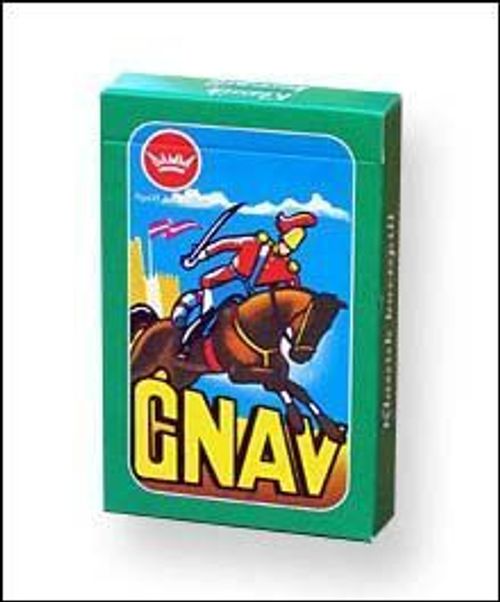
Gnav
Gnav Rulebook: What Beginners Do
Table of Contents
Table of Contents
What Beginners Do
- The object is to trade pieces, and the person at the end of a round who is left with the lowest piece has to pay a match as a fine. Often we begin with three matches each.
There are many rules for the trade. This is particularly the case with the highest or most valuable pieces. If you, for example, are left holding a Cuckoo and someone wants to trade with you, then you have to say "Cuckoo!" Then everybody has to show their pieces. We will explain this as we go along.
First we need to learn the value of the various pieces. Then we can take a trial round. Gnav is easiest to learn by making a try and then consulting the rules if you are stuck.
- First we need to find a piece of paper and put it in the middle of the table. We then write the ranking down so there is no doubt about it. It is also a good idea to include exclamations that apply if you are left holding the pieces that are highest. You can do it like this:
CUCKOO	:	"Cuckoo!"
KNIGHT	:	"Cut off!"
CAT	:	"Mieu!"
HORSE	:	"Pass the Horse!"
HOUSE	:	"Pass the House!"
NUMBERS (Roman) from 12 to 0
POT
OWL
JOKER - 	Tap 3 times with the piece
The Cuckoo has the highest value, Pot, Owl, and Joker lowest. The Joker is the piece with the lowest value.
If the players are not familiar with the Roman numerals these should be included in the note as well: XII = 12 and so on.
- Let's go for a trial round. Give two or three matches to each player. One of the players keeps the bag and gives a piece to everybody. You are not allowed to take a look at your piece until every player has received one and the one who hands them out says: "Look!"
Everybody takes a look at his or her piece but doesn't show the piece to the others.
Listen, listen! It may be that one of the players taps three times with the piece softly but clearly. It means that he has a Joker and of course you don't want to trade it for yours.
So the rule is: If you have a Joker you have to tap. If two players are tapping it means that both Jokers in the bag are in play. It doesn't happen very often, but when it occurs it's an advantage to have the Joker: Both players who tap receive a match each and skip the coming round of play. When everybody has received pieces and has had a chance to take a look at his or her own piece, the trade starts.
- The player to the left of the player who keeps the bag starts. And now the question is: Trade or skip? The object is, as previously mentioned, not to have the lowest piece at the end of the round.
The highest pieces are OK: You say: "I am satisfied." But further down in the row of numbers it starts getting difficult: Should you trade? -and risk getting a pile or an Owl from the player sitting next to you?
Or: - Should you skip the round? and risk that all the pieces in this round are higher?
If the first player skips the round, it is the next player's turn to choose: Skip or trade?
Let's assume that he or she has a zero and says: "I want to trade" to the player sitting to his or her left.
Then the latter player has to trade his or her piece against the zero. He can choose to trade the zero with the player sitting next to him and so on. If latter player has the Cuckoo, a Knight, a Cat, a Horse, or a House (the matadors) things start happening: "Is it a Knight?" asks the player: "Cut off!" Then the player who wanted to trade loses a match and is left with his zero. The trading continues and the task now is to look for the Knight.
To keep track of the various matadors and what is happening to them it is possible to write a note and put it on the table as an aid:
CUCKOO	:	"Cuckoo!"
		The play stops. Everybody shows his or her pieces and the loser has to pay with a match.
KNIGHT	:	"Cut off!"
		The player who wants to trade has to pay with a match. The trading continues and the task is to look for the Knight.
CAT	:	"Mieu!"
		All trades are reversed, and the player who got "the piece that made the Cat hiss" has to pay with a match. The trading continues and the task is to look for the Cat.
HORSE	:	"Pass the Horse!"
HOUSE	:	"Pass the House!"
		For Horse and House this rule applies: The player who wants to trade with someone who has a Horse or a House, has to go on trading with the next player.
Finally the trade round comes to the player who keeps the bag. If he or she is not satisfied with the piece he or she got when pieces were handed out, he or she can trade his piece against one in the bag. The bag then acts like a player. (If a Horse comes out of the bag it is "Pass the Horse" and another trade takes place. If it is a Cat it is "Mieu" – All trades are reversed and so on.) When the trade round is done the player who keeps the bag says: "Show your pieces!" Everybody shows their pieces, and the player with the lowest piece has to pay with a match.
If there is a Joker in play the player who in the end is left with the Joker has to pay with a match. But the Joker drags another player along so that the one who is left with the second lowest piece has to pay with a match as well.
All lost matches end up on the table (in a pool), never with one of the other players.
The player who has lost all his matches is out of the game.
Finally there is only one left: THE WINNER!!
ADULTS THINK GNAV IS DIFFICULT, BUT GENERALLY CHILDREN LEARN IT QUICKLY. FOR THAT REASON IT OFFERS THE SAME AMOUNT OF EXCITEMENT FOR ALL GENERATIONS.