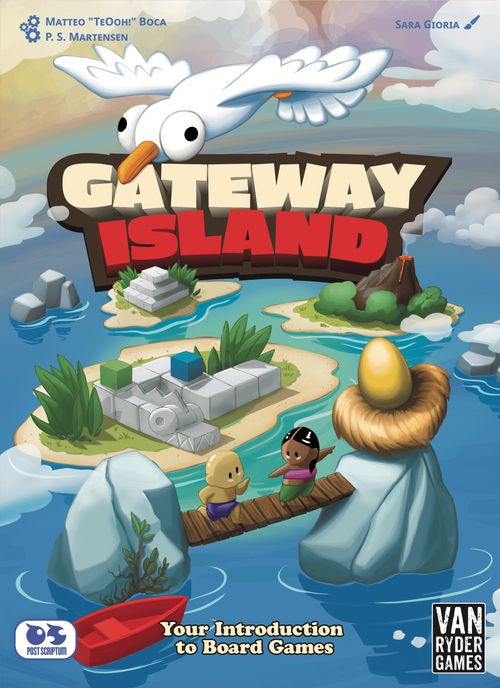
Gateway Island
Gateway Island Supplement
Table of Contents
Table of Contents
What Is a Board Game?
A board game is a game consisting of some or all of the following components: cardboard, wood, plastic pieces, cloth bags, and sometimes unique pieces or components of a special material, shape, or size. A board game is typically played around a table with friends, but there are also digital adaptations, solo games you can play alone, and many other variations of games.
Is a Card Game a Board Game?
The term "board game" is often used in a general manner to include card games and other games that don't actually have a board! When someone mentions their board game collection, for example, there is a very high likelihood they have many card games, dice games, and other games that don't have a board at all!
What Else Should I Know About Board Games?
We board gamers love to classify things! The rest of this book is a glossary of different terms you may come across on your journey. While Gateway Island will introduce you to a lot of different mechanisms and kinds of games, it would be impossible to include everything! There are many other mechanisms not represented in Gateway Island to explore!
Glossary of Board Game Terms and Subjects
General Terms & Subjects
Here are some terms and different kinds of game definitions to help you understand some things you might hear or see discussed online. There are many more terms and subjects, but this should help get you started understanding some common ones.
Abstract Game — A game that is primarily focused on the mechanisms and does not have much connection to the theme. Sometimes the game doesn't have any theme at all. Chess and Checkers are examples.
Card Game — A game that uses only cards, or cards and a few other pieces.
Competitive Game — A game where players compete to be the winner. Usually as individuals, but sometimes in teams or even one player vs. many players.
Cooperative Game — A game where the players work together and win or lose together as a group.
Deckbuilding Game — A game where players start with a small deck of cards (usually about 10) and add more cards to their deck throughout the game.
Depth — Typically referring to the amount of different strategies and tactics that can be employed in a game. A deeper game generally offers more strategies, tactics, and different approaches for players to take.
Dexterity Game — A game that requires physical movement or agility, such as flicking, tossing, or dropping game pieces.
Dice Game — A game that uses only dice, or dice and a few other pieces.
Dungeon crawler — A type of game, often in a fantasy setting, where players control heroes or characters that fight monsters, loot treasure, and experience a grand adventure.
Gateway Game — A game that can be used to introduce someone to the hobby or to a certain kind of game or mechanism. Typically they have simple, accessible rules and play in an hour or less.
Mini/Micro Game — A game that uses very few components. Often just a few cards and/or other components. The games in Gateway Island are mini-games!
Miniatures/Minis Game — A game where miniatures (small plastic, resin, or metal figures) are the main component. Often they are war games or battle games, but miniatures can be included in all types of games.
Party Game — A highly interactive games with easy to learn rules. Often support high player counts.
Solo/Solitaire Game — A game that can be played alone by a single player. Many multi-player games have a solo mode or variant.
Strategy Game — A game that is high on strategy and low on luck. Also often referred to as a 'Euro' game because there was a time when most designers of these games were from Europe (but now strategy games come from designers from all over the world!).
Thematic Game — A game that has a strong focus on creating a story or adventure. Luck usually plays a larger role in this kind of game. Also often referred to as an 'Ameritrash' game (a term that originated as a bit of a slight, but became embraced by many - although it is still viewed in a negative light by some).
Weight — Typically referring to the complexity of a game. Someone might say a game is 'heavy' if the rules are very complex and there are a lot of mechanisms and different things to digest. Conversely, they may call a game "light" if it doesn't have many rules and is easy to learn.
Component Types
Gateway Island features different game components, but there are LOTS more than just what is in this game! Here are some of the more commonly found game components.
Bags — Often with a drawstring, used to put pieces in and to draw them at random
Boards — Often a large board placed in the center of the table, but sometimes can be individual player boards, tiles, or other kinds of boards.
Cardboard Tokens — Small cardboard tokens that come in a "punchboard" sheet
Cards — Usually rectangular and thin cardboard, but can be a variety of different sizes and shapes.
Dice — The most commonly used is a six-sided dice, but there are also dice with 4, 8, 10, 12, 20 and even more sides (these dice are sometimes referred to as polyhedral).
Meeples — Small wooden "people" shaped pieces.
Miniatures — Small plastic figures used as game pieces (used for armies, player tokens, and many other purposes). Some miniatures these days aren't that small at all and can be quite large.
Plastic pieces — Often cubes, discs, miniatures, or custom shapes.
Player Aid — Usually a card (or on the back of the rulebook) or something containing a summary of play order and/or other important rules
Player Screen — A screen a player can use to hide components from view
Sand Timer — An hourglass with sand inside used as a timer.
Spinner — A round dial with an arm that can be flicked or spun to generate something random.
Standees — Cardboard tokens that are placed in a plastic stand so they will stand upright. Often used as a less expensive alternative to miniatures or other plastic pieces.
Wooden pieces — Often cubes, discs, or custom shapes.
Game Mechanisms
Gateway Island features many different mechanisms for you to explore, but there are many others as well. This list is by no means exhaustive of all game mechanisms! We are confident you will discover many, many more on your journey.
Action Selection — When players take turns selecting an Action to take from those available.
Area control — A mechanism that rewards players for controlling an area of the board, usually by having the most pieces (majority) but not always. Sometimes pieces may have varying levels of power or special effects that may grant a player control of the area.
Auction/Bidding — Players bid money or resources in order to "win" some reward or take some effect.
Betting — When players make wagers on a specific outcome.
Bluffing — When players can represent having something they do not. Most people think of the card game Poker when they think about the term "bluffing".
Combat — A general term to indicate fighting and conflict. Combat mechanisms can vary widely from game to game but usually involve player vs. player or player vs. game conflicts.
Deduction — When players are trying to use logic and known information to figure out some unknown element or information.
Dexterity — Mechanisms that require physical movement or agility, such as flicking, tossing, or dropping game pieces.
Diplomacy/Negotiation — A game where deals can be made. Sometimes deals are binding and sometimes, in games with Diplomacy, deals can be broken or not honored.
Drafting — Selecting one of many cards or other pieces and then passing the remainder to the next player. Also sometimes referred to as "pick and pass".
Hexagon grid — When the game board or another component features hexagonal spaces (six sided spaces).
Majority — When players are trying to have the most of something (i.e. the most jewels, the most units in a space, etc.)
Memory — When players need to remember some information that was momentarily revealed.
Pattern building — When players are trying to achieve or match a certain pattern.
Player Elimination — A game where players can be taken out of the game.
Prisoner's Dilemma — A mechanism that, based on a vote, rewards or penalizes players depending on their level of cooperation. If both cooperate they each benefit, however if one cooperates and one does not, the one that does not benefits greatly and the other does not (or is penalized). If neither cooperates, neither benefits (and are often penalized).
Push your luck — A mechanism where the player has a choice to stop and take their rewards or continue for more rewards at the risk of losing what they've gained.
Questions — When a player (or the game) asks other players questions, often trivia questions, but not always.
Quick answers — When players are trying to be the first to answer a question
Racing — When players each control a piece and are trying to be the fastest to cross the finish line or be the first to reach some other defined objective.
Resource management — When players are required to collect, manage, and efficiently use different resources (usually to score victory points!)
Secret roles — When the players do not know the persona or role of the other players. Often there is a hidden traitor, the players are trying to solve a mystery, or there is some other deduction to be made.
Set collection — When players are trying to collect matching resources or other elements.
Simultaneous action selection — When players each select an action and reveal their selection at the same time.
Social Deduction — Typically a high player count kind of game where players interact and try to deduce things through those interactions.
Split and choose — A mechanism where one player splits pieces or resources and then they and/or other players choose what to take.
Tactics — When players are reacting to the moves or actions of other players.
Take that — Games with direct interactions that will negatively affect the status or plans of another player or players.
Wargame — A combat-centric game of conflict between two or more opposing forces.
Worker placement — When each player has meeples (or other pieces and even dice) that are "workers" that can be placed on the board for a select action.