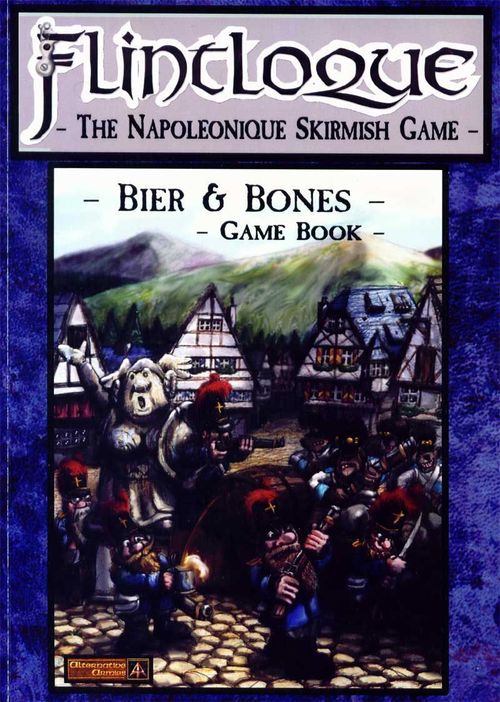
Flintloque (Third Edition): Bier & Bones
Flintloque (Third Edition): Bier & Bones Solo Play Rules
Table of Contents
Table of Contents
Playing Flintloque on Your Own
If you wish to play on your own, the following solo rules come into use. It should be kept in mind that, due to space constraints, a certain degree of common sense is required when using the solo rules. In odd situations unforeseen by these rules, the tossing of a coin should always supersede the rules as listed here. Your characters should behave in a manner that suits them in the game you are playing.
The Solo Flintloque rules have been written concisely and are intended as general instructions for directing the actions of your "robot" opponent.
Feel free to modify, replace or completely ignore any rules you see here. They are simply a suggested way for you to play the game. So long as you can agree with yourself on which rules to use, it's okay with us!
Using the Solo Rules
When playing a Solo game of Flintloque you should follow the rules and process laid out as follows.
Every scenario will have a rating of A, B, or C for each side.
- A is for the side which is generally the aggressor.
- B is for when both sides are generally trying to obtain the same objective, such as a meeting engagement or trying to secure a piece of terrain in the middle of the table.
- C is for the side that is acting as the defender in a given scenario.
Given this knowledge, you must roll on the table below to determine the general aggression level of the enemy force.
- Aggressive: The figures in the enemy force will generally attempt to engage in hand to hand and will abandon safety for the opportunity to inflict damage on your men.
- Neutral: The enemy force will try to balance attacking and keeping the members of its team alive.
- Defensive: Will have a tendency to stay put or search for cover and attack you from afar with firearms.
Solo Aggression Table (Aggression Roll)
| D10 Roll | Type A | Type B | Type C |
|---|---|---|---|
| 1-3 | Neutral | Aggressive | Neutral |
| 4-8 | Aggressive | Neutral | Defensive |
| 9-10 | Defensive | Defensive | Aggressive |
The enemy force in these basic solo rules will always consist of 10 Regular Troop type figures, one of which will be the Section Leader. They will be armed with the standard weapons of their racial type. The Section Leader will have a sword and pistol and will always be of the Professional reputation. You will not know the experience level of any trooper until they attempt to fire, engage in melee, or are forced to take a Morale Check.
Solo Play Tokens
You must fabricate a number of tokens before the game starts (the printed solo token sheet can be copied for this). You need 10 Black Tokens, 5 Grey Tokens, and 3 White Tokens. Place all of these tokens in a cup or bag. When it is time for your enemy to activate figures, you must draw a token to see what the figure will do. The letter represents the colour drawn and the number represents the action taken by the figure. Do not put tokens back into the cup or bag until the maintenance phase of a turn.
Section Leaders will always spend command points to remove Hit tokens using the Officer's Fortune ability. This is all he will ever use them for during play.
Enemy Figure Actions
Each figure's action is determined by the token drawn from the cup, as follows.
1. Move & Melee. The figure moves at a Double March into base contact with the closest enemy figure and initiates close combat. It will not move to close with a figure that has hits on it equal to its Wound stat. Just move to the next closest figure. Will always move to support the Section Leader over the closest enemy if he can reach.
2. Move & Fire. Figure moves at SLOW MARCH directly toward the closest enemy and fires. A figure that doesn't have a loaded weapon will use an offensive magicke attack or perform 1 above.
3. Fire & Move. Figure fires and SLOW MARCHES toward the closest cover, Section Leader, or battlefield objective, whichever is closest. A figure without a loaded weapon will use a defensive special ability. Otherwise it will perform 5 below.
4. Move & Fire. Figure will move at QUICK MARCH into cover while trying to bring itself as close to the enemy as possible. A figure without a loaded weapon will DOUBLE MARCH.
5. Aim or Reload. A figure will pass and attempt to Aim fire or Reload if it has no loaded weapon to fire.
Experience Tokens
When conducting any type of attack for the first time, or making a morale check with a figure, draw another token from the cup. A Black means the figure is Raw. A Grey means the figure is Average. And a White means the figure is Experienced.
When pulling for the Section Leader, a Black draw is followed by another draw. Whatever is drawn, the Section Leader is one level higher than that drawn. So a Black would be Average, a Grey Experienced, and a White Veteran. Immediately place any tokens drawn for Experience back in the cup.
Unknown Quality: To represent the fog of war, if an enemy figure rolls a 10 in melee or rolls a 05 or less on a shooting roll, draw another experience token. If it is higher than his current experience level, it is now whatever this new token indicates.
Actions for the Section Leader
When activating, the following actions will be taken by the Section Leader instead of those listed above when certain circumstances are occurring. They should be resolved in the following hierarchy.
- If at least 3 of the figures on the board have Shaken Tokens, the Section Leader must attempt to move in such a way as to use a Command Point to Rally Troops with the possibility of removing the greatest amount of Shaken Tokens. A Section Leader will NEVER use his last remaining Command Point if he has Hits before performing this action.
- If your Section Leader already has wounds AND is within 30cm of the enemy Section Leader, it will move into contact and initiate melee UNLESS engagement zones prohibit this. He will then act as normal.
- A Section Leader with hits on it will ALWAYS use a Command Point to use the "Officer's Fortune" effect in the Wound Resolution phase.
Solo Aggression by Distance
The printed table pairs distance to the closest enemy with aggression level, giving counts of Black (B), Grey (G) and White (W) tokens. The printed page does not state how these counts are applied.
| Distance to Closest Enemy | Aggressive | Neutral | Defensive |
|---|---|---|---|
| 0-15cm | B1, G1, W2 | B2, G1, W1 | B3, G3, W1 |
| 16-30cm | B1, G2, W2 | B3, G4, W5 | B3, G5, W2 |
| Over 30cm | B4, G2, W5 | B3, G5, W4 | B5, G3, W2 |
Transcription note: this table is printed on page 2 of the solo add-on and is transcribed as printed, without interpretation.
Ending a Solo Game
A solo game of Flintloque should be set to last ten turns or for a specific objective. The game ends when the turns expire, the enemy or your forces flee or all perish, or the objective is met. Determine your victory conditions before play begins.
Most two player scenarios can easily be used for Solo Play by changing the Defending or Attacking player for the solo rules and you taking the other position.