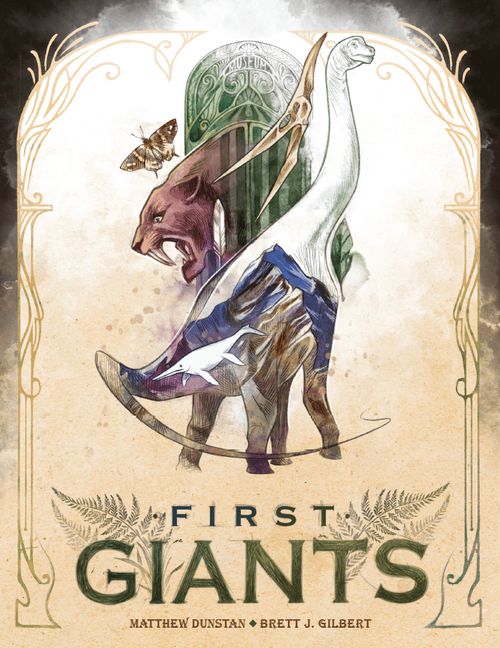
First Giants
First Giants Appendix
Table of Contents
Table of Contents
Flying Family
Featured frequently in dinosaur-related media, Pterosaurs are often strongly associated with dinosaurs by the general public, even though they really aren't true dinosaurs, but are actually simply Flying Reptiles. Unlike the dinosaurs, which evolved into modern birds, there are no survivors from this lineage.
Anurognathus (Size 1)
"Anurognathus", from the Greek ανουρα γναθος "frog jaw".
Every time any player (including you) takes a card with the fossil card symbol (including this card) gain 1 amber. When you take this card, be sure to inform the other players to help them remember their own effects.
Nemicolopterus (Size 1)
The smallest known "adult" pterosaur to date; the actual fossil found may have been a juvenile.
Once during the turn in which you take this card, gain 2 amber.
Pteranodon (Size 3)
More fossil specimens of Pteranodon have been found than any other pterosaur, including both male and female specimens of various age groups and subspecies, allowing for detailed analysis of their anatomy and life history.
Every time you take a Flying card (including this card), gain 2 amber.
Thanatosdrakon (Size 3)
Thanatosdrakon is believed to have had a wingspan of approximately 9 meters.
Every time you take a Flying card (including this card), gain 1 point.
Dimorphodon (Size 2)
Dimorphodons were probably unable to fly for long distances, likely relying on climbing and short flights, similar to modern fowl such as tinamous and woodpeckers.
Once during the turn in which you take this card, gain 1 amber for each Flying card (including this card) in your Study.
Thalassodromeus (Size 2)
Several theories have been proposed to explain the function of Thalassodromeus' crest, including thermoregulation, species recognition, or sexual display, but it likely had more than one function.
Once during the turn in which you take this card, gain 3 amber and 1 point.
Quetzalcoatlus (Size 3)
Quetzalcoatlus was so big that for a long time it was believed that it couldn't actually fly.
Once during the turn in which you take this card, you may spend 3 amber to gain 2 points. You may perform this exchange as many times as you have Flying cards (including this card) in your Study.
Pterosaur Egg (wild)
The Pterosaur egg is a Flying wild card: it is a Flying card, but it can act as a Flying card of any Size in a set. To put it on display, you must spend 2 amber.
Herbivore Family
The Bone Wars, also called the Great Dinosaur Rush, was a period of fierce and cutthroat fossil hunting during the Gilded Age in America. This era was defined by a bitter rivalry between two prominent paleontologists: Edward Drinker Cope (Academy of Natural Sciences in Philadelphia), and Othniel Charles Marsh (Yale's Peabody Museum of Natural History). Both men employed unethical tactics, including bribery, theft, and even the destruction of fossils, in their efforts to surpass one another. They also attempted to discredit each other and disrupt funding by launching personal attacks through scientific publications.
Microceratus (Size 1)
During the Cretaceous, flowering plants were only sporadically found throughout the landscape; it is thus likely that Microceratus mostly fed on ferns, cycads and conifers using its sharp ceratopsian beak to bite off the leaves or needles.
Every time any player (including you) takes a card with the fossil card symbol (including this card) gain 1 point. When you take this card, be sure to inform the other players to help them remember their own effects.
Psittacosaurus (Size 1)
Psittacosaurus is one of the most completely known dinosaur genera with hundreds of fossils from both sexes and from most age classes. Modern theories suggests that it was countershaded (darker on top and lighter on the underside of the body) with a probable disruptive coloration that forms stripes and spots on the limbs.
Once during the turn in which you take this card, gain 1 point.
Diplodocus (Size 3)
Diplodocus lived in what is now mid-western North America, at the end of the Jurassic period, along with other gigantic sauropod dinosaurs, such as Apatosaurus, Barosaurus, Brachiosaurus, Brontosaurus, and Camarasaurus.
Every time you take a Herbivore card (including this card), gain 2 amber.
Stegosaurus (Size 3)
It is generally agreed that Stegosaurus' spiked tail (or Thagomizer) was most likely used for defense against predators. Cartoonist Gary Larson invented the name "Thagomizer" in 1982 as a joke in his comic strip "The Far Side". It was gradually adopted as the official name of the distinctive arrangement of four spikes on the Stegosaurus' tail.
Every time you take a Herbivore card (including this card), gain 1 point.
Pachycephalosaurus (Size 2)
For a very long time, it was believed that the different skull shapes represented 4 different species, until it was realized that the different shapes in fact represented the evolution of the Pachycephalosaurus' different life stages.
Once during the turn in which you take this card, gain 1 point for every 2 cards you have in your Study (including this card). The Family and Size of each card does not matter. If you have an odd number of cards, round down.
Crichtonsaurus (Size 2)
Crichtonsaurus was named after Michael Crichton, the author of the dinosaur novel Jurassic Park.
Once during the turn in which you take this card, gain 2 points and 1 amber.
Triceratops (Size 3)
The first Triceratops fossil discovered consisted solely of its two enormous horns. The paleontologist who analyzed them thought they belonged to a type of Pliocene bison.
Once during the turn in which you take this card, gain 1 point for each Herbivore card (including this card) in your Study.
Herbivore Egg (wild)
The Herbivore egg is a Herbivore wild card: it is a Herbivore card, but it can act as a Herbivore card of any Size in a set. To put it on display, you must spend 2 amber.
Carnivore Family
Some dinosaurs "disappear", like the Dakotaraptor, due to fraudulent use of paleologic material that doesn't actually belong to that species - this is called a nomen dubium.
Compsognathus (Size 1)
One of Compsognathus' kin, Sinosauropteryx, was covered in down, while another, Juravenator, was covered in both feathers and scales, suggesting that members of the same family may have had different types of feather coverings.
Every time any player (including you) takes a card with the fossil card symbol (including this card), you may put 1 fossil on display (by paying its cost). You may choose this card as the one to display with this effect. When you take this card, be sure to inform the other players to help them remember their own effects.
Velociraptor (Size 1)
In 2007, quill knobs were found on the ulna, proving with certainty that Velociraptors (and possibly their cousins) had wings made of feathers rather than down.
Once during the turn in which you take this card, gain 1 amber and you may put 1 fossil on display (by paying its cost). You may choose this card as the one to display with this effect.
Giganotosaurus (Size 3)
Giganotosaurus was one of the largest known terrestrial carnivores, but the exact size has been hard to determine due to the incompleteness of the fossils found so far. Estimates for the most complete specimen suggest a length between 12 to 13m.
Every time you take a Carnivore card (including this card), gain 2 amber.
Spinosaurus (Size 3)
Evidence indicates that Spinosaurus was semiaquatic, and most scientists believe it hunted both terrestrial and aquatic prey, similar to how wading birds like herons hunt.
Every time you take a Carnivore card (including this card), gain 1 point.
Dilophosaurus (Size 2)
The Dilophosaurus holotype is one of the most paleo-pathologized animals ever identified. This makes this specimen one of the most robust of all animals.
Once during the turn in which you take this card, you may put up to 2 fossils on display (by paying the cost of each one). If you display 2 fossils, they must both be from the same Family. You may choose this card as one of the cards you display with this effect.
Carnotaurus (Size 2)
Carnotaurus is the only known carnivorous bipedal animal with a pair of horns on the frontal bone. It is suggested that it used them in a way similar to rams.
Once during the turn in which you take this card, you may put 1 fossil on display at no cost. You may choose this card as the one to display with this effect.
Tyrannosaurus (Size 3)
Prior to Trix's discovery in 2013, Sue was one of the oldest Tyrannosaurus' ever found, having died at the ripe old age of 28. Trix was 35 when it died.
Once during the turn in which you take this card, for each Carnivore card (including this card) in your Study, gain 1 amber and you may put 1 fossil on display (by paying its cost). You may choose this card as one of the cards you display with this effect.
Carnivore Egg (wild)
The Carnivore egg is a Carnivore wild card: it is a Carnivore card, but it can act as a Carnivore card of any Size in a set. To put it on display, you must spend 2 amber.
Marine Family
Life first appeared in the ocean before eventually surfacing and colonizing the land — a major step in the story of evolution. But in an ironic twist, some land animals eventually returned to the sea, gradually re-adapting to aquatic environments over millions of years. Despite their oceanic lifestyle, creatures like ichthyosaurs, plesiosaurs, and mosasaurs descended from land-dwelling ancestors — not unlike how whales evolved from hoofed mammals.
Trilobita (Size 1)
Somewhere around 20,000 species of trilobites evolved into many ecological niches; some moved over the seabed as predators, scavengers, or filter feeders, and some swam, feeding on plankton.
Every time any player (including you) takes a card with the fossil card symbol (including this card), you may spend 3 amber to gain 2 points. When you take this card, be sure to inform the other players to help them remember their own effects.
Ammonoidea (Size 1)
Ammonites are excellent index fossils, as the relatively short time-frame of their existence corresponds to a well-defined geological time period. This allows for rock layers to be easily dated, since the various Ammonite species lifespans was less than a million years.
Once during the turn in which you take this card, gain 1 amber for each different Family (including this card) in your Study.
Elasmosaurus (Size 3)
The first reconstructions of this reptile long ago put its head at the tip of its tail, but paleontologists quickly corrected their mistake.
Every time you take a card from a Family that you do not currently have in your Study, gain 2 amber. If you do not have a Marine card in your Study when you take the Elasmosaurus, gain 2 amber.
Mosasaurus (Size 3)
Despite appearances, Mosasaurus isn't a giant crocodile, but is instead a close relative of modern snakes, various features like having teeth on the roof of it's mouth.
Every time you take a card from a Family that you do not currently have in your Study, gain 1 point. If you do not have a Marine card in your Study when you take the Mosasaurus, gain 1 point.
Ichthyosaurus (Size 2)
The body shape of ichthyosaurus, which looks a lot like a dolphin or a shark, is the result of convergent evolution, a mechanism favorizing similar body configurations in similar environmental situations.
Once during the turn in which you take this card, you may put up to 2 fossils on display (by paying the cost of each one). If you display 2 fossils, they must be from different Families. You may choose this card as one of the cards you display with this effect.
Archelon (Size 2)
Archelon had a leathery carapace instead of a hard shell, a feature common among giant sea turtles like the modern leatherback sea turtle, making them lighter and faster in the water.
Once during the turn in which you take this card, gain 1 point for each different Family (including this one) in your Study.
Megalodon (Size 3)
The name "Megalodon" isn't uncommon among animals; other examples include a clam and a snake, each of which have this word in their names.
Once during the turn in which you take this card, for each different Family (including this card) in your Study, you may put 1 fossil on display (by paying its cost). You may choose this card as one of the cards you display with this effect.
Marine Egg (wild)
The Marine egg is a Marine wild card: it is a Marine card, but it can act as a Marine card of any Size in a set. To put it on display, you must spend 2 amber.
Mammal Family
Approximately 66 million years ago, three-quarters of the plant and animal species on Earth went extinct, including all non-avian dinosaurs. This event, known as the Cretaceous–Paleogene extinction, provided numerous evolutionary opportunities, particularly for the diversification of mammals.
Brasilodon (Size 1)
Every time any player (including you) takes a card with the fossil card symbol (including this card), you may put 1 fossil on display (by paying its cost), or gain 1 point. You may choose this card as the one to display with this effect. In addition, every time this occurs, each of your opponents gains 1 amber. When you take this card, be sure to inform the other players to help them remember their own effects.
Thylacinus (Size 1)
Commonly known as the Tasmanian tiger or Tasmanian wolf. The oldest known fossil record of Thylacine is from around 2 million years ago.
Once during the turn in which you take this card, gain 3 amber. In addition, each of your opponents gains 1 amber.
Arsinoitherium (Size 3)
Every time you take a Mammal card (including this card), gain 2 amber.
Megatherium (Size 3)
Some evidence suggests that human hunting may have lead to Megatherium's extinction.
Every time you take a Mammal card (including this card), gain 1 point.
Smilodon (Size 2)
Once during the turn in which you take this card, you may put up to 2 fossils on display (by paying the cost of each one). You may choose this card as one of the cards you display with this effect. In addition, each of your opponents gains 2 points.
Glyptodon (Size 2)
Glyptodon probably used their very flexible armored tail as a weapon in fights, notably against other Glyptodon to settle territorial or mating disputes.
Once during the turn in which you take this card, gain 3 points. In addition, each of your opponents gains 1 amber.
Mammuthus (Size 3)
Mammoths and Asian elephants are more closely related to each other than either of them are to African elephants.
Once during the turn in which you take this card, you may spend 2 amber to gain 2 points. You may perform this exchange as many times as you have Mammal cards (including this card) in your Study. In addition, each of your opponents gains 1 amber for each Mammal card in your Study (regardless of the number of exchanges you made).
Mammal Egg (wild)
Certain mammals, such as the platypus and the echidna, are monotremes—egg-laying mammals. Fossil evidence, including species like Steropodon and Teinolophos from the Early Cretaceous period, suggests that egg-laying was more common among early mammals in prehistoric times.
The mammal egg is a Mammal wild card: it is a Mammal card, but it can act as a Mammal card of any Size in a set. To put it on display, you must spend 2 amber.
Components
- 65 cards
- 4 Dig Site boards
- 20 wood markers
- 5 Museum boards
- 8 News tokens
- 33 Set tokens
- 80 Amber tokens
- 84 point tokens
- 1 First player token