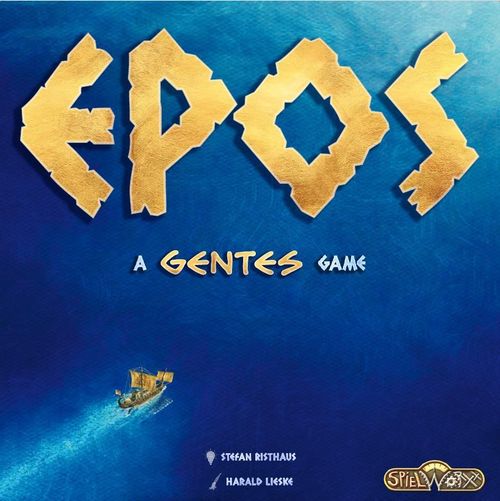
EPOS: A Gentes Game
EPOS: A Gentes Game Campaign Rulebook
Table of Contents
Table of Contents
A. Introduction
Except for the score sheets, no game components are destroyed or altered during a campaign. This allows you to replay your favorite scenarios at any time. This is also possible during "breaks" in a campaign. You can even play multiple campaigns simultaneously if you have several game groups. We suggest playing a campaign with the same group, even though it is possible for people to leave or join the group during a campaign. More information on changes in game groups can be found in section F.
B. Game Overview
The EPOS campaigns are designed for 2-4 players. The solo challenge is described in the base game instructions.
You can play the EPOS base game and the 8 scenarios independently of each other. However, it is particularly interesting and exciting to explore the world of EPOS by playing the scenarios of a campaign in order. Each game within a campaign is called a "chapter."
You have the choice between
- a short campaign consisting of 4 chapters, where you play 4 "random" scenarios depending on your progress,
- the complete campaign with 8 chapters, where the order of the 8 scenarios depends on your progress.
C. Additional Components and Game Setup
In addition to the setup of the base game, perform the following steps. The pictures in this rule booklet show the setup and examples for a short campaign with 3 players.
-
The 40 scenario cards guide you through the campaign. They are in the campaign deck sorted from K01 to K40, as indicated in the bottom right. Never change their order, and do not shuffle them! If the cards are ever mixed up, sort them again in ascending order as shown in the bottom right-hand corner, starting with K01.
Decide as a group whether you want to play the short or complete campaign:
- SHORT CAMPAIGN: Play 4 chapters, whose scenarios are selected from the full set of 8 based on your progress. Prepare the campaign deck with the designated scenario cards without looking at or flipping the cards. The first scenario card is on top.
- COMPLETE CAMPAIGN: Play 8 chapters, where every scenario is played once. Prepare the campaign deck with the designated scenario cards. Go through the campaign deck one card at a time, repeatedly placing the top scenario card at the bottom of the campaign deck without looking at or flipping it, until the first scenario card is on top of the deck.
-
Take your 8 personal markers and place them in your supply.
-
The "No Double Hourglass," "No Tax Collector," and "Cornucopia" tokens indicate whether you have completed personal objectives or used the current chapter's reward. Take the 3 tokens in your color and place them in front of you for now.
-
Each player takes 1 personal score sheet, which you will use for the entire campaign.
- Write your name at the top on the front. You can also give the campaign its own name to distinguish it from other campaigns.
- On the front, record the results of the chapters, in particular your glory points and EPOS points for your ranking. On the back, note which objectives you have already achieved and what benefits you are entitled to. Also, record which jokers you have received or used.
- SHORT CAMPAIGN: Strike out rows 5-8 on the front because you are only playing 4 chapters.
- Take a closer look at the back of your score sheet. Familiarize yourself with the objectives you can complete during the campaign to unlock benefits. Note that requirements for some special objectives must be completed (possibly only temporarily) during a game, but may not necessarily need to be completed later on. Therefore, you need to pay attention to special objectives during a game. Details of all special objectives are summarized in the glossary of this rulebook.
-
Only prepare the chapter according to the first scenario card (for the short campaign and for the complete campaign respectively). Leave all other game components necessary for other scenarios in the box until the campaign rules or scenario cards instruct you to retrieve them.
Now begin your amazing EPOS campaign with the first chapter!
D. Gameplay
As part of the campaign, you try to accumulate EPOS points throughout the chapters. You collect them by winning individual scenarios and completing additional special objectives. Your decisions in each chapter have consequences for the next game and the overall course of the campaign.
The player with the most EPOS points at the end of the campaign is guaranteed a mention in the annals of all peoples!
EPOS points are not glory points in the normal sense of the game but an independent evaluation of your performance in the campaign. It is not possible to convert glory points into EPOS points or vice versa.
Completing special objectives not only earns you EPOS points but also provides benefits for the subsequent chapters. This is crucial because starting resources may decrease from chapter to chapter.
To earn EPOS points for special objectives, you need to adapt your usual playing style. Sometimes you will make decisions that you wouldn't have made in a normal game or scenario outside of the campaign. You will constantly weigh between short-term success in the current chapter and long-term advantages and EPOS points. This makes the campaign a truly special gaming experience.
To be successful in each chapter, you must complete personal objectives and as a group, accomplish shared objectives.
Personal objectives: To complete personal objectives, you need a certain number of glory points and must master scenario-specific challenges. Only if you achieve both by the end of the chapter, will you receive a joker as a reward, allowing you to reuse already-used benefits (further details below). Mark the joker next to the chapter number on the score sheet.
Shared objectives: Your collective success in a scenario determines the course of the campaign and can give everyone benefits. Progressing in subsequent chapters is then easier, and you are better prepared for future challenges.
In each chapter, you play a different EPOS scenario. If a scenario has rule adjustments to the campaign, you will find them in the respective scenario instructions.
Gameplay of Individual Chapters
In each chapter of the campaign, you perform two additional rounds before and after the usual six rounds: the prologue before the 1st round to prepare for the chapter and the epilogue after final scoring after the 6th round to evaluate the chapter for the campaign. Do not tidy up after final scoring! First, follow the epilogue for which you must preserve the game state after final scoring.
The complete sequence of a chapter looks like this:
- Prologue: preparation of the chapter
- Rounds 1 to 6: (possibly origin phase,) flourishing phase, reform phase, and at the end of the 6th round there is final scoring
- Epilogue: evaluation of the chapter for the campaign
Prologue
In the prologue, you prepare the new chapter by performing the following steps: A. reveal the scenario card B. general game setup C. starting resources and benefits
The steps in detail:
A. Reveal the Scenario Card
As a group, read the top scenario card of the campaign deck, which remains active for the whole chapter.
If you are playing the first chapter of your campaign, the corresponding scenario card is already on top of the campaign deck.
If this is not your first chapter, check whether you have successfully completed the shared objective in the previous chapter. If so, reveal the back of the scenario card from the previous chapter so that the advantage granted to everyone is visible.
EXAMPLE: Angelika, Marion, and Heike successfully finished the 1st chapter and are now continuing on the next scenario card. At the bottom of the campaign deck, the back of the previous scenario card indicates that the three of them can permanently use the reward in the next chapter.
Study the objectives on the scenario card and resolve any questions using the glossary at the end of the rulebook, if necessary.
B. General Game Setup
Perform the usual setup for the scenario indicated on the scenario card. Do not take hourglasses, lock markers, or starting resources (coins, pioneers, civilization cards, or education of your population) yet.
Place your "No Double Hourglass" and "No Tax Collector" markers on the game board near the "Tax Collector" action spaces. If you have already achieved the special objectives "No Double Hourglass" and "No Tax Collector," your corresponding markers are already in the box.
C. Starting Resources and Benefits
You receive the starting resources shown on the scenario card. These resources usually differ from the usual resources if you are not playing the scenario as part of a campaign.
NOTE: The information on the scenario card always takes precedence and overrides the general rules of the base game and/or the respective scenario.
In addition to the starting resources, you can choose up to 4 unused benefits from your unlocked benefits to gain additional starting advantages. In the 1st chapter, you have not unlocked any benefits yet. When you take an unlocked benefit, cross out the circle next to the benefit with a mark and enter the chapter number in the corresponding column of the benefit. This way, you can always track that you took at most 4 benefits in each chapter.
You can use each benefit only once - so choose wisely!
As an exception, use unlocked jokers to use a previously used benefit again. In this way, you are not allowed to use the same benefit twice in the same chapter, but you can use different benefits that have the same effect.
Even by using jokers, you can never use more than 4 benefits in a chapter! The jokers do not give you additional benefits but only allow you to use a previously "consumed" benefit again.
A filled mark means that you have unlocked the benefit or joker. A crossed mark means that you have already used the unlocked benefit or joker. It is consumed and generally no longer available.
During the campaign, in the prologue of a chapter, you often receive a lower number of starting resources. Therefore, it is important to complete special objectives and unlock benefits as compensation for the reduced starting resources.
To score EPOS points, it does not matter whether you use unlocked benefits or jokers or leave them unused until the end of the game.
To receive all starting resources and use benefits, follow this order:
- Place the specified number of individual hourglasses on the timeline of your population board and always add 5 lock markers.
- Benefit "-1 Hourglass": Remove 1 single hourglass from your timeline for each used benefit.
- Benefit "+1 Temple or Oracle Marker": Place 1 neutral marker in your temple or oracle area for each used benefit.
- Take the specified number of coins from the general supply.
- Benefit "+5 Coins": Take an additional 5 coins for each used benefit.
- Choose your cards:
- Only in the 1st chapter: Determine the principal and choose your cards according to the rules of the base game. After that, shuffle the remaining civilization cards separately by epochs and place them in face-down decks.
- In all subsequent chapters: The player who had the principal marker at the end of the previous chapter determines who becomes the principal in the current chapter. They may choose themselves. Prepare separate decks for epochs I, II, and III, but do not reveal any cards. If the scenario card allows you to choose cards, take the indicated number from the civilization cards you played in the previous chapter, and take them into your hand. Note the reference numbers of the played civilization cards on your score sheet. During final scoring, played civilization cards do not count!
- Benefit "+1 Civilization Card": Take an additional civilization card from those noted on your score sheet into your hand for each used benefit. If that means you have more than 3 cards in hand, you must (just like in the reform phase) place an additional individual hourglass on your timeline for each civilization card above three.
- After everyone has chosen their cards from the epoch decks, shuffle the remaining civilization cards separately by epochs and place them in face-down decks. Place the top 8 epoch I cards face up in the designated spaces in the card display at the bottom of the game board.
- Starting with the person to the right of the principal and then clockwise, place your pioneers:
- Place the indicated number of pioneers in a polis where you had a city at the end of the previous chapter. Note this on your score sheet. Always place all pioneers in the same territory. If you do not have a suitable territory to choose from (this applies to all of you in the 1st chapter), you must pass for now. After everyone else has placed their pioneers, you may, in the order in which you passed, place your pioneers in an empty polis of your choice. Exception: If the scenario allows you to place pioneers in provinces, you may also place pioneers in provinces during this chapter as part of the campaign. It is not a requirement to have had a city there in the last chapter.
- If the scenario card allows you to place only 1 pioneer in a territory, you do not control the territory for now. If you add more pioneers there through a benefit and have at least 2 pioneers there, you control the territory as per the general rules.
- Benefit "+2 Pioneers": Place an additional 2 pioneers in any polis where you had a city in the previous chapter. If this gives you 6 pioneers in a territory, you may immediately build 1 city and collect revenue. If you do not have a suitable territory to choose from, you must initially pass and then place these additional pioneers along with the other pioneers in any free polis.
- Train your population as described on the scenario card in a number of professions of your choice.
- Benefit "+1 Profession": Train your population in the specified profession once for each used benefit.
- Finally, decide whether you want to exchange 2 individual hourglasses on the timeline for 1 double hourglass. If so, you cannot complete the special objective "No Double Hourglass" in this chapter. So move your corresponding marker from the game board into your personal supply.
EXAMPLE: In the short campaign, Angelika, Marion, and Heike play the scenario "Tribute" as the 1st chapter. As indicated on the scenario card, they place 2 hourglasses on their timelines in addition to the 5 lock markers and receive 20 coins as starting money. They get 2 cards, place 2 pioneers on the map, and train their population in 4 professions.
EXAMPLE: At the beginning of the 3rd chapter, Heike has already unlocked two benefits "+1 Civilization Card" and one each of the benefits "+1 Temple or Oracle Marker", "+5 coins", and "+1 Priest". She has already used "+1 Temple or Oracle Marker" and "+1 Priest" in the 2nd chapter. Heike uses the benefit "+1 Civilization Card" and takes another civilization card into her hand in addition to the one listed on the scenario card. She chooses from the played cards of the last chapter, which she noted on her score sheet. Then she crosses out the benefit and notes a "3" to indicate the 3rd chapter.
Rounds 1 to 6
Play the chapter according to the general rules of the base game and the respective scenario with the following additions.
Builder
If, in the prologue, you took a civilization card from epoch II or III into your hand, you may play it from the flourishing phase of the 1st round onwards. If you do this before the appropriate epoch, you must place an additional individual hourglass on your timeline. You may combine this hourglass with the hourglasses you must take for the action itself according to the action marker or action space.
As in the prologue, every card counts towards the hand limit during the reform phase, including civilization cards from a future epoch.
EXAMPLE: Heike took an epoch III civilization card in the prologue. As long as she does not play it, it counts towards Heike's hand limit in the reform phases of the first four rounds.
Completing Special Objectives
During a scenario, make sure to check whether you completed a special objective. This applies especially to special objectives that you can only complete up to a certain point during a chapter or that you only need to complete temporarily after which their requirements no longer have to be met.
When you complete a special objective, always mark it immediately at the end of the respective turn on the score sheet. The following special objectives exist:
- At the end of the chapter: You must complete the special objective before the chapter's epilogue.
- During the chapter: You must complete the special objective during any round. The necessary conditions no longer have to be met later in the chapter.
- Rounds 1 to 5: You must complete the special objective during the first 5 rounds (including the reform phase).
- Rounds 1 to 4/round 5: You must complete the special objective during the first 4 rounds (including the reform phase). If you achieve it only in the fifth round, it counts as a partial success. In the latter case, mark the special objective initially with a semicircle and complete the circle only the second time you complete this objective.
- Special goals with "No...": To complete the two special objectives "No Double Hourglass" and "No Tax Collector," you must refrain from placing double hourglasses on your timeline or performing the "Tax Collector" action throughout the entire chapter. This abstinence applies from the beginning of the prologue to the end of the epilogue! If successful, return your corresponding token from the game board to the game box and mark the special objective. In subsequent games, leave the token in the box; you can complete each special objective only once. If you use double hourglasses or perform the "Tax Collector" action, take the corresponding token from the game board and place it in your supply until the next chapter.
For each completed special objective, you unlock a benefit. If you use the benefit in the prologue, cross out the circle of the special objective. It is now consumed for the whole of the campaign and is only available again with a joker.
"Cornucopia" Tile
If you successfully completed the shared objective in the previous chapter, you receive a reward in the current chapter.
If you use this reward during the chapter, place your "Cornucopia" tile next to the campaign deck, if not differently explained for certain rewards. This indicates that you are currently not allowed to use the reward again.
If it is a reward that you can use every round, return your tile to your supply during the reform phase. Do this in the step of the reform phase where you remove the markers from used civilization cards and provinces.
Do Not Clean Up!
Play the chapter all the way to the end, including the reform phase and final scoring in the 6th round. Also, pass the principal marker to whoever took the "Principal" action in the last round, if any of you did so.
If you play civilization cards during final scoring, place them distinctly separate from the civilization cards you played with the "Architect" action during the game.
DO NOT CLEAN UP AFTER THE GAME! Do the epilogue first!
Epilogue
Perform the following steps during the epilogue: A. Evaluate the chapter (front of the score sheet) B. Complete personal special objectives (back of the score sheet) C. Complete the personal objective of the scenario card (joker; back of the score sheet) D. Complete the shared objective of the scenario card (success or failure) E. Record civilization cards and cities (front of the score sheet)
Only clean up afterward!
A. Evaluate the Chapter
Use the front of your score sheets.
- Write down the date and played chapter (the scenario's name and the scenario card's unique code) in the corresponding row, if you have not already done so.
- If you have the principal marker, mark the field in the "Principal" column. You determine who starts as the principal in the next chapter. Keep in mind that the principal can still change during the reform phase of the 6th round.
- Write down your earned glory points and determine who won the just-played chapter. Depending on your position, note the following EPOS points:
| Number of players | 1st place EPOS points | 2nd place EPOS points | 3rd place EPOS points | 4th place EPOS points |
|---|---|---|---|---|
| 2 | 5 | 2 | ||
| 3 | 8 | 5 | 2 | |
| 4 | 8 | 6 | 4 | 2 |
If multiple people share the same place even after tiebreakers, add the EPOS points for the tied players and divide them evenly among them, rounding down if necessary.
EXAMPLE: Angelika and Marion are tied for 2nd place at the end of the chapter. They share the EPOS points for the 2nd and 3rd places and they each receive 3 EPOS points after dividing the total of 7 points by two and rounding down.
EXAMPLE: Heike took 1st place with 92 glory points in the 3rd chapter "Trade", and therefore received 8 EPOS points. She had the principal marker at the end and noted it accordingly on her score sheet.
B. Completing Personal Objectives
Check the back of your score sheets to see which personal objectives you achieved in this chapter. Pay close attention to the special objectives that you must complete in specific rounds.
Mark a completed objective and therefore unlock the associated benefit. If you use a benefit, cross out the circle of the objective. It is now consumed for the campaign and is only available again with a joker.
With each completed special objective, you unlock a benefit. Mark the completed objective and enter the EPOS points in the corresponding column.
EXAMPLE: Heike focussed on fulfilling special objectives and unlocked 3 additional benefits at the end of the 3rd chapter. She marks them and notes the earned EPOS points on the right-hand side.
C. Complete the Personal Objective of the Scenario Card
Check if you have completed the personal objective of the scenario card. To do this, you must meet two conditions by the end of the chapter:
- Reach or exceed the specified glory points after final scoring.
- Meet the specified requirements.
There are requirements that you must complete during the chapter at a certain point. Check in the epilogue whether you circled the chapter number on your score sheet and reached the required glory points.
If you complete the personal objective, you receive a joker. Mark it on the back of your score sheet for the corresponding chapter.
EXAMPLE: Heike completes the personal objective of the 3rd chapter. At the end of the chapter, she exceeded 80 glory points and controls regions with 5 cloths. She marks the joker of the 3rd chapter. If she had achieved less than 5 cloths or less than 80 glory points, she would not have completed the objective and would not have received a joker.
D. Complete the Shared Objective of the Scenario Card
Check if you have completed the shared objective of the scenario card as a group. You do not need to reach a specific number of glory points, and you do not receive a joker if you are successful. There are two types of shared objectives:
- Resource objective: You must possess a certain amount of resources together as a group, depending on the number of players. It doesn't matter who contributes how many resources to the total.
- Complete personal objective: Check separately whether each of you completed their personal objective. The shared objective is only completed if each of you also completed your personal objective.
Success: If you have completed the shared objective, the principal crosses out the field in the "Principal" column on their score sheet. Turn the current scenario card over and read what it says in the "Success" box. There is usually a benefit for the next chapter. Leave the scenario card on its back side and slide it under the campaign deck, so that the half of the card with the "Success" box is visible.
Failure: If you did not complete the shared objective, turn the current scenario card over and read what it says in the "Failure" box.
Either way, the scenario card indicates which scenario you will play in the next chapter. Note on the front of your score sheet which scenario (and which scenario card) you will play next.
Go through the campaign deck again, take the top scenario cards one by one, and put them at the bottom of the campaign deck without turning them over until the appropriate scenario card is on top.
EXAMPLE: Angelika, Heike, and Marion played the 3rd chapter on a scenario card and now turn the scenario card over (A). If they successfully completed the shared objective, they play the next chapter on the card indicated (B). As the current principal, Heike marks the success by crossing out her field in the "Principal" column on their score sheet (C). All three enter the next scenario card number on their score sheets and receive a reward (D). They place the card with the back facing up below the campaign deck, so they still can see the reward (E). They go through the campaign deck until the next scenario card is on top and shows the preparations for the next chapter (F).
In case of failure, they proceed to the chapter on the card indicated in the "Failure" box, without receiving a reward (G). They note its number on their score sheets and place the card face-up under the campaign deck (H). Finally, they go through the campaign deck until the next scenario card is on top, which provides instructions for the next chapter (I).
E. Note Civilization Cards and Cities
Note the Poleis in the right-hand column of your score sheet that you control with a city at the end of the chapter. Do not write down provinces or territories that you control with pioneers or through special rules of the just completed chapter.
Also, note the reference numbers of the civilization cards you played during the six rounds in the right-hand column. The civilization cards completed in final scoring do not count!
Choose which of the noted civilization cards you want to keep for the next chapter. They can be cards from all three epochs. However, keep in mind that you must place 1 additional hourglass on your timeline if you play an epoch II or III civilization card early.
It is usually sufficient to note only a small number of cards, usually two more than the "+1 Civilization Card" benefits you have unlocked. You can decide at the beginning of the new chapter whether to use any benefits or leave them unused. Some scenario cards also give you certain cards to take in the prologue. Unselected cards remain in the three epoch decks and come into play from the card display as usual.
If you want to continue the campaign, without changing who to play EPOS with first, you can put your played civilization cards back in the box along with the other components. This way, you have the cards available again at the beginning of the next chapter and can choose your starting hand from them.
EXAMPLE: Heike has written down the Poleis Athens and Syracuse, which she controls with cities, as well as the played civilization cards A03, A18, A25, and A40, for the next chapter. In one of these Poleis, she will use her first pioneers in the next chapter.
Finally, Clean Up
Now you can tidy up the game components and either prepare for the next chapter or continue the campaign at a later time.
E. Evaluation of the Campaign
At the end of the campaign, after the epilogue of chapter 8 or 4, determine who has earned a mention in the annals of your peoples!
You receive EPOS points during the campaign for the following achievements:
- Place at the end of a chapter
- Completed special objectives
- Completed personal objectives*
- Ranking in the glory point totals*
- The distribution of EPOS points for completed personal objectives and the glory point leaderboard depends on the course of the campaign.
If the group completes fewer shared objectives from the scenario cards, those who have strived for personal objectives and thus indirectly contributed to the completion of shared objectives get a bigger reward.
As a group, follow the steps below one at a time and write down the individual EPOS points on your score sheet in the designated space. For steps 3 and 4, look at the back of the last scenario card and evaluate your score depending on whether you successfully completed the shared objective in the last chapter ("Success") or failed ("Failure").
- Place at the End of a Chapter: Add up the EPOS points for your place at the end of a chapter on the front of the score sheet. Enter the result in the designated space.
- Completed Special Objectives: Add up the EPOS points for all completed special objectives on the back and enter the result on the front in the designated space. For only partially completed special objectives, you do not receive any EPOS points.
- Completed Personal Objectives: You receive EPOS points for the number of complete personal objectives, i.e., the number of unlocked jokers on the back of the score sheet. It is not relevant whether you used the jokers or whether they are still unused. Enter the result in the designated space on the front of the score sheet.
- Glory Points - Totals and Ranking: Add your own glory points on the front of the score sheet that you gained in all played chapters. You earn EPOS points both for your total glory points and for your rank compared to the other players.
- TOTAL GLORY POINTS: Earn 1 EPOS point per 50 glory points. Enter the EPOS points in the designated left space.
- RANK: Compare your total glory points with the totals of the other players. Enter the EPOS points according to your ranking in the designated right space. The EPOS points for third place are only awarded in games with 4 players. If several people share the same place, add up the EPOS points for the tied players and divide them evenly among them, rounding down if necessary.
Finally, add up all EPOS points to determine the overall result. The person with the most EPOS points wins the campaign and secures a place in the annals of your peoples!
In the event of a tie, the tied player who completed more personal objectives of the scenario cards wins. In the event of another tie, the tied player who has the higher glory point total wins. If that is also the same, the tied player who was principal at the end of the last chapter or sat closest to the principal in turn order is the ultimate winner.
EXAMPLE: After they successfully finished the 4th chapter of their short campaign, Heike achieves the following total EPOS points (abbreviated EP):
- A. Place at the end of a chapter: Heike took 2nd place in chapters 1 and 4 (5 EP each) and won chapter 3 (8 EP). In chapter 2, she was last (2 EP). Thus, she receives 20 EP.
- B. Completed special objectives: Heike adds up the EPOS points for her unlocked special objectives. In total, she scores 63 EP in this way.
- C. Completed personal objectives: Heike completed the given objective, but did not reach the minimum score in chapter 2 and was therefore not allowed to unlock a joker. She fulfilled the other 3 objectives. According to the scenario card, she receives a total of 9 EP for the 3 jokers. It is not relevant for the evaluation of the campaign whether she used the jokers.
- D. Ranking in the glory point totals: Heike gained a total of 417 glory points and receives 8 EP. Compared to Angelika and Marion, Heike got 2nd place and receives another 14 EP.
Thus, Heike writes down a total of 114 EPOS points on her score sheet as the overall result.
F. Different Player Counts in a Campaign
It is recommended that you play all chapters of a campaign with the same people. If someone leaves a campaign that is in progress, the remaining players can continue the campaign without any changes.
It is also easily possible for someone else to take over from the person who left and continue the campaign on their behalf.
If someone leaves without a replacement, they can technically join again in a later chapter. They can take part in later chapters without problems, collect EPOS points, and complete special objectives in these chapters. However, they do not receive EPOS points for the chapters they did not take part in. Thus, at the end of the campaign, they are less likely to win the overall campaign.
CLARIFICATION: Always check the completion of shared objectives based on the number of people who actually take part in the chapter.
Glossary
Details on Special Objectives and Rewards
| Special objective | Benefit | Description |
|---|---|---|
| Complete chapter 1 | +1 Civilization Card | Requirement: You automatically complete this special objective at the end of chapter 1. Benefit: In the prologue, take 1 additional of your civilization cards played in the previous chapter into your hand. Note the reference numbers of these civilization cards on your score sheet at the end of the chapter. Civilization cards completed during final scoring do not count! |
| Rounds 1-4/round 5: benefit "Play 8 civilization cards" | +1 Civilization Card | Requirement: Complete the "Play 8 Civilization Cards" benefit once during the first 4 rounds of the chapter or in two chapters by the fifth round at the latest. Mark the special objective with a semicircle in the latter case and close the circle only the second time. Benefit: see above |
| During the chapter: 4 cities in provinces | +1 Civilization Card | Requirement: Build 4 cities in the provinces. Later in the chapter, you can also move them to Poleis. Benefit: see above |
| At the end of the chapter: 4 epoch III civilization cards | +1 Civilization Card | Requirement: Play 4 epoch III civilization cards during the chapter. Civilization cards completed during final scoring do not count. Benefit: see above |
| Rounds 1-4/round 5: benefit "Build 6 Cities" | +1 Temple or Oracle Marker | Requirement: Complete the "Build 6 Cities" benefit once during the first 4 rounds of the chapter (including the reform phase) or in two chapters by the fifth round at the latest. Mark the special objective with a semicircle in the latter case and close the circle only the second time. Benefit: Place 1 neutral marker in your temple or oracle area of your population tableau during the prologue. |
| During the chapter: 8 temple and oracle markers | +1 Temple or Oracle Marker | Requirement: Have a total of 8 neutral markers in your temple and oracle area at the end of your turn or at the end of the reform phase. Benefit: see above |
| Rounds 1-4/round 5: benefit "Train 18 Professions" | +5 Coins | Requirement: Complete the "Train 18 Professions" benefit once during the first 4 rounds of the chapter (including the reform phase) or in two chapters by the fifth round at the latest. Mark the special objective with a semicircle in the latter case and close the circle only the second time. Benefit: In the prologue, take an additional 5 coins. |
| During the chapter: 45 coins | +5 Coins | Requirement: Have at least 45 coins in your personal supply at the end of your turn or at the end of the reform phase. Benefit: see above |
| During the chapter: no tax collector | +5 Coins | Requirement: Do not perform a "Tax Collector" action throughout the entire chapter. This also applies to additional "Tax Collector" actions in individual scenarios. Benefit: see above |
| At the end of the chapter: 3 benefit markers | -1 Hourglass | Requirement: Complete 3 different benefit markers. In scenarios with additional benefit markers (progress, new age), you must complete 3 of the 4 available benefit markers. Benefit: Remove 1 hourglass from the timeline during the prologue. |
| Rounds 1-5: empty timeline | -1 Hourglass | Requirement: All 12 spaces of your timeline are empty at any time during the first five rounds. There are no lock markers, hourglasses, action markers (or possibly other game pieces) on the spaces. You usually achieve this in the reform phase of the 5th round. Benefit: see above |
| During the chapter: no double hourglass | -1 Hourglass | Requirement: Do not place a double hourglass on your timeline throughout the entire chapter. This also applies to the prologue and in scenarios where you can later split double hourglasses into 2 single hourglasses. Benefit: see above |
| During the chapter: 6 nobles/craftsmen/soldiers/merchants/priests/scholars | +1 Noble/Craftsman/Soldier/Merchant/Priest/Scholar | Requirement: Train your population 6 times in the mentioned profession by the end of your turn or the reform phase. Temporary or virtual professions do not count, nor do professions you train in final scoring. Benefit: Train the mentioned profession an additional time during the prologue. |
| During the chapter: 6 cities in Poleis | +2 Pioneers | Requirement: Construct 6 cities in Poleis. Later in the chapter, you can also move them to provinces. Benefit: Place an additional 2 pioneers in any Poleis during the prologue where you had a city in the previous chapter. If you have 6 pioneers in a territory as a result, you may immediately build 1 city and take revenue. If you have no suitable territory to choose from, you must first pass and then place the additional pioneers together with the pioneers according to the scenario card in 1 free polis. |
| At the end of the chapter: maximum 1 city | +2 Pioneers | Requirement: Construct only a single city or none at all in a polis or province. You may control as many territories with pioneers (and possibly with Generals) as you like. You may not move the city but must play with this city until the end of the chapter to complete this special objective. You are allowed to move cities only after building all 6. However, you do not have to build a city if you have at least 6 pioneers in a territory. Benefit: see above |
| At the end of the chapter: 10 epoch I and II civilization cards | +2 Pioneers | Requirement: Play 10 epoch I and epoch II civilization cards during the chapter. Civilization cards completed during the final scoring are not considered. Benefit: see above |
Notes and Clarifications on Personal and Shared Objectives on Scenario Cards
In general, you must have completed all objectives by the end of the chapter unless otherwise stated. If an objective specifies a time, check for completion at the specified time, this is always at the end of a round after finishing the reform phase. When you complete a personal objective, record it immediately on your score sheet. It doesn't matter if you complete an objective late or not at all.
Completing the shared objective "Complete Personal Objective" requires that all of you have reached the minimum score and completed the requirement of the personal objective.
The following entries are printed in this order, each under a scenario-card icon:
- Personal Objective: Complete at least 5 demands on your legacy card. Shared Objective: Add up the completed demands of all your legacy cards. Benefit for Completion: In the prologue, each of you places 2 additional roads on the road space, making a total of 4 roads for 4 players. You can build your roads on borders between two territories even when another player's road is already there. More than 2 roads on one border are not possible.
- Personal Objective: Gain both bonuses for long-distance connections, i.e., for connecting provinces with cloth or metal goods tiles. Shared Objective: Every player has completed their personal objective. Benefit for Completion: You may place your pieces on locations already occupied by one or more other player pieces (legate to card ability, explorer in a controlled territory, high priest on an action space). For each other player's piece in this location, you must pay 2 coins to the respective player.
- Personal Objective: Gain the expansion bonus for at least 2 of the city symbols - trading cities, oracle cities, or temple cities. Shared Objective: Every player has completed their personal objective. Benefit for Completion: Once per round, you may replace any action marker on your timeline with the "Cornucopia" tile. Then place the action marker as usual on your timeline and carry out your turn with this action marker again without paying its cost.
- Personal Objective: Remove your 3 player pieces (legate, explorer, high priest) by the end of round 4 from your population tableau. It does not matter whether the player pieces are at their relevant locations or next to your population tableau. If you complete this objective, place a personal marker on the scenario card. Shared Objective: Add up all the professions trained on your population tableau. Virtual professions do not count. Benefit for Completion: You may use the generals, merchants, and trading posts of others to complete the requirements of your "Panem et Circenses" cards if you pay them 2 coins each. Additionally, you must pay the 1 coin specified on the card to the supply. If you want to complete multiple requirements with the same player piece, you must pay each time. You cannot use other abilities of the player pieces (e.g. domination by the general). Special case: You can use roads from the Romans to complete a requirement of your "Panem et Circenses" card if the Romans could complete this requirement according to the rules for road use. Then also pay 2 coins to the Romans and additionally, as usual, 1 coin to the supply.
- Personal Objective: Control territories that offer you a total of at least 5 identical goods as revenue. It is not necessary for you to actually get the revenue in the same action or reform phase. EXAMPLE: Heike controls Athens with 2 glass in the purple region, as well as Rhodes with 2 glass and the province of Scythia with 1 glass in the blue region. Shared Objective: Add up all the revenue in your controlled territories separately for each type of good. It does not matter who controls the cities, and it is not necessary for you to get the revenue in the same action or reform phase. Benefit for Completion: Once per game, when placing a trading post in a province, instead of 2 pioneers, you may place a total of 3 pioneers, in addition to the trading post, to place your "Cornucopia" tile in the territory. Then you immediately receive and subsequently receive 1 good from the province in each reform phase. The trading post offers all abilities just like your regular trading posts. This reward does not apply to trading posts in the Poleis. There, you only gain access to the cultural sites. Special cases: If you, as Romans, reach a province with your road network, you can remove 1 pioneer from any territory to place the "Cornucopia" tile in the province just reached. As Phoenicians, you must give up 3 pioneers and cannot replace 1 pioneer with 3 coins using your special ability. You still receive 1 coin for the trading post with the "Cornucopia" tile in the reform phase as usual.
- Personal Objective: Be the furthest on the protection track after defeating a plague. A tie with other players is sufficient. If you complete this objective, place a personal marker on the scenario card. If playing with two players, you must complete this objective twice. Place one personal marker on the scenario card the first time and another one the second time. Shared Objective: Defeat at least 5 plagues. Benefit for Completion: Once per game, you may acquire a second technology on the same level as the one you already have on a technology card. You must pay the costs and complete the requirements as usual. If you choose a second level II technology in this way, you may acquire one level III technology from these two technologies each. [As printed; the benefit text belongs to a technology-themed card.]
- Personal Objective: Gain the bonus marker for playing 5 "Panem et Circenses" cards. Shared Objective: Every player has completed their personal objective. Final Scoring.
- Personal Objective: Gain the bonus marker for technologies with a total of 8 cogs by the end of round 5. If you complete this objective, place a personal marker on the scenario card. Shared Objective: Every player has completed their personal objective. Final Scoring.
- Personal Objective: Gain at least 2 expansion bonuses for identical city symbols by the end of round 5 - trading cities, oracle cities, or temple cities. If you complete this objective, place a personal marker on the scenario card. Shared Objective: Every player has completed their personal objective.
- Personal Objective: Remove your 3 player pieces (legate, explorer, high priest) by the end of round 3 from your population tableau. It does not matter whether the player pieces are at their relevant locations or next to your population tableau. If you complete this objective, place a personal marker on the scenario card. Shared Objective and Benefit: as in the corresponding earlier entry.
- Personal Objective: Play at least 3 "Pact with the Gods" cards in the new dawn phase for which you receive coins. Do not place these cards in the box during the reform phase, but place them next to the scenario card. When you place the third "Pact with the Gods" card here and complete the objective, also place a personal marker on the scenario card. To complete the shared objective, place additional cards next to the scenario card. Clarification: If you do not at least reach the lowest level or do not receive any coins, you must return the "Pact with the Gods" card to the box. Shared Objective: Add up all your "Pact with the Gods" cards that receive coins that are next to the scenario card.
- Personal Objective: Acquire different technologies with at least 4 cogs. You may not acquire two identical technologies. Shared Objective: Every player has completed their personal objective.
- Personal Objective: Acquire at least 5 different goods during the game, which must be placed on your player board. Shared Objective: Add up the goods on all your player boards.
- Personal Objective: Gain the bonus marker for playing 4 "Pact with the Gods" cards in a single round. If you complete this objective, place a personal marker on the scenario card. Shared Objective: Every player has completed their personal objective. Final Scoring.
- Personal Objective: Acquire at least 6 technologies. Count the individual technologies, not the cogs. Shared Objective: Add up all the technologies you have acquired.
- Personal Objective: Complete all requirements of the legacy card by the end of round 5 at the latest. If you complete this objective, place a personal marker on the scenario card. Shared Objective: Every player has completed their personal objective. Benefit for Completion: Once per game, before or after your regular turn and before or after the trade, you may move the price markers of 2 goods up by exactly 2 spaces each. Then take 1 goods tile of each of the other two goods from the supply. NOTE: You must move both price markers up by exactly 2 spaces each. You may not choose a price marker that you can only move 1 or no space.
- Personal Objective: Gain the bonus marker for technologies with a total of 8 cogs. Shared Objective: Every player has completed their personal objective.
- Shared Objective: Every player has completed their personal objective. Benefit for Completion: Once per game, you may pay for the "train" action up to the limit with any goods, to train one profession with 2 goods each.
- Shared Objective: Every player has completed their personal objective. Benefit for Completion: In the prologue, either pay 8 coins or place a double hourglass on your timeline to buy yourself some protection against the effects of plagues. Each time a new plague enters the game and is triggered for the first time, you will be spared from the personal penalties of the plague. However, the general penalties, such as removing action markers from the game board, still apply. If you choose to buy the protection, place a personal marker on the scenario card. CLARIFICATION: You may also choose to forgo the protection and then, of course, neither pay coins nor take hourglasses. If you choose the double hourglass, you may exchange it at the end of the prologue as usual for two single hourglasses.
- Personal Objective: Control territories that offer you all 4 types of goods (glass, metal, cloth, incense) as revenue. It is not necessary for you to actually gain the revenue in the same action or reform phase. Shared Objective: Every player has completed their personal objective. Benefit for Completion: During the "Road Building" action, you may remove 1 pioneer from a territory where you can build a road according to the usual rules. Then place 1 additional road on any border of this territory.
- Shared Objective: Defeat all 6 plagues.
- Personal Objective: Control territories that offer you at least 7 different goods as revenue. It is not necessary for you to actually gain the revenue in the same action or reform phase. EXAMPLE: Heike completes the personal objective by controlling 3 Poleis, each with 2 goods, and 1 province with 1 good. Angelika controls 2 Poleis, each with 2 goods, and 3 provinces, each with 1 good. Shared Objective: Add up all the goods in your controlled territories. It does not matter who controls the cities, and it is not necessary for you to gain the revenue in the same action or reform phase. Benefit for Completion: Once per game, at any time (even immediately before the evaluation of a plague), you may place your "Cornucopia" tile on a plague tile. From now on, you ignore the personal penalties of this plague. If you defeat this plague, move your "Cornucopia" tile from the plague tile to the scenario card.
- Personal Objective: Build at least 2 city connections, each containing the city with the glory point bonus (Troia, Syracusae, or Naukratis). Shared Objective: Every player has completed their personal objective. Benefit for Completion: Once per round, you may use your "Cornucopia" tile as an action marker on your timeline without taking additional hourglasses or paying coins. Carry out the "protection" action according to the usual rules.
- Personal Objective: Score a total of at least 14 culture points during the scoring of the specified cities and civilization cards of your civilization card. Shared Objective: Add up all your culture points gained through your civilization cards.
- Shared Objective: Every player has completed their personal objective. Final Scoring.
- Personal Objective: Build cities in territories that offer you all 4 types of goods (glass, metal, cloth, incense) as revenue. It is not necessary for you to actually gain the revenue in the same action or reform phase. Shared Objective: Every player has completed their personal objective.
- Personal Objective: Reach space 10 on the protection track during a plague. If you complete this objective, place a personal marker on the scenario card. If playing with two players, you must complete this objective twice. Place one personal marker on the scenario card the first time and another one the second time.
- Personal Objective: Reach 40 culture points by the end of round 4 at the latest. If you complete this objective, place a personal marker on the scenario card. Shared Objective: Add up your culture points at the end of the game.
- Shared Objective: Defeat all 6 plagues by the end of round 5 at the latest. If you complete this objective, everyone places a personal marker on the scenario card.
- Personal Objective: Reach at least space 1 on the protection track when defeating each plague. If this is not the case when evaluating a plague, you must place a personal marker on the scenario card. Shared Objective: Every player has completed their personal objective. Final Scoring.
- Personal Objective: Build both city connections for the same city symbol - trading cities, oracle cities, or temple cities. Shared Objective: Add up all your city connections. Benefit for Completion: Once per game in the new dawn phase, you may place your "Cornucopia" tile on the scenario card and ignore all personal penalties of all plagues in this new dawn phase.
- Further entries repeat "See [earlier entry]" references for personal objective, shared objective and benefit, or state "Shared Objective: Every player has completed their personal objective. Final Scoring."
- Personal Objective: Score a total of at least 17 culture points during the scoring of the specified cities and civilization cards of your civilization card. Shared Objective: Every player has completed their personal objective. Final Scoring.
List of Cities and Abbreviations for Notation on the Score Sheet
| Abbreviation | City |
|---|---|
| AL | Alba Longa |
| AN | Ancona |
| AR | Arabia |
| AS | Assyria |
| AT | Athenai |
| CA | Carthago |
| CN | Cnossos |
| CY | Cyrene |
| DE | Delphi |
| ET | Ethiopia |
| GA | Gallia |
| IB | Iberia |
| LE | Leptis Magna |
| MA | Mauretania |
| ME | Memphis |
| MI | Milet |
| NA | Naukratis |
| NU | Numidia |
| OD | Odessos |
| RH | Rhodos |
| SC | Scythia |
| SE | Serdica |
| SI | Sinope |
| SY | Syracusae |
| TR | Thracia |
| TA | Troia |
| TY | Tyros |