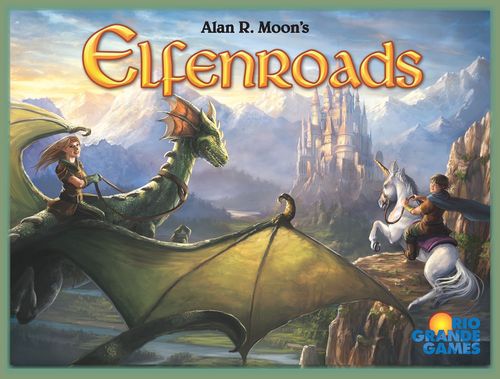
Elfenroads
Elfensea Rulebook
Table of Contents
Table of Contents
Contents
- 6 Elf Boots
- 192 Village Tokens: 32 each in blue, red, yellow, black, green, purple
- 40 Transportation Counters: 10 each of Dragon, Unicorn, Giant Pig, Magic Cloud
- 60 Bonus Counters: 10 each of Dragon, Unicorn, Whale, Giant Pig, Magic Cloud, Raft
- 4 Round Cards
- 1 Starting Player Figure
- 1 Game Board
- 1 Rule book
- 64 Travel Cards: 10 each of Unicorn, Magic Cloud, Giant Pig; 12 each of Whale, Raft
- 6 Transportation Charts
How to Set Up the Game
Each player takes one Elf Boot and 32 Village Pieces of the same color. Place the boots in the elf capital of "Elfenhaven". Each player places her Village Pieces on the other 32 villages.
Separate the cards according to the different backs: castle (Travel Cards) and mountains (Round Cards).
Shuffle the 64 Travel Cards (castle backs) that are shown on the previous pages (Dragon, Magic Cloud, Unicorn, Giant Pig, Whale, and Raft) and place them face down next to the Game Board in one stack.
Place the four Round Cards in one stack near the top left corner of the board with the number "4" on bottom, followed by "3", "2" and "1" on top. The top card always indicates the current round.
Now mix the Transportation Counters and place them face down in a pile next to the board. Turn over five Transportation Counters and place them next to the face down ones.
Place the 60 Bonus Counters face-down in a pile and shuffle them thoroughly.
Each player takes a Transportation Chart. Put the remaining Transportation Charts back in the box.
Give the Starting Player Figure to the oldest player so she can start the game. After she has completed her turn, the turn passes to the left.
Game Board
In Elfensea, the well built road network connects the villages with each other. Each road runs through a specific region, through the light green plains, dark green woods, yellow desert and over the gray mountains. The rivers and sea routes can also be used to travel from one place to the next.
Elves may use six different types of transportation. Depending on the region, a type of transportation may allow fast or slower travel, and some types of transportation may not be used in some regions at all.
Travel Cards
Each Travel Card indicates the type of transportation (which transportation counter to use) and the type of region it can be used in. Each round symbol indicates a type of region. A single round symbol indicates that only one travel card must be used. A double round symbol indicates that two Travel Cards must be played to use the chosen road.
If a specific region's symbol is missing, player's cannot use that particular Travel Card or Transportation Counter in that region.
- The Giant Pig cannot travel in the desert, and requires 2 Travel Cards when traveling in mountains.
- The Magic Cloud cannot travel through the desert and requires 2 Travel Cards for the plains, woods, and sea.
- The Unicorn cannot travel through the plains and requires 2 Travel Cards for the desert.
- The Dragon requires 2 Travel Cards to fly over the woods.
- Rafts can travel on rivers and the sea. Upriver and on the sea, Rafts require 2 Travel Cards.
- The Whale can only travel on the sea and requires only 1 Travel Card.
How to Play
Elfensea is played in 4 rounds. Each round consists of the following six phases:
- Deal the Travel Cards.
- Draw Transportation Counters.
- Plan the Travel Routes.
- Move the Elf Boots.
- Finish the Round.
The first time you play Elfensea: always play the phase described in the section you just read, before you continue to the next section.
1. Deal the Travel Cards
In the first round, the Starting Player shuffles the Travel Cards and deals 8 cards to each player. She places the remaining cards face down in a stack next to the board. On subsequent rounds, the Starting Player shuffles all Travel Cards from the Travel Card stack. She then deals eight new Travel Cards to each player. In the rare case where there are insufficient Travel cards for all players to get eight new Travel Cards, she deals an equal number to each player.
Each player receives 8 cards.
2. Draw Transportation Counters
Beginning with the First Player and proceeding clockwise around the table, each player draws one Transportation Counter at a time until each player has drawn a total of four new Transportation Counters. A player may draw one of the face up Transportation Counters, in which case a face down Transportation Counter is turned up to replace it, OR draw a face down Transportation Counter. During the game, all Transportation Counters that are drawn face up are kept face up while all Transportation Counters that are drawn face down are kept face down.
As players may retain Transportation Counters from the previous round, they may now have more than four Transportation Counters. Transportation Counters that are drawn face up are kept face up while all Transportation Counters that are drawn face down are kept face down.
Each player draws four Transportation Counter and places them in front of her either face up or face down, depending on where she drew them from.
Tip: Choose types of transportation that are identical with the ones on your Travel Cards.
3. Plan the Travel Routes
Beginning with the Starting Player, the players take turns to place one of their Transportation Counters face up on a road. Only one Transportation Counter may be placed per road.
A player may only place a Transportation Counter on a road if that particular type of transportation is suited for traveling on the chosen road. The Transportation Charts indicate which Transportation Counter may be used on which road. For example, a Giant Pig may not be placed on a desert road.
Each Transportation Counter placed on the board may be used by all players in planning their Travel Routes.
A player is not required to place a Transportation Counter. She may pass her turn.
A player may pass one turn and place a Transportation Counter on a later turn. However, if all players pass consecutively, the phase ends.
The players take turns to place one of their Transportation Counters face up on a road. Only one Transportation Counter may be placed per road. The chosen Transportation Counter must be suited for traveling in that region. The Transportation Charts indicate which Transportation Counters may be used on which roads. Transportation Counters may be used by all players. Instead of placing a transportation counter, you can pass. When all players have passed consecutively, this phase ends.
4. Move the Elf Boots
A player moves her Elf Boot along the roads or rivers from village to village. The object is to collect her own Village Pieces.
Traveling On Roads
Each player may use each Transportation Counter on the board when she moves her Elf Boot. Beginning with the Starting Player, each player may move her Elf Boot along as many roads as desired, provided the following requirements are met:
- The traveled road must have a Transportation Counter on it.
- The player must play a Travel Card that matches the Transportation Counter. For example, a Unicorn card for a road with a Unicorn Transportation Counter.
- If a Travel Card indicates a double region symbol, the player is required to play two identical Travel Cards for this Transportation Counter in order to move her Elf Boot on this road.
A player's turn is finished when she cannot or does not want to play another Travel Card.
Example 1: Chris wants to travel from Thée Hatches via Annashaven to Krantz Rapids. On the road in the woods from Thée Hatches via Annashaven he comes across a Dragon Transportation Counter. Since the Dragon demands two Dragon Travel Cards for flying over the woods, Chris is required to play two Dragon Travel Cards for this road. Then he continues through the plains to Krantz Rapids. On the plains road he finds an Giant Pig. Since travel through the flat plains is easy with an Giant Pig, one Giant Pig Travel Card is sufficient to travel to Krantz Rapids.
Traveling On Rivers
For Raft Travel Cards there is no Transportation Counter. A player moves her Elf Boot on a river by simply playing the number of Raft Travel Cards indicated on the Transportation Chart.
To travel downriver, you need one Raft Travel Card. To travel upriver, however, you need two Raft Travel Cards.
Example 2: Brandy (green) wants to travel on the river in the direction indicated by the arrow from Kimbourg to Thée Hatches. For this route, she is required to play one Raft Travel Card. John (blue) wants to travel upriver from Thée Hatches to Kimbourg. However, since he is traveling in the opposite direction indicated by the arrow, he has to play two Raft Travel Cards.
Traveling On the Sea
For Raft Travel Cards and Whale Travel Cards there are no Transportation Counters. A player moves her Elf Boot on the Sea by simply playing the number of Raft Travel Cards or Whale Travel Cards indicated on the Transportation Chart. Magic Clouds can also be used on the Sea. It takes 2 Magic Clouds to travel by Sea and there must be a Magic Cloud Transportation Counter on the Sea Route. Note however, that Rafts and Whales can still use a Sea Route that has a Magic Cloud Transportation Counter on it.
The Magic Cloud is only type of Transportation Counter used on the Sea.
Example 3: Anna wants to travel on the sea from Martha's Ochard to Wolfsboro (she uses two Cloud Travel Cards as there is a Cloud Token on that sea route), then on to Gordonshaven (she uses two Raft Travel Cards), then to Half Moon (she uses one Whale Travel Card) and finally to Full Moon (she uses one Dragon Travel Card).
Traveling Back And Forth
On her turn, a player may move from village to village on as many roads as she wishes, provided she can play the required Travel Cards for each road. A player may also use the same road more than once on her turn. However, each time she uses that road, she must play the required Travel Cards.
One road may be used several times on one turn if the matching Travel Cards are played.
Example 4: On the road in the woods from Thée Hatches to Wolfsboro the type of transportation is a Magic Cloud. Therefore, Chris must play four Magic Cloud Travel Cards to travel from Thée Hatches to Wolfsboro and back.
Collecting Village Pieces
For each village a player reaches, she takes her Village Piece and places it in front of her. She also takes the piece from the village where she ends her turn.
Players place all played Travel Cards on a discard pile next to the Travel Card stack.
When a player reaches a village, she collects her Village Piece and places it in front of her.
Collecting and Using Bonus Counters
The first time a player visits a Village with Bonus Counter symbols (her village token is there), she draws Bonus Counters. Depending on the Village, she either draws 2 and keeps 1 or she draws 4 and keeps 2. She looks at all the Counters drawn before deciding which to keep. She places Bonus Counters not chosen face down back in the pile. All Bonus Counters are kept face down.
A player's first visit to some villages rewards her with Bonus Counter(s). Some villages reward the player with one Bonus Counter and others reward two. When the village shows four Bonus Counters, the player draws four and keeps two; when the village shows two Bonus Counters, the player draws two and keeps one.
Bonus Counters can be used in one of three ways.
- A player can use a Bonus Counter just like a regular Transportation Counter.
- At any time, a player can discard a Bonus Counter (put it back in the pile) and draw a Travel Card.
- At the end of the game, the players with the most and second most Transportation Counters of each type score points.
Players can use a Bonus Counter as a Transportation Counter, to draw a Travel Card, and to score points at the end of the game.
Note that players may never place Raft and Whale Bonus Counters on the board so they can only be used to draw Travel Cards or count towards scoring points.
If a player visits a Village she has previously visited (her village token is not there), she does not draw Bonus Counters again.
Special Caravan Moves
If a player cannot play the Travel Card(s) required by the type of Transportation Counter, she can play any three Travel Cards (including Raft and Whale Travel Cards) instead. This is called a Caravan.
Instead of playing the required Travel Card(s), you can play any three Travel Cards instead as a "Caravan". The cards played may be of any combination of transportation types.
5. Finish the round
After all of the players have moved their Elf Boots, the following actions take place:
The Starting Player puts the top Round Card beneath the stack.
- She then passes the Starting Player Card to the next player to her left who becomes the new Starting Player. Remove the Transportation Counters from the board and thoroughly mix them face down with those turned in and the face down ones next to the board. The face up Transportation Counters remain face up and are not turned face down and shuffled with rest.
The Round Cards are changed and the Starting Player Card is passed to the left. The Transportation Counters on the board are shuffled in with the face down ones next to the board.
End of Game
Elfensea ends after the fourth round. At the end of the fourth Round, each player counts her score. The player with the most Points wins.
- Each Village Token she has collected is worth 1 Point.
- The player who has the most Bonus Counters of each of the six types (regular Transportation Counters are not worth anything) scores 2 Points.
- The player who has the second most Bonus Counters of each type scores 1 Point.
- If two or more players are tied for the most Bonus Counters, they each score 2 Points and no player scores for second most.
- If one player has the most and two or more players are tied for second most, each of the tied players scores 1 Point.
The player who collects the most Village Pieces and the most Bonus Counters of each type after 4 rounds wins.
Example 5: In a game with four players, the players end the game with the Bonus Counters shown in the table below.
| Player | Dragon | Unicorn | Whale | Giant Pig | Magic Cloud | Raft |
|---|---|---|---|---|---|---|
| Anna | 3 | 0 | 2 | 0 | 2 | 1 |
| Natalie | 2 | 2 | 0 | 1 | 2 | 3 |
| Scott | 1 | 1 | 4 | 0 | 0 | 3 |
| Todd | 1 | 1 | 1 | 3 | 1 | 1 |
Anna scores 5 points for her Bonus Counters: 2 points for her Dragons, 1 point for her Whales, and 2 points for her Magic Clouds.
Natalie scores 8 points for her Bonus Counters: 1 point for her Dragons, 2 points for her Unicorns, 1 point for her Giant Pig, 2 points for her Magic Clouds, and 2 points for her Rafts.
Scott scores 5 points for his Bonus Counters: 1 point for his Unicorn, 2 points for his Whales, and 2 points for his Rafts.
Todd scores 3 points for his Bonus Counters: 1 point for his Unicorn and 2 points for his Giant Pigs.