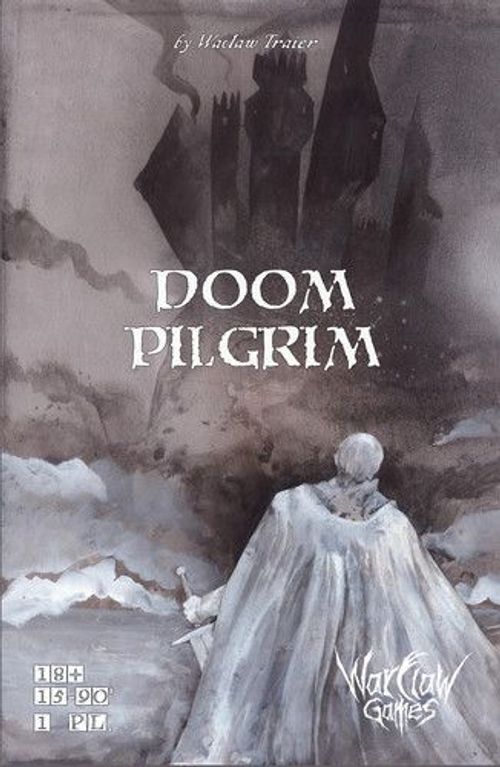
Doom Pilgrim
Doom Pilgrim Notes on How to Play
Table of Contents
Table of Contents
Reading the Cards as a Gamebook
DOOM PILGRIM mechanics came, aside from the cards-choosing part, from gamebooks. If you adopt this view, it may clarify a lot of things, the main thing being that you just follow the text, and it tells you what to do. Each card is like a paragraph in such a gamebook. You leave the page (put the card aside) after you read it, and after you applied the changes to your character sheet.
Fights Without Dice
DOOM PILGRIM avoids dice rolling. Instead, it adopts the approach of so-called idle games: things happen on their own just on the basis of their initial state. You just read about fights you are coming through while your initial conditions (like having this or that item, this or that strength or weakness) determine the outcome, and you do not need dice, complex tables, and stuff. In most cases, if the card does not state otherwise, you win the fight after just writing down the wounds taken, if there are any.
Damages, even the hard ones like losing a limb, usually mean just the price you had to pay for WINNING the fight, and you really won the fight if the text does not state otherwise, especially in more complex quests, like crawling through a dark castle, where the result may be that you just got beaten up and must leave without any loot if you do not meet the right conditions. The text always tells you.
Psychic Drops
Another thing that may be misleading is what psychic drops stand for in this game. ("Drop" is here in the meaning of fall, decrease, decline, etc.) A psychic drop in this game is anything you gain in the form of +X, apart from WOUNDS and gold. Yes, you gain it, as it is in the form of +X, but remember that gaining a drop is a kind of loss in the end, similarly as when you gain damages or penalties. This applies only if it is not clear from the text that the thing is otherwise; for the base game, this applies fully, as there really are no other things with +X mechanics than psychic drops, WOUNDS, and gold.
Cases like depression, confusion, and fear are clearly psychic drops. The only really misleading one may be fatigue. It may seem not a "psychic" drop as it relates to the body, but by the "psychic drop" term is meant anything that is not straightly physical like losing a limb or getting a deep cut, so overall fatigue (meaning OVERALL fatigue, not just body tiredness) belongs in this area naturally.
One important thing concerning psychic drops: you need 3 drops of the SAME TYPE to be doomed (and lose the game). So, when you have for example 1 depression, 2 fear, 2 fatigue, 1 confusion, and 2 dismay, you are still not doomed even though they are 6 in total, because you do not sum interspecies total in the case of psychic drops.
A different situation is in the area of CURSES and DISEASES. Here you do sum interspecies: when you have 3 CURSES of any type in total (like curse of the werewolf, curse of the werehawk, and curse of the wampyre at the same time), you are doomed, similarly as when you have 3 DISEASES of any type in total (pox alongside with pestilence and rabies, for example).
Story Items vs. Gameplay Items
There is a bit of a schizophrenic situation about what items you possess at the start of the game, and it is interwoven throughout the whole game as a tax for the complexity of the story part. On the story level, you always have plenty of things, so you can procure things of common need, like some clothes, bread in your knapsack, a knife to cut the bread, and even some money for common things. You also have plenty of things needed for adventuring, like an ordinary weapon, maybe even some rope, a lockpick, and who knows what. This is on the story part.
But in the GAMEPLAY part of things, you have only things you found during the gameplay, i.e. things that are mostly in italics as keywords that you should write to your character sheet. So, you can buy things only for gold you gained and written down into your sheet, and only the weapons and battle equipment (like a shield, a piece of armor, and such stuff) you have written down can trigger a fight effect (like diminishing WOUNDS you get). This way, your character sheet is empty at the beginning of the base game (expansions may add characters with some initial equipment or money).
As the narration is quite complex, you must use your wit from time to time to understand what's happening concerning the items meant in the narrative. For example, if the text asks you if you have your ordinary weapon or if you have got a magic one during your journey, you must understand that you have AT LEAST the ordinary one if you have not found a magic one. Similarly, when you in one story give a knife to wild people so they could improve their living standards, you do not need to contradict this part of the text thinking you have no knife to give them. Also, when another text tells you that you bought a small house for a nice price without telling you that you shall lose some gold from your inventory, you do not need to wonder if or when you got the money for it. DOOM PILGRIM is a game about fate over a wide period of time and you, as the hero, do and have many things that cannot be limited to the gameplay. Some cards even tell you a long story from your hero's life; many things happen in the story part, but you make changes in your character sheet only when the text tells you, in italics and with the icon of a writing pen.
The Pictures on the Cards
In DOOM PILGRIM, you build your fate, not only a row of encounters, though at least in this base game, encounters and events familiar to classic RPG players form the biggest part of the stories, and that is also why you can sometimes see yourself on the picture. If there is a man on a horse attacking a dragon in the picture, it probably will be a depiction of you. Mostly, when there is a figure looking not towards, but from you on a card, YOU ARE THIS FIGURE (like a pilgrim standing in front of the castle on the DOOM PILGRIM box cover art). There are some exceptions to this standard, and you will understand when you find them. Overall, you can understand the pictures on the cards as some "prophetic flash images" of stories that will happen when you take this or that way, standing at a crossroads of your life.
Reading Advice
READ TWICE if you do not understand the meaning of the text, and be especially careful about words like "can", "have to", "after", "if" and so on. Such words are not usually in italics (like gains and losses) but they play an important role in the gameplay, with "if" and "otherwise" being the most important of all.
Sometimes you need to go through the whole text on the card to identify your condition and get your results, and sometimes you find your condition at the very beginning of the text; in this case you usually do not need to continue reading (and you will save some mystery and surprise for later if you do not do that), but do not run too rashly from the text: look at least broadly at the following text in case there is not another paragraph by chance (usually graphically separated) that you could apply too. For example, there is a card that allows you to torture your enemies to get some valuable info after you defeated them, so if you stop reading right after you found you defeated them (as you naturally do not need to read the other paragraphs about them defeating you when this does not apply to your conditions), you would not get to the paragraph at the end of the text. Similarly, there can be also some loot you would lose if you dealt with the texts inattentively.
However, the main rule is: PLAY THE GAME TO AMUSE YOU! There are not going to be any tournaments in DOOM PILGRIM that would need strictly set rules, so all the rules are here only to make an amusing experience for you, and if you do not want to apply this or that rule, or to apply it differently, do as you wish! Similarly, if you are not sure about this or that effect of the card, apply it as you see it most logical (use your wit or taste). If you even bypass one thing by twisting the rules to your advantage, no worries, another danger awaits right behind another corner to punish you. Really, PLAY AS YOU WISH.
The game came also from the inspiration by tarot cards, which you usually do not really "play" as such, but you more just like dive into their universe.
A Few Hints for the Start
If you will play too defensively, avoiding all danger, you will also most probably get no loot, and when the time comes to face some inevitable danger, you may find yourself defenseless.
Similarly, cards that do nothing, that have only a story text on them without telling you to make any change in your character sheet, are like aces, as they bring you closer to the win (i.e. bottom of the deck) with no harm, but on the other hand, no harm, no gain, and without gains, some cards can kill you more easily.
Quite often, some cards will serve as such "aces" for you even though they have some gameplay text on them, in the case when there is no condition that applies to you (for example a town visited when you do not have gold to buy anything there). Remember that such cards may be useful for you later in the game, so you should maybe postpone such a card rather than play it now.
Of course, you will first need a bunch of gameplays to find which card is such a place, such an "ace", and which does not.
So, watch your steps, adventurer!