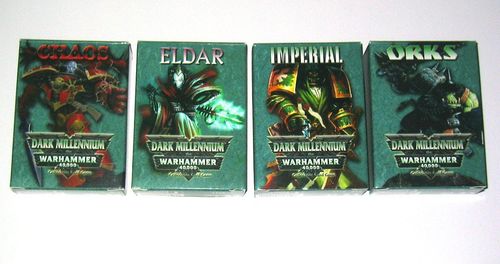
Dark Millennium: The Warhammer 40,000 Collectible Card Game
Dark Millennium: The Warhammer 40,000 Collectible Card Game Tournament Rules
Companion to the Dark Millennium rulesheet. Official Sabertooth Games "Dark Millennium Tournament Rules" v1.2, current as of 29 November 2005, reproduced from the Wayback Machine capture of the publisher's site, which is no longer online. The rules state that they may have changed since publication; see the Sabertooth Games website for the current version of the official rules.
Note: the printed document says "This document supercedes the any other versions of the rules." It is transcribed as printed.
Table of Contents
Table of Contents
1 Generic Tournament Rules and Game Setup
100 General
100.1 These rules assume a tournament game between two players. The Tournament Organizer or Organizers of a tournament will be the final judge of any rules question at that tournament.
100.2 In constructed play, each player needs his or her own deck, consisting of a minimum of sixty (60) cards and at least one (1) set of sectors. A constructed deck can have no more than four (4) of any individual card.
100.3. In Sealed Play, participants receive a starter deck of their choice and three (3) booster packs from the current expansion and have thirty (30) minutes to build a minimum forty (40) card deck. There is no maximum deck size.
- 100.3.1 Players may only include cards of their chosen faction in their deck, as well as any universal cards. Factions are denoted by the differing card frames. Light blue frames belong to Imperial, Red card frames belong to Chaos, Gray frames are used by Orks, Yellow frames belong to Eldar, and assets with skulls at the top of the text box are Universal cards.
- 100.3.2 Horus Heresy cards may only be used by Imperial or Chaos players. Loyalist cards (blue frames) may only be used by Imperial players. Traitor cards (Red frames) may only be used by Chaos players. Unaligned cards (light grey) from HH may be used by both Chaos and Imperial players.
100.4. In Open Format, any cards from Dark Millennium or Horus Heresy may be used in a player's deck.
100.5 In Standard Format, only cards from select expansions or products may be used. The current legal sets are: Leave No Survivors (HH), Sedition's Gate (SG), Traitor's Gambit (TG), Daemon's Fire (DF), Hands of the Emperor (HE), Blades of the Traitor (BT), Battle for Prospero (BP), Dropsite Massacre (DM), Battle for the Golden Throne (GT), Siege of Terra (ST), Dark Millennium (DMM) and any promotional cards (R) a player may have.
100.6. Tournament Rounds shall last no longer than 50 minutes. Players should receive a warning with 10 minutes remaining. At the end of 50 minutes time will be called. The player currently taking a BA finishes their BA and both players move straight to victory and a winner is declared. See section 102 for more.
101 Starting The Game
101.1 At the start of the game, each player shuffles his or her own deck so that the cards are in a random order. Each player may then shuffle his or her enemy's deck.
101.2 After the decks have been shuffled, the players determine which player will be the attacker and which player will be the defender by revealing the top card of their deck. Whoever rolls lower chooses to be the attacker or the defender. In case of a tie, flip a coin. Place the revealed card back on top of the deck. Once the attacker and defender has been determined, the defender chooses one (1) set of three (3) different sectors to fight at. The sectors chosen must share the same planet name and have different English card names.
102 Winning and Losing
102.1 If a player captures two (2) sectors during a game, he or she wins the game. At the end of four (4) turns or time, if neither player has taken two (2) sectors, the player that has the most points in captured sectors wins the game. Sectors are worth a number of points equal to the number of flags that was required to capture them at the time they were captured. If there is a tie in points or neither player has captured a sector, the game ends in a draw.
102.2 In single elimination situations, if there is a tie after 4 turns, extra turns are played until a sector is taken.
103 The Golden Rules
103.1 Whenever a card's text directly contradicts the rules, the card takes precedence.
103.2 When one effect says something can happen and another says it can't, the "can't" effect wins. For example, if one effect reads "This unit may not be blocked" and another reads "This unit may block any attack," the effect that keeps you from blocking wins out.
103.3 Cards only affect and check against the sector they are at unless otherwise specified.
2 Cards
200 General
200.1 When text on a card refers to "this card" it means the card the text is printed on and not any copies.
200.2 When text on a card grants a bonus or other effect to "any card" the effect is granted to only one copy of the chosen card and not any duplicates of it in play.
200.3 Two cards have the same name if the English versions of their names are identical, regardless of anything else printed on the cards, including subtitles.
200.4 Some abilities on cards may have costs that need to be paid before the ability on a card may be played. Costs may only be paid using cards controlled by the player wishing to play the ability.
200.5 There are three positions a card can be in: ready, locked, and charging. Cards may never be in more than one position.
200.6 There are 4 types of cards: Unit, Asset, Ship and Sector.
201 Parts Of A Card
201.1 The parts of a card are: Name, Flags, Firepower, Assault, Speed, Armor, Text Box, Command Line, Die, and Collector's Information. Some cards may have none or more than one of any or all of these parts.
- 201.1.1 Name: The name of a unit card or asset card is printed along the left hand side of the card. The name of a sector card is printed along the top of the card. The name of a ship card is printed in the middle of the card.
- 201.1.2 Flags: Flags are found in the upper left hand corner of the card. On sector cards, the number found in that area is the number of flags required to take the sector as well as the victory points that sector is worth.
- 201.1.3 Firepower, Assault, Speed and Armor: Firepower, Assault, Speed, and Armor are found in the middle of a unit card from left to right respectively. Armor is found in the lower right area of an asset card. They may be modified or set to a particular value.
- 201.1.3.1 Ship cards and Asset cards may be given these values by card effects although they do not normally have them. Ship and Asset cards are not considered to have values of 0 when they do not have given values in these areas.
- 201.1.3.2 When these values are equal to X, if X is undefined, X equals zero.
- 201.1.4 Keywords: Keywords are located at the top of the text box and give background insight into a card. They may be targeted by abilities. If a keyword is in bold, It has Special Rules.
- 201.1.4.1 Unique: There can only be one copy of a Unique card with the same name in play at a time at each sector. After setup, if a player has more than one copy of a Unique card in play at a sector, he or she chooses one of them to keep in play and returns the rest to his or her hand. After setup, if both players have a copy or copies of the same Unique card in play at a sector, all copies are removed from play and placed in the owner's hand. If a Unique card is infiltrated and a copy of that card is already there, destroy the old card and place it in the discard pile.
- 201.1.4.2 Honored: After setup, for every Honored card you have you may discard one card from your command hand and redraw cards to replace the discarded cards.
- 201.1.4.3 Unstable: When an Unstable card is destroyed, you may add it to your command hand instead of placing it in the discard pile.
- 201.1.4.4 Shock Troop: Shock Troops may be deployed face-up during the Deployment phase instead of face-down.
- 201.1.5 Text Box: The Text Box contains rules text or abilities.
- 201.1.6 Command Line: The command line is used only during the battle phase.
- 201.1.7 Die: The die is utilized in rolling.
- 201.1.7.1 Rolling: When you will be required to roll to determine the outcome of an ability or action, discard the top card of your deck and note the die number on the bottom left-hand corner of the card, next to the command line. That is the number you have rolled.
- 201.1.7.2 Types of rolls
- 201.1.7.2.1 Test rolls: Whenever you see a number and a plus sign in parenthesis, you have a test. Roll. If the number you roll is equal to or greater than the number in parenthesis, you pass the test. Otherwise, you fail.
- 201.1.7.2.2 d6 rolls: Sometimes "d6" will replace a fixed number on a card. Whenever you need to know what that number is, roll to find out.
- 201.1.7.2.3 Variable rolls: These rolls will have different effects depending on the number rolled. Cards that contain variable rolls will describe their effects on them.
- 201.1.8 Collector's Info: Collector's info has no game effect.
202 Zones
202.1 A zone is a place where cards can be during a game. There are five basic zones: deck, hand, discard pile, in play, and removed from the game. Each player has his or her own set of zones, except for the in play zone, which is shared.
202.2 If a card would go to any deck, discard pile, or hand other than its owner's, it goes to the corresponding zone of its owner's instead.
- 202.2.1 The order of cards in a deck or in a discard pile can't be changed except when effects allow it. Cards in other zones can be arranged however their owners wish, although who controls those cards, their orientation, and attached cards must remain clear to both players.
202.3 Cards may become attached to other cards as the result of an effect. If the card that these cards are attached is moved from one zone to another, any attached cards also move to that zone.
202.4 Each deck must be kept in face-down piles. Players can't look at or change the order of cards in a deck. Any player may count the number of cards remaining in either player's deck at any time.
202.5 If an effect puts two or more cards on the top or bottom of a deck at the same time, the owner of those cards may arrange them in any order. That deck's owner doesn't reveal the order in which the cards go into his or her deck.
202.6 When a player's deck is empty, they shuffle their discard pile into their deck. If they have no cards in the discard pile or deck, they are unable to draw cards or make rolls. Any tests are automatic failures. If an effect allows a player to search their own or another players deck, that deck gets shuffled by it's owner after the player is done searching it, then offers their opponent an opportunity to shuffle it.
202.7 The hand is where a player holds cards that have been drawn but not yet played. There is no maximum or minimum hand size. A player may arrange his or her hand in any convenient fashion and look at it as much as he or she wishes. A player can't look at the cards in another player's hand but may count those cards at any time.
202.8 Any card that's used, discarded, or destroyed is put on top of its owner's discard pile. Each player's discard pile starts out empty. Each discard pile is kept in a single face-up pile. A player can examine the cards in any discard pile at any time but can't change their order. If an effect puts two or more cards into the same discard pile at the same time, the owner of those cards may arrange them in any order.
202.9 Effects can remove cards from the game. Some effects may provide a way for the card to return to play and use the term "set aside." Cards that are set aside this way are still removed from the game, even though that removal may be temporary.
- 202.9.1 Cards in the removed-from-the-game zone are kept face up and may be examined by either player at any time. Cards "removed from the game face down" can't be examined by either player except when instructions allow it.
- 202.9.2 Cards that might return to play should be kept in separate piles to keep track of their respective ways of returning. Cards with no way of returning may be kept in one pile for each player, regardless of what removed them.
3 Game Rules
300 General
300.1 A phase or step ends when both players pass consecutively. No game events can occur between phases or steps.
300.2 When a phase or step ends, any effects scheduled to last until the end of that phase or step expire.
300.3 When a phase or step begins, any effects scheduled to last until that phase or step expire.
301 Deployment Phase
301.1 The deployment phase is broken down into two steps: First wave deployment and regular deployment. The attacker always goes first in this phase. You may not pass during this phase.
- 301.1.1 First Wave: Each player alternates placing (deploying) the top card of their deck face-up in a sector that they have not deployed a card to yet this turn.
- 301.1.2 Regular Deployment: Each player draws a hand of 6 cards. Starting with the attacker, each player alternates deploying 1 card from their hand face-down to any sector. There is no limit to how many cards you may deploy to a single sector. Continue deploying cards 1 at a time, until both players are out of cards. When both players are out of cards, move to the battle phase.
302 Battle Phase
302.1 Each battle phase contains two battles: The attacker's battle and the defender's battle. Each battle is broken down into three steps: The setup step, the battle step, and the victory step. The attacker chooses a sector they have cards at to begin the battle.
303 Setup Step
303.1 In the setup step, each player does the following things in this order:
- 303.1.1 Flip all cards at that sector face up. Lay your cards out so that both you and your enemy can see them clearly.
- 303.1.2 Do anything that says, "When you set up your army, ..." Some cards will have this instruction in their ability box. Simply follow the instructions on the card.
- 303.1.3 Deploy your ship cards. Send any ship cards you deployed to this sector to your fleet area.
- 303.1.4 At this point, if one player has no cards at this sector, skip immediately to the victory step.
- 303.1.5 Draw your command hand. Each player draws a hand of six cards. While cards are in your command hand, the only part of the card you look at is the upside-down part at the bottom, called the command line. Whenever you play a card from your hand, it is discarded after use. You may not play the command line abilities of the cards you have deployed to this sector, only the ones in your hand.
304 Battle Step
304.1 Starting with the attacker, players take turns playing a single battle action. When it is your turn to play a battle action, you may choose to do one of the following:
-
Shoot with one of your ready or charging units.
-
Charge one of your ready units.
-
Assault with one of your charging units.
-
Play a "BA" card.
-
Play a "BA" ability.
-
Withdraw.
-
Pass.
-
304.1.1 There is no limit to the number of BAs a player can play in each battle. Once both players pass on playing BAs in succession, the battle step ends and victory is checked for.
304.2 Shoot with one of your ready or charging units
- 304.2.1 Lock the shooting unit. Lock the unit to show that it is shooting. You cannot normally shoot with a unit that was already locked.
- 304.2.2 Choose your target. You may shoot at any enemy unit or asset at the current sector. Shooting attacks, however, cannot target ship cards. The target becomes the "defending" card, while your shooting unit is the "attacking" unit.
- 304.2.3 Your enemy decides whether to block or not. Your enemy can only block with one of their ready or charging units that has greater speed than your shooting unit. To block, your enemy must lock the unit he wants to block with. The blocking unit becomes the new defending unit. A unit cannot block if it was the original target of the attack.
- 304.2.4 Play tactic (T) cards and abilities. Starting with the player who controls the attacking unit, players take turns playing a single tactic card or ability, or passing. Once both players have passed in succession, the tactic step ends. There is no limit to the number of tactics that can be played during a given BA. Tactics resolve immediately. Bonuses or abilities granted by cards or abilities only last until the end of the BA in which they were played. If you play a tactic card from your hand, discard it after use. Tactics printed on units may only be played once per BA unless otherwise stated.
- 304.2.5 Deal damage. After both players pass on playing tactics, the shooting unit deals an amount of damage equal to its firepower to the defending card. If this damage equals or exceeds the defending card's armor, the defending card is destroyed and placed in its owner's discard pile. Otherwise the damage is erased and the defending unit survives. Damage never "carries over" to another BA.
304.3 Charge one of your ready units
- 304.3.1 To charge a unit, turn it upside-down so it faces your enemy. Your turn now ends. No tactics may be played during this BA.
304.4 Assault with one of your charging units
- 304.4.1 If you have a charging unit, you can use your BA to assault with it. There are 2 types of assaults: standard and special. When you assault with a unit, you must choose either its standard assault or its special assault, assuming it has one.
304.4.2 Standard assaults
- 304.4.2.1 A standard assault is similar to a shooting attack because it uses the unit's basic assault value.
- 304.4.2.2 Lock the assaulting unit. Lock the unit to show that it is engaged in combat.
- 304.4.2.3 Choose the target of the assault. You may choose to assault any enemy unit or asset at the current sector. Enemy ships cannot be assaulted. The target of the assault becomes the defending card, while your unit is the attacking unit.
- 304.4.2.4 Your enemy decides whether to block or not. If your enemy has any charging units, they can decide to block your assault. Unlike shooting, speed doesn't matter when blocking assaults. To block, your enemy must lock the charging unit they want to block with. That unit becomes the defending unit.
- 304.4.2.5 Play tactic cards and abilities. Same as in a shooting attack. See section 304.2.4.
- 304.4.2.6 Deal damage. After both players pass on playing tactics, the attacking unit deals an amount of damage to the defending card equal to its assault. As with shooting, if the damage is equal to or greater than the defending card's armor, the defending card is destroyed. Unlike shooting, if you deal more damage to a unit than that unit's armor, you may choose to assault another unit with the remaining damage. This second assault is called a "sweeping advance".
- 304.4.2.6.1 Using the invulnerable ability does not prevent your opponent from making a sweeping advance and your opponent may choose the same unit as the target of that advance. Damage from that assault still counts as being dealt.
- 304.4.2.7 Sweeping Advance. Assuming you have at least 1 damage left over after destroying a unit in an assault, you may immediately assault another unit with the remaining damage. This counts as an assault, and players may play more tactics before the damage is dealt. After both players pass on playing tactics again, damage is dealt as described in section 304.4.2.6. You may only do one sweeping advance per BA. If your assaulting unit was somehow destroyed in the first assault, then it cannot make a sweeping advance. You may not make a sweeping advance after destroying an asset. You may not make a sweeping advance into an asset. Sweeping Advances may not be blocked.
304.4.3 Special assault
- 304.4.3.1 If I have a charging unit with a special assault, when I lock it to attack I can choose to use the special assault instead of my assault value. A special assault is any ability printed on a card that starts with an "A:".
- 304.4.3.2 Check to see if you can play the ability.
- 304.4.3.3 Lock the assaulting unit.
- 304.4.3.4 Your enemy decides whether to block or not. Just like standard assaults, your enemy may block your special assault with any of his charging units. If he decides to block it, your assault switches to a standard assault that targets the blocking unit.
- 304.4.3.5 Play tactic cards and abilities. Again, same as in shooting. See section 304.2.4.
- 304.4.3.6 Deal Damage. If your enemy blocked your special assault, it is time to deal damage. If your unit deals more damage than the defending unit's armor, you can choose to either make a sweeping advance as described in section 304.4.2.7, or you can resolve the special assault.
- 304.4.3.7 Resolve the special assault. Do what the card says.
304.5 Play a "BA" card
- 304.5.1 Some command cards have "BA" printed on them.
- 304.5.2 Check to see if you can play the ability.
- 304.5.3 Lay the card on the table. This lets your enemy know what you are doing.
- 304.5.4 Pay any necessary costs.
- 304.5.5 Play tactics. As described in section 304.2.4, starting with the player that played the BA, players take turns playing a single tactic or passing.
- 304.5.6 After both players pass on playing tactics, do what the card says.
- 304.5.7 Place the card in your discard pile.
304.6 Play a "BA" ability
- 304.6.1 Some units, assets, or ships have abilities that take your whole battle action to use. These abilities are also preceded with "BA." You can play these abilities even if the card they are printed on is locked, unless the ability requires you to lock them.
- 304.6.2 Check to see if you can play the ability.
- 304.6.3 Tell your enemy which ability you are using.
- 304.6.4 Pay any necessary costs.
- 304.6.5 Play tactics. As described in section 304.2.4, starting with the player that played the BA ability, players take turns playing a single tactic or passing.
- 304.6.6 After both players pass on playing tactics, do what the card says. If the card
304.7 Withdraw
- 304.7.1 If you have no ready or charging units, you can choose to withdraw from the battle. Withdrawing ends the battle immediately. All of your cards at this sector are destroyed and you proceed directly to the victory step. E abilities on your units are not played, however any in your hand are.
304.8 Pass
- 304.8.1 After both players have passed on taking a BA in succession, proceed to the victory step.
305 The Victory Step
305.1 Once both players pass on playing BAs in succession—or one player withdraws— the battle ends and you proceed to the victory step. During the victory step, you check to see if either player won the sector.
- 305.1.1 Both players total up the number of flags on their units and assets. Flag icons are in the top left corner of each card.
- 305.1.2 Starting with the attacker, both players reveal their command hands. In any order the attacker chooses, resolve all events (E:) that are in the command line of cards that were in the attacker's command hand or in the ability box of any cards that were in play at the end of the battle. Adjust both players' flag totals as necessary.
- 305.1.3 After the attacker's events are resolved, the defender resolves all events on their units and in their command hand in any order they choose. Once again, after the events are resolved, adjust both players' flag totals as necessary.
- 305.1.4 Both players discard their command hands.
- 305.1.5 A player wins the sector if they have MORE flags than their enemy and at least as many flags as the sector requires.
305.2 If a player won the sector, discard all cards at that sector and the winning player places the sector in their fleet area. No cards can be deployed to it.
305.3 If neither player won the sector, return all face-up cards there to the ready position and leave them at the sector, face up. The battle is unresolved and the remaining forces there live to fight another day!
305.4 If a player has now won two sectors, the game is over. Victory and the planet belong to them!
306 The Defender's Battle
306.1 After the attacker's battle has ended, the defender chooses a sector to battle for. The defender must choose a sector that he or she has cards at and cannot choose the sector that was just fought over. If the defender cannot choose a different sector, either because there is only one sector left or because the defender doesn't have any cards at another sector, the turn ends. Assuming the defender can choose a sector to fight over, the second battle is played out using the above rules starting with section 304, with one exception: this time the defender takes the first battle action instead of the attacker.
307 The End Phase
307.1 Once you have fought the attacker's and the defender's battles, the turn ends. Each player rallies all of his or her ship cards. The next turn begins. Start again from the beginning, following the deployment and battle phases as described in section 301.
307.2 If the end phase marks the end of turn 4, refer to section 102 to determine the winner of the game.
4 Abilities
400 General
400.1 An ability is text in a card's text box that generates a effect. Command Lines are also considered abilities.
- 400.1.1 Command line abilities may only be played while in your hand and only during the battle step and are the only abilities that can be played from your hand.
- 400.1.2 Command Line abilities may also be referred to as cards of that ability type ("BA", card, "T" card, etc).
- 400.1.3 All abilities are governed by the same timing and rules regardless of where they appear on a card.
400.2 Abilities can be beneficial or detrimental.
400.3 There are 2 different types of abilities: Activated and Static.
400.4 Cards may have more than one or no abilities. Abilities may generate more than one effect. You may play any and all abilities printed in a card's text box in play.
- 400.4.1 When a command line has more than one ability, only one of those abilities may be played.
400.5 After an ability is played, it exists independently of its source. Destruction or removal of the source after that time won't affect the ability.
400.6 Abilities function only while the card with the ability is in play, unless the ability states otherwise or unless the ability can only work, trigger or be played from a zone other than the in-play zone. Some abilities may be played when the card is not in play. These abilities are clearly marked.
- 400.6.1 Abilities may only be played from cards at the sector that is currently being fought over unless specifically stated and only affect the current sector unless specifically stated. The exception to this are abilities that trigger off of the card being destroyed (this includes Invulnerable). The reason for this exception is because these types of abilities are played from the discard pile and not the in-play zone.
- 400.6.2 Abilities printed on command lines in your hand are not considered to be in play.
401 Activated Abilities
401.1 Activated abilities are preceded by a bold face term (BA, A, T, R, M, E, DR, or Invulnerable). Each of the different types of abilities have a separate time when they can be played. Activated abilities are written as Timing Cost: Effect. The activation cost is everything before the colon. Anything that appears before the colon (:) on an ability is a cost. Costs are not optional. Costs may only be paid using cards controlled by the player wishing to play the ability. Example: If an ability says "BA Lock 3 units: You win the game." You must lock three of your units for the ability's cost to be paid. You may not lock your enemy's cards to pay for an ability unless the cost specifically allows you to.
- 401.1.1 BA: This stands for Battle Action. This ability may only be played when you are allowed to take a Battle Action. See section 304.6 for more.
- 401.1.2 A: This stands for Assault and is otherwise known as a Special Assault ability. This ability may only be played when assaulting. See section 304.4.3 for more.
- 401.1.3 T: This stands for Tactic. This ability may only be played when you are allowed to play tactics. Tactic abilities printed on cards in play may only be played once per Battle Action.
- 401.1.4 R: This stands for Reaction. This ability will tell you when it can be played and what game effects it has. Reactions may only be played once per trigger per copy.
- 401.1.5 M: This stands for Modifier. This ability may only be played in response to a roll and only once per roll per copy. See section 201.1.7 for more.
- 401.1.6 E: This stands for Event. This ability MUST be played during the victory step. They are not optional and each separate event may only be played once during the Victory step. See section 305 for more.
- 401.1.7 DR: This stands for Deployment Reaction. This ability may only be played after the card it is printed on is deployed face up during the Regular Deployment phase. See section 301.1.2 for more.
- 401.1.8 Invulnerable: This ability may only be used after the card it is printed on is destroyed. The effect will tell you what must be done for the ability to be successful. For example, if a card says Invulnerable: 5+, the person playing the ability must roll a 5 or higher for the ability to be successful. If successful, the card with this ability is not destroyed, but is retuned to the in-play zone in the sector it was at in the locked position instead. If the unsuccessful, the card is destroyed as normal.
401.2 Only a card's controller (or owner if the card is outside the in-play zone) can play its activated ability unless the card specifically says otherwise.
401.3 If an activated ability has a restriction on its use, that restriction continues to apply even if its controller changes.
401.4 Abilities may target one, none, or more than one thing. If the player playing the ability is required to make choices on what is targeted by the ability, that player must be able to make all choices required by the effects to play the ability.
- 401.4.1 Example 1: An ability says "BA: Lock one enemy unit." The choice that must be made is which enemy unit to lock. If the enemy has no units that can be locked, the ability cannot be played. However, this ability can be played if the enemy has only locked units.
- 401.4.2 Example 2: An ability says "BA: Your enemy discards 2 cards." The player playing the ability is choosing their enemy, not the cards to be discarded. Therefore, this ability may be played even if the enemy has 1 or no cards in their hand. They simply do as much as they possibly can.
- 401.4.3 Example 3: A card says "BA: Lock all enemy units." Since the use of the word "all" means no units have to be chosen, this ability can be played even if the enemy has no units.
401.5 The order of resolving a BA card or ability is: Declare, pay, play tactics, and then resolve. Targets are chosen during resolution. You must have a legal choice or target when you play the ability, but those choices are not made until the ability resolves. Therefore, it is possible for a BA card or ability to have legal targets when initiated, but have no legal targets when it resolves. This does in no way invalidate rule 400.5. You cannot stop the ability from happening, but you may be able to change things in such a way that causes the ability to have no effect.
- 401.5.1 Example: An ability says "BA (2+): Destroy one enemy unit with an armor of 4 or greater.", and my enemy has one unit that fits those restrictions. At the time of playing the ability, my enemy plays a card that says "R: After your opponent plays a BA ability printed on a card, destroy that card." The source of the ability has been destroyed now, but rule 400.5 takes precedence. Now, after playing tactics, my enemy has in one way or another changed the situation and the unit that was armor 4 or greater is not a valid target when both of us have passed on tactics and the ability resolves. The ability resolves with no effect, and my BA is over.
402 Static Abilities
402.1 Abilities that are not preceded by a bold face term and colon are static abilities. Static abilities are always active. Static abilities always resolve before activated abilities.
402.2 In the case of resolution of multiple static effects, the player whose Battle Action it currently is resolves theirs in any order they choose, then their opponent resolves theirs in any order they choose.
402.3 Counterattack: Counterattack is a static ability. When a defending unit with counterattack is dealt damage, it deals an amount of damage back to the attacking unit equal to its current firepower or assault, depending on which statistic the attacking unit is using. Note: When a special assault is being resolved, no units are considered to be defending. You cannot counterattack against a special assault, however if you block and it reverts to a standard assault, you can counterattack as normal.
5 Additional Rules
500 General
500.1 When dealing damage from either firepower or assault, you must deal at least one (1) damage to destroy the target of the attack, even if the target of the attack has 0 armor.
500.2 Numbers may be modified to below 0.
500.3 Cards that are already locked, ready, or charging may be locked, rallied, or charged as part of the result of an effect.
500.4 Cards that are already locked, ready, or charging may NOT be locked, rallied, or charged as part of the result of a cost.
501 Errata and Clarification
This section will contain the most current wording of a card.
501.1 Kor Phareon (R 45): This card is considered to be the same as Kor Phaeron for Unique purposes.
501.2 The Unspeakable (DMM 14, ability text): T Lock: Any unit gets +1 armor for each ship you have in play.
Glossary of Terms
Attack: Shooting and assaulting are collectively referred to as attacks.
Combat: Some abilities may refer to "combat" on them. For example: "T: Any unit gets -1 armor. Only playable while this unit is in combat." This means this tactic can only be used while it is an attacking or defending unit in a shooting attack or one of the different assault types.
Destroy: To move a card from the in-play zone to its owner's discard pile. Only cards in play can be destroyed. If a defending or attacking unit is destroyed during the tactics phase of an attack, the BA ends immediately, without a damage-dealing step.
Deploy: To place a unit in a sector. Deployment is not the same as infiltration.
Discard: If a card tells you to discard, those cards always come from your hand unless the card specifically references discarding from somewhere else, like "Discard the top 2 cards of your deck."
Flag Unit: Any unit that currently has one or more flags.
Infiltrate: To send a card to the current sector, in the ready position. The ability that lets you infiltrate will tell you where the infiltrated card must come from, such as "infiltrate a unit from your discard pile." When a ship is infiltrated it goes immediately to your fleet area.
Non-flag unit: A unit that currently has no flags.
Rally: To return a card to the ready position.
Unlimited: Some tactics, reactions, or modifiers may have this word at the end. This means that you can play that ability any number of times, not just the one time most abilities are normally limited to.