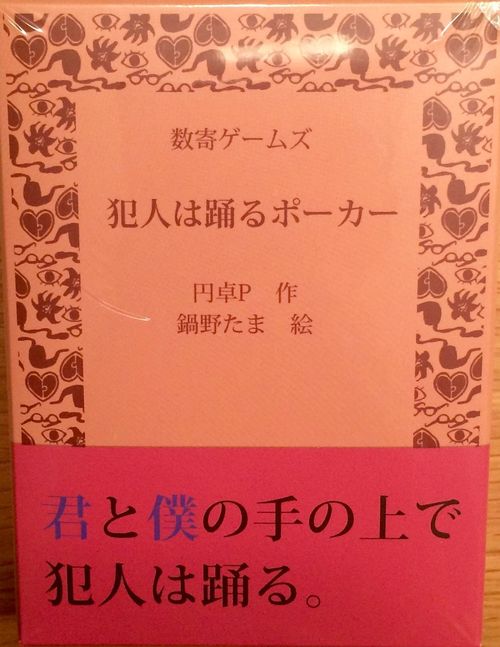
犯人は踊るポーカー (Criminal Dance Poker)
犯人は踊るポーカー (Criminal Dance Poker) Advanced Rules
Table of Contents
Table of Contents
Overview and Scope
The advanced rules make three changes to the basic rules. Of these, ② and ③ do not apply to 2-player games. A 2-player game uses the basic rules as they are.
- Standardized 2-game match: The basic rules made a 2-game match an optional rule. The advanced rules make it standard.
- No targeting of the Victim: In the second card exchange, the Victim is removed from the cards that can be targeted.
- Advanced exchange rule: When the targets of card exchange overlap, players reveal their hands to each other, and the player with the higher-ranked hand gets the card.
| Rule | 4-player | 3-player | 2-player |
|---|---|---|---|
| First card exchange | ③ Advanced exchange rule | ③ Advanced exchange rule | Basic rules apply |
| Second card exchange | ③ Advanced exchange rule, and ② No targeting of the Victim | ③ Advanced exchange rule, and ② No targeting of the Victim | Basic rules apply |
① Standardized 2-Game Match
The basic rules said that the player who wins one game wins the match. Under the advanced rules, the player who wins 2 games wins the match.
With 4 players, a match can last up to 5 games. With 3 players, a match can last up to 4 games.
By agreement of all players, you may instead play to any match length of 3 or more games, and the player who wins that many games wins the match.
② No Targeting of the Victim
In 4-player and 3-player games, the Victim cannot be chosen as a target in the second card exchange.
As a result, in 4-player and 3-player games, the Victim can be chosen as a target only in the first card exchange.
③ Advanced Exchange Rule
This rule changes how step ② (Card Exchange) is handled from the basic rules. It applies in 4-player and 3-player games.
Action
Action follows the basic rules. On the signal, each player points at the card they want.
In the example, the green and blue players pointed at the same card. Under the basic rules neither player would get the card. Under the advanced rules, the ranks of the hands are compared.
Draw ①: Resolve the overlapping cards first
Resolve the cards that were pointed at by more than one player first. If more than one card has overlapping pointers, resolve them at the same time.
Players whose pointers overlap reveal their hands to each other in secret and check them.
In the example, the green and blue players check each other's hands regarding the purple card.
Draw ②: The higher rank wins the card
The player with the higher-ranked hand, among those who pointed at the card, gets the card they pointed at through their Action.
A player with the lower-ranked hand does not get a new hand.
In the example, the blue player gets the purple card as their hand. The green player gets nothing.
Draw ③: Basic rules for the rest
After that, each player receives the card they pointed at, following the Draw section of the basic rules.
Pass
Pass follows the basic rules.
After the exchange, every player must hold exactly one card.
Note 1: Three or more players pointing at the same card
If three or more players point at the same card, no one gets that card.
In the example, the red card becomes the new hand of the purple player. The red, green, and blue players do not get the Victim card.
Note 2: Two players left with no card
After the card exchange, it is possible for two players to have no card. In that case, perform the Pass from the players whose pointers overlapped.
Also refer to the "4-Player Exception" in the basic rules.
Judgement
Judgement follows the basic rules. The player holding the lowest-ranked card is eliminated, unless the Victim is the Detective or the Witness, in which case the player holding the highest-ranked card is eliminated.