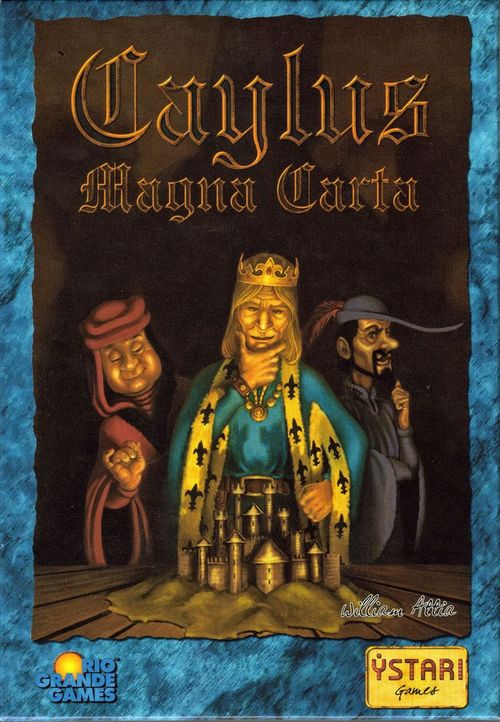
Caylus Magna Carta
Caylus Magna Carta — Beginner Rules
Table of Contents
Table of Contents
Contents
- 63 cards
- 4 sets of 12 cards (one set per player: red, green, orange, blue)
- 5 cards featuring neutral buildings (pink)
- 7 cards featuring prestige buildings (blue)
- 1 first player card
- 1 bridge card (passing order)
- 1 castle card
- 16 workers (4 per player)
- 4 passing markers (1 per player)
- 1 provost
- about 100 cubes representing 4 types of resources (food, wood, stone, gold)
- 24 prestige point tokens (4 prestige points: 7 tokens; 3 prestige points: 8 tokens; 2 prestige points: 9 tokens)
- 56 one denier coins
- this booklet
Once Upon a Time...
- King Philip the Fair wants to have a new castle built in Caylus. Workers and craftsmen are flocking by the cartload, attracted by the great prospects of such a formidable task. All along the road that snakes from the foot of the castle, a city is slowly rising up…
Goal of the Game
The players embody master builders. By building the King's castle and developing the city at its foot, they earn prestige points. When the castle is finished, the player who has earned the most prestige points wins the game.
Setup
- A player takes the neutral cards (pink background) and places the Peddler card on the table (see the following page). Then, the player shuffles the remaining pink cards and places 1 card (2 player games), 2 cards (3 player games) or 3 cards (4 player games) to the left of the Peddler. Thus, the player has just started building the beginning of the road. The remaining pink cards are set aside; they will not be used in the game.
- Prestige cards (blue background) are set aside, face up. The Hotel (see the end of the rules) goes back into the box. It will not be used with this version of the game. The cards featuring the bridge and the castle are placed next to the road.
- Prestige point tokens are sorted out according to their value and placed next to the castle. In three player games, 1 token of each value is removed; in two player games, 2 tokens of each value are removed.
- Each player chooses a color and takes the corresponding cards and pawns except for the Lawyer and the Church (not used when playing this version; see the end of the rules), which go back into the box. Players then shuffle their cards. Each player piles them up face down (that is, with the green side showing), and takes 3 cards from their own pile. Now, each player may discard all the cards in their hand and take 3 new cards. This may only be done once. Discarded cards are placed face up in a discard pile. Each player has their own discard pile.
- Each player takes 2 food cubes, 2 wood cubes and 4 deniers.
- The first player, chosen randomly, takes the first player card.
Game Principles
Resources: food, wood, stone, gold. There are also worker pawns.
Castle tokens: Dungeon, Walls, Towers.
Set up: To start the road (here, in a 4 player game), the peddler (D) is placed on the table. Then, 3 random neutral cards are placed on the peddler's left (A, B, C). Thus, the road will start from A to D, and will lengthen with each building built by the players. The bridge (E) and the castle (F) are placed above the road.
Cards: Each player has their own pile of building cards.
- The border of the card (G) bears the color of its owner.
- The building's cost, to be paid with resource cubes, is shown in the top left-hand corner (H).
- In the top right-hand corner, the coat of arms (I) indicates the number of prestige points the card will yield at the end of the game if the building is actually built.
- The card's primary effect (K) is indicated under the picture of the building (J). The player who places one of their workers on the building is the recipient of this effect.
- Finally, the secondary effect of the building (L) is indicated in the box at the bottom of the card. This effect will benefit the owner of the building if another player places a worker on this card. A detailed account of the cards' effects is provided at the end of this booklet.
Castle: The castle is divided into 3 parts: the Dungeon, the Walls and the Towers. In order to build these parts, the players must spend batches of resources.
Progress of the Game
Be careful: In this game, gold is a wild resource. A cube of gold equals a cube of any type, no matter if it is used to build a building or a part of the Castle (see below). White cubes stand for cubes of any kind (including gold).
The game is divided into turns. Each turn is divided into 5 phases.
Phase 1: Collecting Income
Each player gets 2 deniers from the stock.
Phase 2: Actions
Starting with the first player and then following in clockwise order, the players must pick one of the following actions:
A) Pick a card
The player pays 1 denier to the stock to take the first card on their pile and add it to their hand. If there are no cards left in the pile, the player shuffles the cards of their discard pile and builds a new pile.
The number of cards a player may have in their hand is not limited.
B) Replace all the cards in your hand
The player pays 1 denier to the stock to discard all the cards in their hand (the player must get rid of them all), place them face up in the discard pile, and take the same number of cards from their pile. If there is not enough cards left in the pile, the player shuffles the cards of their discard pile and builds a new pile.
C) Place a worker on a building
The player pays 1 denier to the stock and places 1 worker on a card along the road. There can be only 1 worker per card. A player may place a worker on a neutral building, on one of their own buildings, or on a building belonging to someone else.
Placing a worker on a residential building or a prestige building is forbidden.
Example: Green has built a market building on the road. On their turn, Red decides to place a worker on it. Red pays 1 denier to the stock and places their worker on the card. For the duration of this turn, it is impossible to place another worker on this building.
D) Construct a building from your hand
The player takes a card from their hand, pays its cost (indicated in the top left-hand corner) to the stock, and adds the building at the end of the road. From this point on, the players may place a worker on the building when the time comes for them to choose an action.
Example: On their turn, Blue decides to build a building from their hand. Blue chooses the quarry, pays its cost – 2 stone cubes and 1 food cube – to the stock, and places the new building at the end of the road. From now on, any player may choose to place a worker on the quarry on their turn.
E) Construct a prestige building
The player chooses a prestige building among those that are still available, pays its cost (indicated in the top left-hand corner of the card) to the stock, and places the prestige building before them (the building is NOT added to the end of the road).
Example: It is Green's turn, and the player decides to build a prestige building. Green chooses the statue, pays its cost – 2 stone cubes and 1 gold – to the stock and places the statue in front of them.
F) Passing
The player puts their passing marker on the space of the bridge with the lowest number. The first player who passes gets 1 denier from the stock.
Once a player has passed, they cannot take any actions for the remainder of the phase.
Phase 2 lasts until all players have passed.
Example: It is Orange's turn. The player decides to pass and places their marker on the first space of the bridge. Being the first to pass, Orange takes a denier from the stock.
Phase 3: Effects of the Buildings
NB: See the end of the rules for the various effects of specific buildings.
Buildings are activated in order, starting at the beginning of the road, up to and including the last card of the road.
- A building without a worker is not activated.
- A building with a worker on it has a primary effect profiting the owner of the worker, then a secondary effect profiting the owner of the building.
- If a player has placed a worker on one of their own buildings, they only take advantage of the building's primary effect; the player may not choose the secondary effect.
The players get their workers back.
NB: The players do not have to use the effect (either primary or secondary) of a building. The owner of a building may use its secondary effect even if the worker's owner chose not to use the primary effect.
Phase 4: The Castle
Following the passing order, the players may offer batches to the castle (if they want to). A batch is composed of 3 resources: 1 food, 1 wood and 1 stone. Each player gives the stock their cubes accordingly and takes as many point tokens as they have given batches.
Prestige point tokens are taken according to a certain order: first those of the Dungeon (red tokens), then those of the Walls (orange tokens) and finally those of the Towers (yellow tokens). A player may earn tokens of different colors in the same turn.
A player cannot offer more batches than there are prestige point tokens left in the stock. So, it is possible for a player to have some batches left.
The player who has offered the most batches during this phase takes 1 gold cube from the stock. In case of a draw, the player who offered that number of batches first wins the cube.
If no one has offered any batch during this phase, 2 tokens are removed from the stock of victory points — these tokens are removed from the game. As was the case for building, these tokens are taken from the proper section of the Castle (red, then orange, then yellow).
If no token is left in the stock, the game is over.
Example: During phase 5, Orange (the first player on the bridge) offers 1 batch and takes 1 Dungeon token. Blue offers 1 batch (with 1 gold to replace the food cube) and takes the remaining Dungeon token. Green offers 2 batches and takes 2 Wall tokens. Red offers nothing. Being the player who has offered the most batches, Green wins 1 gold cube from the stock. Had Green offered 1 batch, Orange would have won the gold cube.
Phase 5: End of the Turn
The first player card is passed to the player on the left of the current first player, and a new turn begins.
End of the Game
The game ends at the end of the turn when the stock has run out of prestige point tokens.
Each player adds up their prestige points as follows:
- each token in their possession is worth its value in prestige points (4, 3 or 2 prestige points)
- the buildings the player has built along the road yield prestige points, as shown in the top right-hand corner of the card (buildings which remain in the player's hand yield no points).
- the prestige buildings the player has built yield prestige points as shown in the top right-hand corner of the card.
- each gold cube yields 1 prestige point
- each group of any 3 cubes (except gold) yields 1 prestige point
- each group of 3 deniers yields 1 prestige point
The player with the most prestige points is the winner. There is no tie-breaker.
Detail of the Buildings
NB: apart from the Hotel, prestige buildings have no effects.
Neutral Buildings (pink)
Park, Forest, Quarry
- Park: Get 1 cube of food from the stock.
- Forest: Get 1 cube of wood from the stock.
- Quarry: Get 1 cube of stone from the stock.
Peddler
Buy 1 cube (any resource but gold) from the stock with 1 denier.
Trading Post
Get 2 deniers from the stock.
Wood Production Buildings — Farm, Sawmill, Quarry
- Construction: When one of these cards is placed on the road, put 4 cubes of the type produced by the building (food for the Farm, wood for the Sawmill, stone for the Quarry) in the secondary effect area.
- Primary: The worker's owner takes 1 cube of the type produced by the building (food for the Farm, wood for the sawmill, stone for the Quarry) from the stock.
- Secondary: The card's owner takes 1 cube from the secondary effect area (if there is no cube left, the owner gets nothing).
- 2 players: put 2 cubes of the type produced in the secondary effect area (instead of 4).
Peddler
- Primary: Buy 1 or 2 cubes (any resource but gold) from the stock with 1 or 2 deniers.
- Secondary: Buy 1 cube (any resource but gold) from the stock with 1 denier.
Market
- Primary: Exchange 1 cube from your personal stock with 4 deniers.
- Secondary: Get 1 denier from the stock.
Gold Mine
- Primary: Get 1 gold cube from the stock.
- Secondary: Exchange 1 cube from your personal stock with 1 gold cube from the stock.
Stone Production Buildings — Farm, Sawmill, Quarry
- Primary: Take 2 cubes of the type produced by the building (food for the Farm, wood for the Sawmill, stone for the Quarry) from the stock.
- Secondary: Take 1 cube of the type produced by the building (food for the Farm, wood for the Sawmill, stone for the Quarry) from the stock.
Bank
- Primary: Buy 1 gold from the stock with 1 denier or buy 2 gold from the stock with 3 deniers.
- Secondary: Buy 1 gold from the stock with 2 deniers.
Standard Rules Buildings
NB: These buildings are not used in the light version of the game.
Church
- Primary: Buy 1 Castle token with 2 deniers, or buy 2 Castle tokens with 5 deniers.
- Secondary: Buy 1 Castle token with 3 deniers.
NB: Tokens are always taken from the best section available (that is, the Dungeon, then the Walls, then the Towers).
Lawyer
- Primary: Construct a residential building by paying 1 food cube and turning over one of your cards along the road (except a Lawyer).
- Secondary: Get 2 deniers from the stock.
Résidence and Hotel
Each of these buildings brings their owner a bonus income of 1 denier during the income phase.
NB: The price to pay to build the residential building (1 cube of food) is repeated between parentheses on the card of the Lawyer.