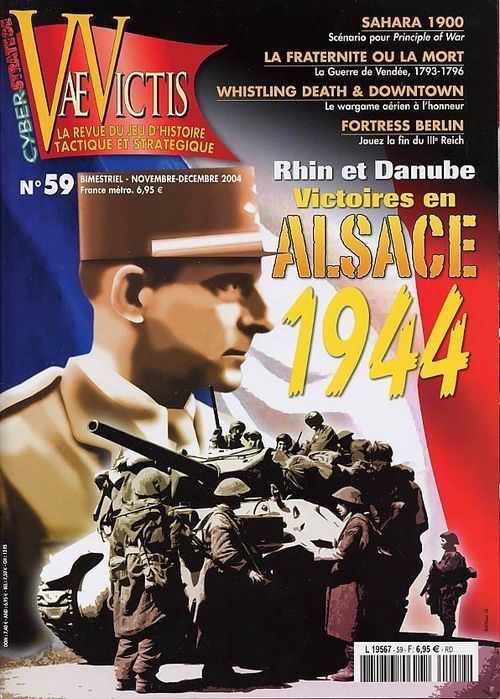
Alsace 1944
Alsace 1944 Designer Notes
Table of Contents
Table of Contents
Designer's notes for Alsace 1944 (Vae Victis #59) by Luc Olivier, English translation by Roy Bartoo (community translation, likely from Vae Victis #61), distributed via grognard.com.
1 - Genesis
Alsace 1944 is essentially the first game in a new series initially titled “The Great Battles of the French 1st Army” [Les Grandes batailles de la 1re Armée Française]. From the beginning, the intent was to reuse the game system from Ardennes 1944 of VV48, with adaptation for the scale of the battle chosen. However when reading the book on the history of the French First Army written by Marshal de Lattre, which begins with the invasion of the island of Elbe and ends in Germany, few really interesting situations were apparent. Interesting in a game-play spirit of course, that is to say with balanced sides and action possibilities: this notably is the charm of the Ardennes battle and explains the number of simulations on the subject. After a rapid battle of Provence and the equally rapid liberation of most of the French territory, Army B which became the 1st Army, hit the defenses of the Vosges. The battle of the Vosges was essentially a series of infantry combats in very difficult terrain, resembling the assaults of the Great War and not resulting in much. The attack on Belfort, in the south of the Vosges, with the push to Mulhouse appeared to be a maneuver allowing the flanking of the enemy entrenchments. The initial assault brought the piercing of the enemy front and the capture of Belfort and Mulhouse, followed by a powerful enemy counterattack, which presents a certain gaming interest for both sides. The most surprising thing is that no simulation of this campaign had previously been designed: perhaps because no American troops were involved ...
There is little historical documentation on the subject but with the aid of colonel Paul Gaujac, it was possible to obtain a generally complete order of battle. For the map, we started with the reprint of the historical Michelin map of 1947, which guaranteed us the size of the cities and towns, the vegetation cover, and the road net from the end of the war. A recent IGN map allowed us to complete the terrain and the overall effect. For the combats, the base is the history of the French 1st Army, completed by the books of P. Gaujac and of G. Saint-Martin.
The game was designed by two people, which did not especially simplify the creation process but produced a dialogue likely to result in a better simulation. In addition a Cyberboard module was rapidly created, which simplified playtesting and modeling, thanks again to the cybertesters.
- The principal mechanisms
The fundamental mechanisms - the motor - of the game are directly those of Ardennes 1944 with the principle of activation by formation and the spending of AP (Action Points) by units: two for infantry and three for armored/motorized. The time scale is also of two days, which gives an identical tempo. The map and unit scales are more detailed because the battle is smaller but that does not change the system. The rules were reread and partially rewritten for more readability and less approximation; some remains alas. The main difference between the rules is the ability to attack from several hexes during a normal attack instead of having to pay for a prepared attack, which is explained by the smaller unit scale (battalions rather than regiments). Bridges also are less costly to cross because no account mentions the same difficulties as in the Ardennes. Finally, units no longer escape unharmed from a retreat with the addition of the Disorganized status.
Counter values were not easy to establish. For combat strength, a point is worth roughly 100 men or about 10 tanks, the counter value may include outside detachments or reinforcements depending upon the degree of detail in the historical sources. For the quality level of units, the first observation is that it is quite low for most units. For the French, that is explained by the general fatigue of the troops and the amalgamation with new recruits. The very weak level of the FFI units [French partisans] is due to their lack of support weapons and their tactics which were more suited to guerilla warfare than regular combats. For the Germans, most of the troops are second line - Volksgrenadiers - likewise the SS division, partially composed of Ukrainian volunteers of doubtful loyalty. The elite units of each side therefore have a unique importance, due to their rarity and their fragility, being required to absorb the first step loss.
The choice of stratagems was both obvious and complex because although they allow the simple simulation of events which would require units and/or entire paragraphs of special rules, they must be important to players’ strategies without ruining the game. Thus the five given to both sides each have their interest which should not be neglected.
3 - Some tactical advice
According to the different playtests performed, the game seems balanced and exciting for both sides which each have attack and defense possibilities. It is best to play the short scenario once or twice to understand the beginning of the game and the possibilities of formation activation; then you can move on to the complete battle. A new scenario allows the complete battle but gives more freedom to both sides to plot their strategy (see this issue).
French: Despite the initial setup which puts many French troops opposite scarce German defenses, the French task is not easy. You must very quickly break through the enemy lines and drive towards Belfort and Mulhouse with rotten terrain and a defense in several lines. Beware of the German counterattack because it can be surprising. It will be necessary as historically to try to reach the Rhine in three turns, all while attacking Belfort at the same time. Use the given stratagems with care: the two raids can let you reach Belfort more rapidly, the Bridge Captured is useful for driving on the Rhine and the Lack of SS Elan will slightly slow the German counterattack. One the breakthrough is achieved and the maximum of terrain conquered, wait and throw back the German counterattack, then return to the attack to secure Mulhouse, and even aim for a strategic victory. With many units in a formation, you must maximize your use of the fatigue rules and not hesitate to fatigue at least 1/3rd of the troops each turn.
German: Even if the beginning seems desperate with a weak line in front of a multitude of enemies, realize that the attack is not easy with such difficult terrain and, especially, on turn 3 the cavalry arrives. The idea would be to prevent an enemy breakthrough before the arrival of reinforcements, which would greatly hinder the enemy’s capture of Mulhouse. The placement of Strongpoints is very important it it would undoubtedly be very wise to use them to create a second line, close to the front. Based on the enemy position on turn 3, the reinforcements will either counterattack, plus gaps, or simply become part of the defense, obviously it all depends upon the game situation. Remember however that the enemy is numerous and powerful, don’t waste everything in futile counterattacks. The stratagems are very important, first to slow the enemy with the Alert Battalions, the Antitank Ditch and Bottleneck, then to counterattack with the LXIII AK HQ. The placement of the Bottleneck is especially important because it can neutralize a road axis for the turn. Similarly mining a village is important to cover a retreat and the IP are useful to improve a defense, consider that the goal is to slow the enemy since he has only eight turns to capture the objectives which are in your possession at the start.
There is much more to say, but I leave you the pleasure of discovery: good gaming!