Alice Chess
Alice Chess Clarifications
Table of Contents
Table of Contents
Clarifying the Rules
Written by Fergus Duniho
Parton describes Alice Chess in Curiouser And Curiouser and in Chessery For Duffer And Master. Both descriptions are the same, and in neither one does he mention castling or en passant. In the Zillions Rules Files for Alice Chess by Jens Markmann and by Pierre Tourigny, each has stipulated that castling and en passant are not part of the game. Furthermore, on the Alice Chess page of the British Chess Variant Society, George Jellis has written, "En passant capture is abolished. The inventor of Alice Chess, V. R. Parton, said nothing about the rule for en passant capture, but since the rule for orthodox chess can be interpreted in at least two different ways (does the capturing pawn have to be on the first or second board?) and is subverted by the fact that the square passed over may be occupied on the other board, it is usual to forgo it." He doesn't mention anything about castling. In one of the Alice Chess games listed by David Pritchard in his Encyclopedia of Chess Variants, one of the players castles.
Given that Parton himself didn't state that castling and en passant are not part of the game, I think it is fair to assume they are. They should be discarded only if the rules of Alice Chess somehow make them impossible, but in fact they do not.
Let me begin by describing how castling would work in Alice Chess. All the usual conditions for castling will apply, plus Alice Chess introduces a new condition. When a King and Rook castle, the spaces they move to should both correspond to empty spaces on the opposite board. This is because a piece may move only to a space whose corresponding space is unoccupied. Also, once the castling is complete, both pieces transfer to the corresponding spaces on the opposite board.
Jellis mentions some details about en passant that I also thought of while working on my own Zillions Rules File for Alice Chess. First is the question of whether the capturing Pawn has to be on the first or second board. As I understand en passant, it allows a Pawn to capture a Pawn it could have captured if that Pawn had made a one-step move instead of a double move. Thus, the Pawn that can take another by en passant must be the one that could have taken the Pawn if it had moved only one space. This means a Pawn on the second board. When a Pawn makes a double move, it will switch boards, and if it lands beside an enemy Pawn on the other board, that Pawn will normally be able to take it by en passant. But Alice Chess does introduce one situation in which the rule of en passant becomes ambiguous. When a Pawn makes a double move, it may pass over a space whose corresponding space on the other board is occupied. Thus, the space the enemy Pawn would have to go to for an en passant capture will be occupied.
There are three options here. One is to allow both a regular capture and an en passant capture when it's a piece the Pawn can capture. Another is to allow only a regular capture. And the third is to abolish en passant altogether. Since double captures never happen in Chess, Duniho does not favor the first option. The usual assumption in Chess is that a Pawn making an en passant capture moves to an empty space. If this is a rule of Chess, it never has to be enforced, because the available space always is empty. Besides this, if the piece occupying the space is the same color as the Pawn that could otherwise move there by en passant, en passant will still be impossible. The option of abolishing en passant seems too extreme. As in Chess, Pawns can still block each other in Alice Chess, and the original purpose behind en passant was to help blocked Pawns get unblocked. So it makes sense to include en passant as far as it is possible to do so. Duniho favors the middle option, in which a Pawn may capture by en passant any enemy Pawn that lands beside it while making a double move -- so long as the space corresponding to the one it passed over is also empty. It does this by moving to the empty space behind the Pawn that just moved. If that space is not empty, then en passant is impossible, but so long as it is empty, en passant works.
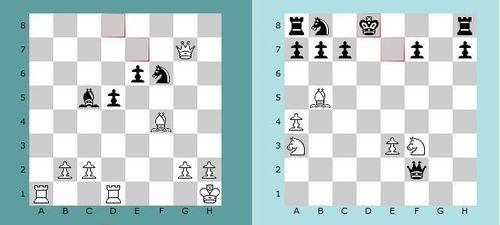
Another ambiguity in the rules concerns whether a piece may block a check by moving from the board the King is not on. The first rule states, "A move must be legal on the board where it is played." Since this move would leave the King in check before the transfer, it might be thought that it would be illegal. After all, it is illegal to leave the King in check. But since the King is in check on a different board, it doesn't matter. The clause "on the board where it is played" narrows the domain of legality to a single board. Leaving a King in check would count toward this move being illegal only if the checked King was on the same board as the piece was moving from. Logically, this interpretation of the rules makes more sense, because it is non-recursive. It is defining the legality of moves in Alice Chess in terms of what would be legal in Chess, as played on a single board. The other interpretation, that a piece may not move from the other board to block a check because that leaves the King in check until the piece transfers to the King's board, is circular. It is defining legality in Alice Chess in terms of what is legal in Alice Chess. But you can't define something in terms of itself. It makes more sense to define something in a non-recursive, non-circular way.
Furthermore, this interpretation is the consensus among those who have programmed Alice Chess. This interpretation is accepted by Fergus Duniho, Jens Markmann, Pierre Tourigny, Ed Friedlander, and H. G. Muller. It is also accepted by Antoine Fourrière, writing on Alice Chess strategy on the same page. And it is reflected by a comment that shows up in a sample game published in David Pritchard's Encyclopedia of Chess Variants. The relevant comment is included after Black's 22nd move. It mentions a threat that could win the White Queen, and the only way this would be possible is if the White Queen could block a check by transferring to the King's board after it moves.