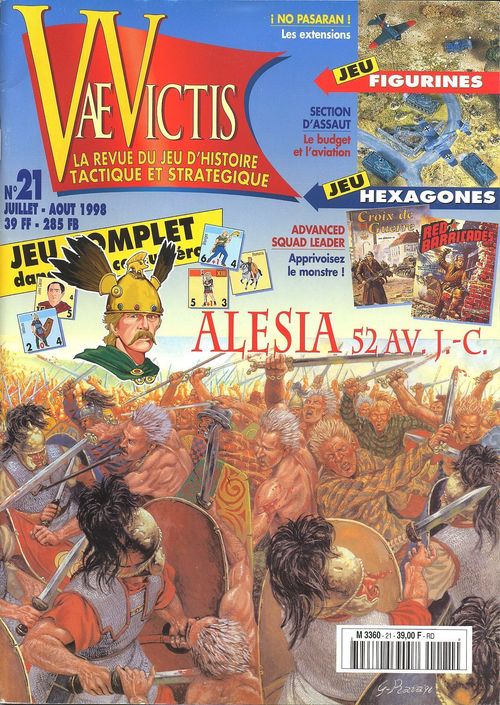
Alésia, 52 Av. J.-C.: César contre Vercingétorix
Alésia, 52 Av. J.-C.: César contre Vercingétorix Errata
Table of Contents
Table of Contents
I. Counters
Clarification: The counters of the relief army are identified by a dark blue band, those of Vercingétorix's army (9 units) by a lighter blue band.
Correction: The Vellaves counter of the relief army should have a +1 modifier on its front side. A corrected counter is provided in Vae Victis no. 22.
II. Map
Clarification: The towers (Gallic or Roman) and the earth or water-filled ditches of the Roman fortifications are purely decorative.
Clarification: Fortifications 1410-1411 and 1510-1411 are oriented towards 1410 and 1510 respectively.
III. Rules
2. Sequence of play, Phase B.3
Clarification: It is of course forbidden to move, in phase B.3, a leader who has already moved in phase B.1.
2. Sequence of play, Phase C.1
Clarification: A player may not make a voluntary tactical deployment (it must necessarily be in sight of an enemy unit).
Correction: The paragraph "Special case" is to be replaced by the following:
- Deployment may not take place in an enemy ZOC.
- The Gaul may not deploy adjacent to a fortification or a Roman camp.
- The Roman may deploy only inside his double line of fortification or in a Roman camp.
2. Sequence of play, Phases C.2 and C.3
Clarification: If a unit, during a tactical movement or during a movement after combat, comes into view of an enemy leader on his strategic side, the units of that leader must deploy immediately. If the movement phase is in progress, the unit responsible for the activation may then continue its movement.
It is then checked whether this tactical deployment does not lead to other tactical deployments as in phase C.1.
Once all the "chain" deployments are finished, the movement or combat phase may resume its course.
2. Sequence of play, Phase D. Retreat and strategic rally
Clarifications:
- A Roman leader may turn back to his strategic side only if he is inside his double line of fortification or in a Roman camp.
- There is no constraint on the retreat of units. A unit may retreat if it is in sight of the enemy, adjacent to an enemy unit, or even in the ZOC of an enemy unit.
4. Combat units
Particularity of the legions.
Clarifications:
- During a tactical movement phase, it is forbidden to exchange a legion for its two half-legion counters and then, after movement, exchange the two half-legions for the legion counter.
- A disorganised legion may be exchanged for its two disorganised half-legion counters.
- Two disorganised half-legions may be exchanged for their disorganised legion counter.
- Two half-legions, of which only one is disorganised, may be exchanged for their disorganised legion counter.
- A counter in rout may never be exchanged.
6. Orientation and ZOC
Clarification: ZOCs do not extend from the interior to the exterior of Roman or Gallic fortifications. Exceptions: the Roman ditch and the Gallic walls situated at 0915, 0917 to 1147 and 1216 have the particularity of not having a "direction" and of blocking the ZOCs on both sides.
7. Movement
Clarification: A one-hex movement (not in enemy ZOC) is always possible whatever the cost of the terrain.
7.2 Tactical movement
Correction: A Gallic unit which crosses the Gallic wall of the Alésia oppidum does not have to make the disorganisation test due to the crest, except in the case of a rout movement or a mandatory retreat after combat.
7.3 Leaving an enemy ZOC
Clarification: A unit may leave a hex located in an enemy ZOC by spending +1 PM, on condition that it does not directly enter another enemy ZOC hex.
8.2 Command
Clarification: The command range of a leader is blocked only by enemy units (but not by enemy ZOCs). Command (8.4) is checked before tactical movements (for movement allowance) and before combats (to know whether one may attack).
9.1 Roman camps
Clarification: The placement of Roman camps is forbidden on hexes of 4th level. On the map this corresponds to level 3, the numbering starting from zero.
Clarification: In game terms, a Roman camp completely "cancels" any adjacent Roman fortification (in particular, a Roman unit attacking from a Roman camp does not have the column shift due to an adjacent fortification).
9.2 Fortifications
Clarification: The penalty for attacking across a fortification, a camp or the Alésia wall applies in both directions: from outside to inside, but also from inside to outside.
Clarification: The crossing of a fortification from inside to outside, by a Gallic unit, does not create a breach.
Clarification: The breach marker is placed in the hex on the inner side of the fortification. The effects of the breach apply to all hex sides of the fortification (of the same line of fortification) of that breach hex.
8.5 and 11.4 Death, wounding or capture of leaders
Clarification: A leader alone in a hex may be attacked by enemy units. He simply undergoes a death, wounding or capture test. If he is unharmed or wounded, he is placed by his owner on the nearest friendly unit. If no route free of enemy ZOCs exists to the nearest friendly unit, he is automatically captured. The attacker may advance into the hex freed by the leader unless the leader is in a camp or behind a fortification or a wall.
If a 1E or E result occurs in combat, eliminating all the units stacked with a leader, the leader must follow the same process as above (a mortality test, then retreat to the nearest unit).
Clarification: A decoy alone attacked by an enemy unit, or whose hex is occupied by an enemy unit, is immediately removed from play and returned to the Gallic camp or to a Roman camp (on its tactical side) by its owner. This decoy is not allowed to make a tactical movement that turn.
10. Archery
Clarification: Roman fortification archery may only be directed towards the outside.
Clarification: If a Gallic unit occupies the inner hex of a fortification side, the archery capacity of this fortification is cancelled.
11.2 Combat resolution
Clarification: A unit which attacks must attack all the units which exert a ZOC on it.
Clarification: The attacker is not obliged to attack all the units in a stack. However, all the units in a stack must be taken into account in the riposte, and they suffer its effects. Likewise, the leader is not obliged to take part in an attack (in which case he is not affected by any possible * result). However, he is always taken into account during the riposte and suffers its effects.
11.3 Combat results
Clarification: The constraints of a non-mandatory retreat (on a T or d result) are the same as those of a mandatory retreat (except for the test for crossing the Alésia crest, see 7.2 above).
11.5 Retreat and advance after combat
Clarification: A unit may retreat into a hex occupied by a unit or stack of units located in an enemy ZOC.
Clarification: If a unit retreats onto a unit, or into a stack, which is attacked in another combat, that unit is not taken into combat for that combat but suffers its effects.
Clarification: A Roman unit may not advance after combat across a Roman fortification not adjacent to a Roman camp. It may do so if it is situated in a camp (existence of gates).
Note: A Roman unit may therefore never cross a fortification not adjacent to a camp (tactical movement, advance or retreat after combat, rout).
12.3 Rout
Clarification: Half of the movement allowance is calculated by rounding up to the higher number.
12.4 Effects of rout
Correction: The fourth paragraph must be deleted. The -3 modifier shown in 12.5 must be applied to the d10 used for rallying, which is therefore never automatic.
12.5 Rally test
Clarification: A unit disorganised by fire may attempt a rally (if it has neither moved nor fought).
IV. Three-player game
13. Three-player game
Clarification: The tactical phase of the Gauls takes place as follows:
- Movements of Vercingétorix.
- Movements of the relief army.
- Combats of Vercingétorix (who may choose to make joint attacks with the units of the relief army).
- Combats of the relief army.
- Rallies.
Note: The rule "a unit which attacks must attack all the units which exert a ZOC on it" must be respected globally by the two Gallic players, and not separately for each of them.
14.3 Victory conditions
Correction: For the two examples of leader capture (5-point bonus), the parenthetical mentions are incorrect: "for death" is printed in place of "for capture". The text should read: (20 points for the capture of Comnios) and (13 points for the capture of Antonius).
V. Tables
Correction: Roman combat table: third column, read 5-7 (and not 4-7).
Correction: Gallic combat table: third column, read 4-5 (and not 3-5).
Translator's note: the French correction names the Roman leader "Antoine"; he is "Antonius" in the English rulebook.