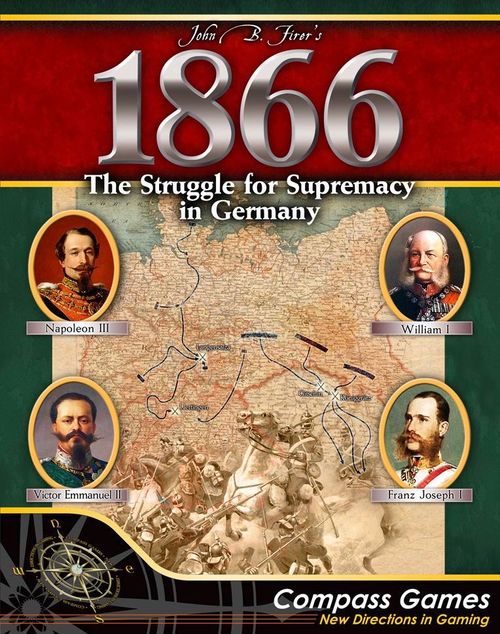
1866: The Struggle for Supremacy in Germany
1866: The Struggle for Supremacy in Germany - Official Designer Errata (December 20, 2018)
Source: official Compass Games designer errata sheet, December 20, 2018 (supersedes all previous editions).
Card Errata
-
Correction: Card #25 'dissolve' is misspelled and should read "Bismarck Dissolves the German Confederation".
-
Correction: Card #25 (Bismarck Dissolves German Confederation). Add to card text: "This card may not be played as an Event after the Mobilization Phase."
-
Clarification: Cards #3, 4, 6 and 7 (Army of the Elbe, Army of the Main, Field Entrenchments x2) are missing the "Mobilization" banner on the bottom of the card and are in the Mobilization deck. Card #s 1 - 27 comprise the Mobilization Deck; Card #s 28 - 55 are the War Deck.
-
Correction: Card #8's (Moltke) text is incorrect; should read a -2DRM vice +2DRM.
-
Clarification: Card #9 (Last Minute Peace Initiative)
- See 6.25 as a general reference in regards to Response cards. The card must be played immediately after play of the DOW card by your opponent. In this case, his DOW card is completely voided and that ends his operational round. It is now your operational round. If it is not played immediately after the play of DOW, it cannot be used later in the game as a Response card/event.
- In the rare instance that a player holds both cards Card #2 DOW and #9, he cannot use #9 to cancel his own play of DOW.
-
Clarification: Card #53 (Pontoon Train): Once played, the card is in effect for the entire activation of an army or force - its use terminates at the end of the round in which it was played.
-
Correction: Card #30 (II Reserve Corps). Should read "2R Division" vice "1R Division".
-
Clarification: Card #35 (Reserves from Inner Austria). There are no extra Austrian IBs in the 1866 cyberboard gamebox counter mix so the Austrian player may use an eliminated IB to satisfy the first option of the card, if desired and available.
-
Clarification: Cards #38 and 48: As in mobilization, generals are placed/replaced based upon specific nationality (see 6.21/18.4 clarification below).
-
Clarification: Cards #40 (Prussian General Staff) and 42/43 (General Staff): All activations are declared upon play of the card.
-
Correction: Cards #42 (General Staff), 43 (General Staff) and 44 (Cholera) text is incorrect. Disregard the last sentence: "A +1 DRM to the battle roll of a force containing an Austrian combat unit'".
-
Clarification: Card #54 (Has a Battle Been Fought?): For all intents and purposes, the player of the event has complete control over the activated force within the scope of the card text. The activated force must be able to attack someone, i.e. the activated force must be able to reach an enemy occupied space excluding the possibility of interception and avoid battle. In addition, an enemy occupied space must actually be entered or the -1VP is lost to the side playing the event. The player whose force is activated may still control the use of response cards in any resulting battle.
DESIGNER'S NOTE: The purpose of this card is twofold. If played to activate one's own force, it can serve as a SUPERCARD to activate a general who would normally require a higher value Ops card to be activated, i.e. it is a positive action. If played against an opponent, it causes an opponent's force to seek battle in an unfavorable situation, i.e. it is a negative action. However once battle is joined, it is not the intent of the card to prevent an opponent from playing response cards which may favor him in the battle.
-
Clarification: Card #44 (Cholera): For this card's purpose only, "Kingdom of Prussia" is defined as the Kingdom of Prussia, Rhineland, Westphalia, Silesia and Prussian Saxony.
Counter Errata
- Correction: The Prussian 5th and 6th Corps have their IDs reversed on their reduced sides (PR 5 has PR 6 on the reverse side, and vice versa).
- Clarification: There are two VP markers (Prussian and Austrian), each with a DOW on the reverse side; either marker can be used for the initial VP score during the Mobilization Scenario. The side that declares war flips their marker to the DOW side and places it on the appropriate VP space if not already there; that is the only VP marker used for the remainder of the game (see 4.3). Likewise, if there is French Intervention, the Turn marker is flipped to the Fr Intervention side to so indicate the new situation.
Map Errata
- Correction: Game Turn Track, May I should read "Earnest" vice "Ernest".
- Clarification: Koblenz and Coblenz are the city and same location.
- Clarification: There a railway between Strasbourg and Kehl.
- Correction: Frankfurt is Austrian controlled at start. It was erroneously changed to Prussian control during the production cycle.
Rules Errata
- Page 3 Correction: The counter descriptions for fortress destroyed and fortress besieged are reversed.
- 4.3 Clarification: The initial AT START VP marker should be that of the nationality currently leading in VPs, i.e. Austria in both scenarios. If Austria leads in VPs and plays the DOW card, then flip the marker to its DOW side; if Prussia leads in VPs and plays the DOW card, replace the Austrian VP marker with the Prussian VP marker and flip it to its DOW side.
- Explanatory Note 6.21/18.4: Nationality is used for mobilizing AND placing generals. The color scheme provided at 2.32 reflects the general nationality group of a unit (generals and CUs), e.g. light blue is for German Federation units. Within this general nationality group is the specific nationality of a unit, e.g. Charles is a Bavarian general of the German Federation. The general nationality is used for MOBILIZING a unit, e.g. Alexander of Hesse is mobilized as a Federation general, and the SPECIFIC nationality is used for placing the unit, e.g. Alexander of Hesse must be placed on an Austrian unit.
- Add to the end of 9.1: NOTE: If a unit is using Special Railroad Movement (see 9.61) to cross a river, the +1 additional movement cost normally associated with such movement is not applied.
- 9.51 Clarification: Treat a 0SP EBC unit as if it was a 1SP unit when calculating an overrun.
- 9.51 Correction: Delete "minor city" in front of "space".
- 9.51 and 10.6 Clarification: A sole cavalry unit (force or army) may always avoid battle against a pure infantry force.
- 9.62 Add: NOTE: The routes through the Special Railroad Junction may not be used for Interception but may be used for Avoid Battle and Retreat. In the latter two cases, the +1MP does not apply.
- 9.63 Clarification: Political control of railroad connections (see 9.61) that involve an independent city pass in the same way as city political control, immediately upon occupation unlike railroad connections in provinces.
- 10.4 Clarification: "... This space must be a suitable retreat space (see Rule12.1) but not an unbesieged enemy PC marker. ..."
- 10.5 Clarification: "... The space entered must be a valid retreat space per Rule 12.1 but not an unbesieged enemy PC marker. ..."
- 12.1 Clarification: If a defender has no space to retreat to, i.e. to a a space the attacker entered from, occupied by an enemy unit or a prohibited connection, the defender's army/force is eliminated, with no replacement of reduced corps by an EBC unit and any general present eliminated.
- 13.3 Clarification: An army making a siege attempt conducts it as an integrated whole - you cannot activate one unit then another and then another to conduct multiple attempts. This in effect means that an army besieging a 3-level fortress could only conduct one possible siege attempt per activation since corps have an MA of 3. An army besieging a Level-1 or -2 fortress could conceivably conduct two siege attempts depending upon the MAs of the units within the army AND the fortress level.
- 13.6 Clarification: Treat any force that is conducting a sortie as if it is "entering" the besieger's space. This means that for all intents and purposes, all rules that pertain to the entry of a force into an opponent's occupied space also pertain to the force conducting a sortie and the besieging force, e.g. Interception, Avoid Battle, etc.
- 14.4 Characteristics of Political Control. Change second bullet to: "You may not Avoid Battle into a space containing an unbesieged enemy PC marker (10.4)"
- 15.1 Clarification: The Hungarian Klapka Corps is always in supply.
- 16.4 Correction: "Chalons" should read "Nancy".
- 16.0 Clarification: Paris is the only French supply center for deployment purposes. However, see 16.2 and 15.4 for tracing a supply LOC for on-board French (Austrian) units.
- 18.4 Clarification: Mobilized generals must be placed on a unit of their respective nationalities, e.g. a Bavarian general on a Bavarian unit, a Prussian general on a Prussian unit, etc. (see 6.21)
Mobilization to War Setup Errata
- Clarification and Correction: The Prussian ID at Flensberg is at full-strength and should read "Slw" vice "Swl".
Seven Weeks War Setup Errata
- Correction: Austria played Cards #2, #5 AND #25.
- Correction: Add Cialdini to the force at Ferrara.
- Correction: Add Süd-Armee Reserve ID to the army at Quadrilateral North.
- Correction: The Prussian ID at Altona should read "Slw" vice "Swl".
- Correction: German Allies: Corps Support Box: "1x Sa ID" should read "1x Sx ID".
Example of Play Errata
- p. 15 (WOR3) Correction: 5th sentence, paragraph 2 should read "I roll a 1, which is successful..."
- p. 16 (FOR3) and Fig 7 Clarification: Frankfurt is now controlled by Austria so +1VP for Austria; adjust VP totals accordingly.
- NOTE: In the event the Example of Play conflicts with the Rules, the Rules take precedence.
Designer's Notes Errata
- p. 19 (Coordinated Attacks and the Combat System) Correction: last sentence, paragraph 1 should read: "... (a -2DRM added to Frederick's low die roll)." For further clarification: throughout the rules booklet, any reference to the use of the Moltke card should indicate a -2DRM vice a +2DRM.
Player's Aid Chart Errata
Terrain Effects (9.0) Clarifications:
- The +1MP cost and Combat Effect for crossing a river is only applied once between two spaces no matter how many rivers are actually crossed, i.e. no more than a +1MP and one column shift is applied to any cross-river movement/combat.
- The Flensburg to Altona/Hamburg connections DO NOT cross any rivers. Due to space restrictions, the Flensburg space was offset to accommodate it on the map.
Battle Resolution Table Experimental Optional Rule:
- +1 DRM if a defending force contains a Prussian combat unit
DESIGNER'S NOTE: This optional change is included for those players who believe that the effectiveness of the Needle Gun is not adequately represented within the current 1866 system. It is included for the defense only as this weapon was especially effective against Austrian attacking formations. The Needle Gun card remains unaltered.
Additional Optional Rules
9. General Counter Revisions
Eliminate Fanti and reduce Albert's Seniority Rating from 3 to 2.
DESIGNER'S NOTE: Fanti was originally added to the Italian general pool to provide a leader who could be activated using any card in the deck. However he died in 1865. Players may continue to use him if they find this revision too restrictive for the Italian Army. Albert's current Seniority Rating allows him a much greater chance for command than is perhaps warranted. Reducing his rating to 2 remedies this but will probably hinder the Allied forces in the West.
10. Attrition Rule
Add an Attrition Segment to 5.4. All forces roll on the Attrition Table (conducted simultaneously), not just out of supply forces. Apply the following DRMs to each die roll:
- -1 if less than 17 SPs in the space
- -1 if in a controlled province/country
- +1 if on a mountain or swamp space
- +1 if out of supply
DESIGNER'S NOTE: This rule is added for those who believe that large forces should suffer some level of attrition for remaining together in a space. In addition, it acts as a hindrance on the massing of large forces in one space at the end of a turn.
11. Seniority Rules Modification
Replace the current 18.3 with the following:
18.3 Seniority of a general also represents the number of units that general can activate for interception, movement or siege. If there are subordinate generals present with the commander of a force, those generals add their modified seniority to that of the commander and thus the commander is capable of activating more units than he would normally be capable of doing. A general's basic seniority rating is modified to 1 when in a subordinate position.
For example, if a general's seniority is "3" he could normally activate 3 units. However, if he has a subordinate, he is now able to activate 4 units. When subordinate, a general's seniority rating as it affects his ability to add to a commander's command capability is reduced to "1". A general may activate an unlimited number of subordinate generals.
DESIGNER'S NOTE: This rule may be used in conjunction with 10 above or by itself. Either way, it reduces a player's ability to easily mass large armies, an aspect of 1866 which had caused dissatisfaction with some players.
12. Modification of Auto Victory for Occupation of Berlin
If Berlin is occupied by the Austrian player, a VP is scored as usual but its occupation does not cause an automatic victory per 21.1. Instead, the Austrian player rolls a die during 5.6 and on a 5-6, he obtains an automatic victory; on a 1-4 the war continues.
DESIGNER'S NOTE: The Prussian political scene with Bismarck as Minister-President was more robust than that of the Austrian Empire with its deep divisions. Therefore, it is quite conceivable that the mere occupation of Berlin would not necessarily have the same drastic effects on the will to continue the struggle as that of an occupation of Vienna. This rule is patterned for those who believe that it is too easy for the Austrian player to get an automatic victory by the occupation of Berlin.